After our short boat trip out to see Gunfleet lighthouse on Tuesday morning it seemed a good opportunity to revisit some of the Essex lighthouses – and introduce Bob and Joe the Drone to them as well.
Back in 2012 the Naze Tower had been my first stop on my lighthouse tour and I’d not been back since. Some may argue that the Naze Tower might not have been a lit aid to navigation, but it also may have been – and, more importantly, it’s a lovely place to visit.
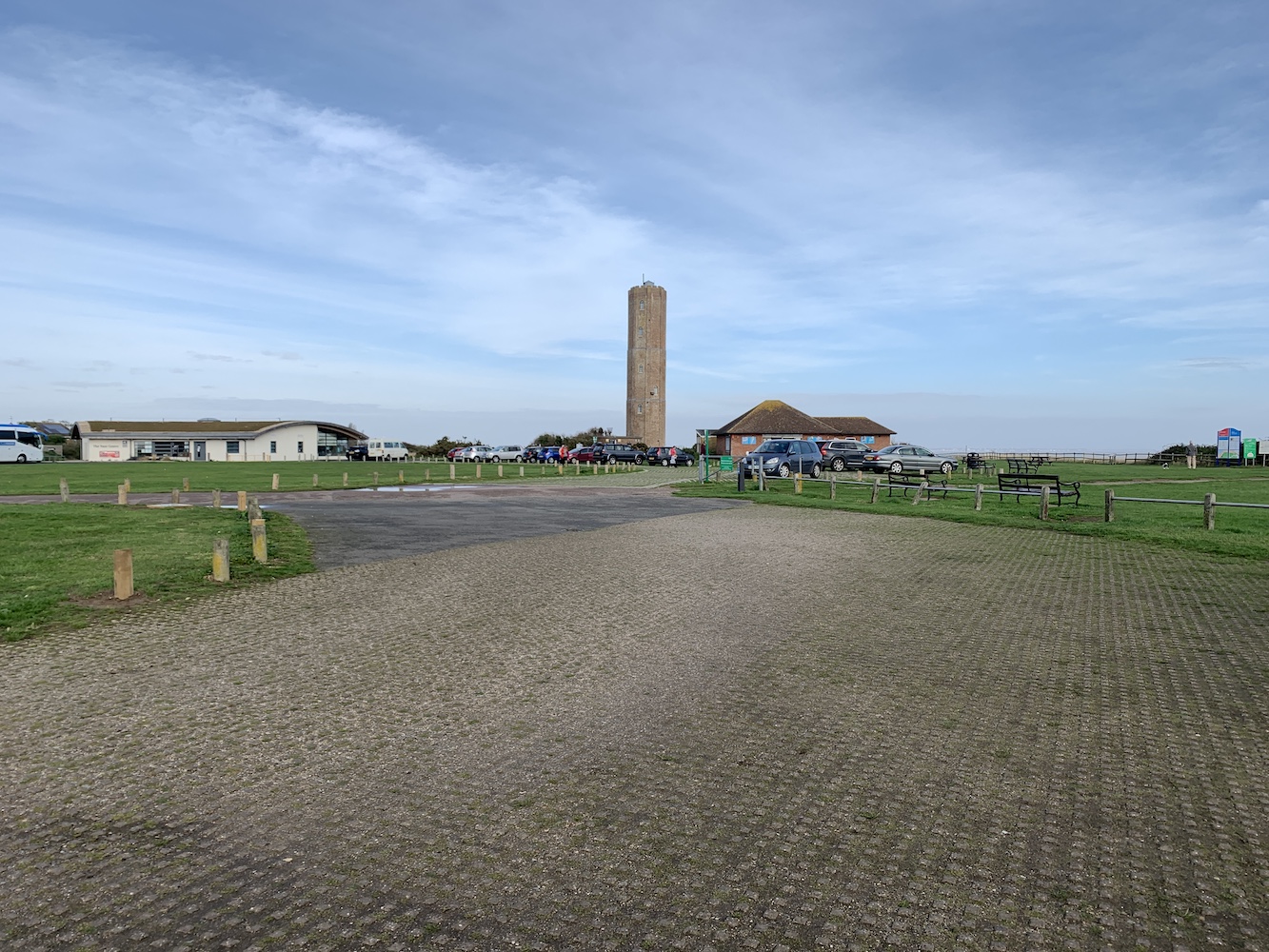
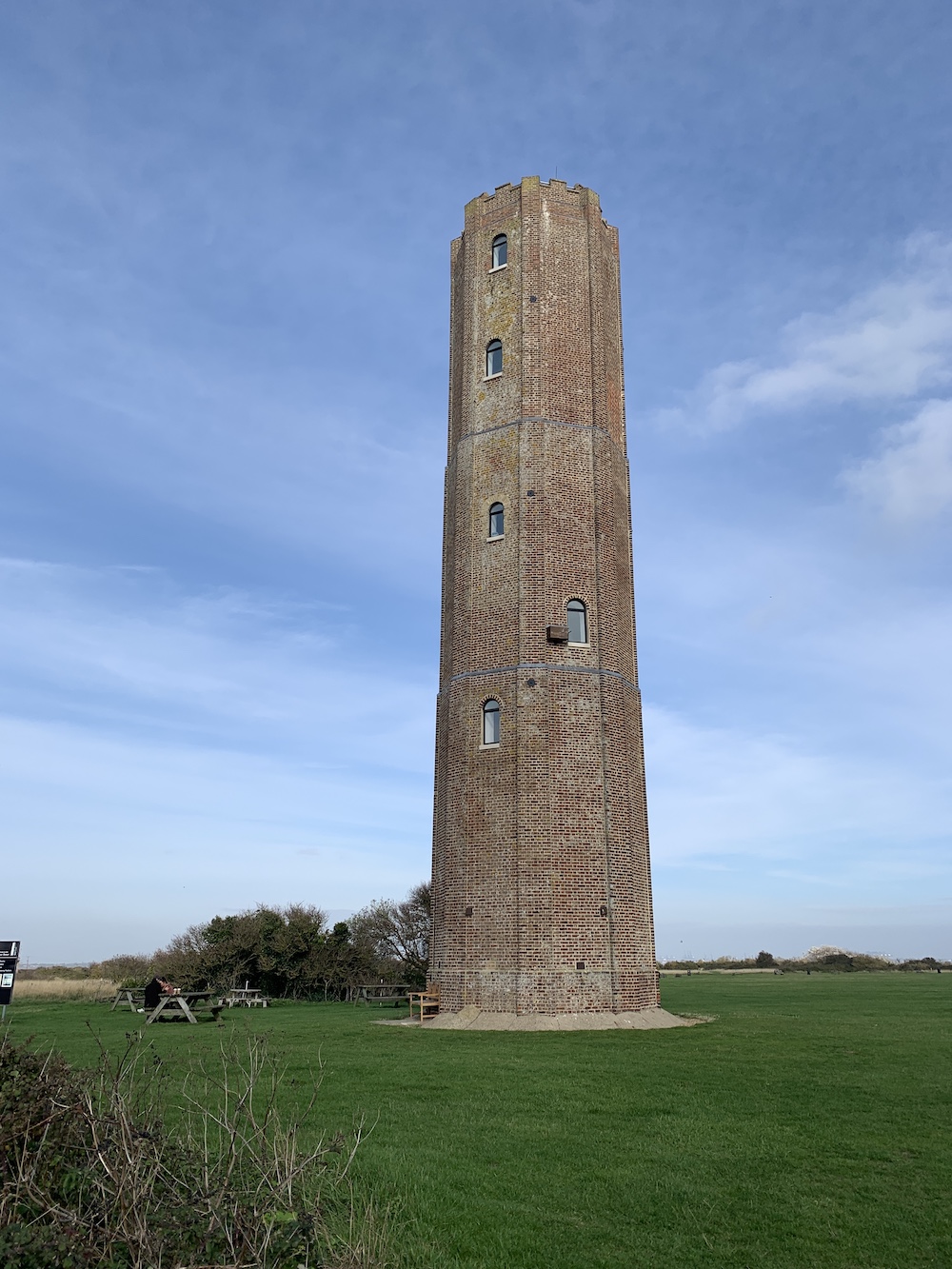
The Naze Tower
Due to Covid-19 the tower is currently closed, but that didn’t matter as the sun was shining and it was dry. My lighthouse pal John had joined us and we were all pleased to be able to spot Gunfleet lighthouse in the far distance having been closer to it that very morning.
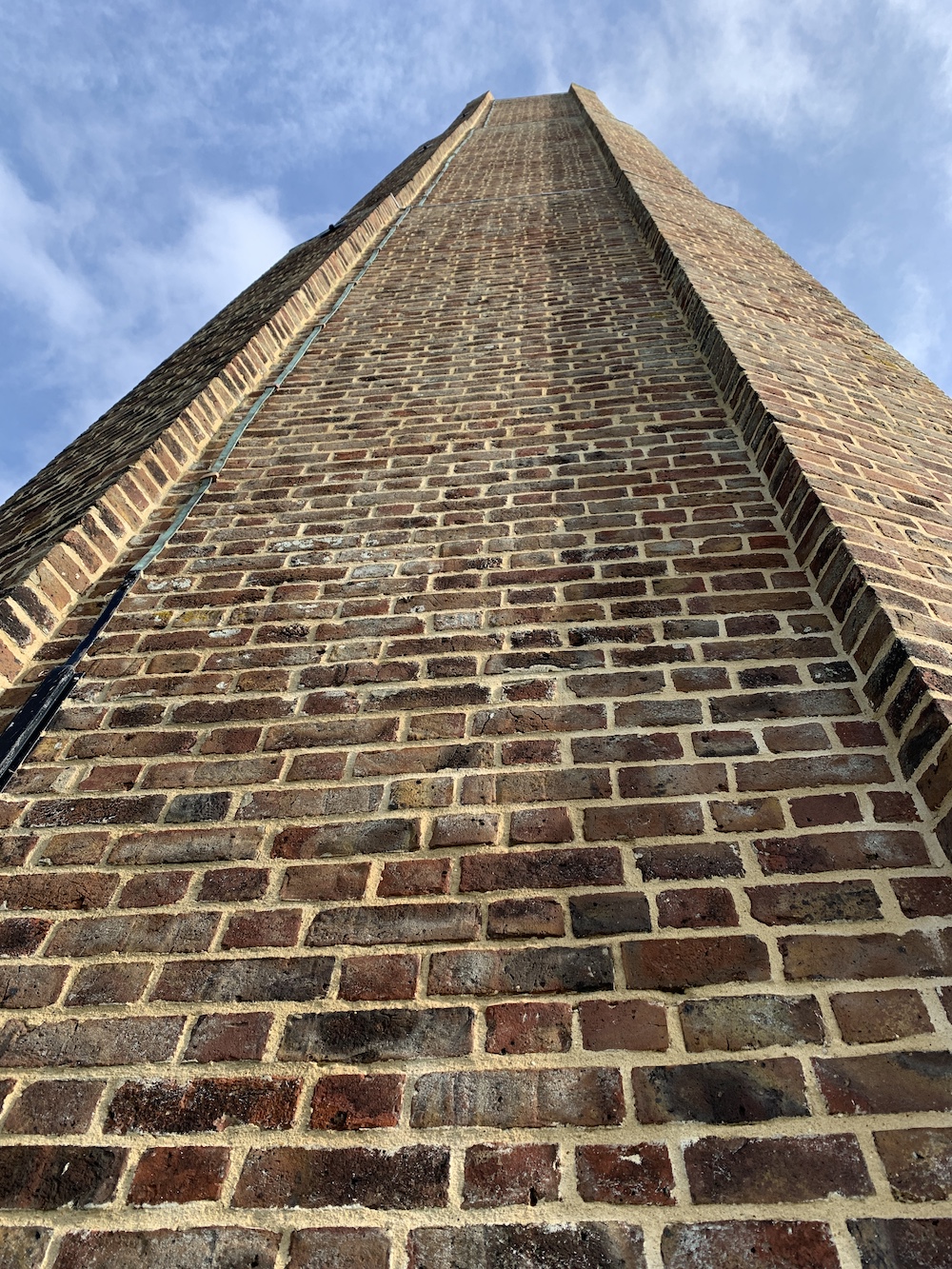
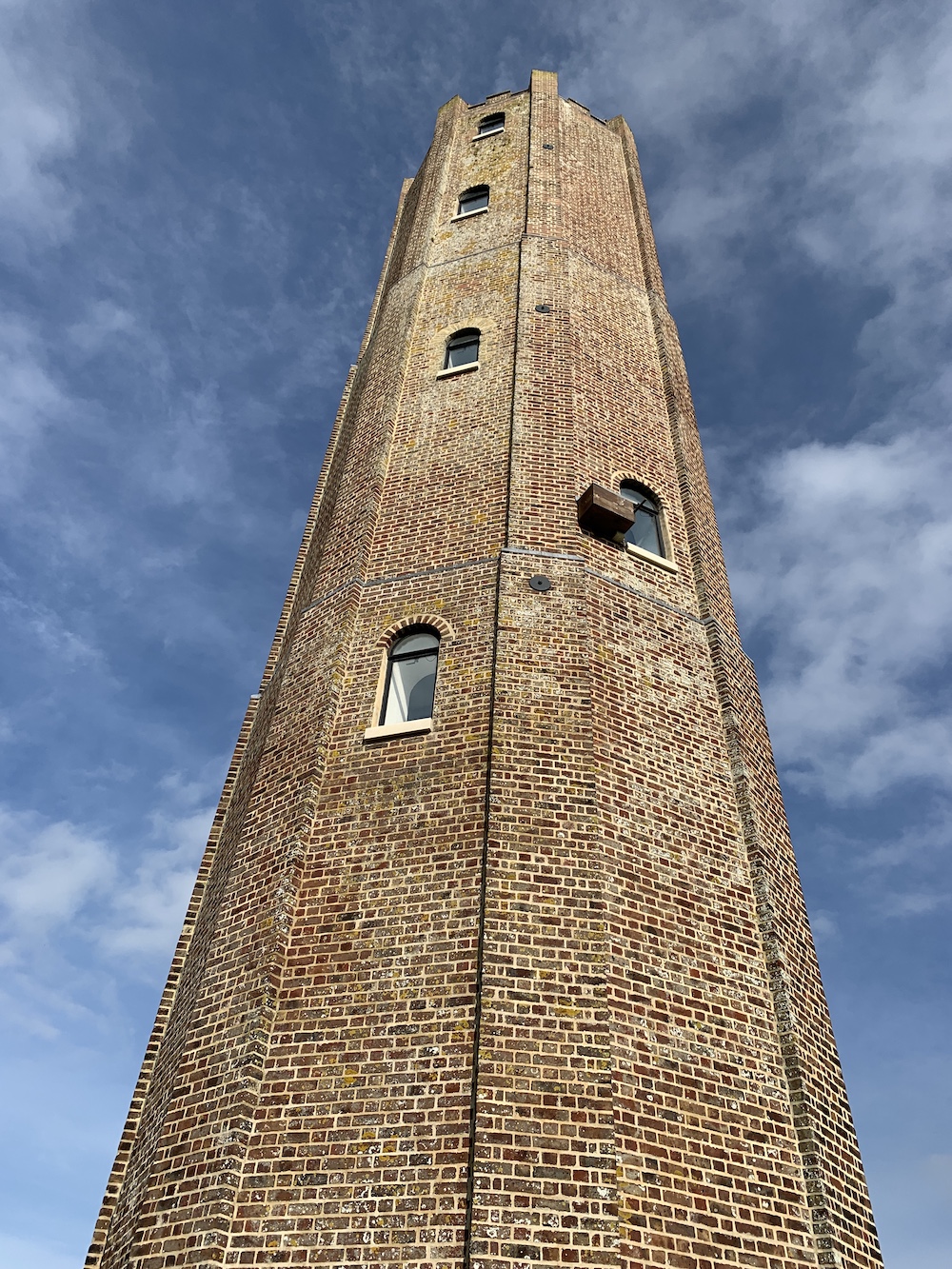
The Naze Tower is quite impressive and is clearly very well looked after. The beautiful brickwork is looking excellent when you consider that the tower was built in 1720. The tower had been somewhat neglected in the past, but the owners did some extensive renovation and, in 2004, it opened to the public for the first time. Presumably it needed, and will continue to need, some repairs and maintenance done on it – it is 300 years old after all.
When it does reopen, hopefully next year, you can see it’s 8 floors which feature an art gallery with exhibitions, and a museum about the tower and surrounding area. On top of that, quite literally, you get the panoramic views.
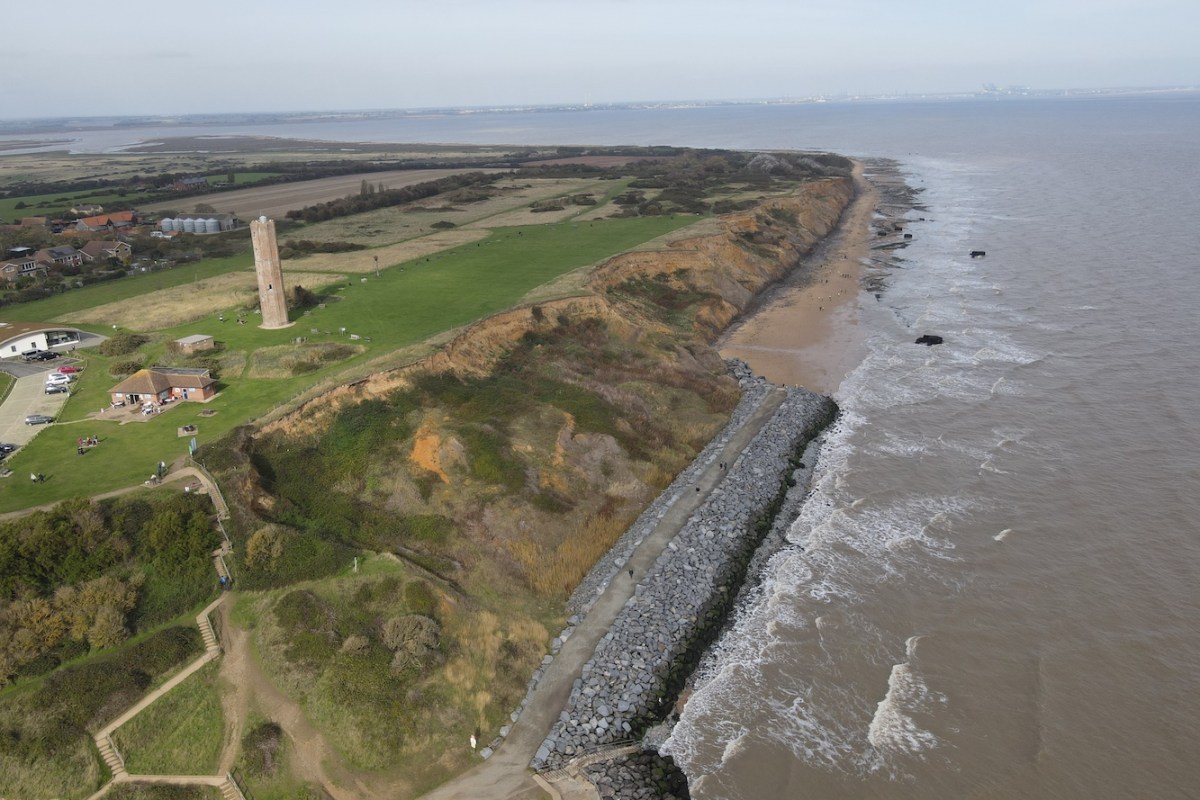
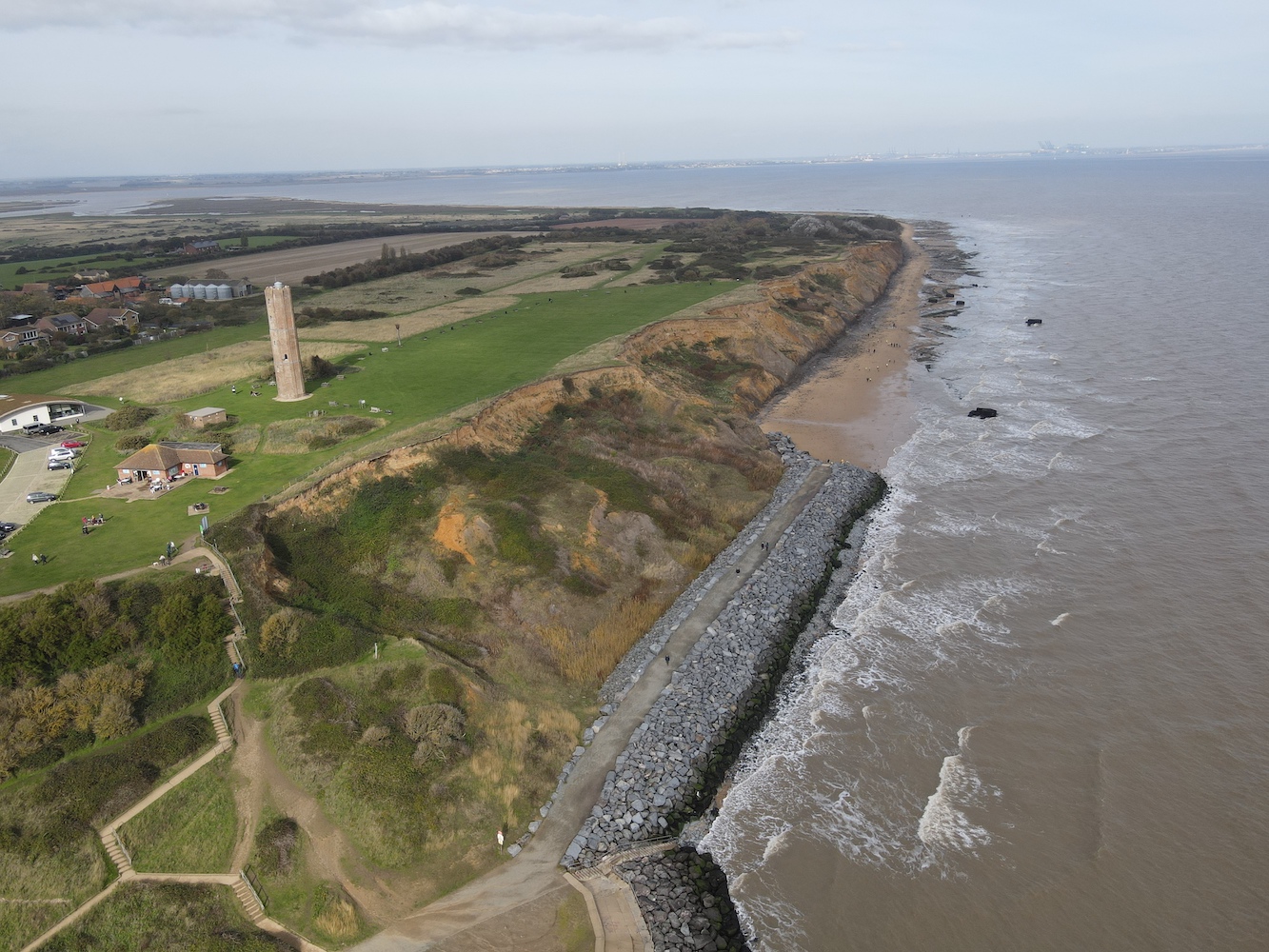
Joe took to the sky and, as usual, captured the glorious coastline. Seeing this coastline is always tinged with a little bit of sadness though as it really does suffer from erosion. There is evidence on the beach here that some measures have been taken to try to reduce the erosion in the area as you can see in the picture below.
The sea defences were clear in one of Joe’s shots
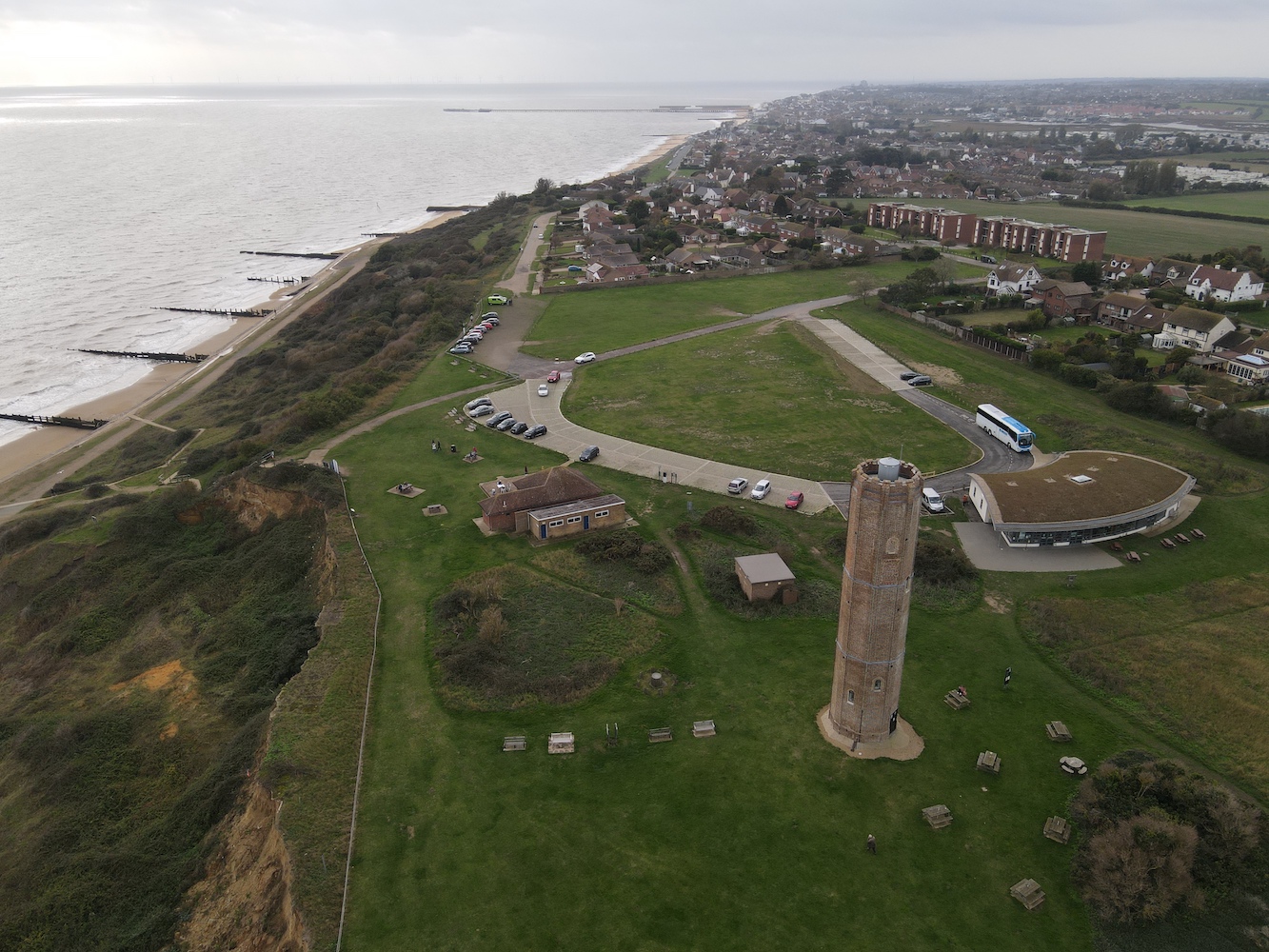
The view from above looking towards the south
There’s a lovely little tea room nearby too and we chose to have lunch outside on a bench before waving goodbye to John and continuing on our way.
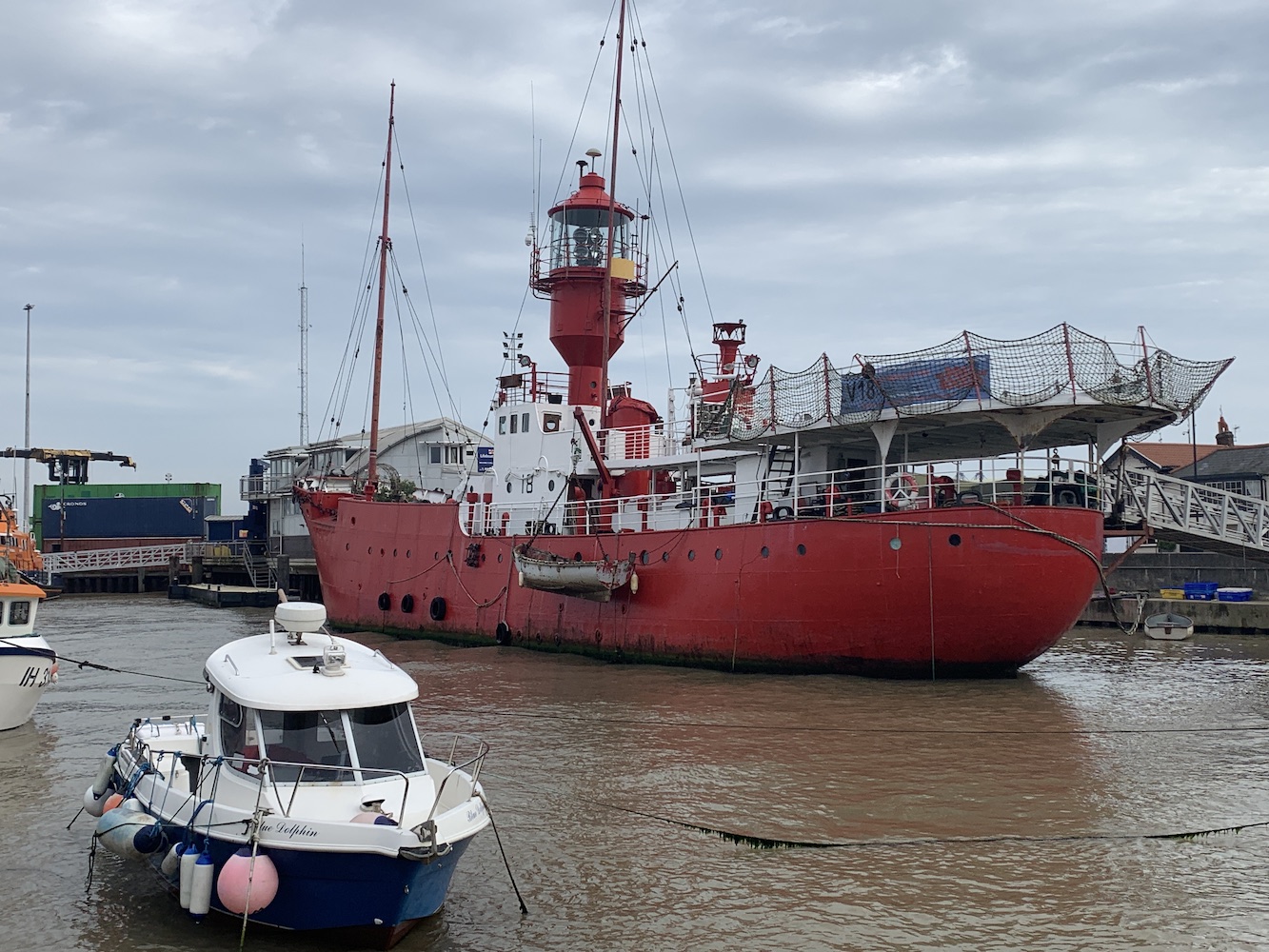
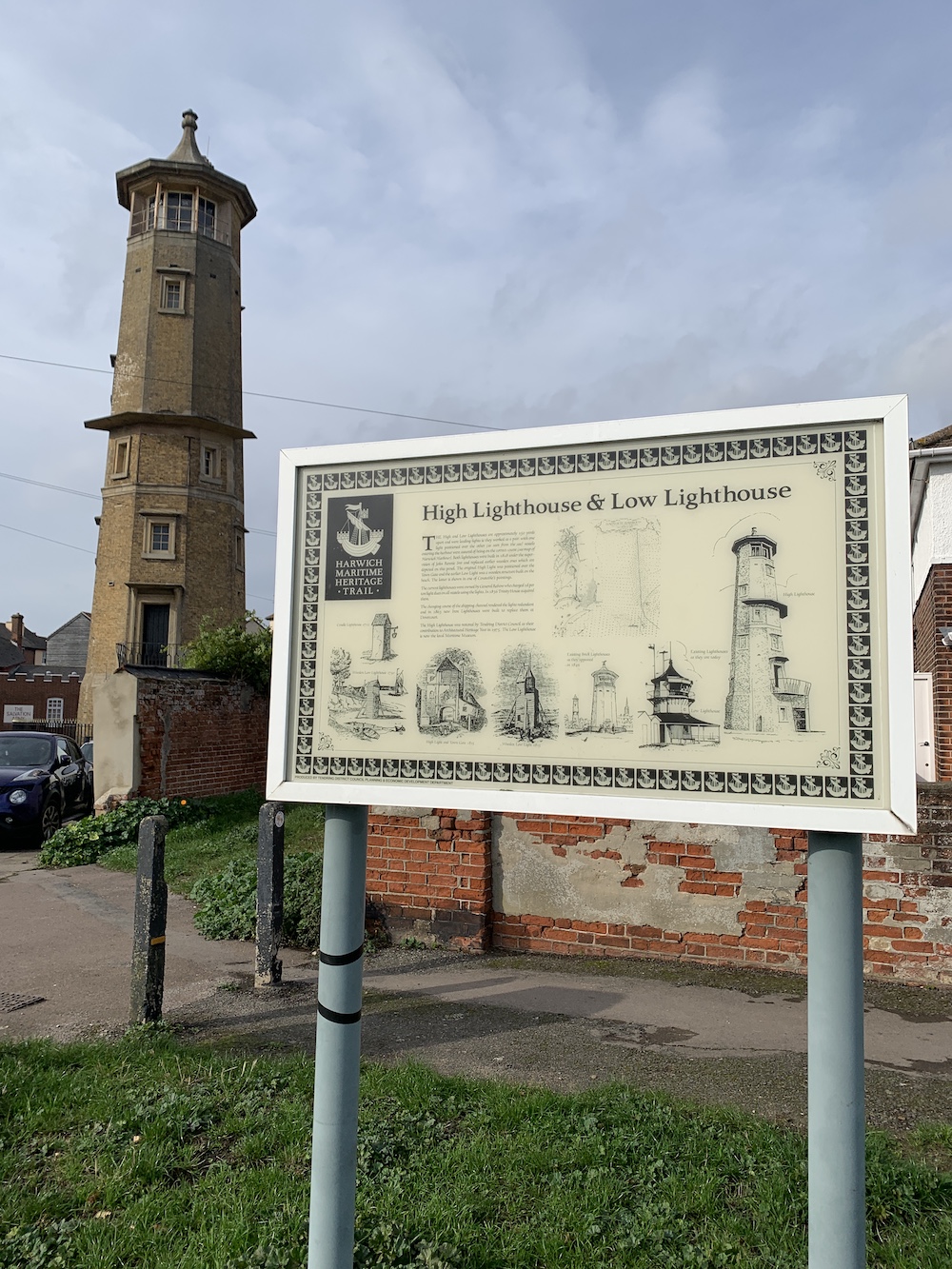
Harwich awaited our arrival and this is quite a special place for those with any maritime interest. It is where Trinity House monitor their lighthouses from – as well as the Northern Lighthouse Board lights during evenings and weekends. Trinity House also has a depot and buoy yard here. It has its own two old lighthouses, a Light Vessel you can (under normal circumstances) look around, the Lifeboat Museum and an array of other points of interest that make up the town’s Maritime Heritage Trail. In addition we were able to see three more light vessels anchored off shore in the area.
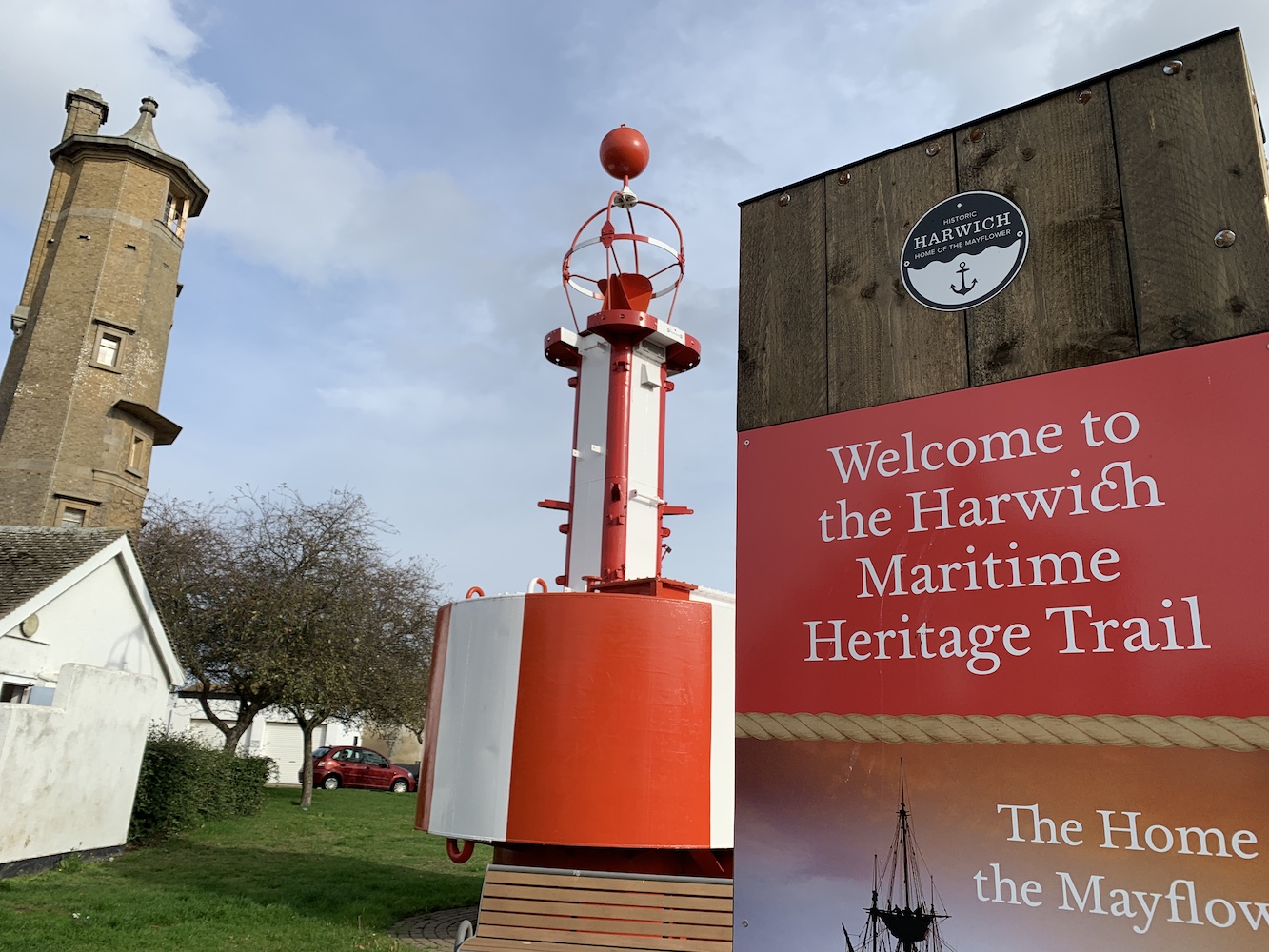
Harwich High Light and the Harwich Town Buoy at the start of the Maritime Heritage Trail
Light Vessel 18 which is usually open to visitors
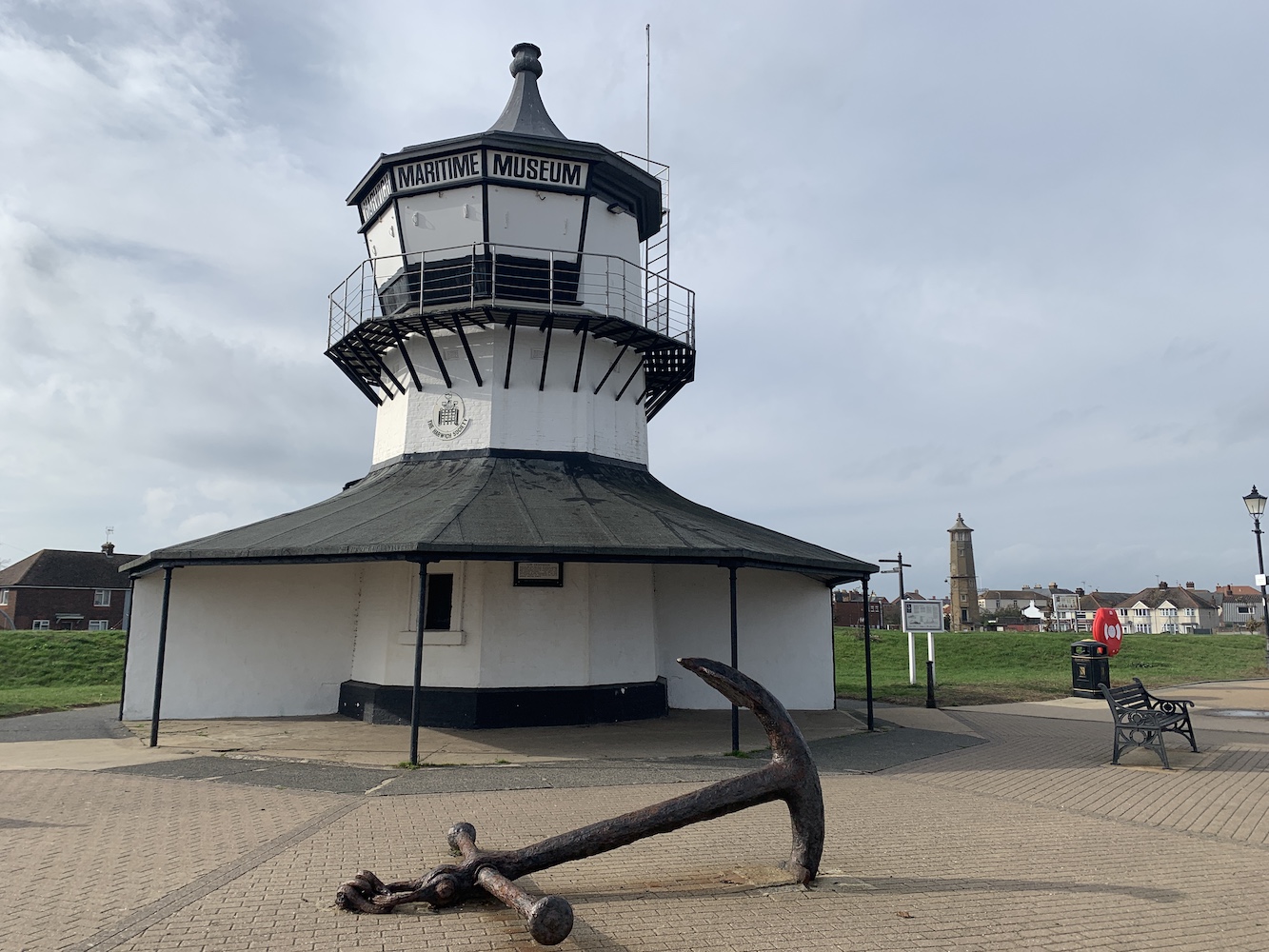
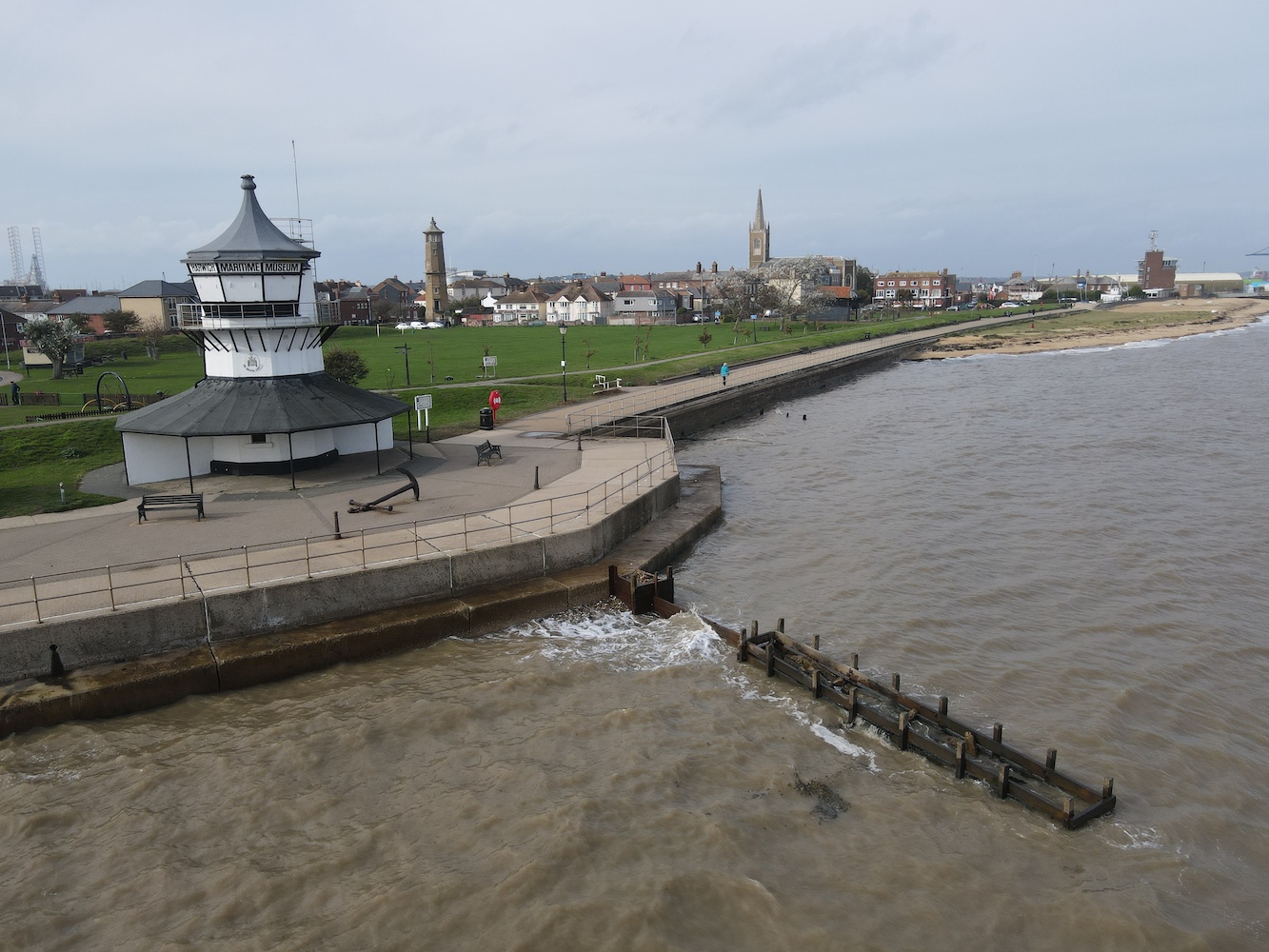
The two lighthouses here are no longer active and haven’t been since 1863 when they were replaced by the two Dovercourt lights (more on those in a bit). The low light has housed the Maritime Museum since 1980 and the high light is now run by Harwich Society as a local interest museum.
Harwich High Light
The existing towers replaced the town’s original leading lights. All of these lights were intended to work in pairs to guide ships safely into the harbour.
Harwich Low Light with the High Light visible in the background
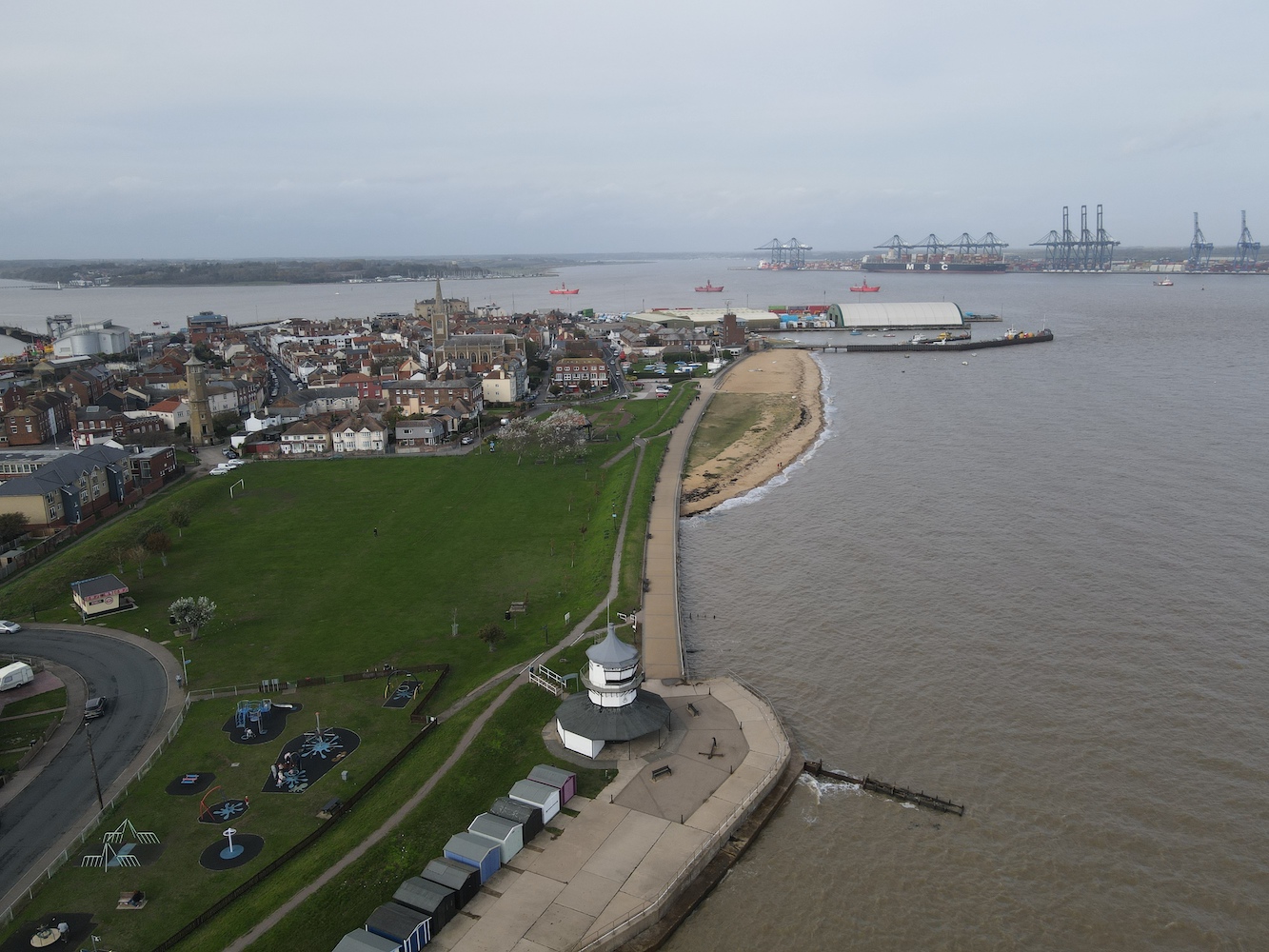
Joe had a little fly around the area too, which is actually how we realised the light vessels were offshore.
An aerial view of Harwich’s harbour area with the three light vessels visible
The lighthouses in Harwich
Harwich is a fascinating place and it would be nice to spend some more time here getting stuck into the maritime history.
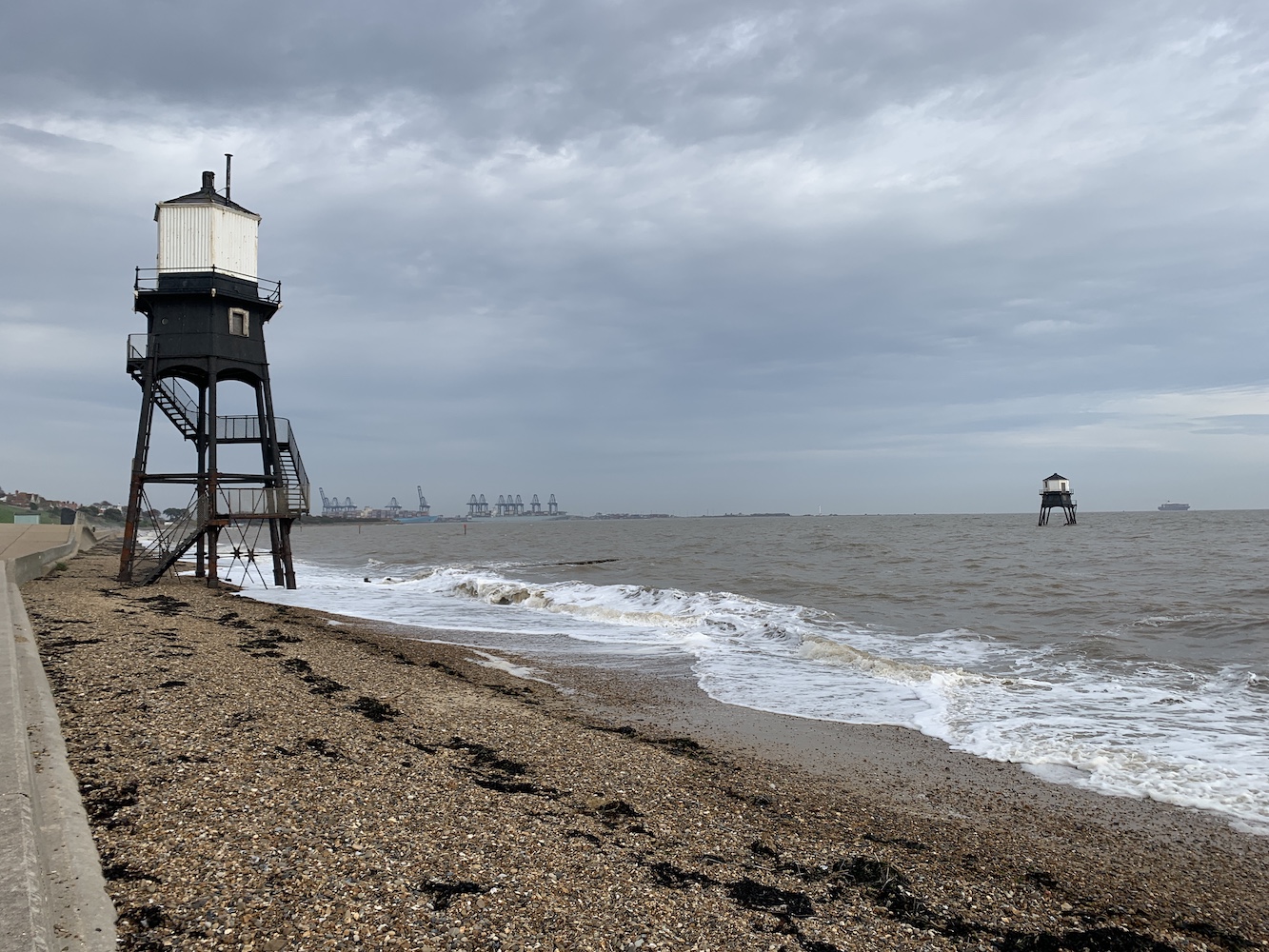
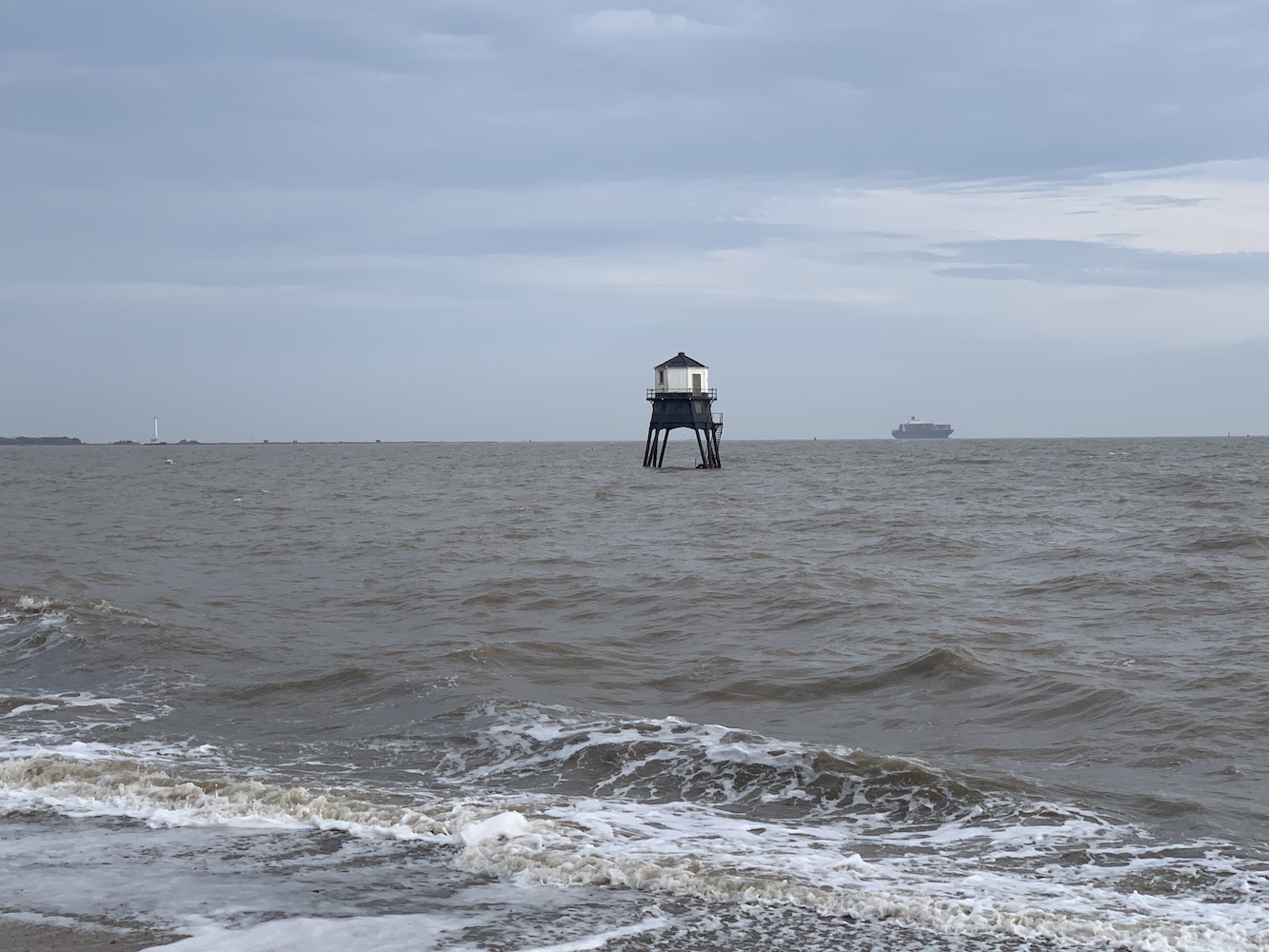
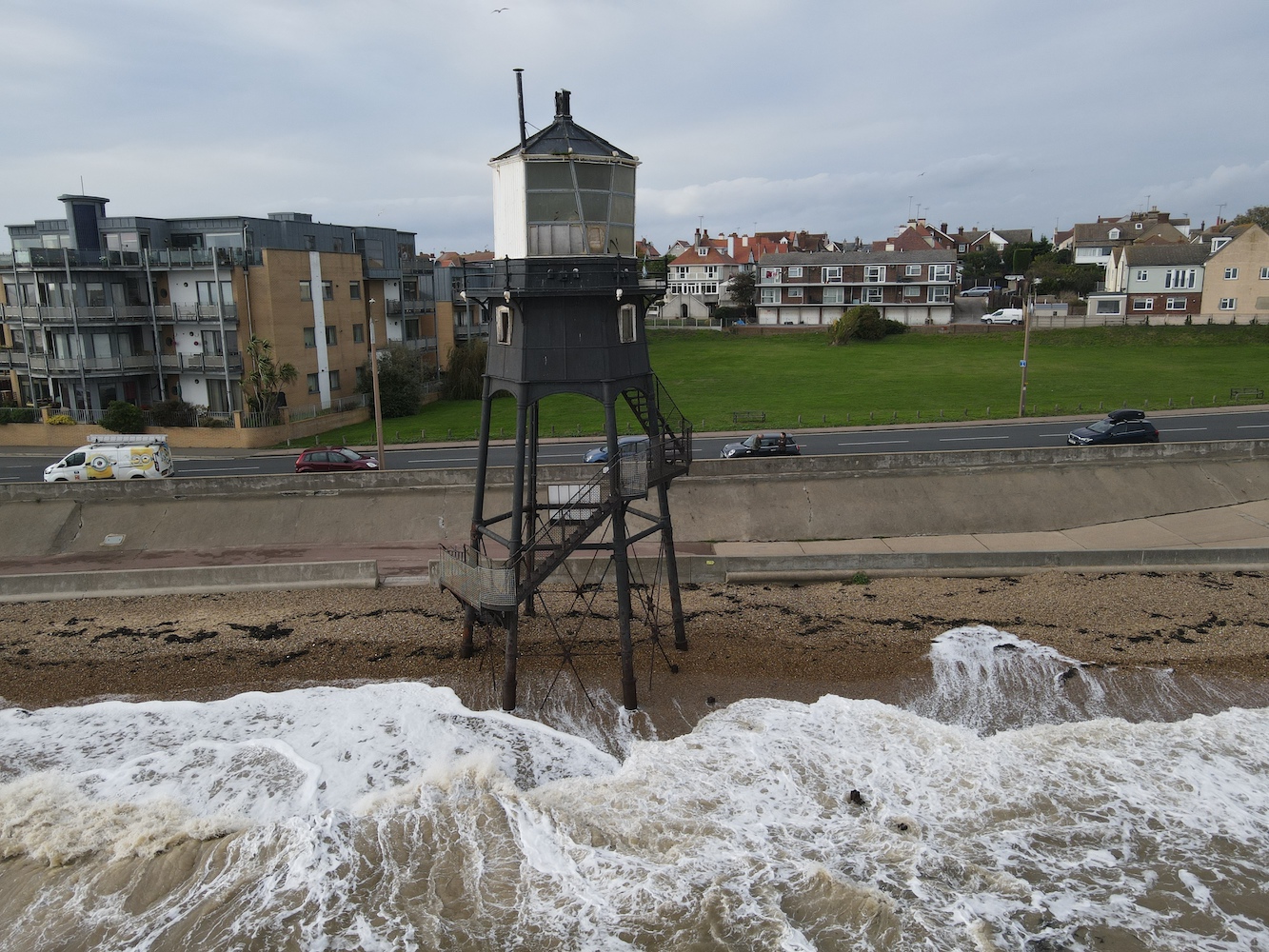
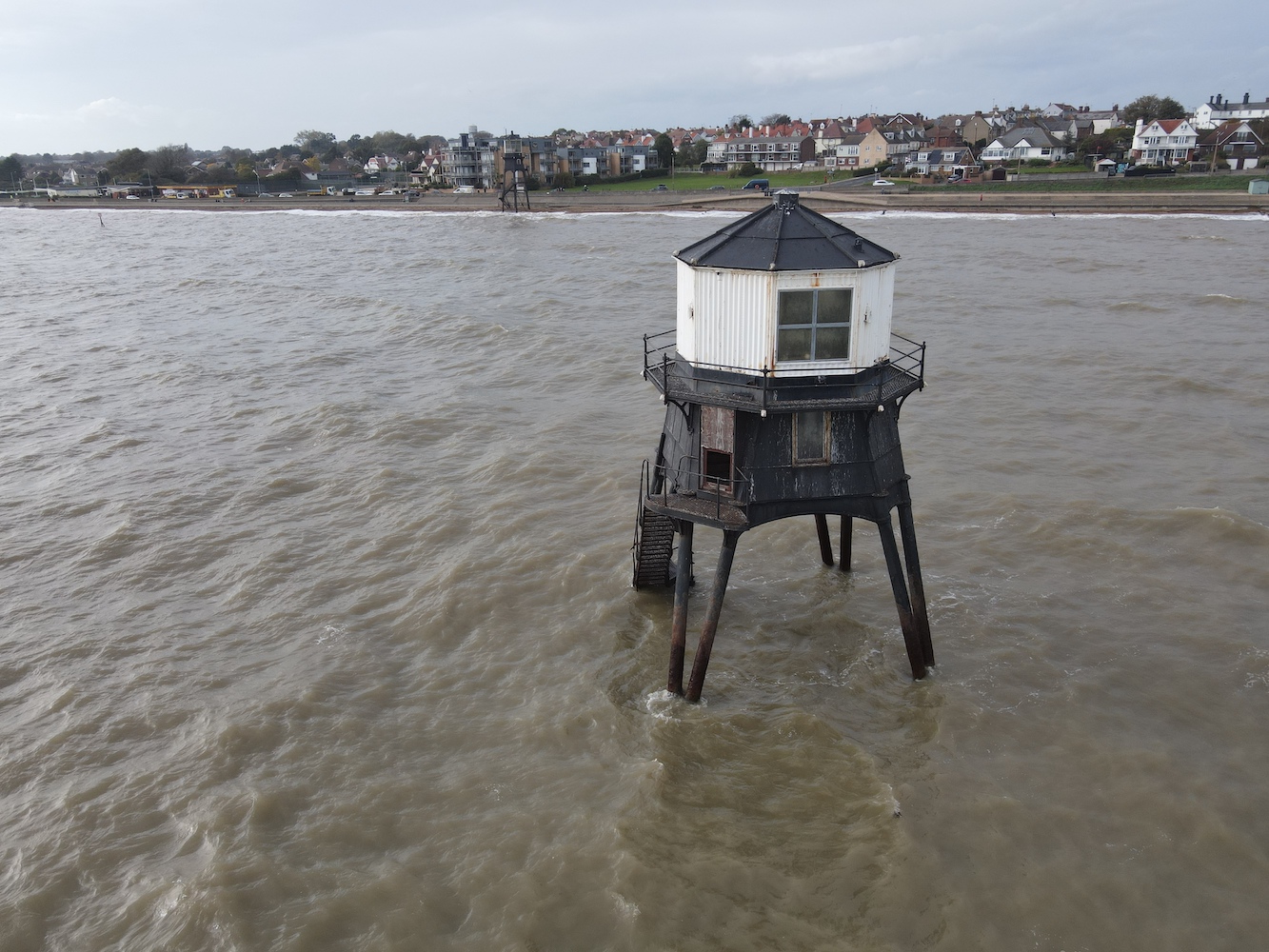
Just a short drive to the south we found the two Dovercourt lighthouses. On my original tour I’d seen these two at low tide and with high tide now approaching it was interesting to see the bottom of the outer light under water and the rapidly heightening waves splashing around the base of the inner light.
The lighthouses at Dovercourt
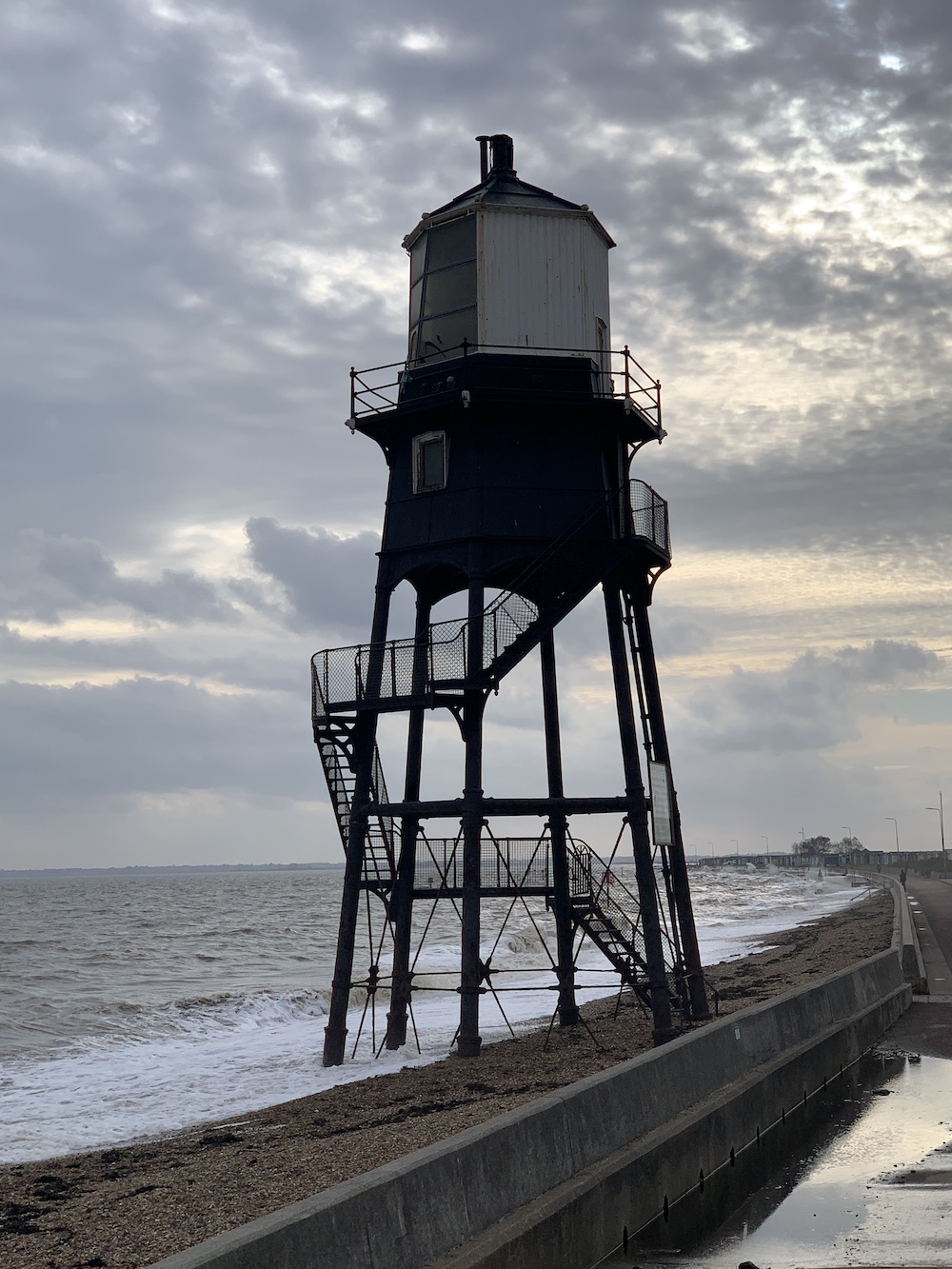
As mentioned, these lighthouses were introduced in 1863 to replace the Harwich lights. At the time they were built they were believed to have been fairly revolutionary in that they were of the new screw pile design and were prefabricated. A ‘causeway’ was introduced between the two lighthouses which can be walked with care at low tide.
Dovercourt Inner lighthouse
The lights were decommissioned in 1917 when buoy markers were installed to mark the approach to Harwich and since then have been through a period of restoration in the 1980s. Recent investigations have found that further restoration work is required to secure their future and it looks like this is in hand, which is always good to hear.
Dovercourt Outer lighthouse
They are quite unique structures and it was good to also see them from a different angle with the help of Joe the Drone.
Dovercourt Inner light from the seaward side
Dovercourt Outer lighthouse from above
Yet another day of doing a little more exploring and revisiting had come to an end. A very good day it had been and with it also being the last planned lighthouse trip of the year I was glad it had been a success and undertaken with great company.
Let’s hope even a little lighthouse visit can occur at some point before the year is out. Finger crossed 🙂
A key target for this trip was to attempt to get out on a boat for a closer look at Gunfleet lighthouse. After spotting it in the distance during my first visit to the Naze Tower, it had always felt so out of reach, but I like to think that these things are never really out of reach. You just need to find a way of getting there so I did some research and found a boat company, Sophie Lea Charters based in Brightlingsea, who were willing to take us out.
I’d originally selected Wednesday as the day of the trip but having spoken to the boatman on Monday evening it was looking like Wednesday wouldn’t be possible. However, he did say an early trip on Tuesday would be an option. You have to jump at these chances when they come, don’t you? I’d also invited my lighthouse partner in crime John to join us, but the early start meant he deprived himself of a few hours’ sleep in order to arrive on time for the trip.
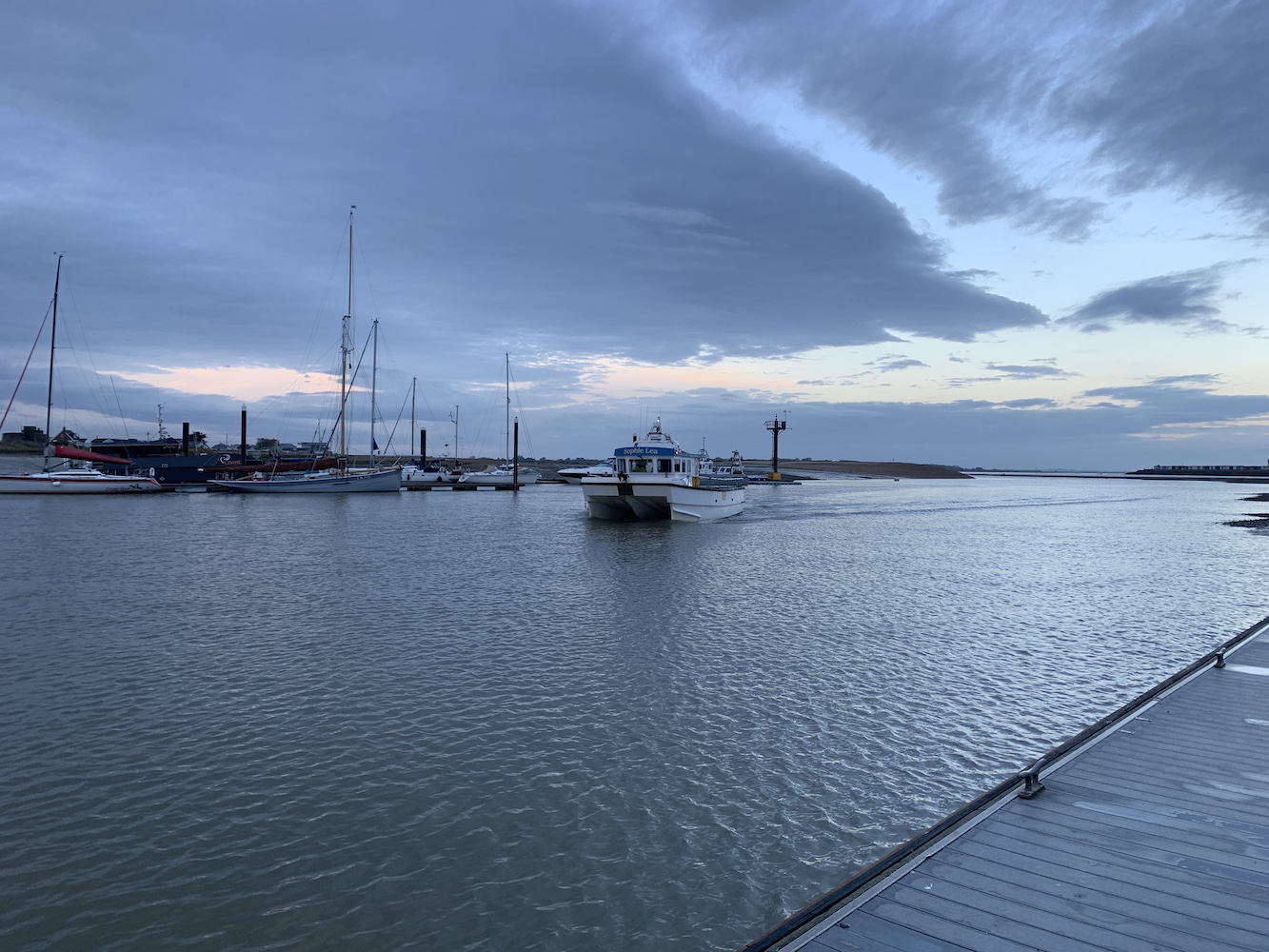
We found Sleeping Beauty in his van when we arrived at the car park and once we were all ready, we had a nice stroll around the harbour area, which seemed picturesque. Thankfully the rain had stopped and we could enjoy the views while we waited for the boat to arrive.
The boat arrives
Once Lee arrived with the boat and we’d hopped on board we were warned that we wouldn’t be able to get very close to the lighthouse as it sits on Gunfleet Sands, the very sandbank it was designed to make mariners aware of. This reminded me of something an island/hill-bagging friend said to me last year, that lighthouses were built to warn boats to stay away from them so by trying to get as close as we can to them goes against their intended purpose. Gunfleet was a perfect reminder of this, and in this case Gunfleet wins as the tide was low. Waiting for high tide that day wasn’t an option due to worsening conditions as the day went on and attempting to get around the east side of the sandbank would also not have been wise given the increasing wind and swell.
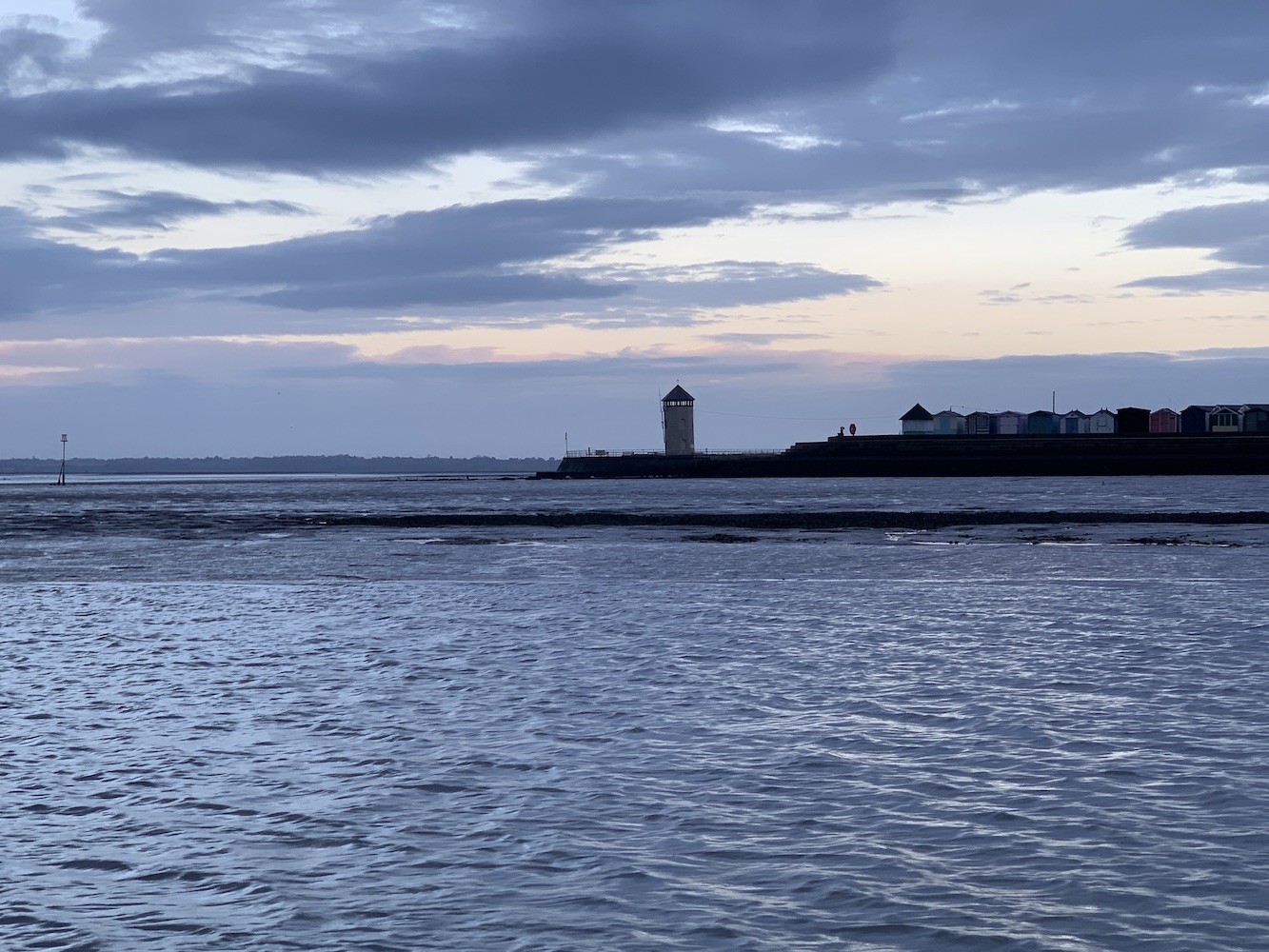
John pointed out a nearby faux lighthouse, Batemans Tower, which is actually a memorial. Historic England’s website suggests that the tower, when built, was actually intended to be used as a lighthouse, but the port plans in the area never materialised.
Bateman’s Tower
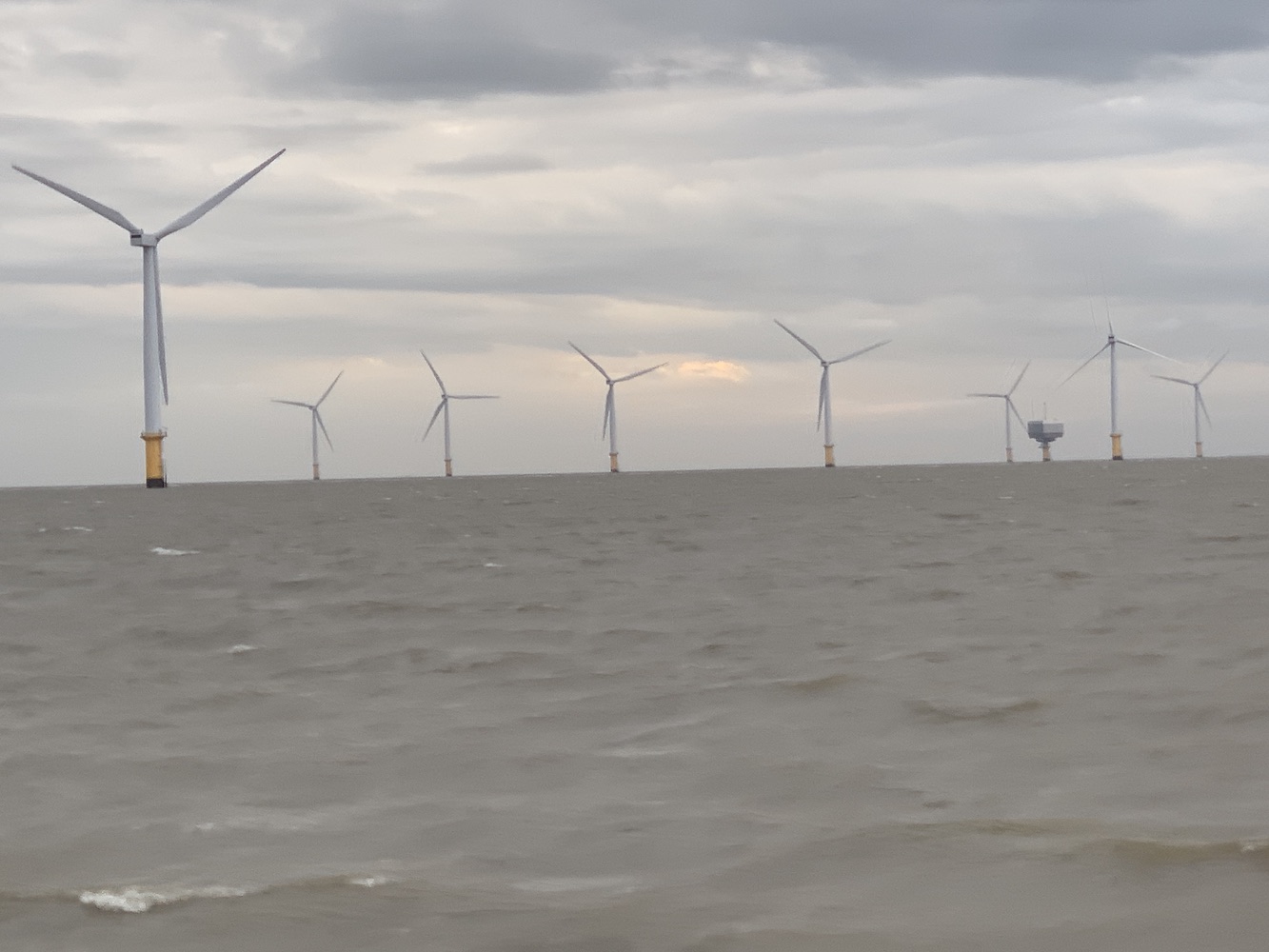
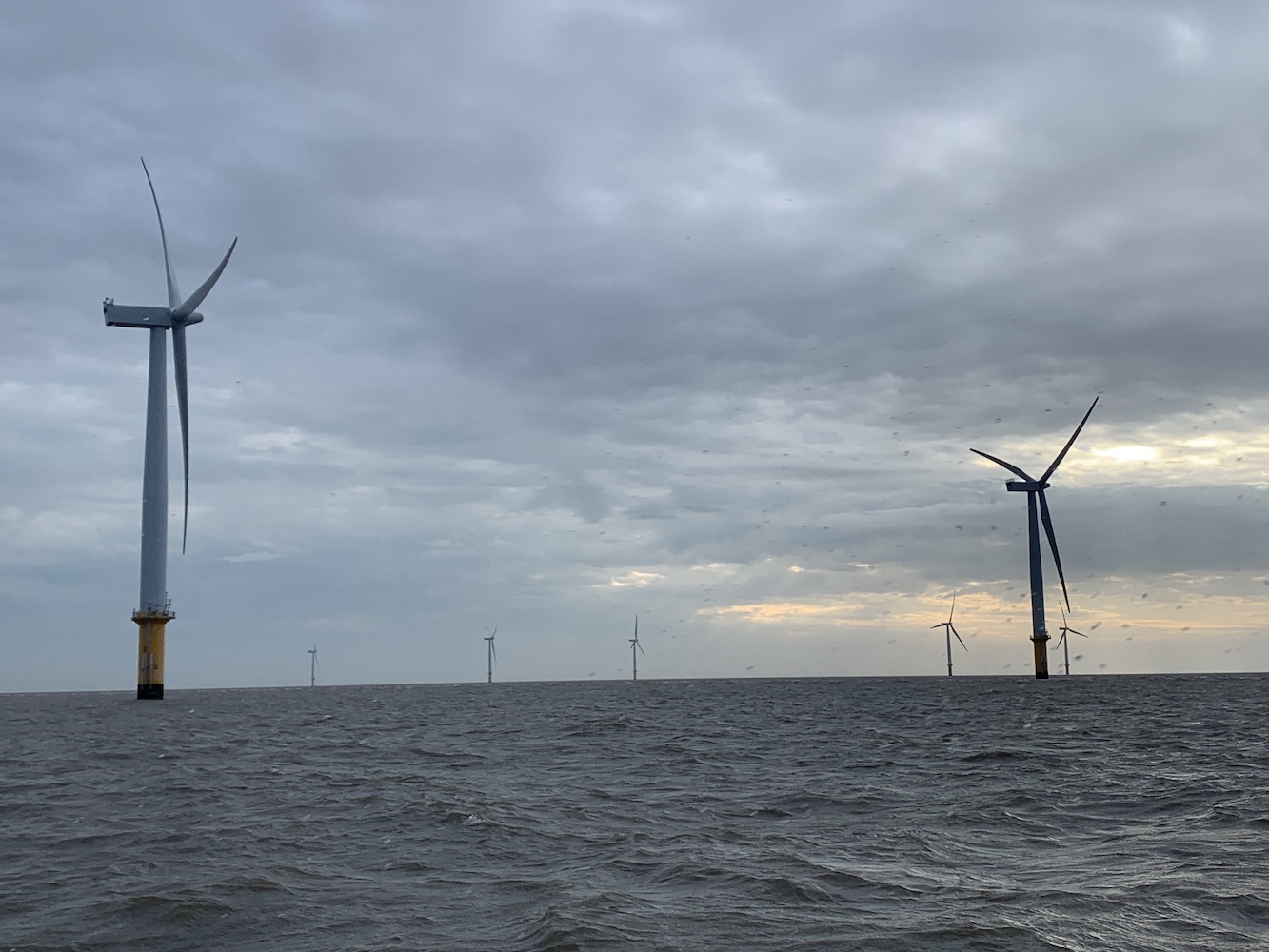
The trip out was good and we passed the Gunfleet Sands wind farm. It was the first time I’d sailed close to an offshore wind farm and I think we were all impressed, even those who aren’t normally so keen on wind turbines!
Passing the wind farm – apologies for the wonky horizon!
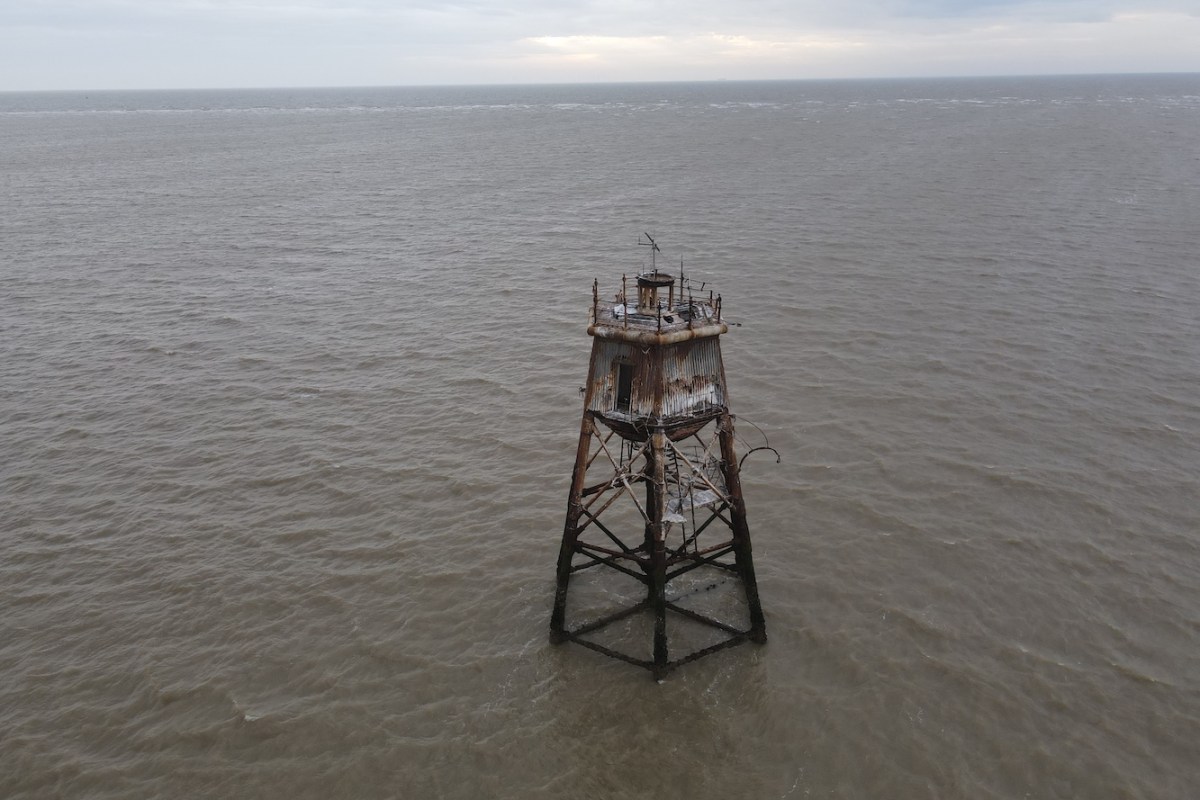
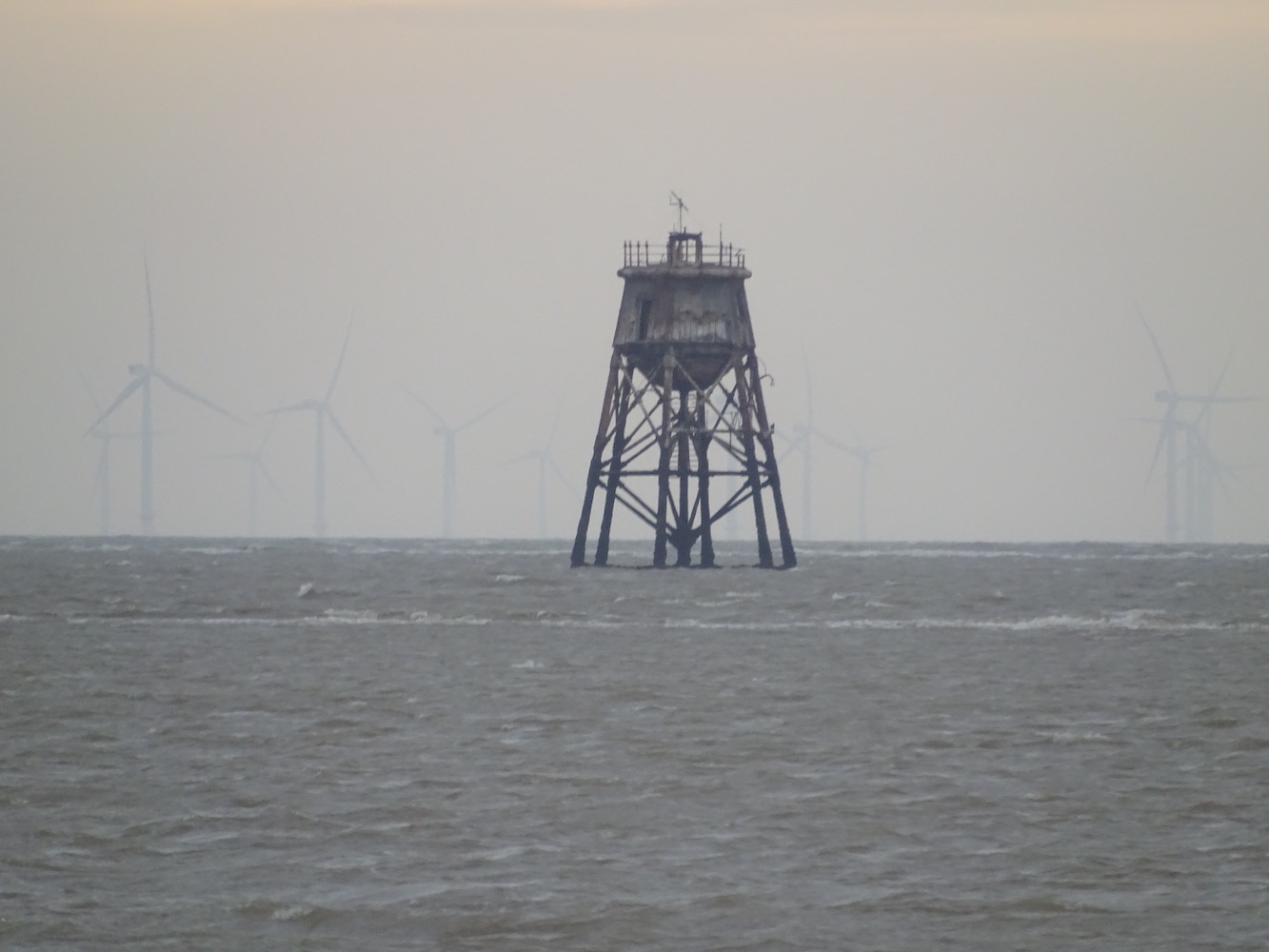
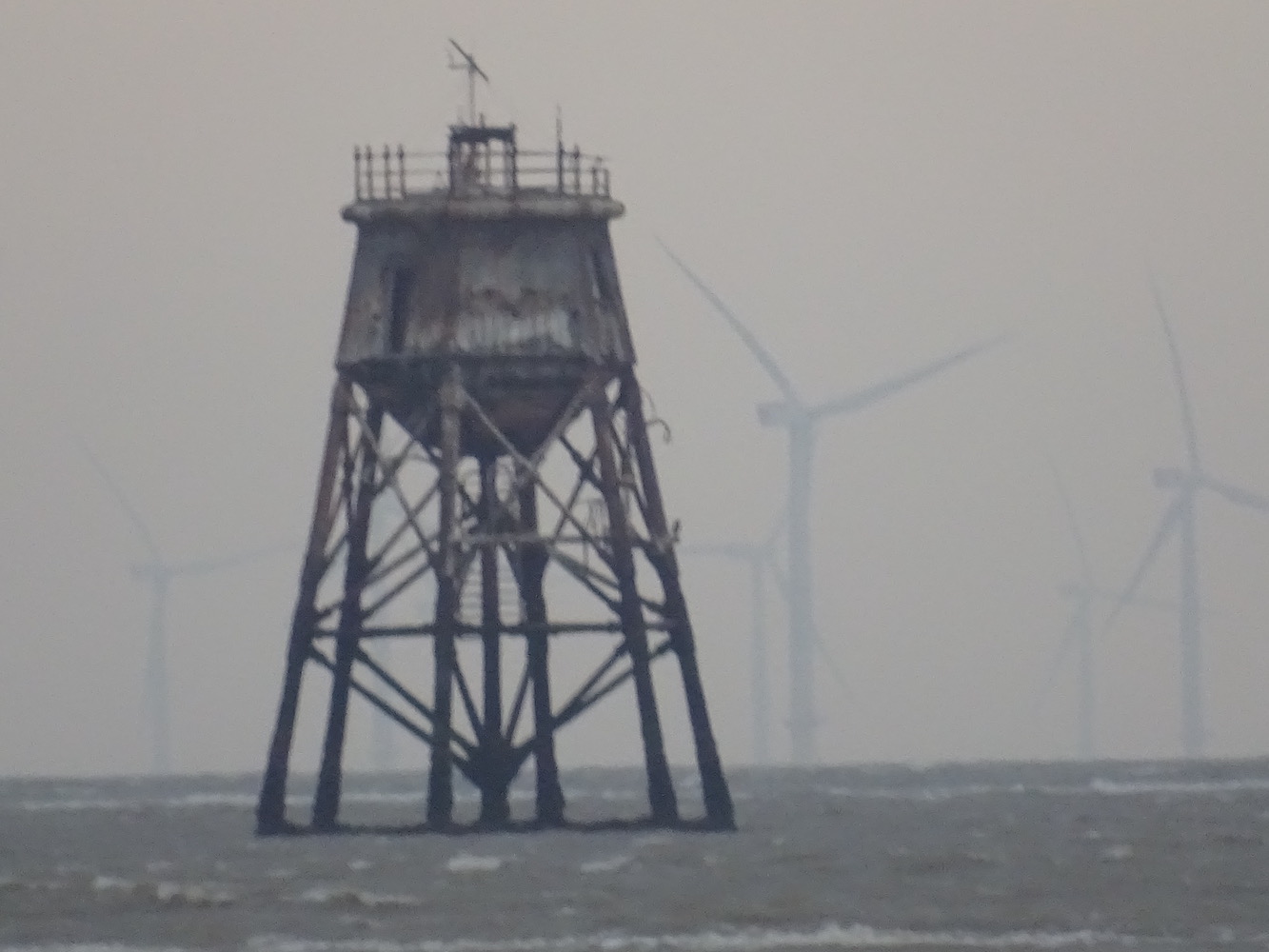
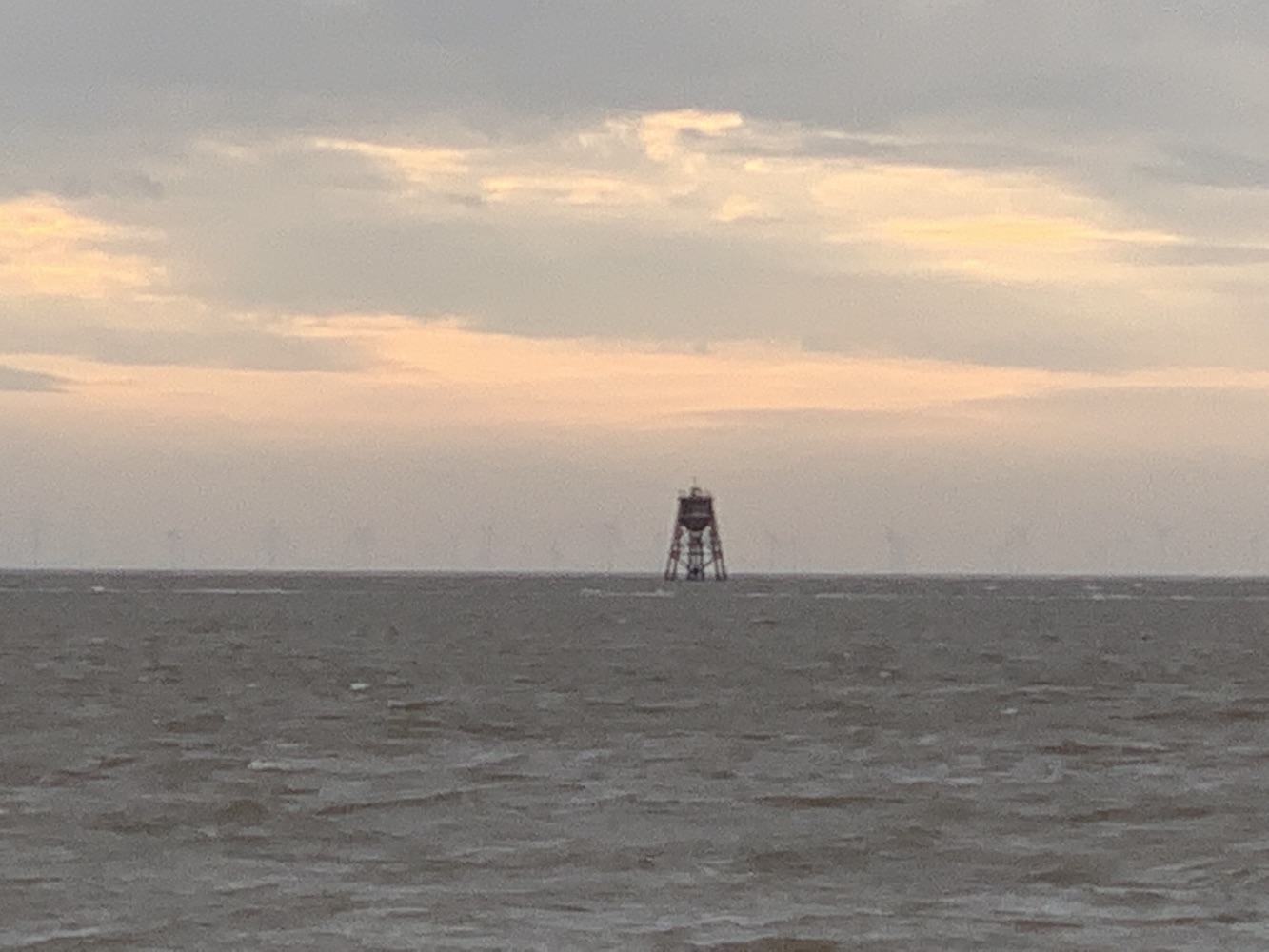
It seemed to be a while before the lighthouse came into view, but eventually we spotted it. It has a fairly distinctive shape now without the lantern on top. There’s a lovely postcard online (towards the bottom of the page) showing how it looked when it was an active lighthouse marking the sandbank. It’s actually a really interesting tower – and the sole surviving screw pile lighthouse in the area with the other few lost over the years. The whole idea of building a lighthouse on a sandbank sounds a little bit mad, but it clearly worked for a long time, although gradually these structures are being lost to the sea as time passes and they are no longer maintained. The latest casualty is the Wyre light that guided ships safely into Fleetwood on the Lancashire coast which has now almost completely collapsed.
Gunfleet was an active lighthouse, operated by Trinity House, from 1850 until 1921 as a manned station. It lies six miles off the coast of Frinton-on-Sea. It must have been a rather interesting place of work, almost like a rock station but with less space. There’s a great page online showing a few pictures from inside the tower in 2005 when a couple of chaps visited, which can be seen here.
Edging closer to Gunfleet lighthouse
There’s another interesting tale from Gunfleet’s history, which perhaps explains a little why it wasn’t in such a bad state internally in 2005. In 1974, it was partially renovated by the team behind the Dutch Radio Atlantis (to be broadcast as Radio Dolphin from Gunfleet lighthouse). After much of the equipment was installed representatives from the police, Home Office and Trinity House visited and demanded to be allowed into the tower. Eventually the broadcasters relented and were arrested with all of their equipment being removed from the tower before they had managed to get it up and running. A full account of this story can be found here.
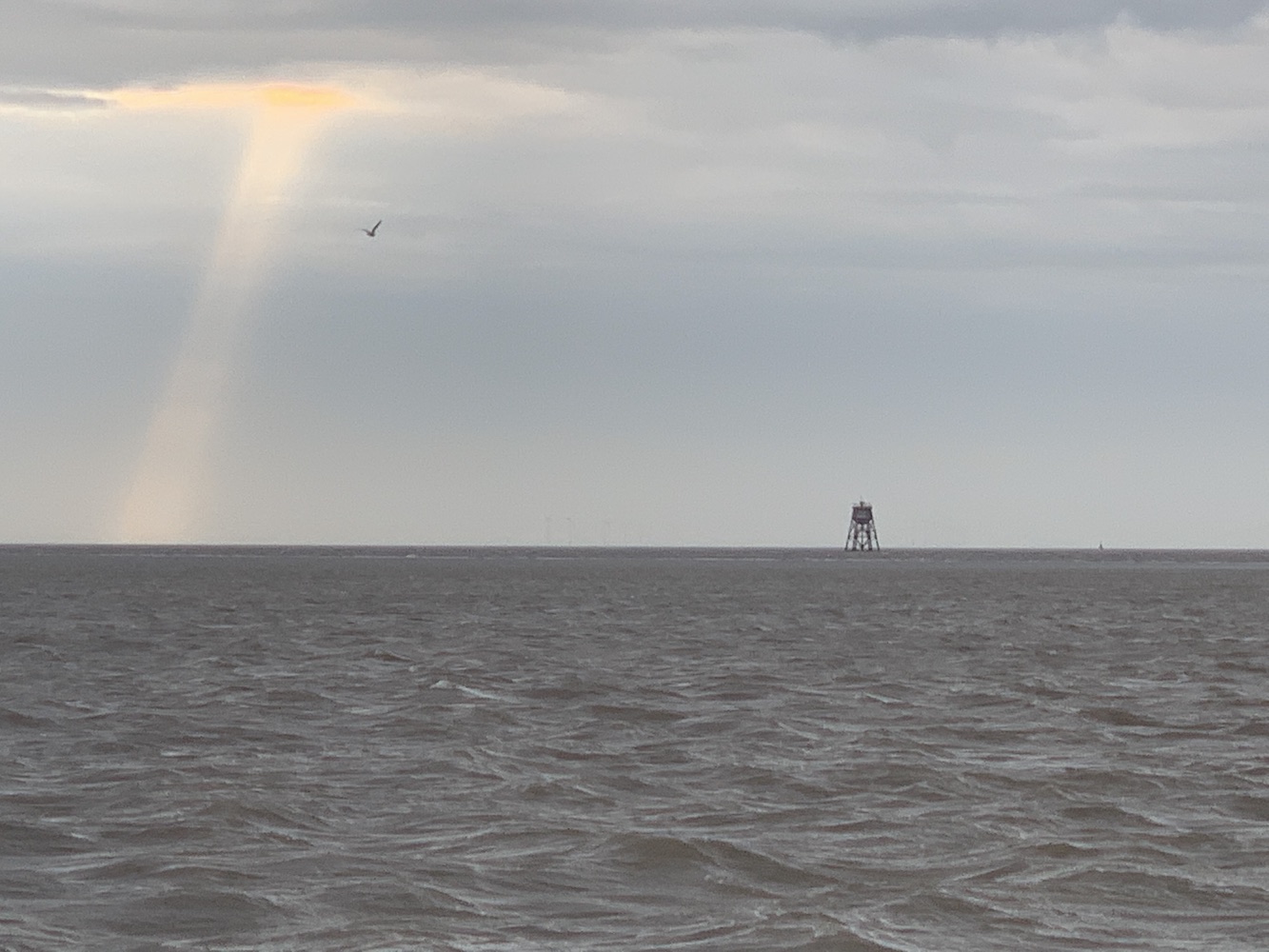
With the lighthouse now looking clearer Lee stopped the boat and informed us that it was as close as he could go as we didn’t have much water depth to play with. Although we weren’t as close as we would have liked to have been, we were able to enjoy a bit more of a broader view. As we began to take our pictures a wonderful ray of sunlight shone through the clouds to the left of the lighthouse which was great to see.
The lovely scene that greeted us near Gunfleet
In the meantime Bob launched Joe the Drone with my assistance (I’ve got rather good at helping with take offs and landings on boats, I must admit) and flew him towards the lighthouse. The wind had picked up by this point and Bob kept a close eye on how Joe was managing with the conditions. Always a bit worrying when the drone is flying over a massive expanse of water. Thankfully Joe made it out towards the lighthouse and got some excellent pictures, showing us more of the detail we couldn’t see from the distance we were at.
Gunfleet lighthouse from above
My favourite of Joe the Drone’s shots
A cropped version of Joe’s picture showing a bit more detail
John took these great pictures of the lighthouse with the wind turbines in the background haze, which I thought made for really interesting images.
Gunfleet lighthouse (picture: John Best)
A closer view with the wind farm in the background (picture: John Best)
We admired the lighthouse for a while and enjoyed the view as it changed again with the lovely orange sky as the sun began to break through even more of the cloud. Joe arrived safely back on the boat and we began our return journey, watching the lighthouse getting smaller and smaller.
The beautiful orange sky at Gunfleet lighthouse
We passed even closer to the wind turbines on the way back and John also pointed out the buoy that has now replaced Gunfleet lighthouse and marks one end of the sands.
Taking a closer look at the wind farm on the return journey
It had been a really good little boat ride and to get out and see something that most people take little or no interest in was pretty special. Gunfleet lighthouse had always felt like a tricky one and in a way it still is as it has that element of not being able to get close to it. At least with rock lighthouses they are on a rock that you can either sail close to or, if you’re lucky, even land on, but this is something else. But the trip was worth it, that’s for sure.
One of the lovely views on the journey back
There was more lighthouse visiting later that day, but I shall save that for another post. 🙂
Following a day visiting the lights of Suffolk on Sunday, it’s was Norfolk’s turn yesterday. It’s another area I’ve been to a few times but covered very few of them in detail on here.
Gorleston-on-Sea was first up and I was happy to return to this one. On my 2012 tour I was in the habit of parking in any old car park and then walking to the lighthouse rather than parking as close as I could to it. That meant I spent a little longer wandering the streets of Gorleston that time.
Gorleston lighthouse
This time I spent a little more time seeking different angles and approaches rather than just close-ups of the tower. This theme continued for much of the day, but more on that later. I made a point of walking around the back of the tower this time and then strolling out along the pier, noticing the beach on the other side, which I’d not realised was there before.
Gorleston lighthouse from behind
Joe the Drone had a bit of a fly around and captured some excellent pictures as usual.
Gorleston lighthouse with the beach in the distance
Gorleston harbour from above
Northwards we went to Winterton-on-Sea. Last time I was there I got the feeling that visitors weren’t massively welcome with lots of private road signs in the area. So I then settled for a view above the houses in nearby roads. This time though we went for a different approach, this time from the beach and sand dunes.
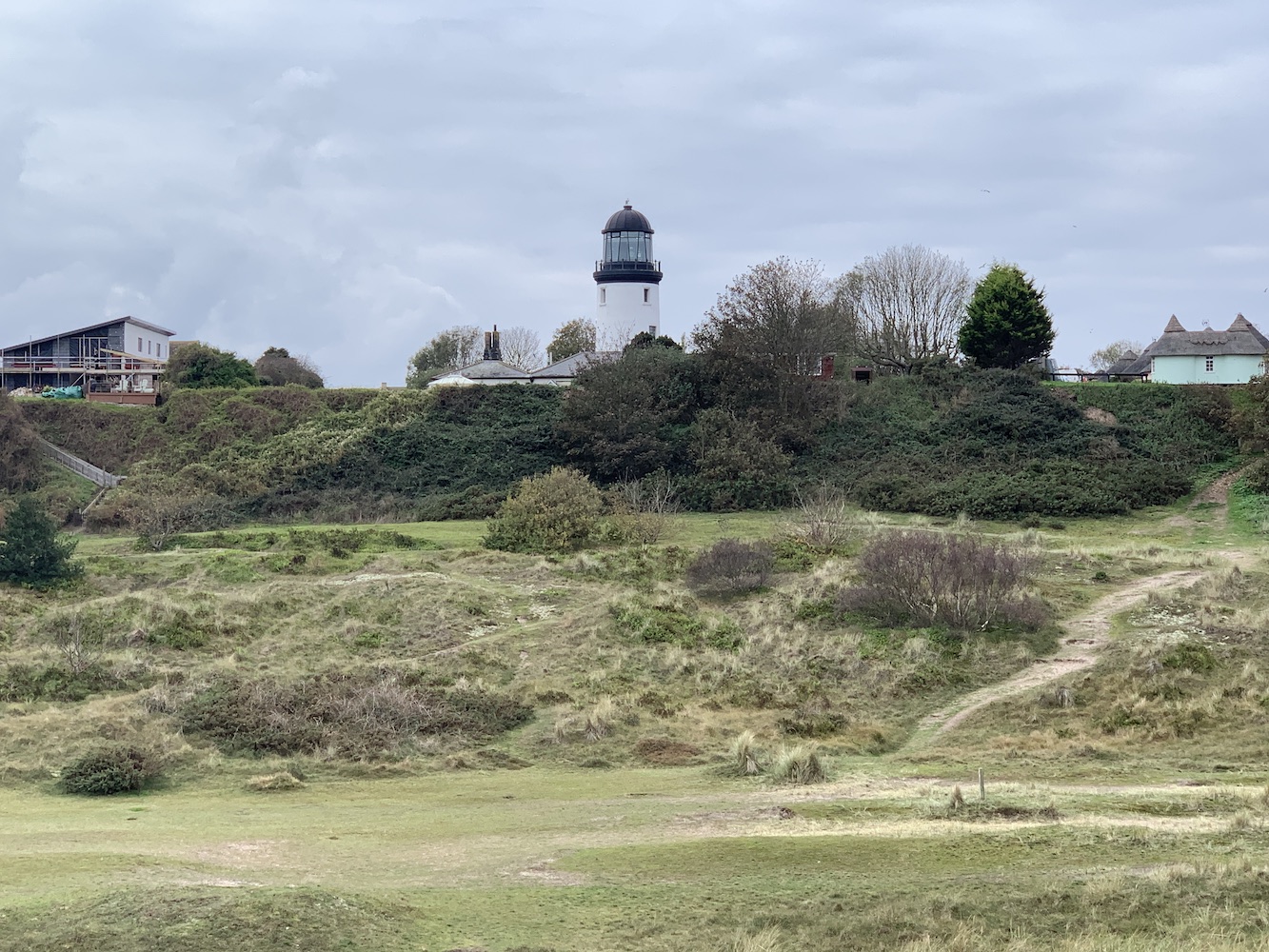
Winterton-on-Sea lighthouse across the dunes
I’m glad we did as it’s a much more enjoyable approach. While Bob flew Joe about over me like I was in some sort of action film, I wandered as close as I could get to the lighthouse, which wasn’t that close, but I found some higher ground and got some nice views from there.
Winterton lighthouse from the coast
Joe had got some great views too.
Winterton lighthouse from above, looking north
Winterton lighthouse from above, looking south
Winterton lighthouse from the east
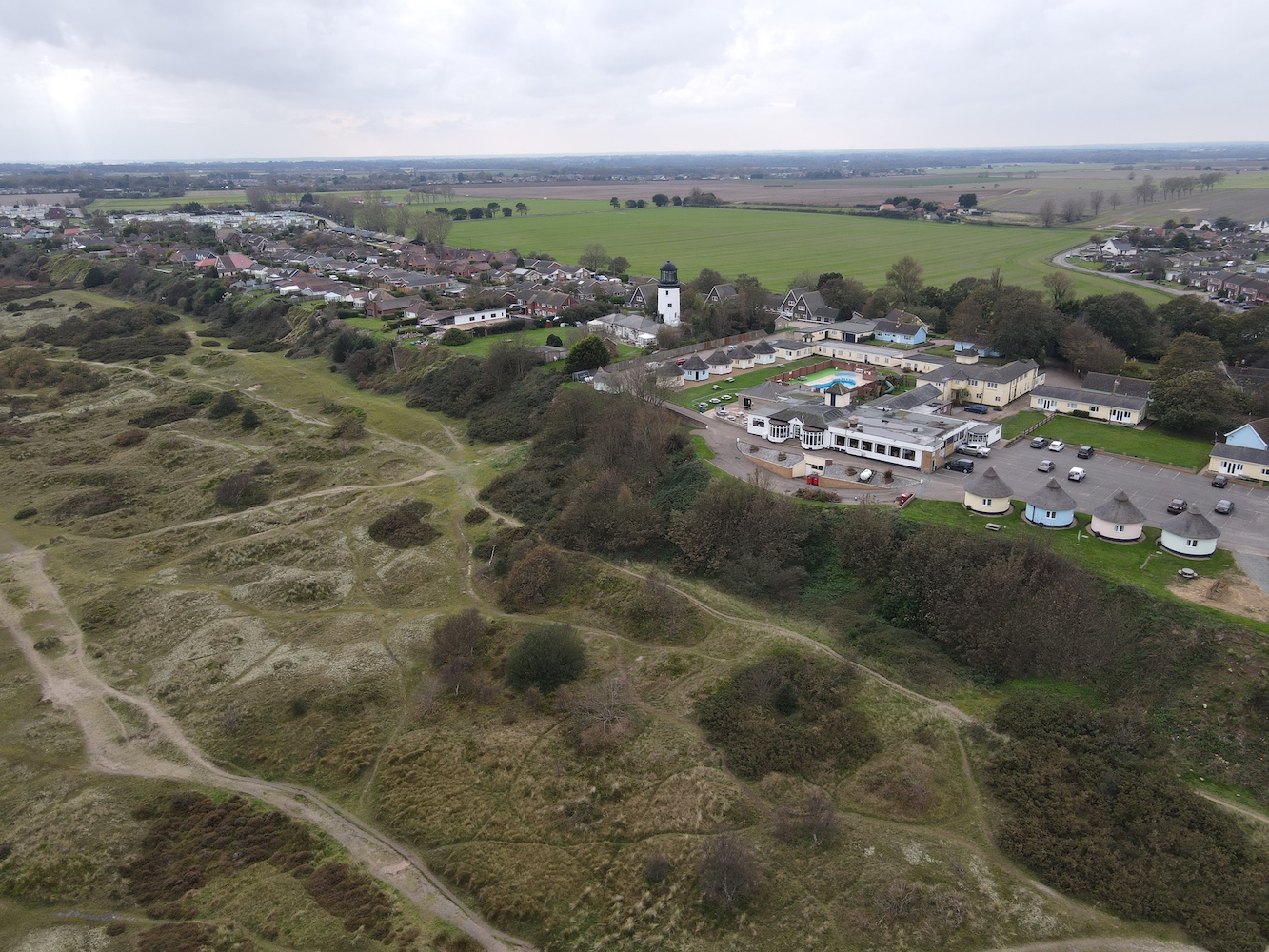
Bob then suggested we try approaching from the nearby holiday camp area so we set off back over the dunes. This turned out to be a good idea as, although we still couldn’t get close enough to touch the lighthouse we got much closer than I’d been before. So I was happy with that – and it was nice to see the tower behind the coloured little houses too! Winterton lighthouse is actually available as a holiday let and Lighthouse Accommodation can provide more details about this.
Winterton lighthouse from the neighbouring holiday accommodation
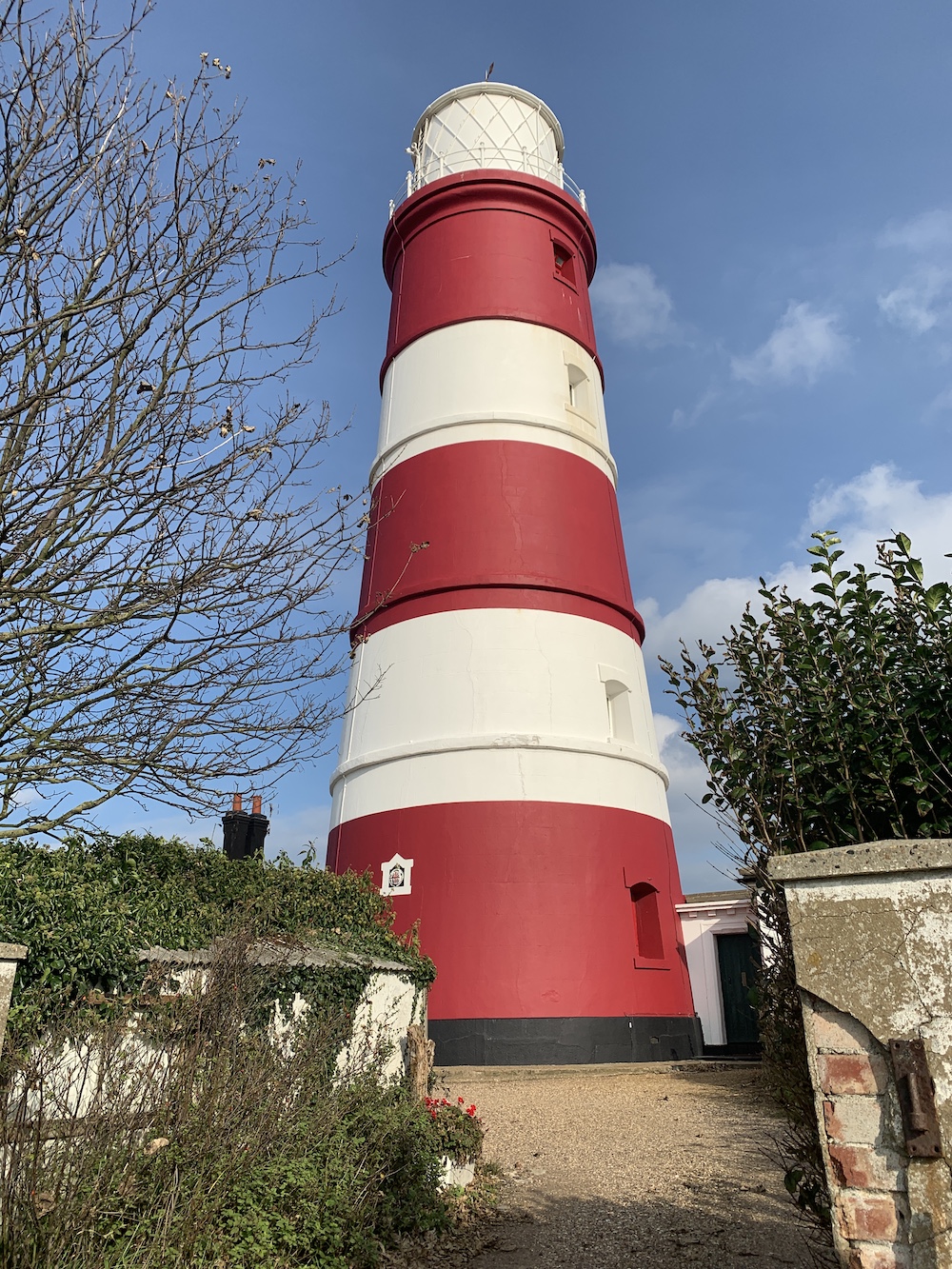
On the subject of Lighthouse Accommodation, which is written and compiled by my lovely friend Joy, our next stop was Happisburgh lighthouse where Joy is a very active volunteer. As we arrived at the lighthouse the clouds cleared and blue sky and sunshine came out. It’s always been nice weather when I’ve visited Happisburgh.
Happisburgh lighthouse
Approaching Happisburgh lighthouse
It was also nice and calm there today so the walk along the track to the lighthouse was very enjoyable as was the stroll around the wall. The lighthouse is currently closed because of the pandemic, but I would highly recommend going there once it opens again. It’s such a special place and you can see why the community work so hard to keep it running.
Happisburgh lighthouse from the entrance
Happisburgh lighthouse from the east
One more stop of the day and that was Cromer. The lighthouse here is at the end of a private road and the cottages here are let out by Rural Retreats. On other occasions we may have been tempted to drive up the road, but with Bob wanting to be there long enough to fly the drone I suggested we take the coastal route by walking from the town centre. It’s a great walk, although initially we weaved our way through the people in the town to ensure we kept our distance. Once we started walking along the promenade it was a bit easier and the views opened up. We reached the row of beach huts and Bob, who was in his usual position in front of me, spotted the steps leading up the cliff.
The sign that marks the start of the steps
I knew there would be quite a few steps and they were pretty tiring, but thankfully they changed direction enough to keep them a bit more interesting. Once at the top we took a left turn and followed the various paths along the coast. It wasn’t long before the lighthouse came into view, which is always encouraging! Bob, off in front again, found a narrow track leading from the path up to the lighthouse which went from a fair little path to quite a steep final section, but once at the top I was there and could enjoy views all around.
Cromer lighthouse comes into view
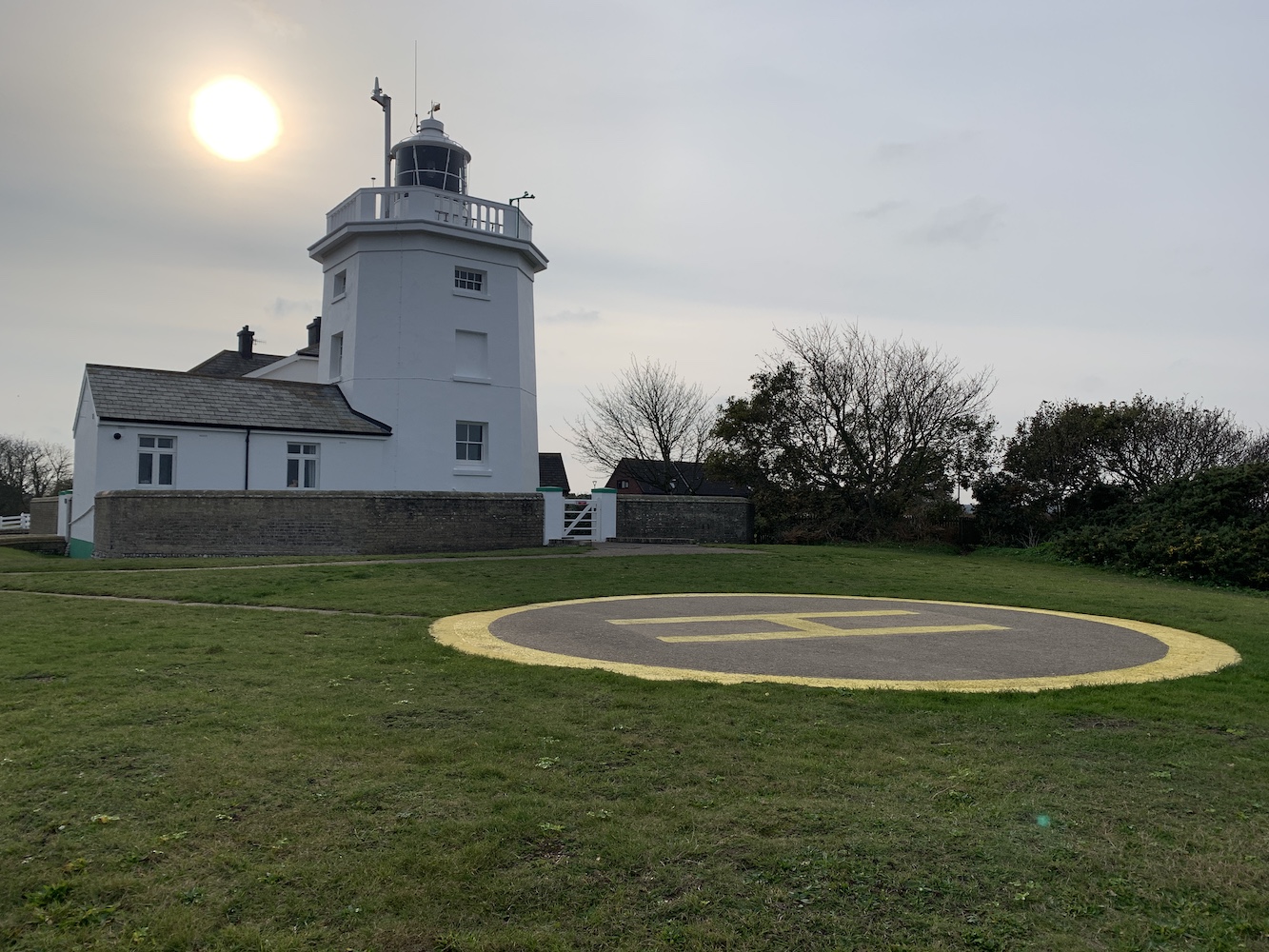
There was a perfectly positioned helipad for Joe the Drone to borrow for take off.
Cromer lighthouse
Cromer lighthouse from the north
Cromer lighthouse from the west
I imagine Cromer lighthouse would probably have been quite a popular station to serve at as it looks fairly spacious judging by the size of the associated buildings and the width of the lighthouse. It was great to see the light on too. That’s always an added bonus.
Cromer lighthouse in action
On the walk back I enjoyed the occasional look back to the lighthouse as I took a slightly different route along the paths. The views down to the beach and pier were wonderful too with people’s reflections in the water.
Cromer beach and pier
Rather than taking the steps back down to the beach huts we followed the path down and came out in the town. More weaving between people ensued and we were soon back at the car.
A great day and I’m so glad I took the opportunity of suggesting the alternative routes at both Winterton and Cromer. The coastal route is near enough always more enjoyable. 🙂
In recent blog posts I’ve become very aware of how little credit and attention I gave each lighthouse as I was whizzing around so many – particularly in the early days of my 2012 tour when I only included one picture per post. The methods of posting on this blog then were somewhat different with me needing to send the text by email to a particular address and attach a picture to have that included at the end.
This week I am in East Anglia and, although I’ve seen a couple of these lighthouses a number of times they’ve not received the coverage they deserve on here. So I now want to rectify that.
Yesterday was a day for exploring the lighthouses of Suffolk and our first stop was Southwold. With grandparents living in the area, Southwold is a place I spent many a wonderful childhood holiday. Perhaps it was the lighthouse here, sitting proudly in amongst the houses, that contributed to my love of lighthouses. It’s hard to say, but I can certainly see that it might have been.
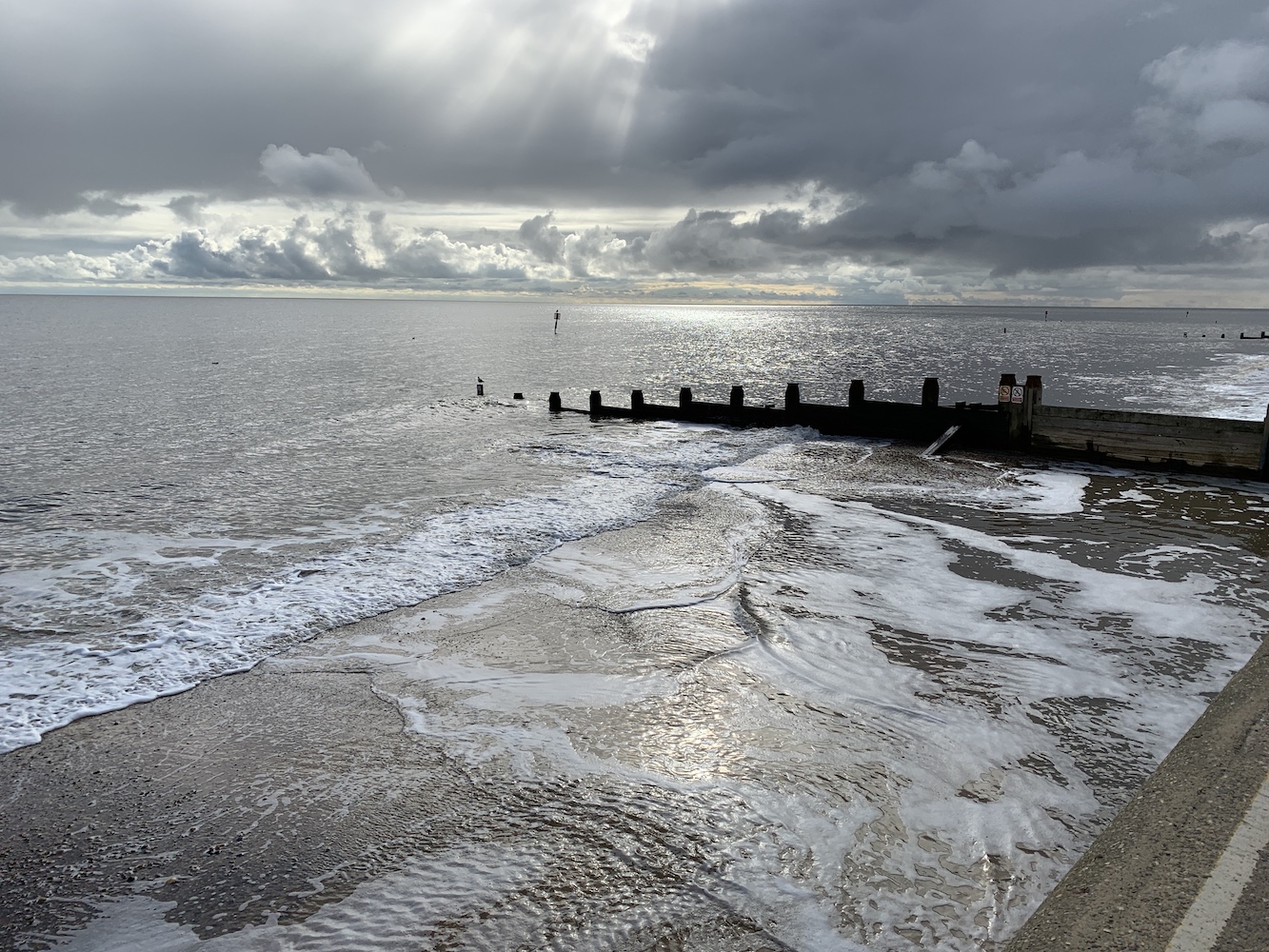
Southwold beach
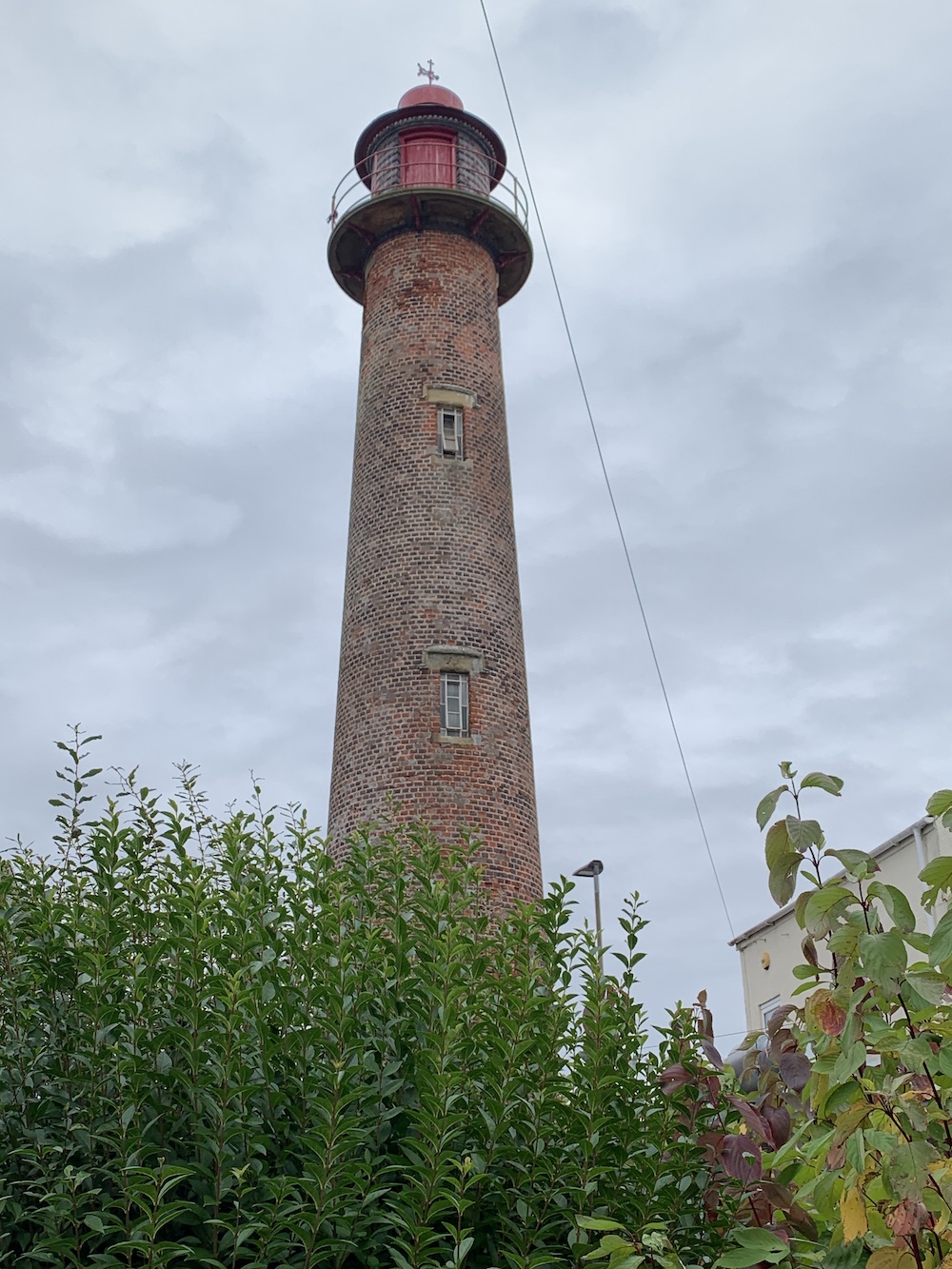
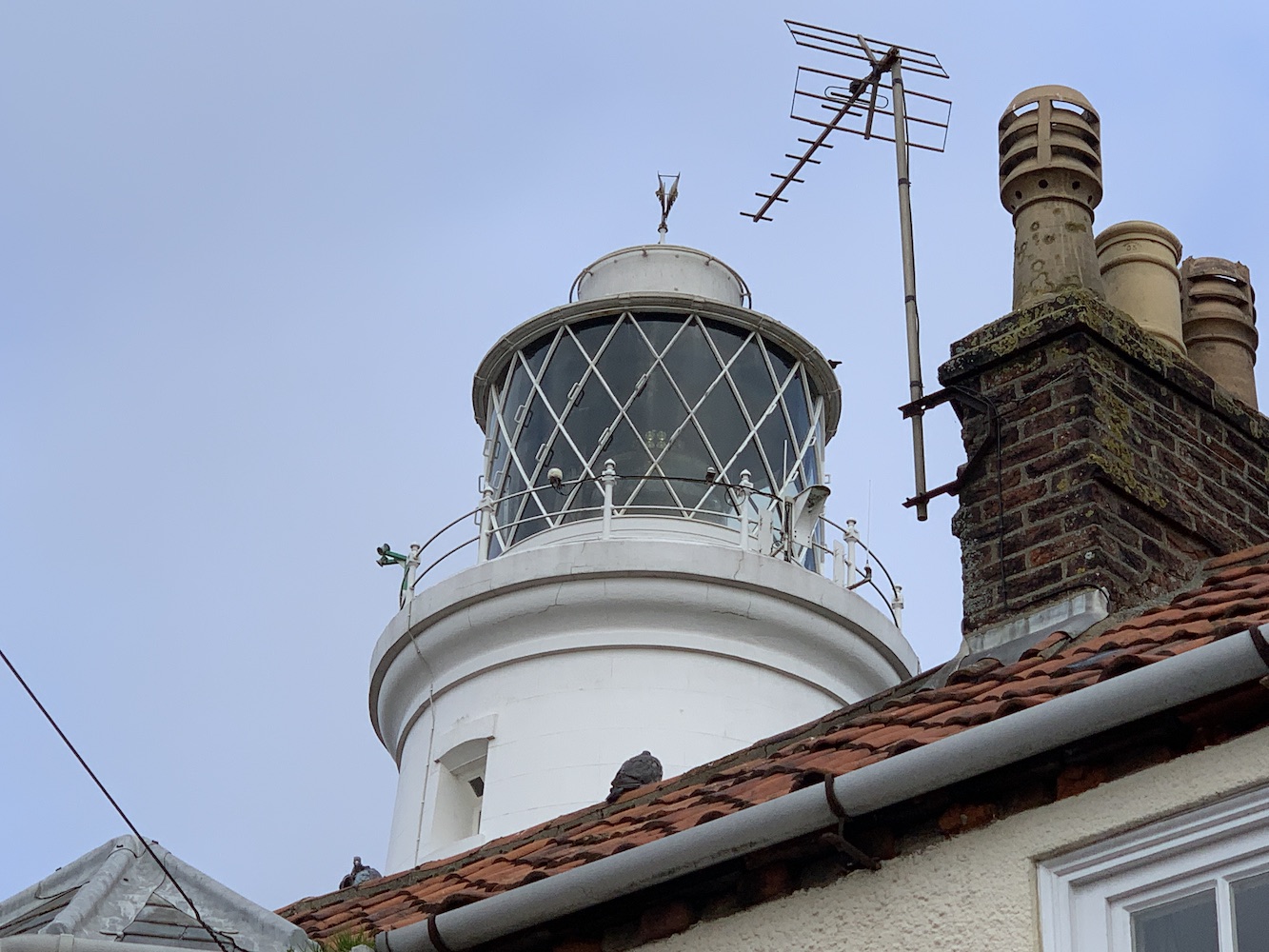
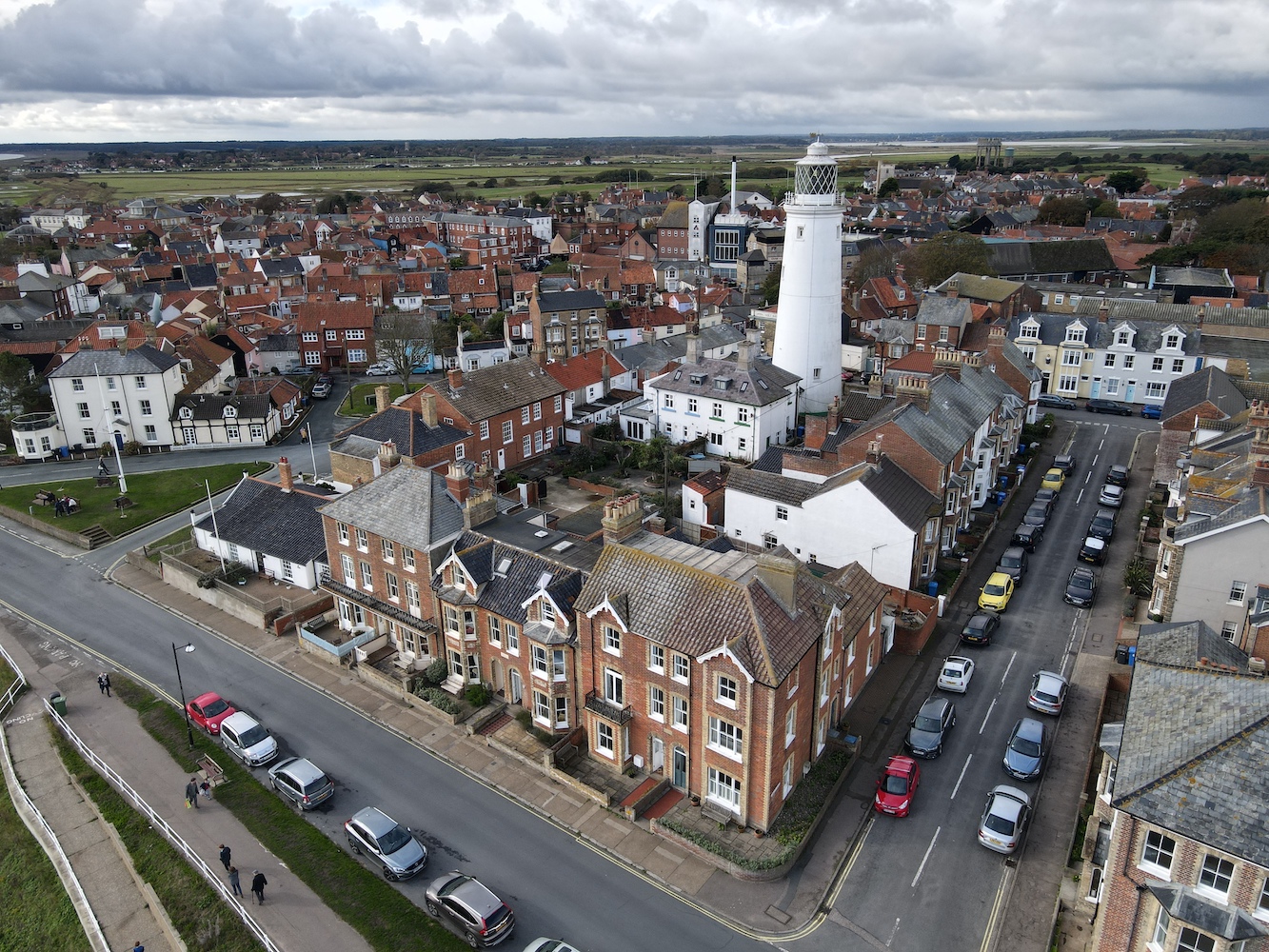
With all the times I’ve seen the lighthouse here I’ve not yet managed to make it inside and yesterday was no exception. It may well be closed as it’s now out of season or it could well be the pandemic, but either way I had to satisfy myself with an external view, but what a lovely view it is. With this one, although I love to see it close-up, the best views are the glimpses you catch of it above and between the roofs and the houses as you walk around the area.
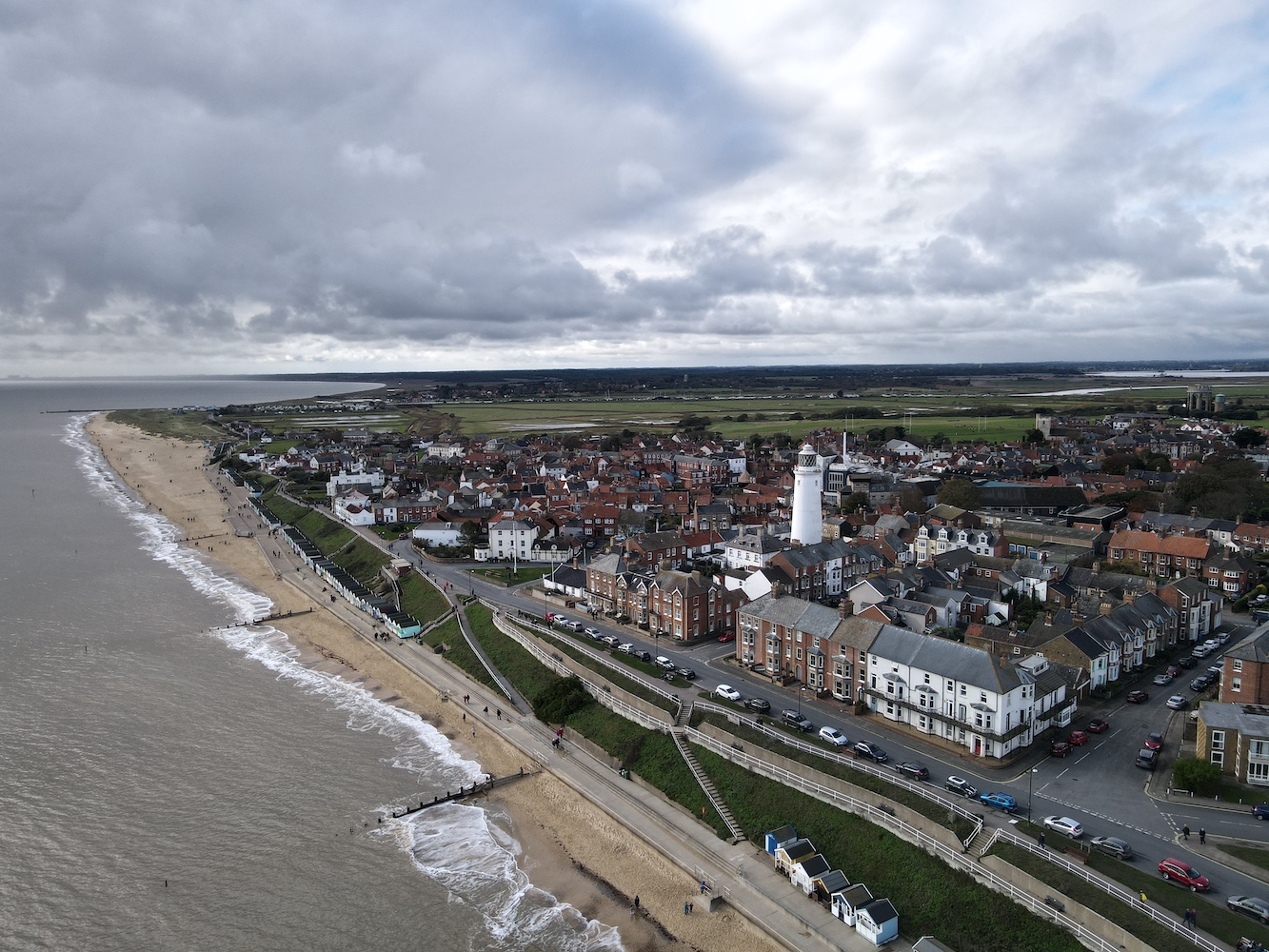
Southwold lighthouse
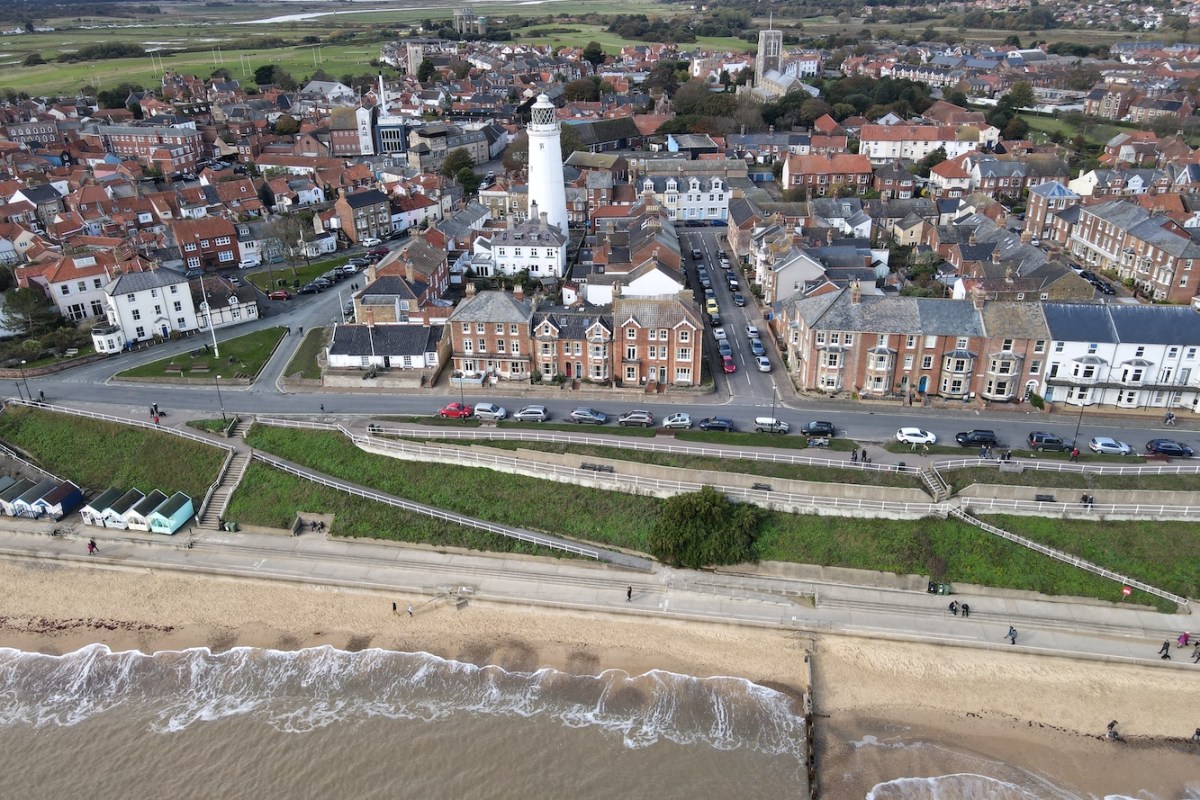
With very calm conditions Joe the Drone was able to get an outing too. Bob attracted a bit of interest from passers by, which he’s not used to in the more remote places we go to in Scotland! My favourite view of Joe’s was taken from above the sea looking down on the town with the lighthouse standing proud. It was also good to see how it looked facing south with the shape of the coastline.
Southwold lighthouse from above
Our second stop of the day was Pakefield, which we managed to catch between showers. The lighthouse here is no longer active with the squat tower now used as a Coastwatch station. Again, this is one you can visit under normal circumstances, but the virus is currently impacting on that. Pakefield is the only lighthouse I’m aware of that you access through a holiday park!
Pakefield lighthouse
Up went Joe again and captured some great images showing just how small the lighthouse looks in relation to its surroundings (unlike Southwold) and the beautiful coastline here that is so characteristic of the area.
Pakefield lighthouse from above
Three lighthouses awaited in Lowestoft. Rather greedy of Lowestoft, but you will not hear me complaining. The two lighthouses on the end of the north and south piers in Lowestoft can be easily seen from the south pier, but you can’t get close enough to either to be able to touch them. The north pier is closed completely to the public while a fence prevents you from getting to the south pier light.
Lowestoft North and South Pier lighthouses
However, we had Joe and we weren’t afraid to use him – between rain showers again.
Lowestoft South Pier lighthouse
Lowestoft North Pier lighthouse
It was fairly overcast, but still good to get a different angle on these two and see the harbour from above. The harbour is far bigger than I ever remember it being.
Lowestoft harbour
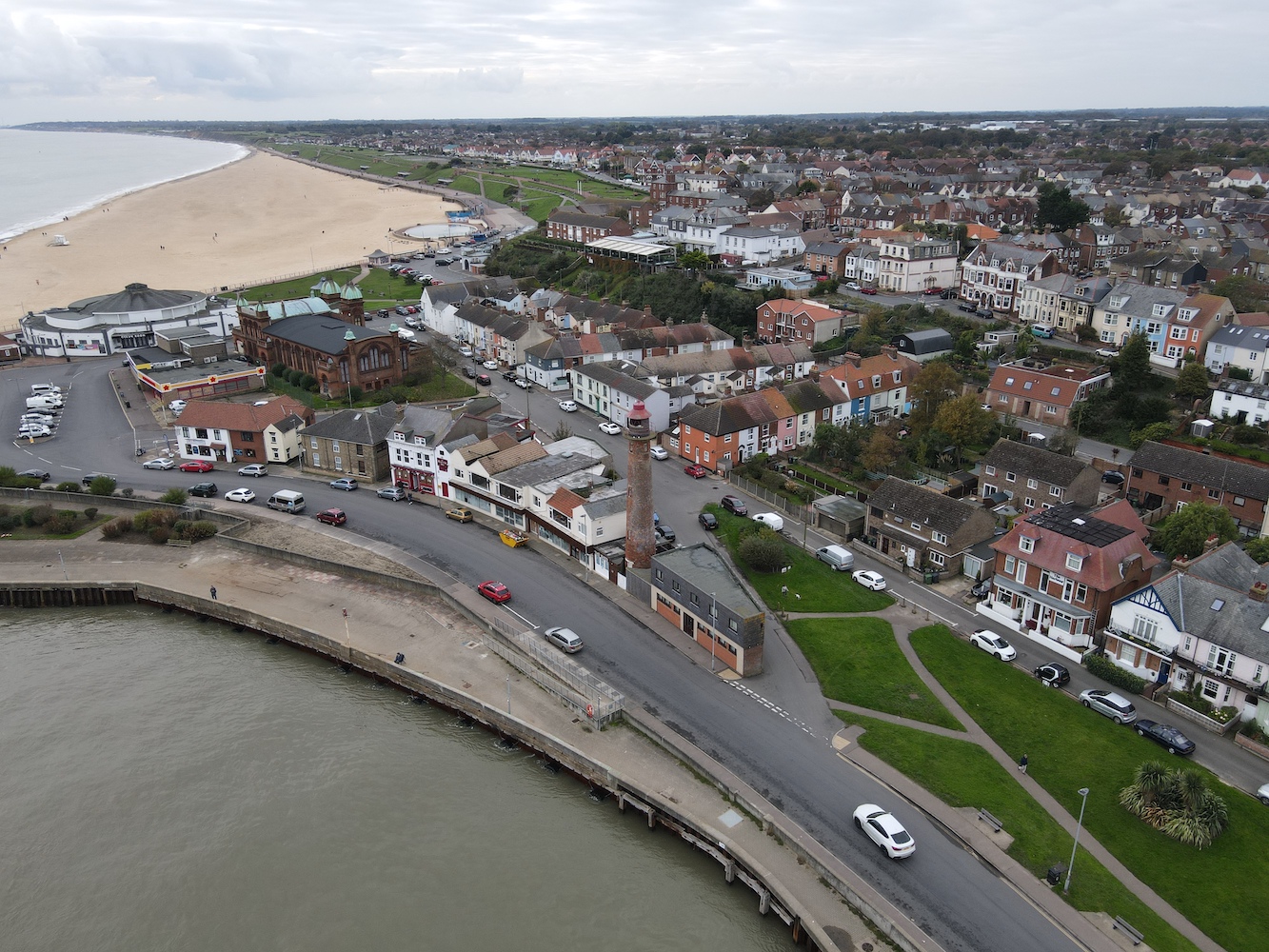
With one lighthouse to go we continued north. As the lighthouse appeared among the trees on the landward side of the car I pointed it out to Bob’s surprise. I don’t think he’d expected it to be there and it’s another one that’s not in a standard location. It is right next to a main road on the west side and slightly further inland than you would expect. We parked up and wandered up through Sparrow’s Nest Gardens to get to it. This was rather good as I’d remembered the area being quite picturesque and filled with trees on my previous visit, but that time I’d parked to the north and so missed most of the nicest bit.
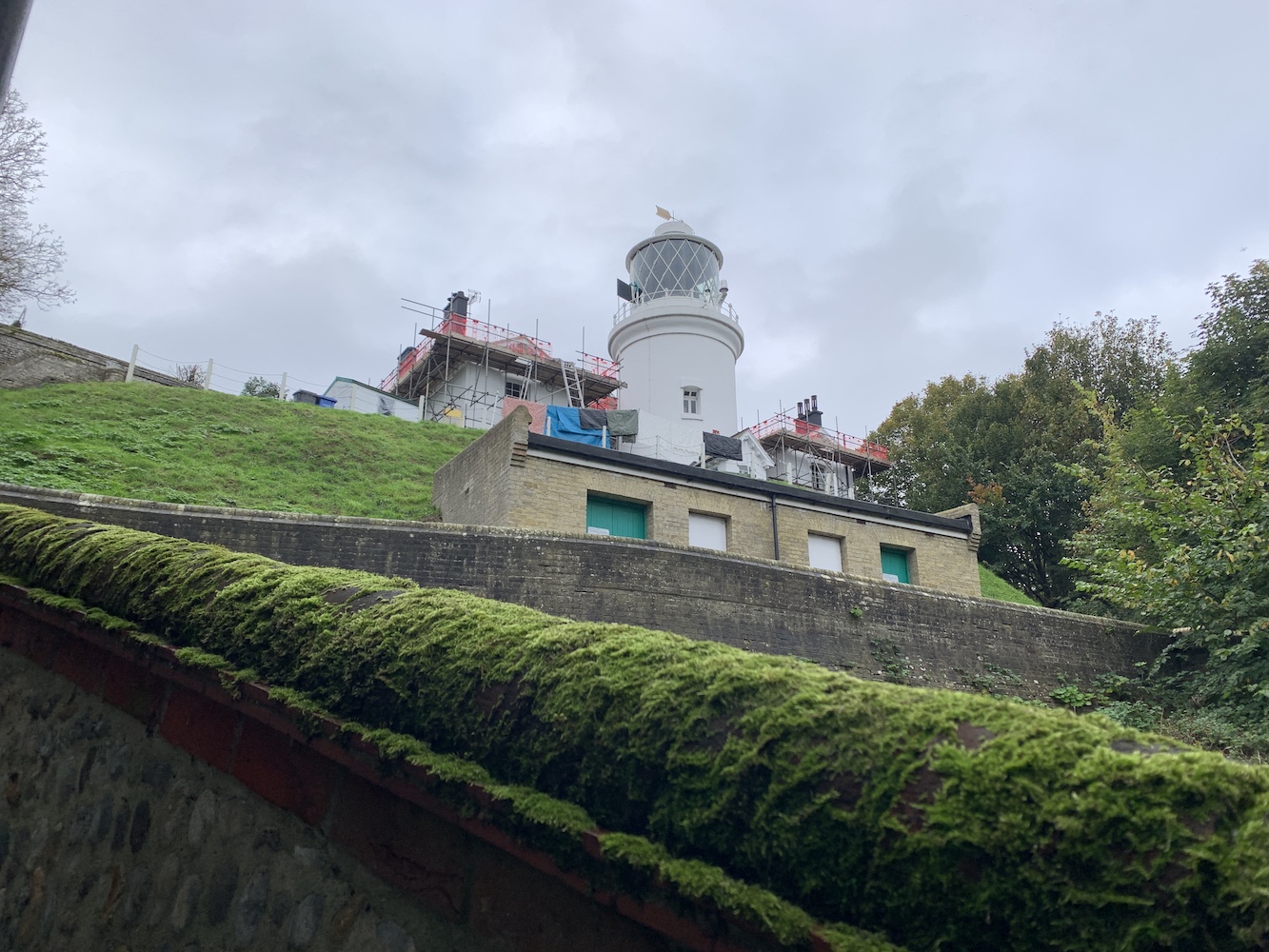
Lowestoft lighthouse
We strolled up the steps to the south of the lighthouse, which I think gives the best land-based views of the tower. From almost every other angle the lighthouse is obscured by trees. There is currently some work going on here with scaffolding covering the two buildings, which detracts a bit from the loveliness of it, but of course that’s only temporary.
We followed the steps up to the road, passing the lighthouse complex and then strolled back into the Gardens. We were delighted to see some fairly tame squirrels running about across the paths and on the grass.
A squirrel at Sparrow’s Nest Gardens
That kept the kids and I entertained for a while as Bob went to the car to pick up Joe for his final flight of the day. From above you can really see how well surrounded the tower is by trees, and you also get an idea of just how big Lowestoft is, which amazed me.
Lowestoft from above
Lowestoft lighthouse from above
It had been a lovely day of revisiting a few old friends, now with my greater appreciation of these structures and their wonderful surroundings. It’s nice to do these things at a slower pace every now and then. 🙂
I am posting this from the community shop on the island of Canna, one of Scotland’s Small Isles to the south west of the southern point of Skye. That in itself says a lot about the island. The community shop is the only place on the island where visitors can access WiFi and there is very patchy mobile phone signal. To some that may be a reason not to visit, but my opinion is that it adds to the charm. As a result, Canna has been able to retain that traditional community feel where no one needs to lock their doors, and everyone helps and supports each other. The community shop is open 24 hours a day and works on an honesty box system where customers write down what they bought and how much they paid.
The logo for the Community Shop on Canna
Owned by the National Trust for Scotland, the island is unique in that the National Trust will sometimes do calls for new residents on the island and people must apply. The school on the island has not been open for some years now as the teacher and all primary aged pupils moved away.
Canna – or its neighbour Sanday, which it is attached to by a bridge – boasts a little lighthouse and this was a key reason for choosing to visit the island. Bob had also never been here, so he was keen to get to the island’s high point. The trip had originally been planned for Easter and we had booked accommodation in the West Caravan run by Canna Campsite. Due to the pandemic, we had to postpone our visit and we re-booked for the October half term holiday in the hope that we would be able to travel. The announcement by the Scottish Government last week meant that we were still able to travel thankfully.
We had a stroll along the beach at Chanonry Point on the way to Mallaig. It was the first time I’d been to Chanonry Point since my 2012 tour and there were the usual dolphin spotters about. It was nice to approach it from the road end this time as last time I’d walked to it along the beach from the campsite to the east.
Chanonry Point lighthouse
It also meant I got to see the old pier, which I assume was built for servicing the lighthouse.
The pier at Chanonry Point
After an overnight stay in Fort William we arrived in Mallaig. Another point I should highlight about Canna before I continue is that it is not allowed for non-residents to bring vehicles over to the island, so we struggled on board with our masses of luggage and food supplies.
The ferry journey was good with very few other passengers on it and everyone keeping their distance. The best part, of course, was seeing Canna lighthouse on the approach to the island. I do enjoy seeing these types of towers and it made me look forward to the walk to it even more – although it seemed like quite a long way!
Canna lighthouse from the sea
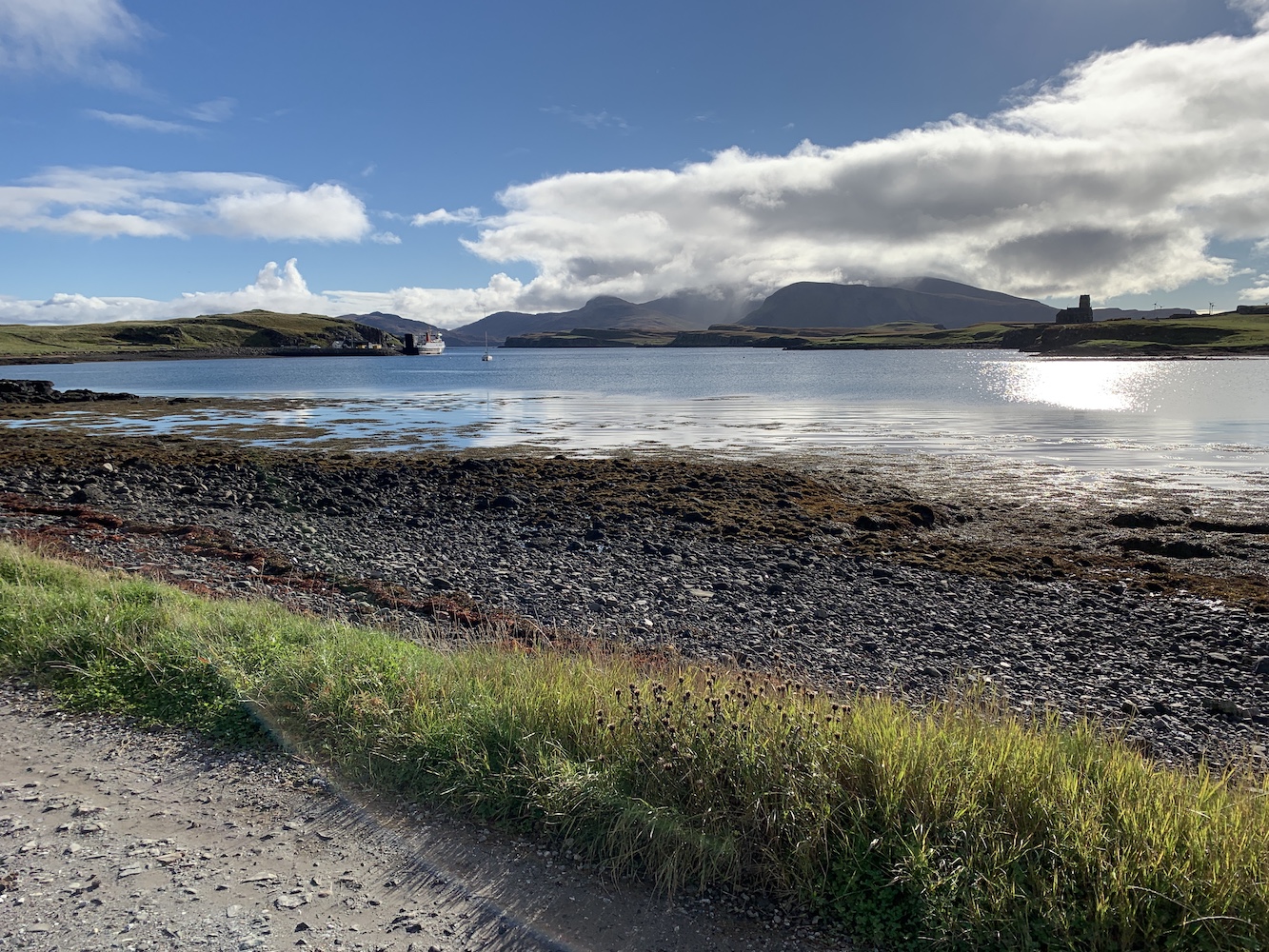
After we’d had our bags collected by the campsite owner to take along to the caravan, we set off along the road passing the shop, the post office and a few houses on the way. The day was so calm and there were beautiful views all around.
The view shortly after arrival on Canna
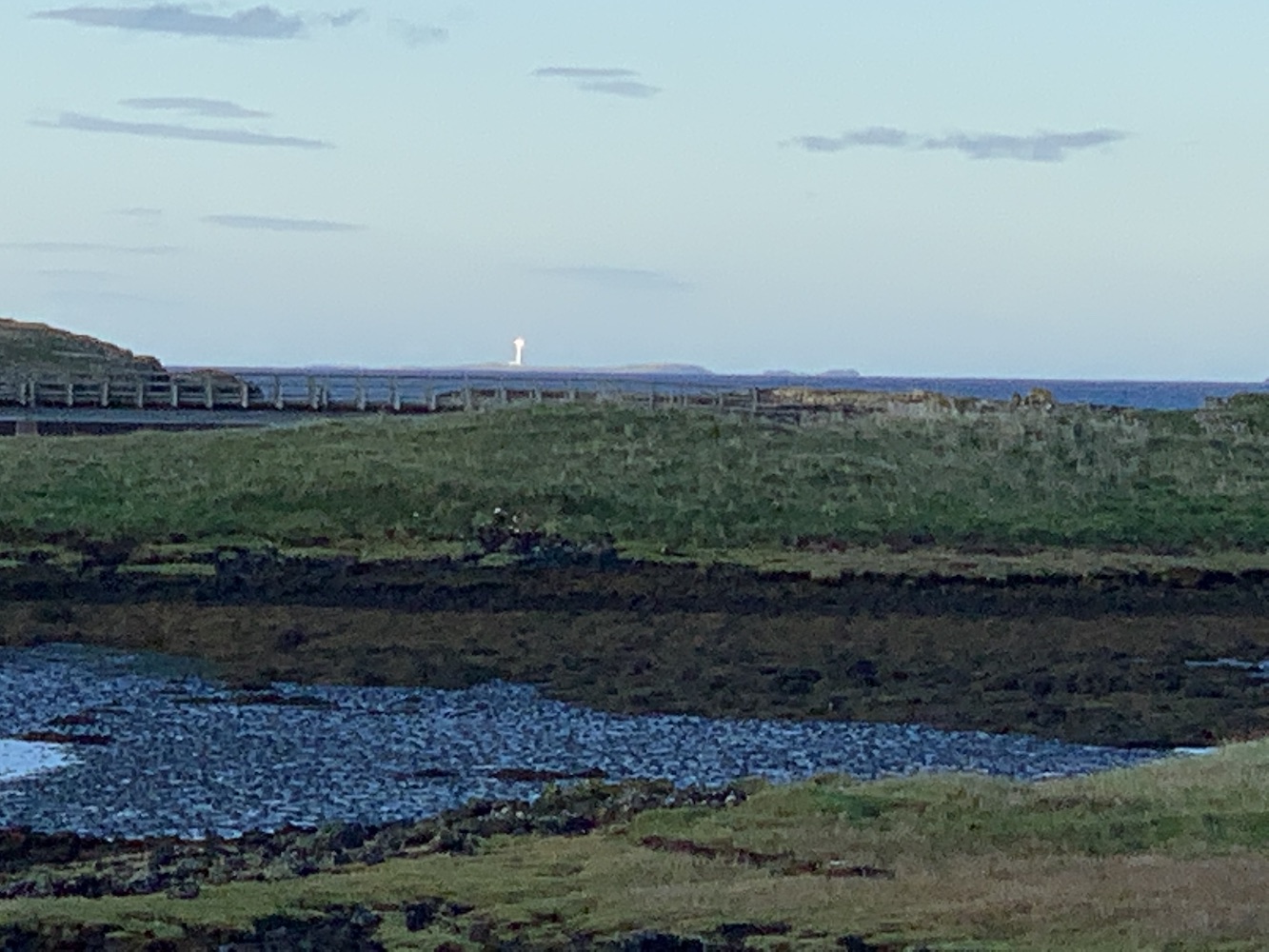
I had two aims for my visit to Canna. The first was to reach the lighthouse and the second was to find a point on the island from which I would be able to see Hyskeir lighthouse flashing at night. Hyskeir is around 6 miles off of Canna and the lighthouse and island it sits on are one of my favourite places. My visit there a few years ago (that blog post doesn’t give it enough credit) was fantastic. It wasn’t long after we arrived at the caravan that Bob called ‘I don’t think you’ll need to go far to see Hyskeir flashing’. Looking out of the big living room window of the caravan I could see Hyskeir there on it’s low lying island, visible just above the bridge across the Sanday. I’ve since noticed that the caravan may be one of the only houses/places to stay on the island from which you’d be able to see it without going outside. So lucky! You can probably guess what I spent the evening doing that first night – oh, ok and the second evening!
A distant view of Hyskeir lighthouse shining in the sun
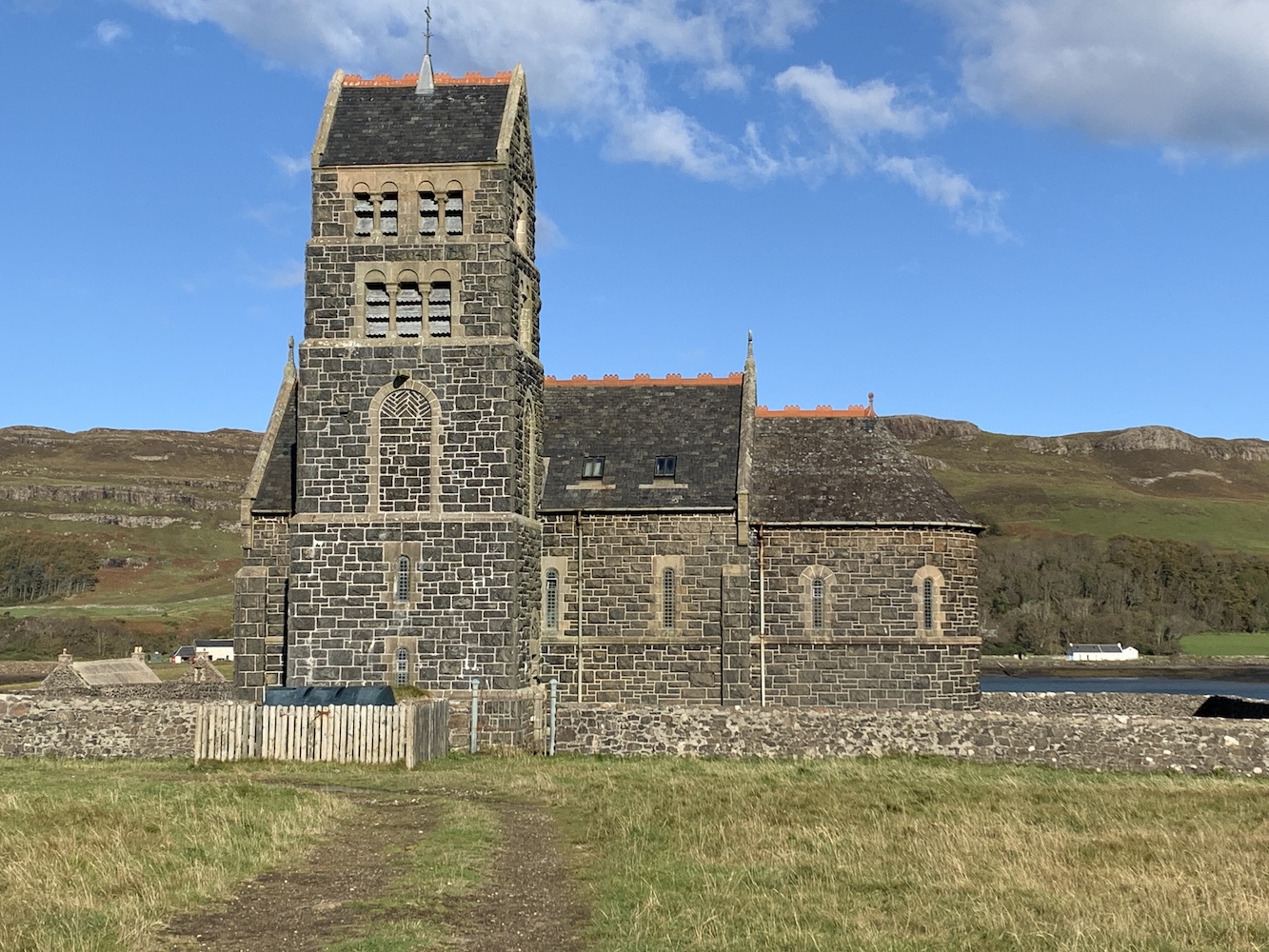
After a showery day yesterday we decided today would be the best day to walk out to Canna lighthouse. The wind was still strong as it had been yesterday, but it was dry and sunny. We wrapped up in our numerous layers and set off. The puddles were still full this morning, which occupied the kids for the first half an hour of the walk. We’d been to the high point of Sanday on our first day here so we knew where we had to go. The track continued all the way along to the church and disappeared just before the six wildly spinning wind turbines.
The church on Sanday
From this point we became a bit more wary. The lady who owns the caravan had told us that there were some cows out towards the lighthouse and one of them had been a pet last year and so could be a little bit too approachable. We aren’t keen on cows and are very aware of the risks of coming across them when they have calves. We were on our guard and, as we reached the off piste and sometimes boggy section, Bob navigated us across higher ground to give us good vantage points as we went to help with spotting the cows before we reached them.
One of the views on the way to the lighthouse
We found them eventually, in a small gully area – presumably sheltering from the wind to the south west of the lighthouse. We crept past as fast as we could and made our way up the other side. Checking back every now and then to make sure we weren’t being followed, we slowly began to let our guard down on the final stretch to the lighthouse.
The final approach to the lighthouse
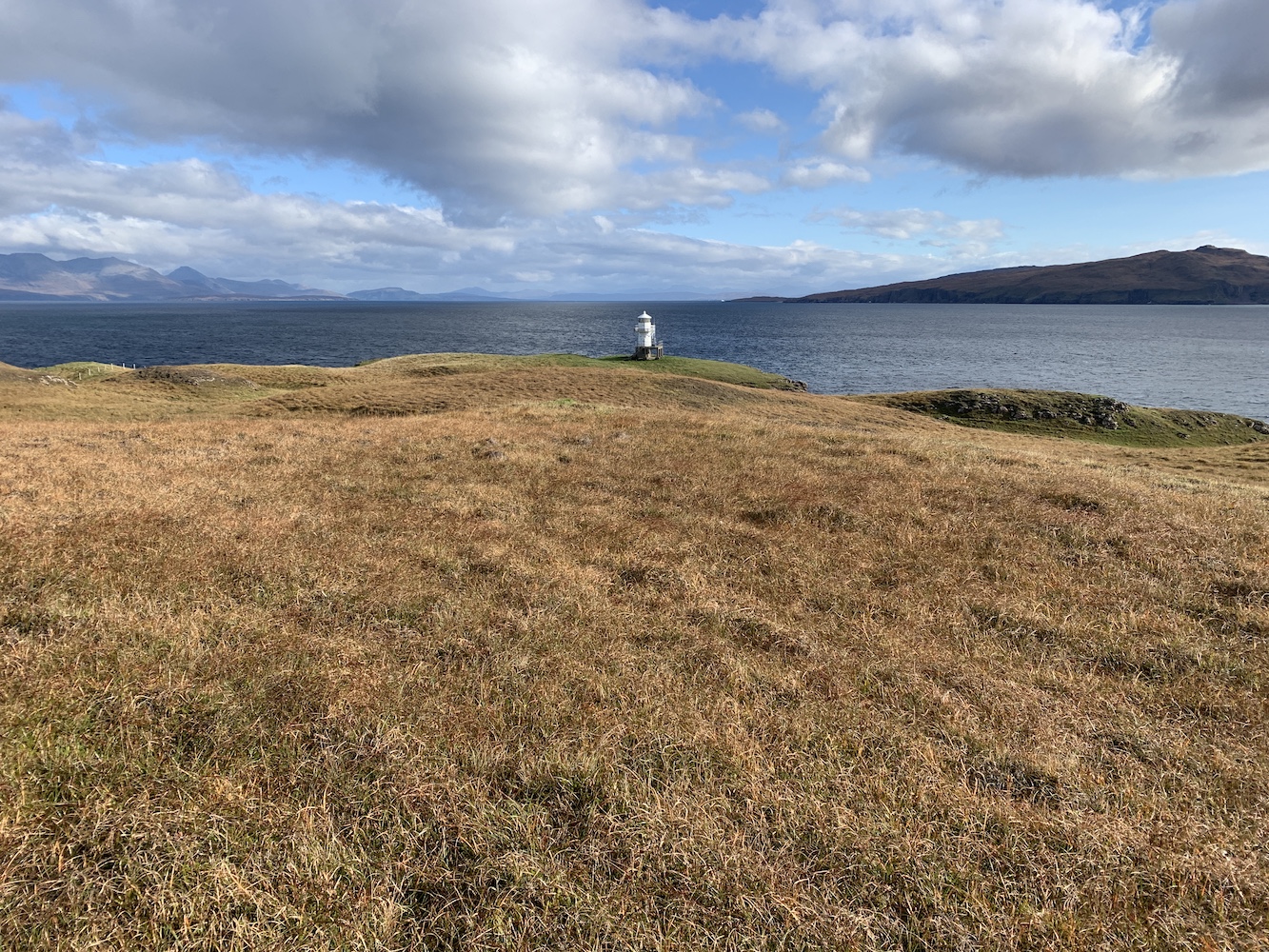
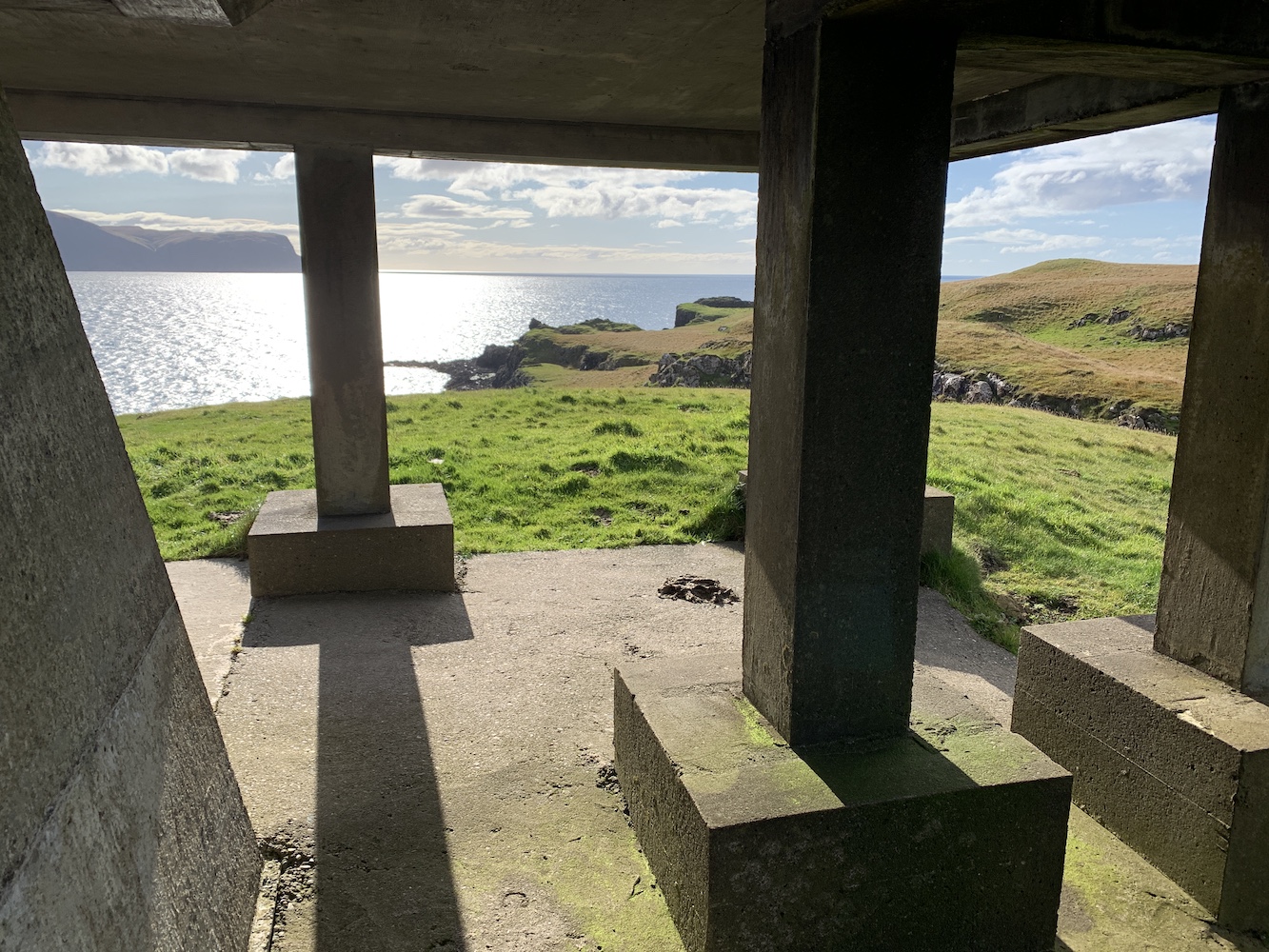
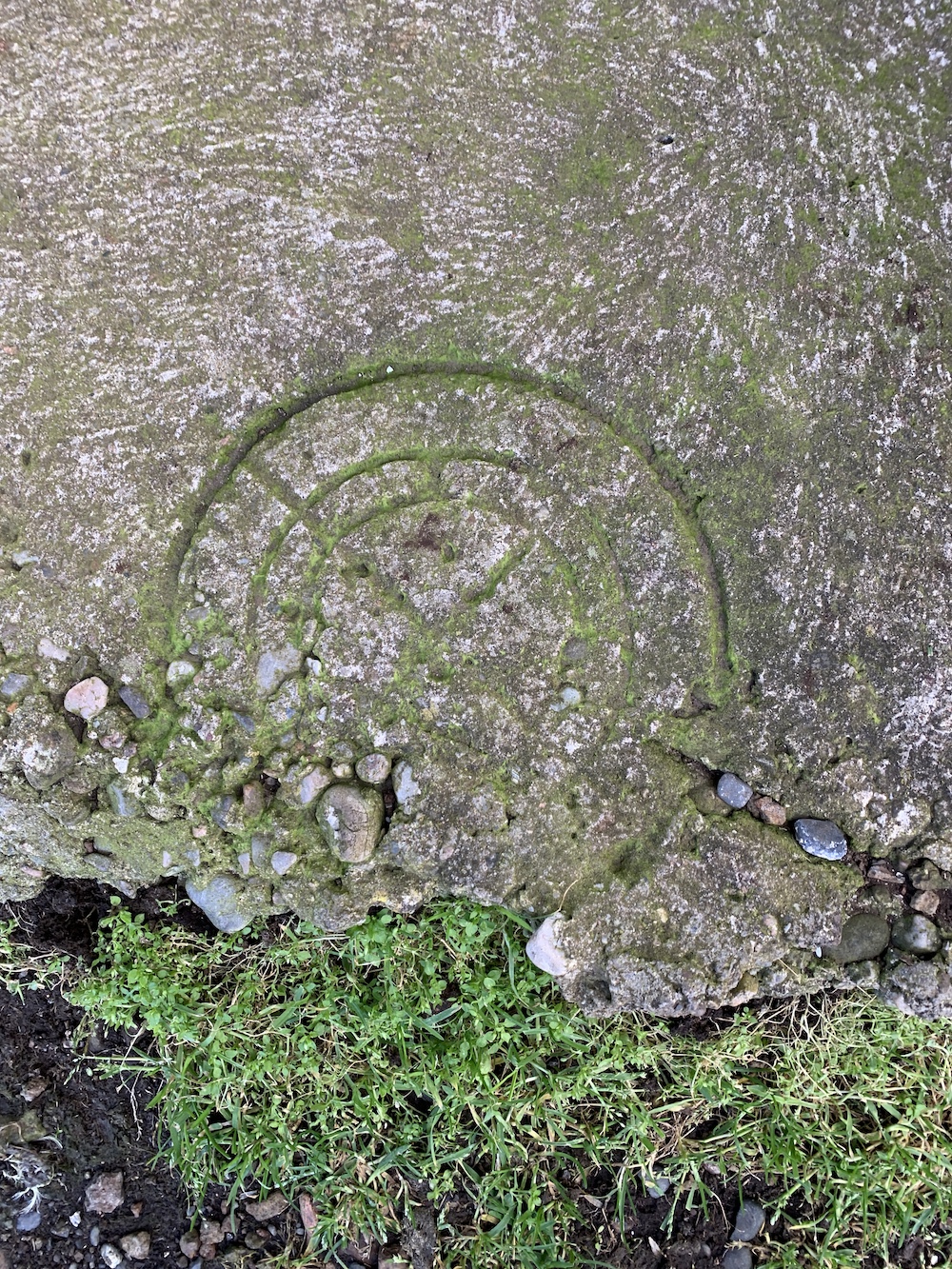
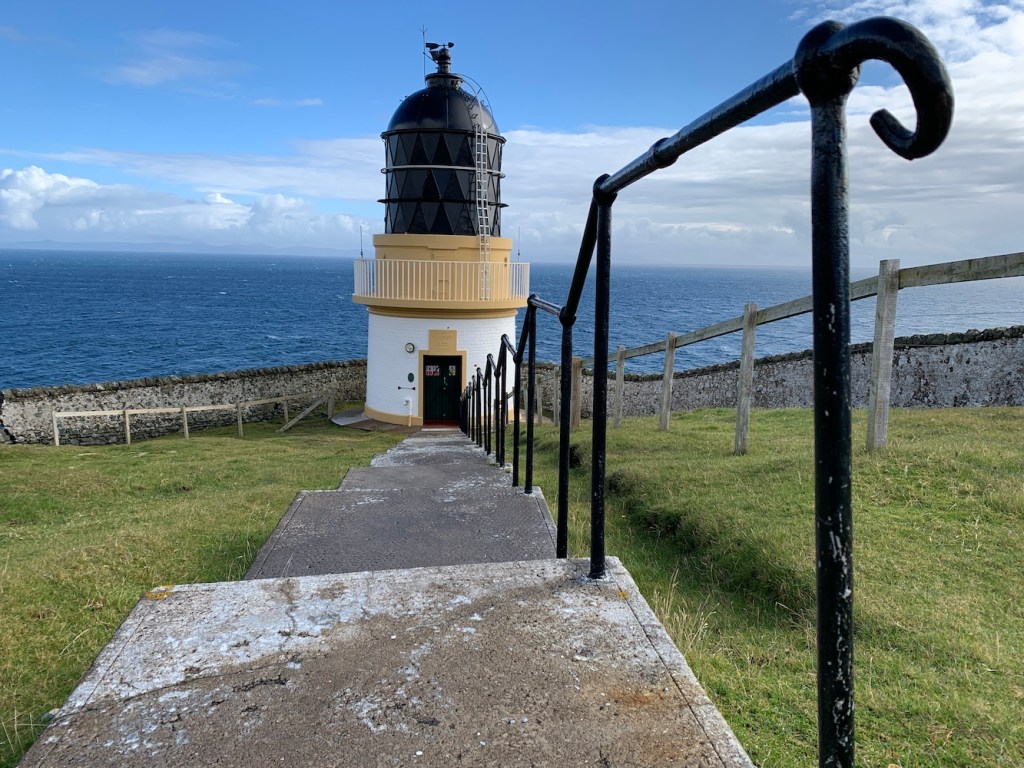
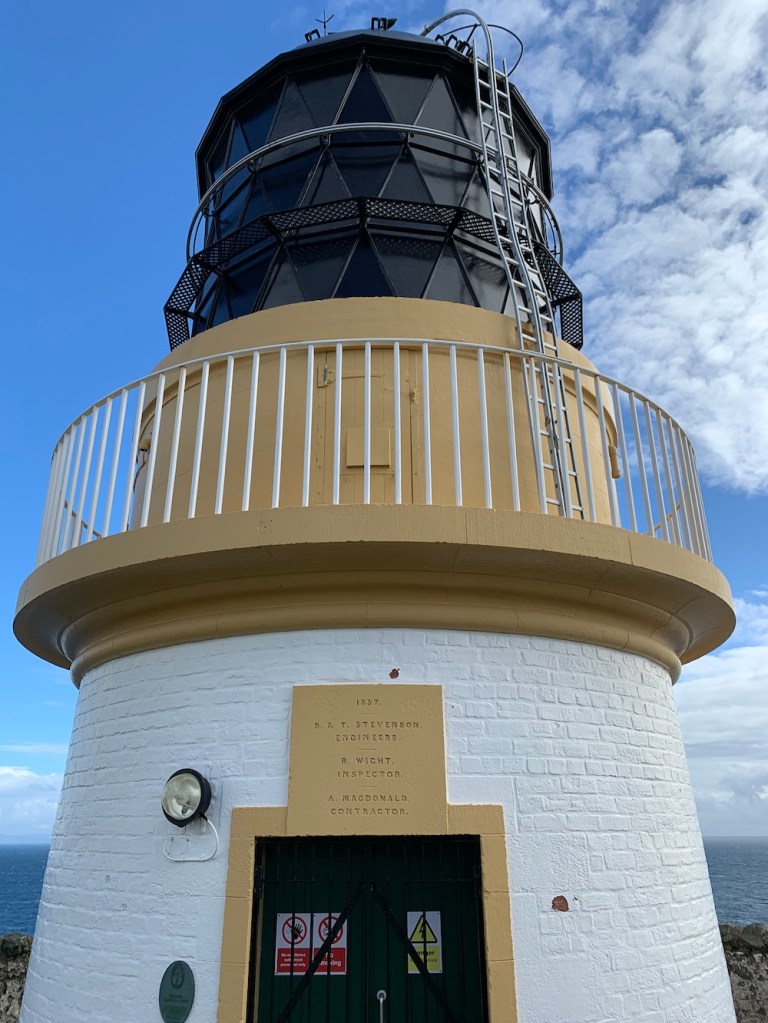
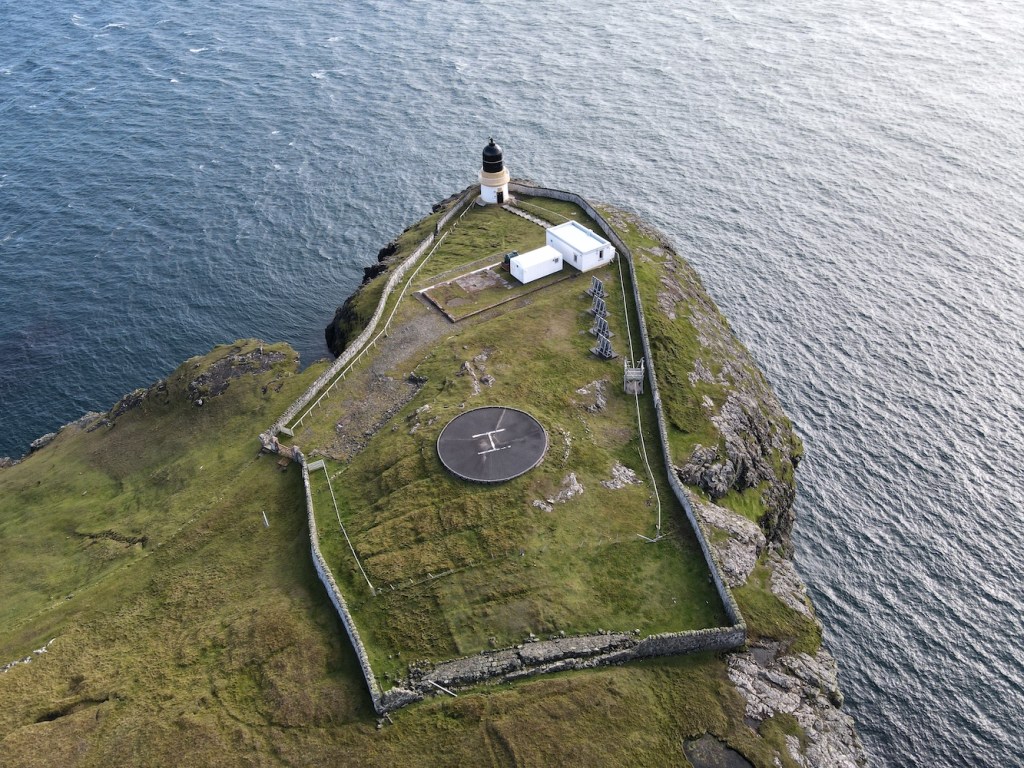
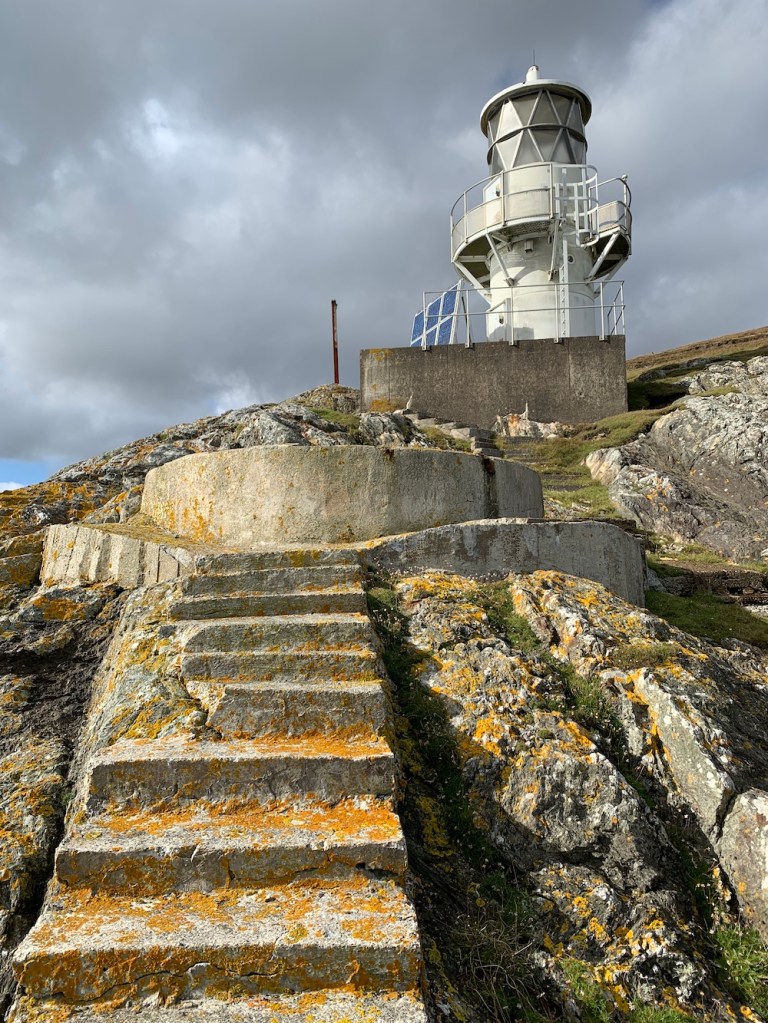
These lighthouses are always in such beautiful locations. I think of Eigg lighthouse on Eilean Chathastail in particular. They look great with the extra platforms and, at this one, the platform made the perfect spot for a picnic. Here it was also possible to walk underneath the platform which I’d not been able to do before. Just down from the lighthouse is the landing area for the lighthouse with an old derrick. Here are a few pictures of the lighthouse.
Canna lighthouse
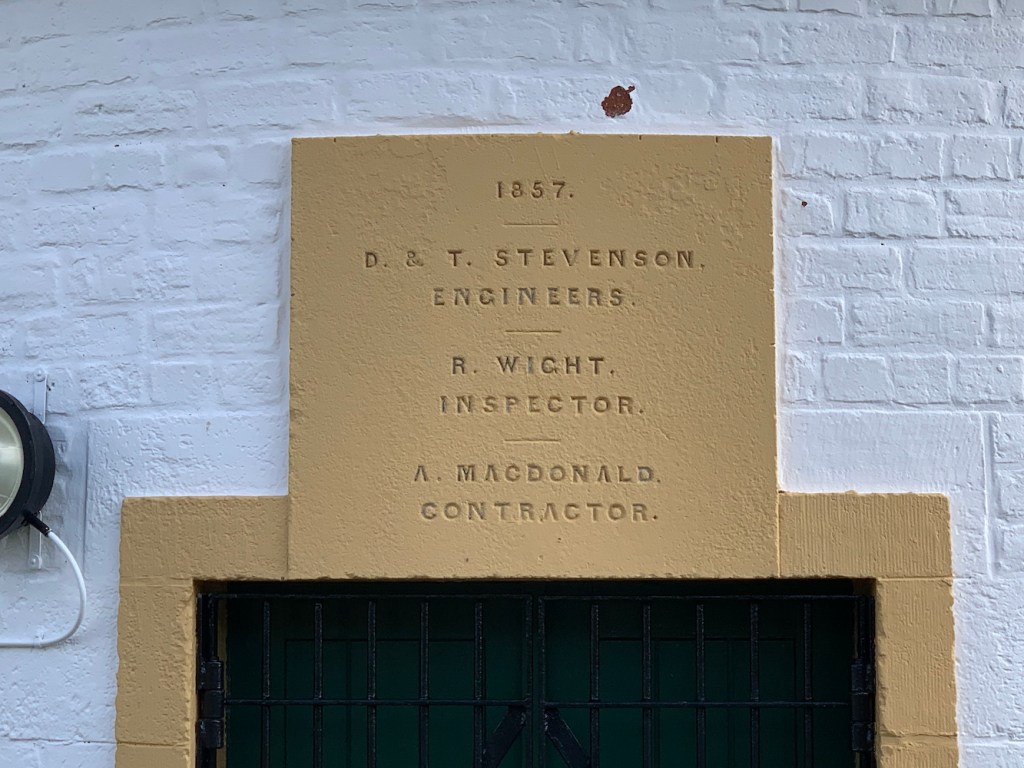
An engraving on the stone under the lighthouse platform
Looking back on the return journey
Once we were satisfied that we had spent enough time there and eaten enough to get us through the return journey we set off. Considering the location of the cows on the southern side of the island on our walk out, Bob suggested we take the more direct route along the north coast on the way back. This turned out quite well with no sign of the cows and we got back to the ‘Gate of Safety’, as we called it, a lot quicker. From here it wasn’t long before we were back on the track near the wind turbines and church again, and then the walk was straightforward.
One of the views on the walk back along the north side of the island
It had been a great walk and we were amazed at how well our six-year-old had coped with it. He was still managing to find enough energy to run up to and jump into the puddles as we neared the caravan! It had also been fantastic to see another new lighthouse and explore Canna and Sanday. There are so many reasons I would recommend Canna as a perfect holiday destination. Firstly, it’s a great place to ‘get away from it all’ as they say. Secondly, it is beautiful – it is the lowest lying of the Small Isles and therefore much easier to get around and explore. Which relates to the third reason to visit, which is that there is so much to see here as demonstrated by the fact that my son says he wants to stay forever and explore all of the tidal islands, hills, and other points of interest. There is a fantastic sea stack over on the east coast which we saw yesterday. Finally, if you are into lighthouses, the walk out to Canna lighthouse is great, if a little challenging in places, and getting to see the lighthouse on Hyskeir flashing is such a treat.
Another one of my favourite views on Canna
We have another two evenings left here, and I intend to make the most of seeing that beautiful Hyskeir flashing out of the window as the dark descends. 🙂
It’s been just over seven years since I visited my first lighthouse in the Western Isles and it’s taken six week-long trips there to have got as close as I possibly could to all 23 of the lights. The map below from my book shows where they all are. I’ve physically touched 20 of them and have been close to three others. Those are Milaid Point, Gasker and, today’s light Calvay.
Lighthouses of the Western Isles
This morning it was time to leave the Western Isles. We’d previously booked the ferry from Lochmaddy on North Uist to Uig on Skye. Once we became aware that we couldn’t get out on a chartered boat though, I suggested we change the booking to go out from Lochboisdale instead so we could at least pass Calvay and it’s little light as we left. With the booking changed, we poised ourselves on the outside deck of the ferry for departure.
The view from the ferry towards Gasay island
While we waited we could see the lights on both Gasay, which we visited on Sunday, and Calvay. By the time we set off the lights had gone out for the day. It was good to pass by Gasay having been there a few days ago and to see some of the rocks we had wandered about on submerged.
Gasay lighthouse
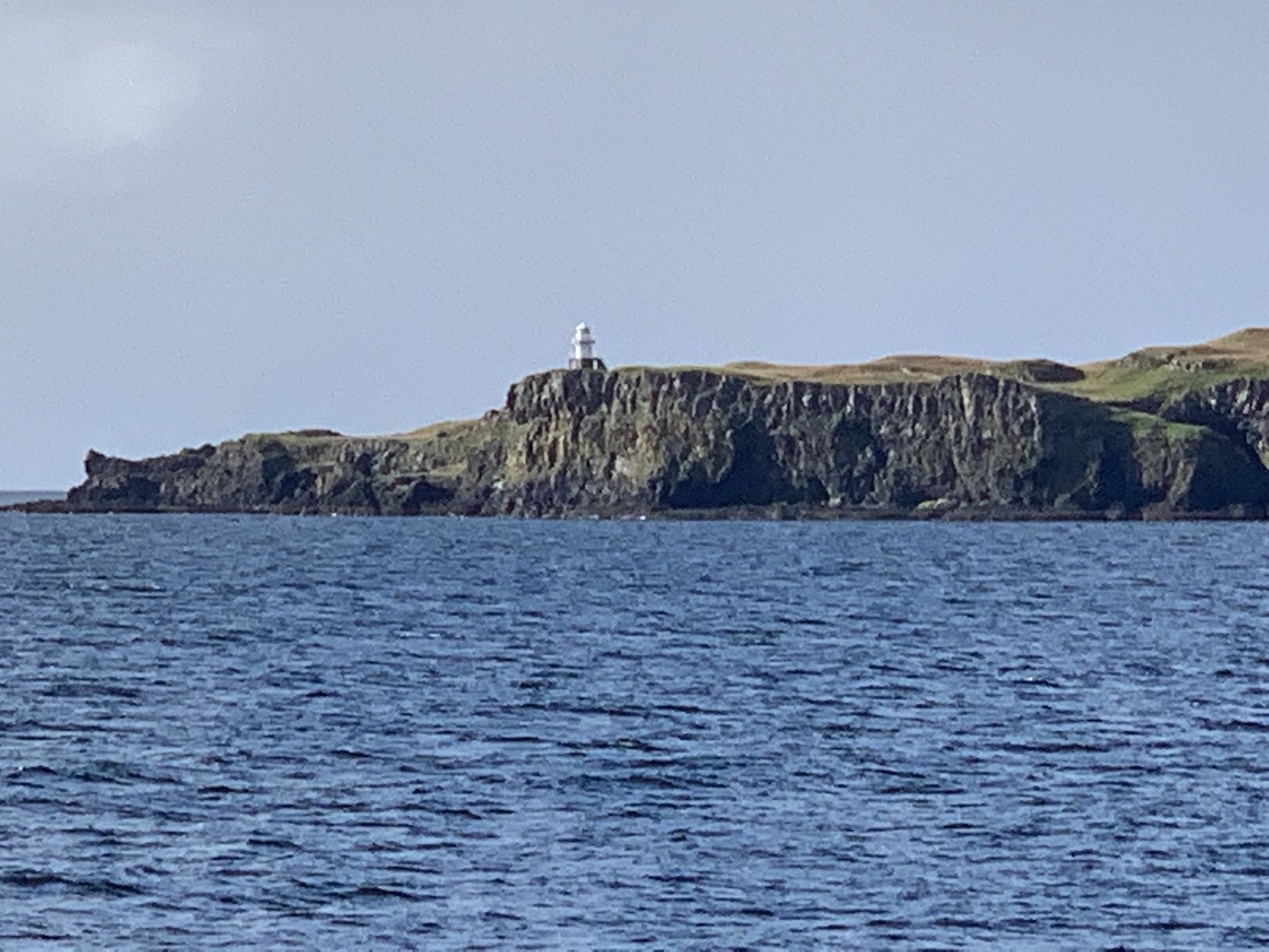
A little further on was Calvay. The light on Calvay is a twin of the one on Gasay and has the important role of guiding vessels safely into and out of Lochboisdale.
Calvay and its lighthouse with South Uist behind
Calvay is a relatively small island, but it has some history. In the 13th century a castle was built on a tidal section of the island and later Bonnie Prince Charlie used the castle, now in ruins, to hide.
A Wikipedia entry for Calvay castle states that the island also has a lighthouse built by David Alan Stevenson in 1891, which is very clearly no longer the case. That does, however, suggest that it was the small white towers, like Sgeir Ghlas which I visited on Saturday, that stood here previously. I notice there is no mention of Gasay lighthouse on the Northern Lighthouse Board’s Stevenson’s engineers list, which suggests that the light on Gasay came later.
Calvay lighthouse
It may have just been a fleeting glance at Calvay’s little light, but hopefully at some point I will get to take a closer look.
So that’s me having visited all of the lighthouses in this area. I’ve had to try harder and been more persistent here than I have in any other region of the UK. I’ve had some fantastic days out with highlights being: visiting the unnerving Sula Sgeir and the beautiful North Rona on my very first visit to the Western Isles; walking up to Barra Head lighthouse and the incredible views from that most southerly point of the Outer Hebrides; two stunning days in a row wearing short sleeves in the sunshine when visiting the Flannans Isles and the Monach Islands followed by Haskeir lighthouse; to this trip where I reached some of the most remote lights.
Me at North Rona, 6 months pregnant, in 2014
I know I have three left I can improve upon and hopefully the opportunity will arise one day. I now feel more confident about landing on Gasker having had my little scrambling episode to get to Rubh Uisenis. I’d like to land at Milaid Point when conditions allow and visit Calvay when boats are back up and running again. Until then I will enjoy my wonderful memories of this stunning part of the country.
At Barra Head lighthouse in 2018
Before I finish this post I wanted to return to the topic of COVID-19 as mentioned in yesterday’s post. The pandemic has undoubtedly had an impact on the trips we have managed this year. While we have enjoyed the trips, they are not the same as they were pre-COVID.
In terms of visiting lighthouses using chartered boats we are now going alone or with one or two friends rather than with 10 or more others as we have done in the past. This, of course, increases the cost significantly.
In addition, we always book self-catering accommodation where we know we’ll not be mixing with others. Our choice in accommodation is also dictated by the cancellation policies as we realise that short notice cancellations may be required to ensure we comply with the government’s regulations. We don’t eat out, instead cooking dinner for ourselves at the accommodation or getting a takeaway. This trip has been the first where we have used public transport (the ferry) and we sat outside for the crossing with face masks on, and fortunately today’s crossing was very quiet so we sat indoors away from others with our face masks on for the entirety of the journey. Some of these things aren’t enjoyable, but the opportunity to visit these lighthouses, get outdoors and have a change of scene more than makes up for it. 🙂
Phew, where do I begin? I’m not sure I’ve ever put as much effort into visiting a single lighthouse as I did over the past few days with Ushenish. With a good view of Calvay lighthouse from the ferry tomorrow when we leave Lochboisdale, it only left this one lighthouse that I had not yet seen in the Western Isles.
The plan for the beginning of this week had been to go out with Uist Sea Tours from Lochboisdale, land on Calvay and then head around to the landing point for Ushenish as well as doing some islands for Bob along the way. All was well, and then COVID-19 arrived on South Uist. David who runs Uist Sea Tours contacted me at the end of last week to say that he may need to go into self-isolation and was then in regular contact over the weekend with updates and then final confirmation that he would not be able to take us out. I should say that David has been incredibly quick to respond to my messages in organising the trip and I hope one day we do manage to get out on his boat. A really professional company who are up for these mad lighthouse and island-related days out.
Then the fun of finding an alternative boatman began. During the course of Sunday I contacted five alternative boat companies, two based on the Uist, one on Barra and two others on Skye. We had also floated the idea with Seumas at Sea Harris on Saturday and he ended up offering us a really reasonable price to come all the way down from Scalpay just to take us to the landing for Ushenish and then drop us back off again. I really cannot recommend Sea Harris enough! Some companies weren’t available or weren’t running due to the pandemic, one got back to me with a quote and a couple didn’t respond. Needless to say it was a lot of effort.
Bob made the suggestion that we could walk out to the lighthouse. Initially I was hesitant, thinking that it was a ridiculously long walk, but we looked at the map and I suddenly realised that this was the only way I could guarantee I would get there (boats are obviously weather dependent, although it was looking ok for today). I happily agreed to this plan and we chose today rather than yesterday as the weather was forecast to be considerably better.
This morning we set off, parking at the starting point we’d found on a short recce the other day. The route was initially following a good path and across a couple of nice (although broken in places) bridges. There had been heavy rain early this morning, which meant the paths were fairly muddy in places.
The route finder leads the way
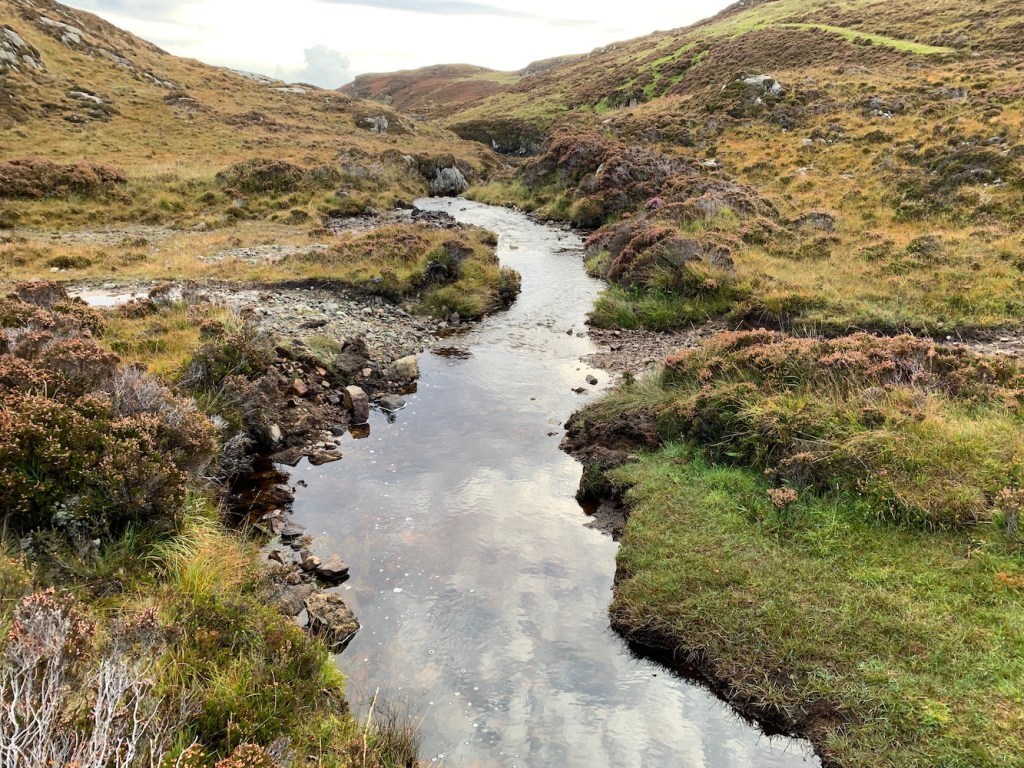
One of two little bridges that made crossing streams easy
Some very picturesque views early in the walk
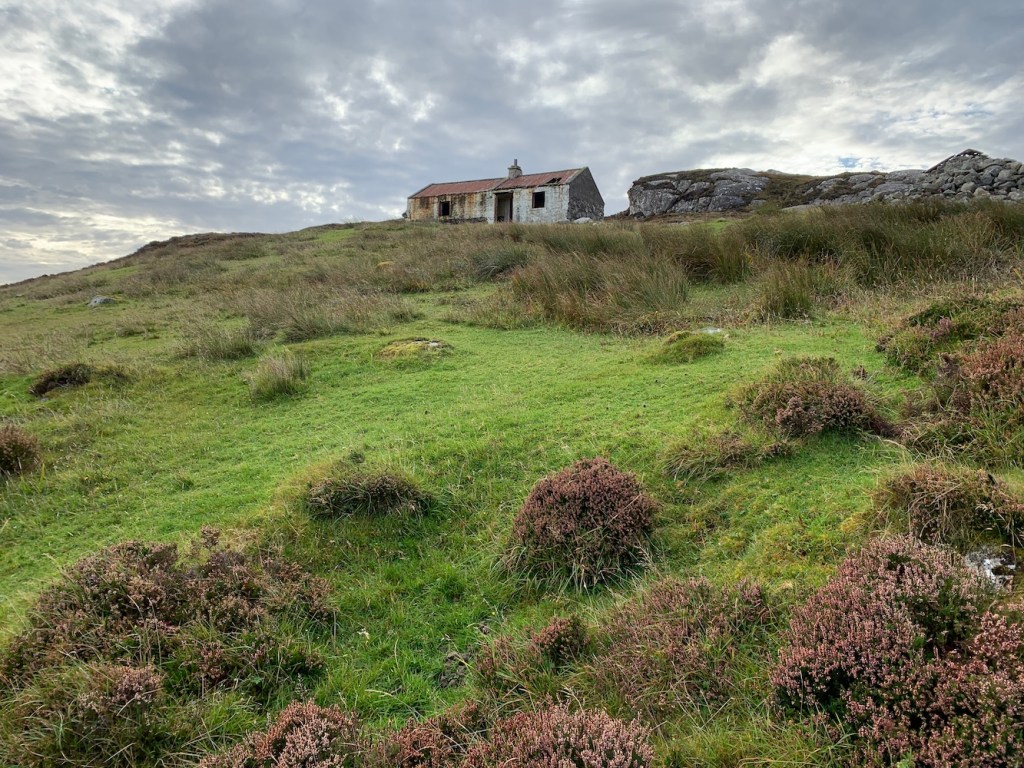
We encountered a number of ruined buildings along the way
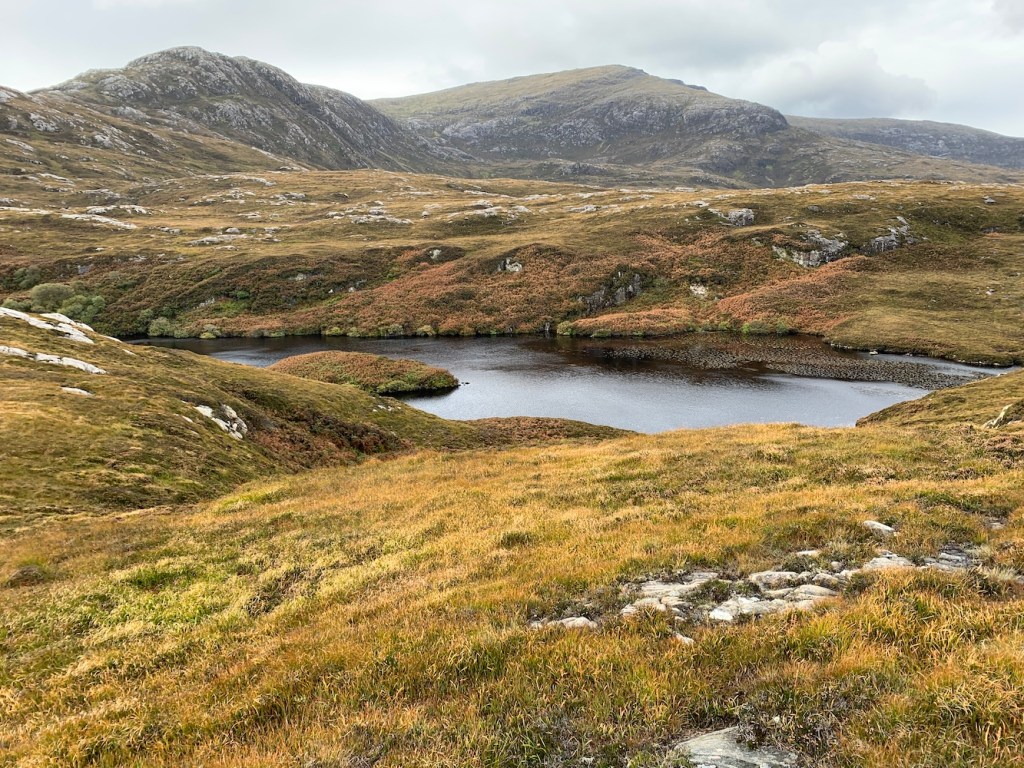
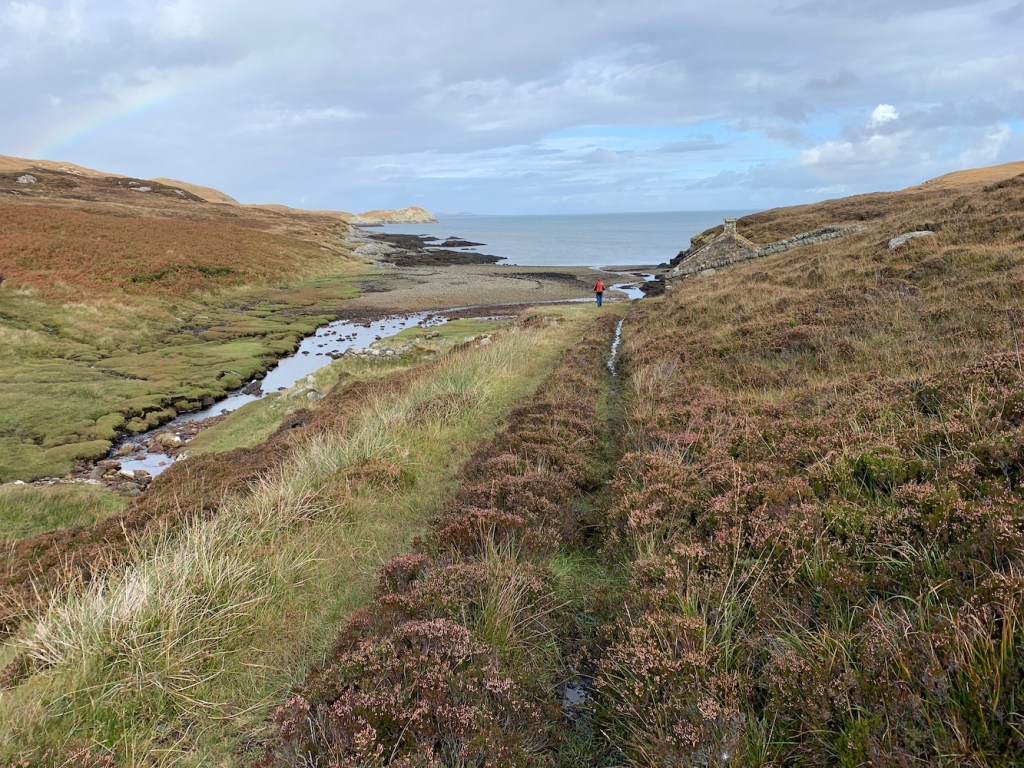
The path follows alongside Loch Sgioport (or Skipport)
After around 1.5kms the path marked on the map ended, but for an extra half a kilometre an extended track continued. Between dodging mud and boggy sections I managed to stop and enjoy the views.
The extended path then came to an end and it was down to Bob to guide us through. One of the biggest challenges during the walk was crossing rivers. Some, such as the one pictured below, involved a bit of a leap of faith. Others weren’t so wide, but presented other challenges such as slippery rocks at crossing points which led to me getting very wet at one point!
Approaching the beautiful Loch Bein
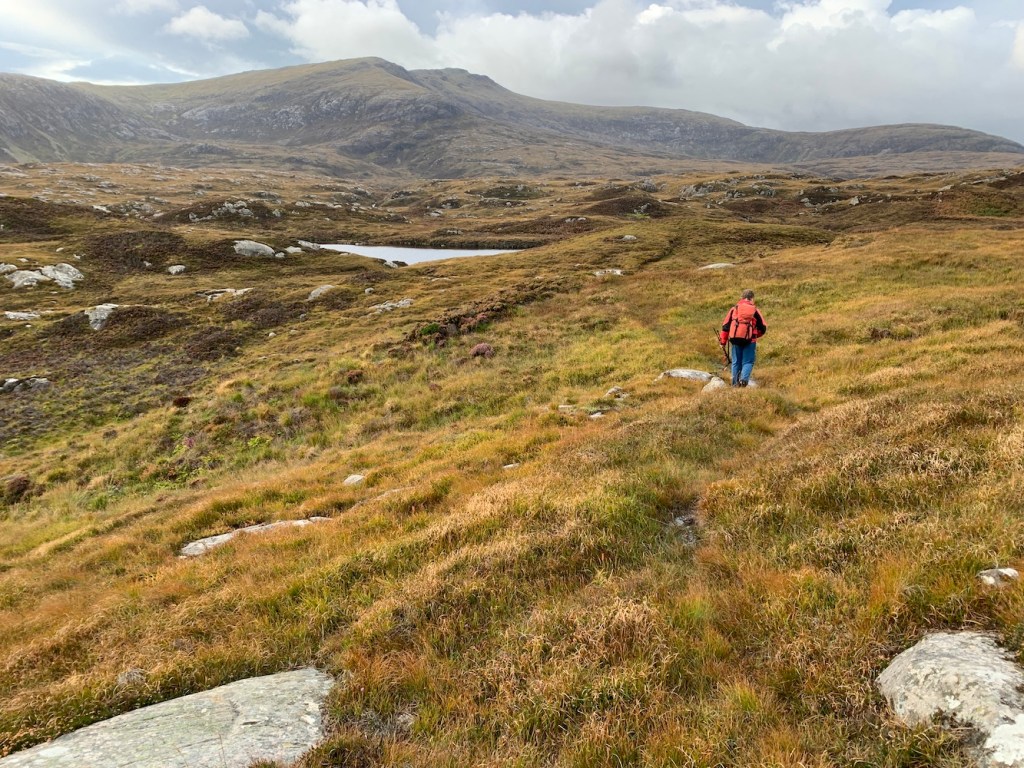
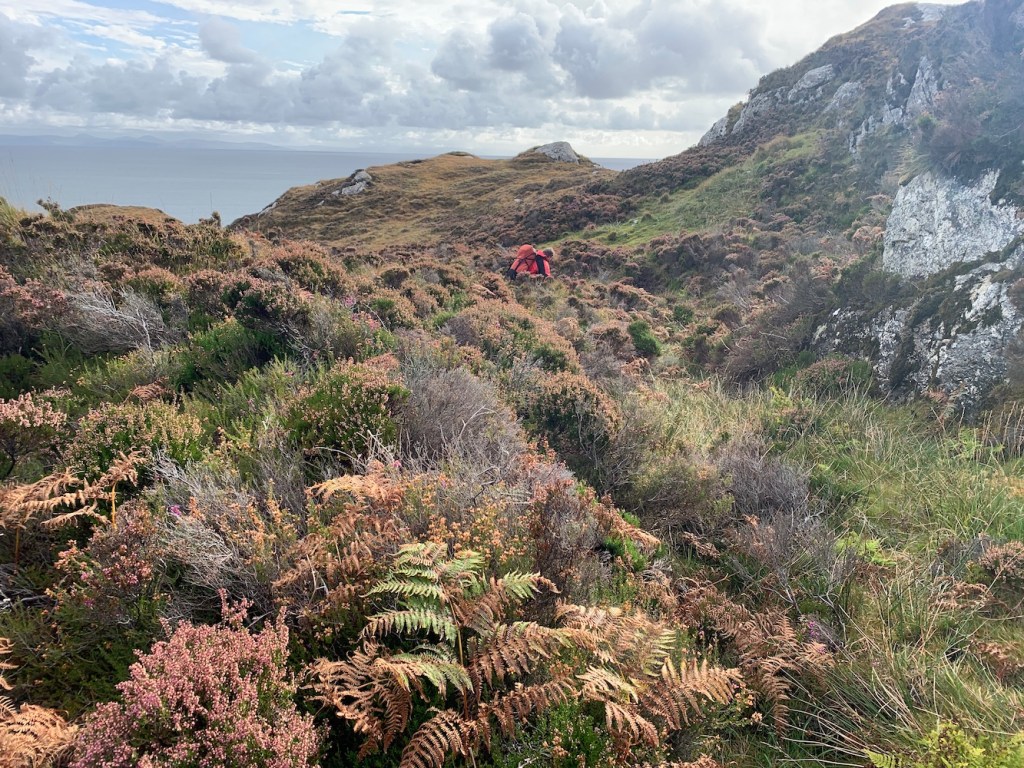
The terrain varied from muddy, boggy, rough to overgrown. There were plenty of up and downhills too, which kept me on my toes. Bob had chosen a higher route across the section between the end of the extended path and the lighthouse landing area to help avoid the longer undergrowth and even wetter ground further down. The section with no path was by far the trickiest and when we could we followed the deer tracks. Otherwise Bob navigated us professionally through whatever terrain we came upon.
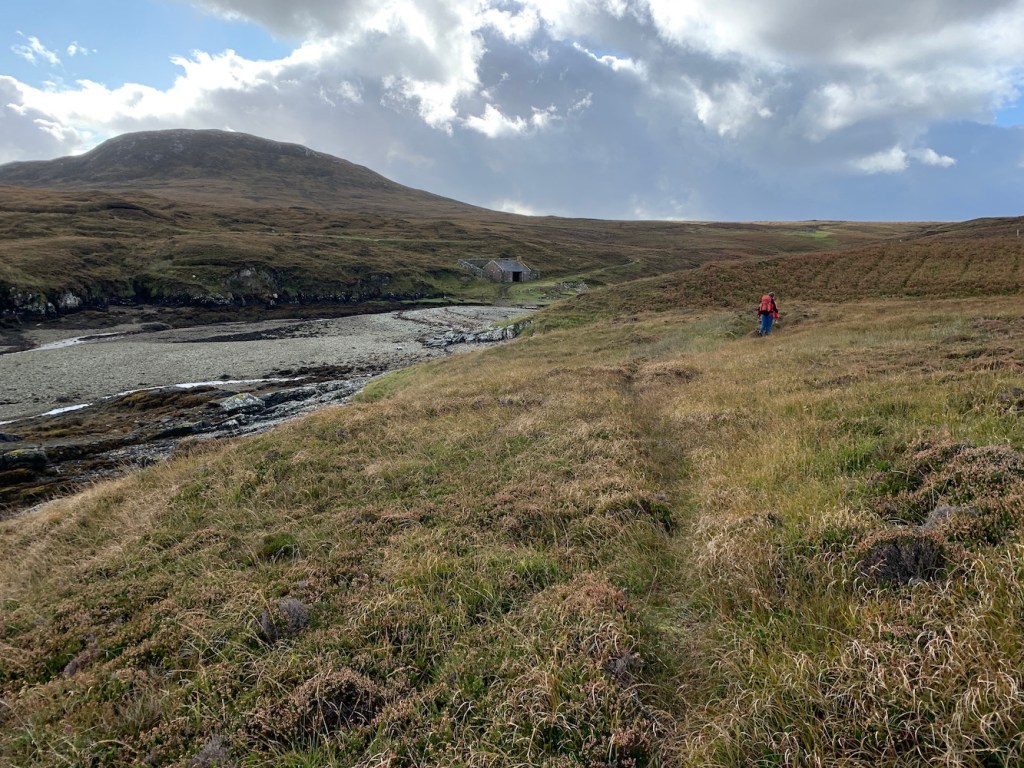
After what felt like a long time, the old lighthouse store at the boat landing area came into view and we followed a deer track along the coast.
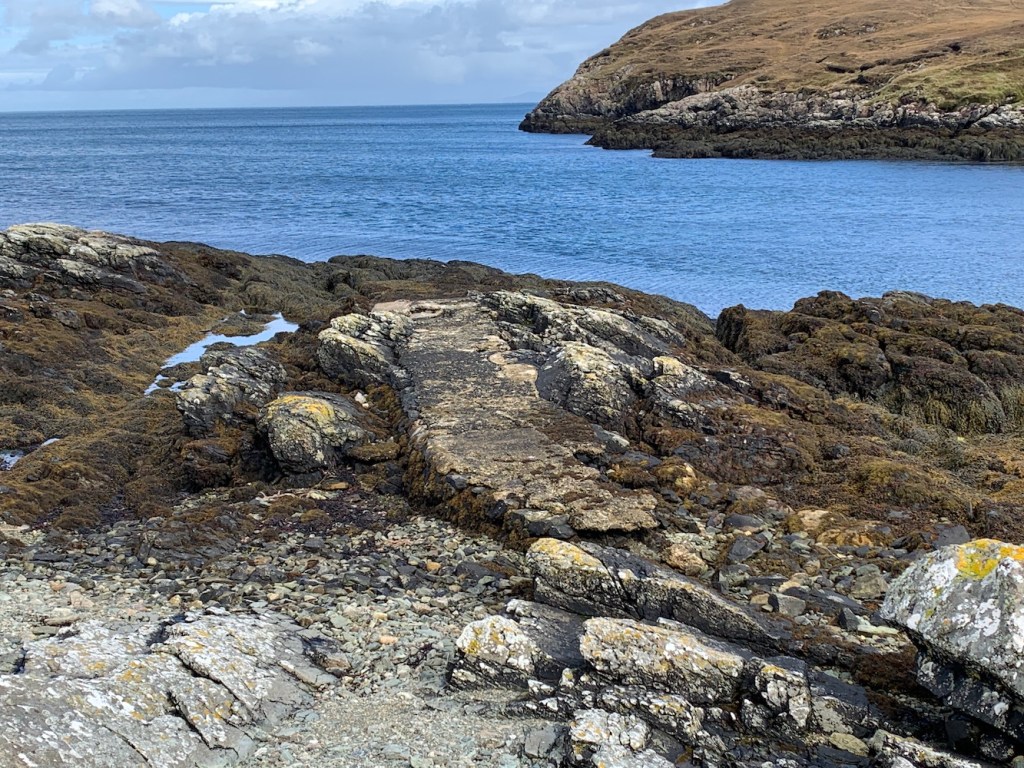
The old concrete landing is now in a poor state.
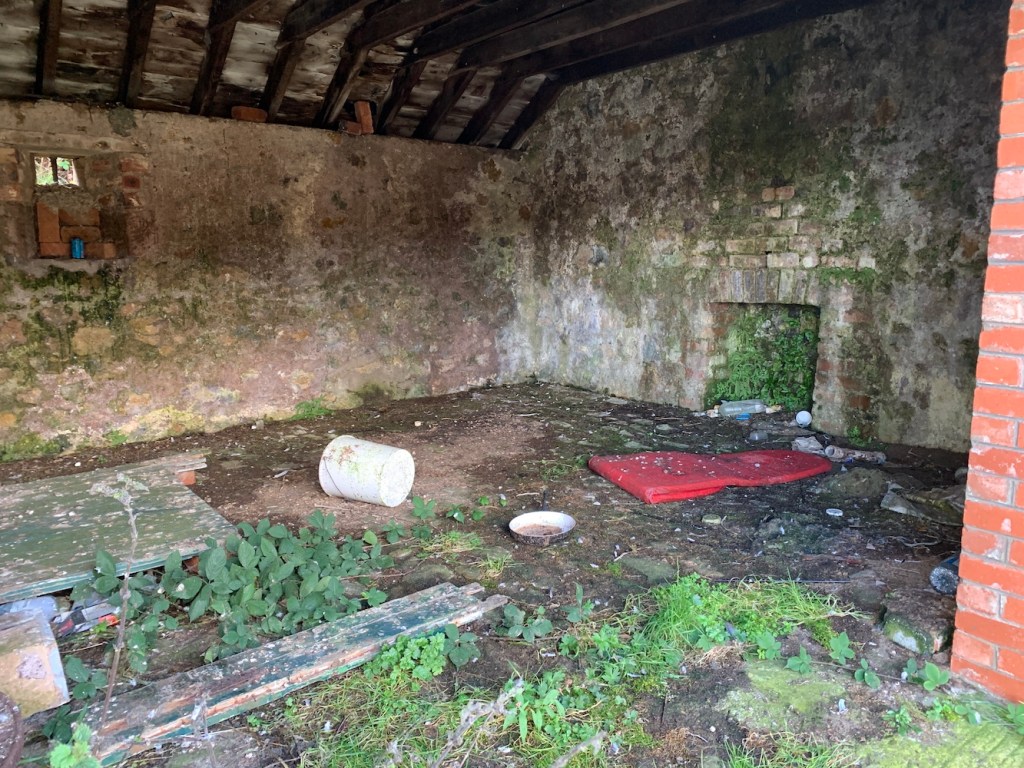
The old lighthouse store at the start of the track to the lighthouse
The view looking back from the track to the lighthouse
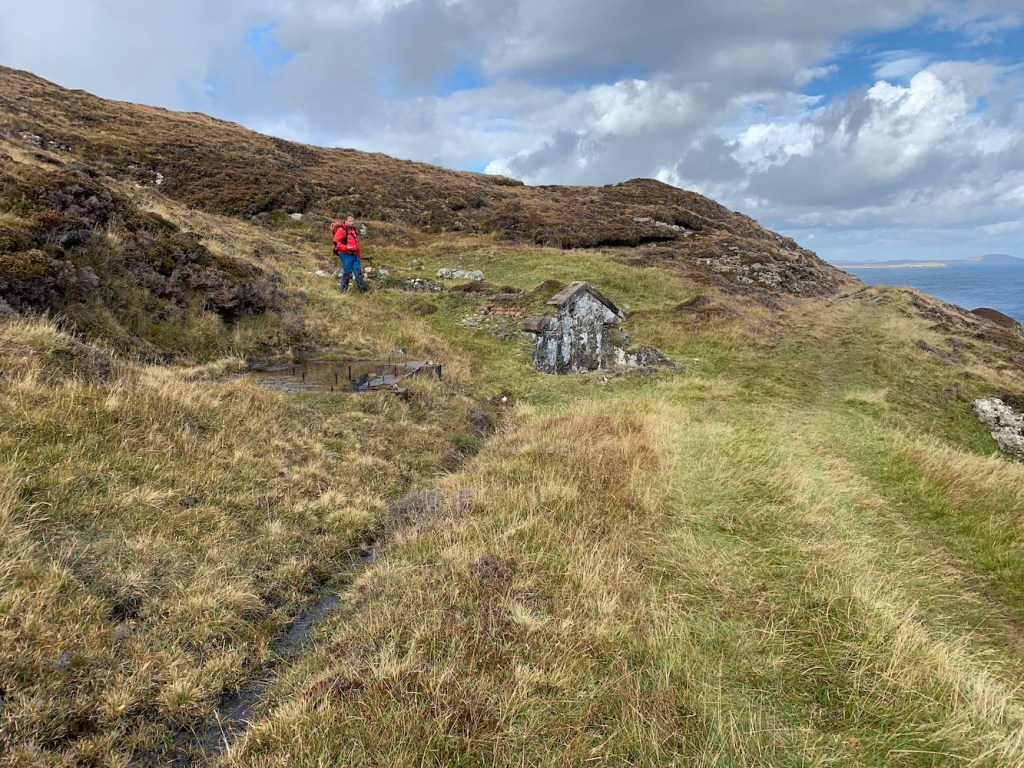
We spotted the partially covered water storage hut alongside the track
I knew it couldn’t be long before we reached the lighthouse and Bob stopped ahead of me, which is always a good sign that we are on the approach.
The approach to the lighthouse
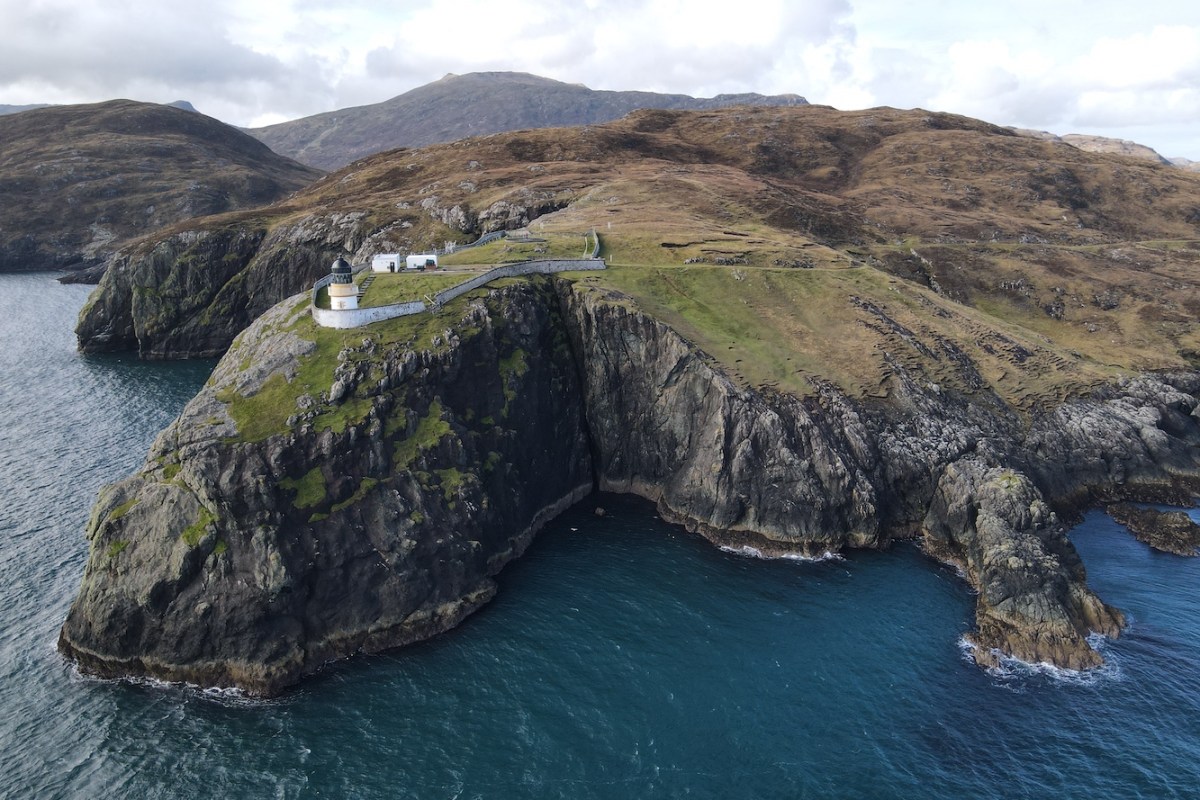
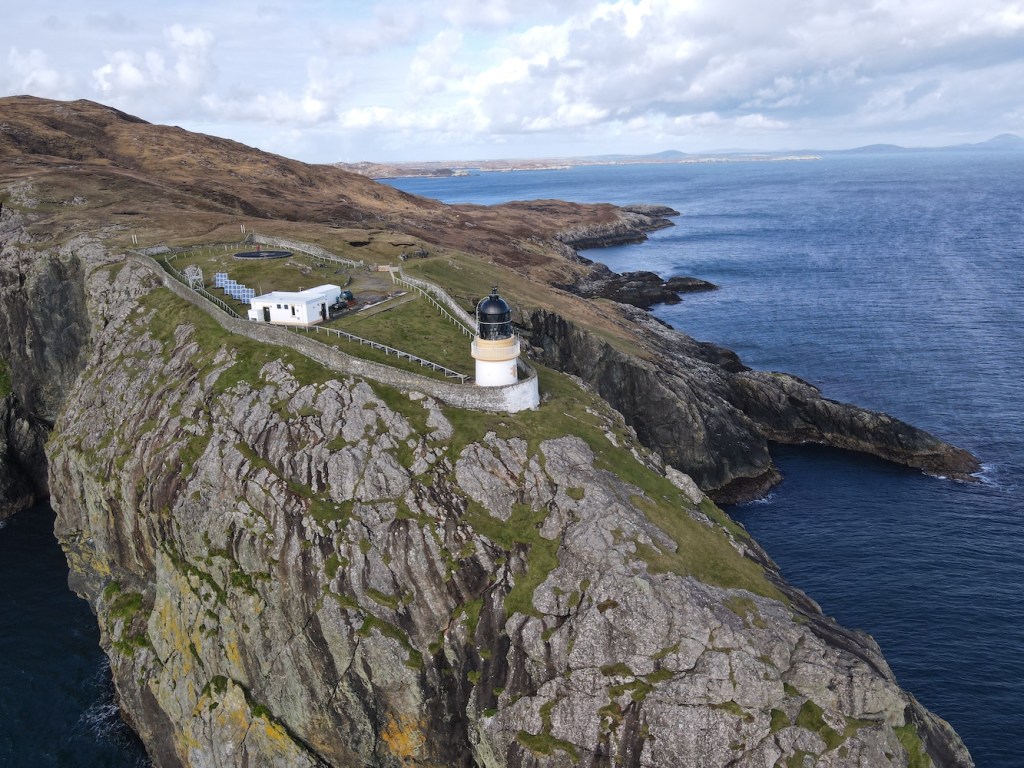
Ushenish lighthouse is a small tower, not needing to be high due to its position on a tall cliff. There are a couple of buildings within the complex, but originally there would have been the keepers’ houses here where they lived with their families – what a life that would have been! The houses have now been demolished, but you can still see their foundations.
The information panel is looking a little weather beaten, but is full of information
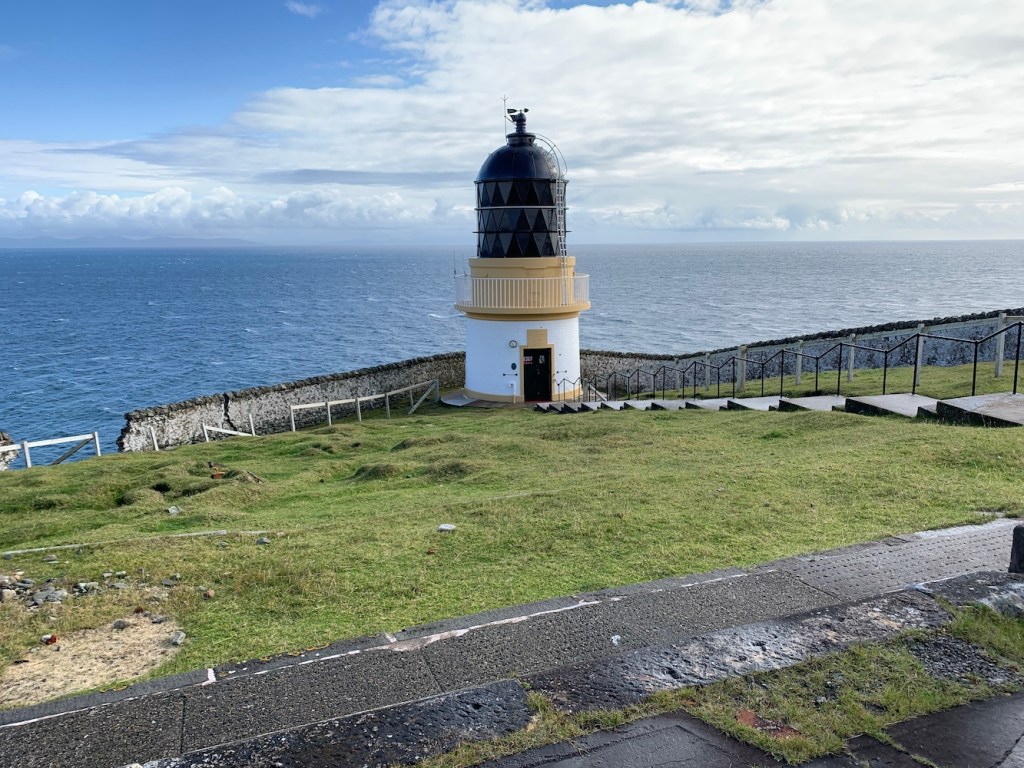
Ushenish lighthouse
It was a real shame to see the wall around the lighthouse falling away in places. As with Tiumpan Head the other day, it reminds you of the hard work that would have gone into building it all those years ago, over 160 years in fact. It is sad to see, but I suppose the wall is no longer so important.
It was fairly windy at the lighthouse with some strong gusts, but Bob decided to try putting Joe the Drone up to see if he could manage to capture some images. Joe only went up for a short time due to the wind, but still managed some fantastic shots.
There was an interesting structure in the complex. I recalled seeing something very similar elsewhere, it may have been Auskerry in Orkney. I have since heard that the platform was used to house four small wind generators that the Northern Lighthouse Board were trailing to supplement the solar charging (many thanks to the reader who provided the answer to that).
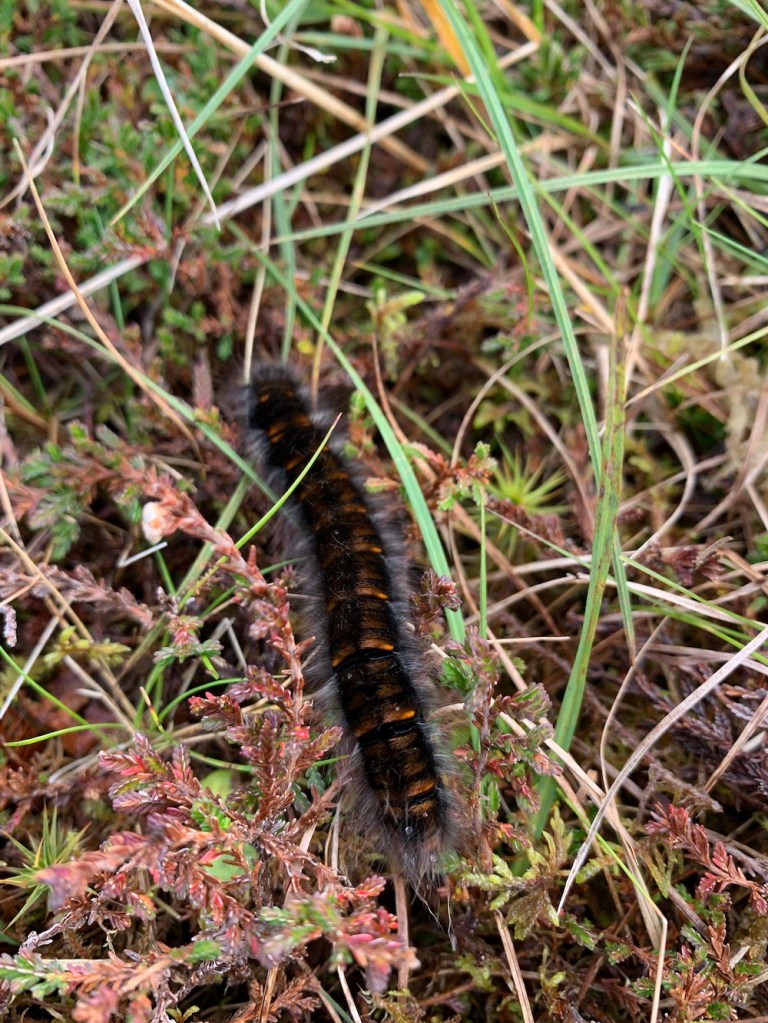
After having lunch at the lighthouse it was time to begin the long journey back. This was where we suddenly began to spot nature aplenty. Within the lighthouse complex there were a number of hairy caterpillars and it always amazes me how these small creatures that seem so delicate can survive in such harsh areas. I recalled visiting Eshaness lighthouse in Shetland last year and being fascinated by how many butterflies were there. They always look so small and easily damaged and yet seeing them in these locations proves that they are much more hardy than we give them credit for. All the way back to the car there were caterpillars littering the ground and I made a point of being careful to avoid stepping on them.
Further along the track we had a call from our little daughter who wanted to speak to us. As we were chatting Bob said “Is that an eagle?” and we watched as a sea eagle flew around close by and then landed near the edge of the cliff. We waited patiently to watch it fly off again, but it seemed quite happily settled on the ground. What a treat!
We reached the landing area again and braced ourselves for the off piste section again.
The walk back was tiring and we just kept walking. I felt that if I stopped I wouldn’t want to get going again so I put my head down, concentrated on one step at a time and waited patiently until we got to the easier section again.
A wonderful view looking down on Lochs Bein and Sgioport
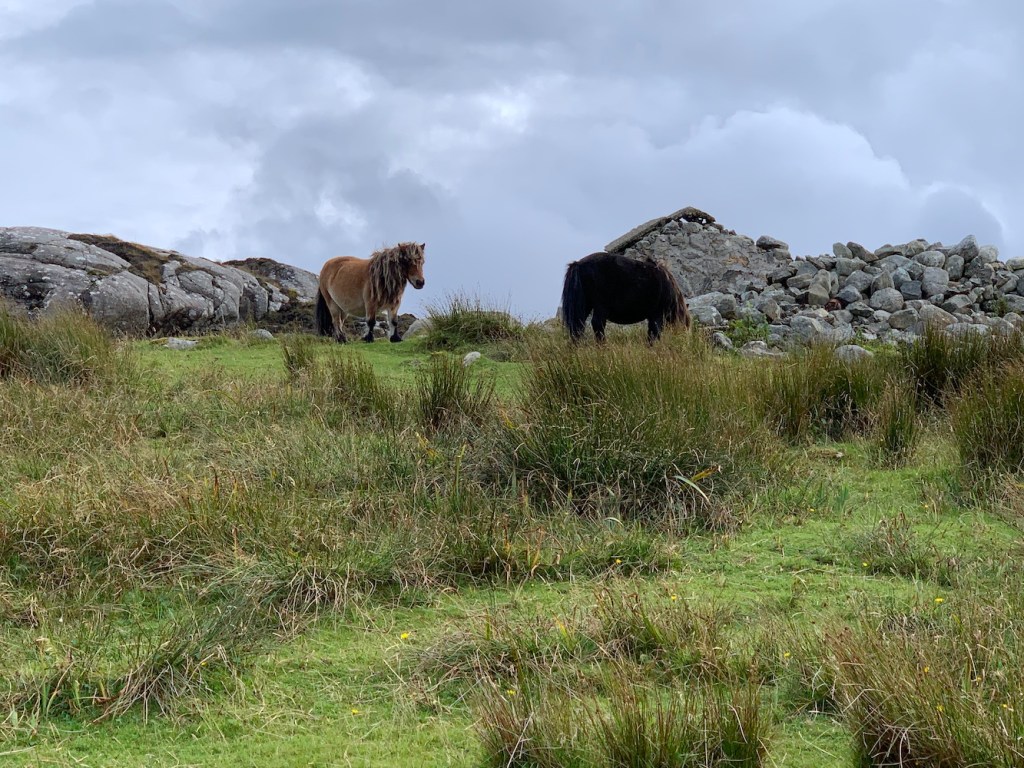
Some Eriskay ponies welcomed us back to the path
I was glad to be back on the path, but even happier to get back to the road. It had been a long walk, about 10 miles in total with the weaving around we did to make the going a little easier. Walking to Ushenish lighthouse is the furthest and most challenging walk I’ve ever done to a lighthouse and I am pleased that it involved more effort than many others. A reviewer of my book described my ‘tenacity’ and I’d not realised until reading that how determined I am to reach these places. I certainly am determined, even if it nearly breaks me. I certainly won’t be forgetting the walk to Ushenish in a hurry. A great day! 🙂
This morning we waved goodbye to Lewis and Harris after a great few days there, and hello to the Uists. This is my first time visiting this part of the Western Isles, excluding the brief visit to Weavers Point yesterday. A new place to explore!
During the research process for my book I had looked into access to the lights on the small islands of Gasay and Calvay on the approach to Lochboisdale. Calvay was obvious, it would require a chartered boat or you could get a good view from the ferries into and out of Lochboisdale. Gasay was a bit more involved and this morning we decided to investigate for ourselves.
Lochboisdale harbour with Gasay and Calvay lights in the distance
I was aware that Lochboisdale has fairly recently undergone a harbour development programme and my research suggested that the island of Gasay had become linked to South Uist as a result. Arriving in Lochboisdale we found this is exactly what had happened with the harbour development works completed in 2015.
Driving slowly around the harbour area we spotted a slope that looked like it would lead where we wanted to go. We parked up and set off. I was very pleasantly surprised to find a well trodden track leading up from the harbour. This track led up to a recently constructed cairn from which you had great views and could see the light from.
The cairn that marks where the path leads
Fortunately the track continued further until we reached a large gravelled area which gave some views looking back across the harbour.
Looking back at the harbour
This was where we had to go off piste and stomp our way through the heather. The island is peat moorland and there was evidence of peat being dug here in the past. This meant there were some banks to get up and down, but aside from that the walk wasn’t too bad – we’d both expected the ground to be a lot worse.
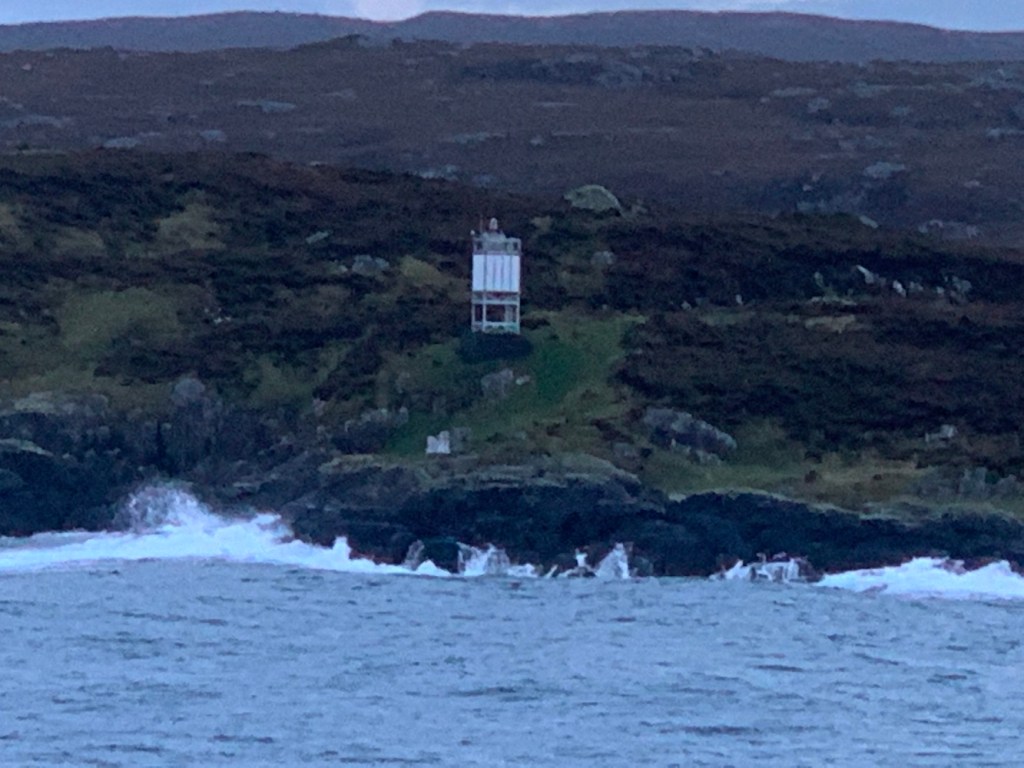
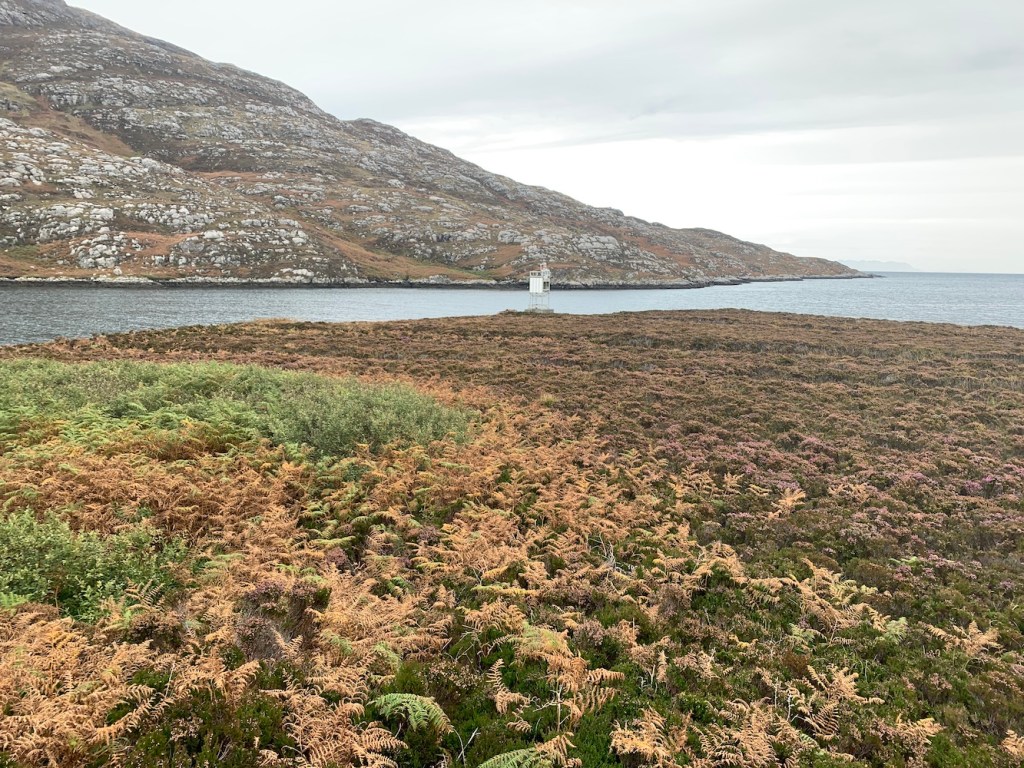
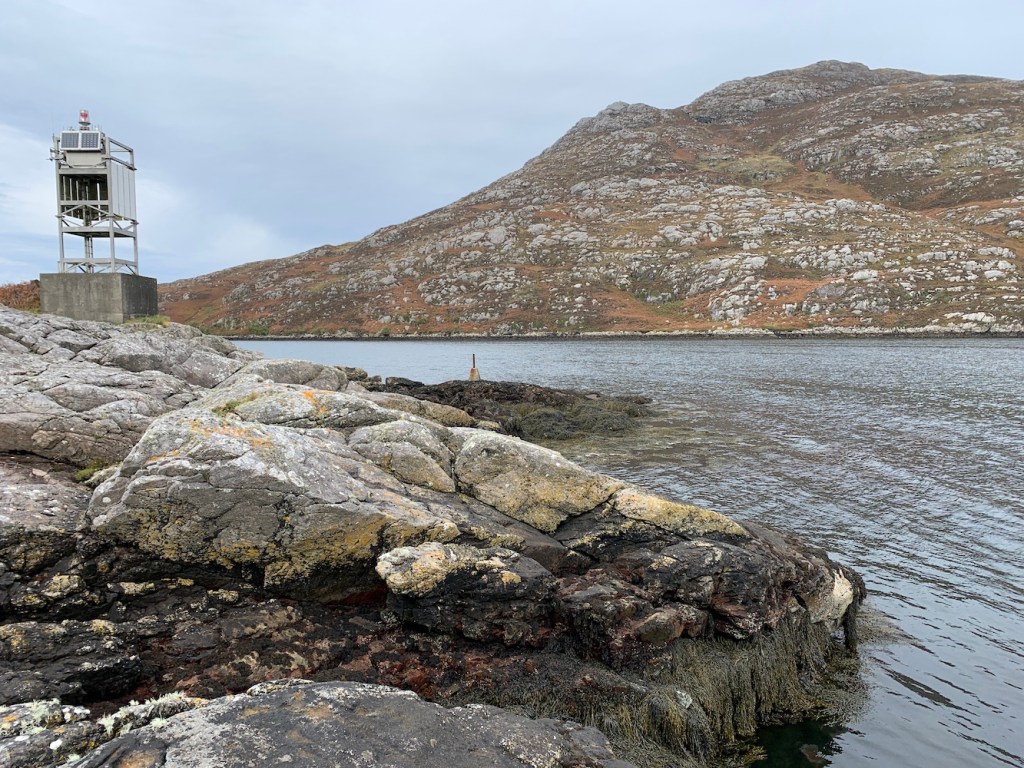
The light on Gasay and the heather we crossed to reach it
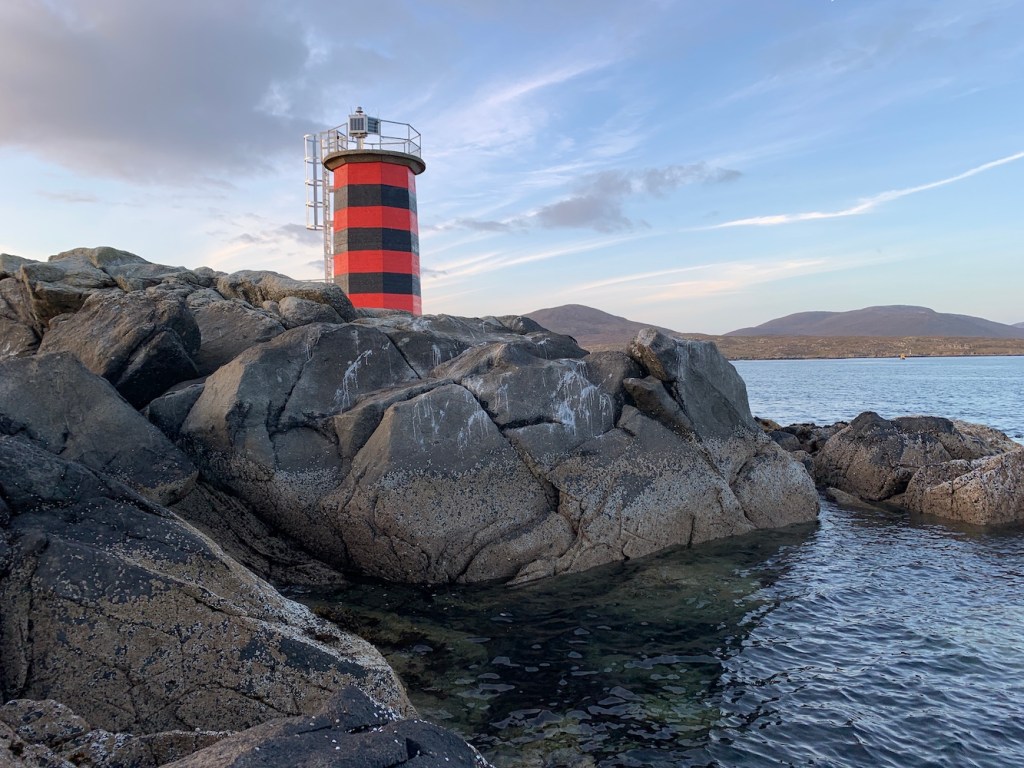
I was intrigued to see what the light looked like close up as it is so infrequently photographed. As you can see from the pictures it is one of the Northern Lighthouse Board‘s metal framework towers clad with white panels, except this light has the panels on the top level only and on one side there are no panels. It’s interesting to see another configuration of the white panels as they do differ on some of the flat-pack lighthouses.
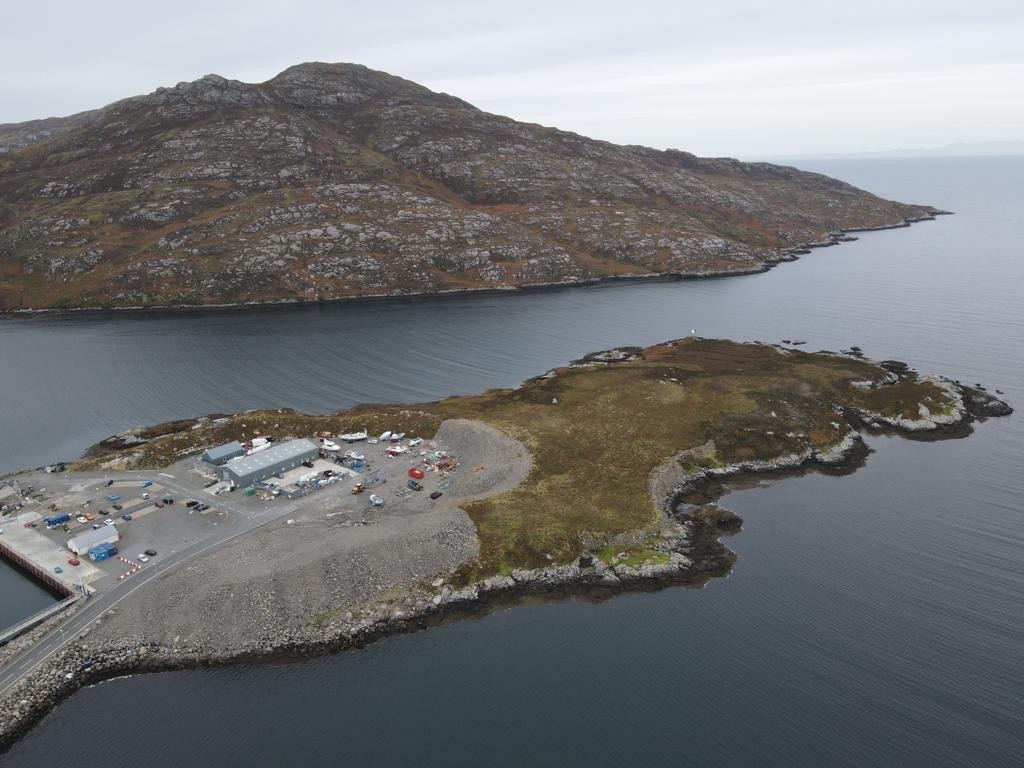
As usual Joe the Drone had accompanied us and got some great images of the lighthouse, the island and the harbour too. These aerial images give a clearer view of Gasay as an island and the causeway that now connects it to Lochboisdale.
The aerial view showing the island more clearly
The Lochboisdale Harbour website suggests that a Phase 2 for the harbour development is being considered which could see the ferry terminal moved to the south side of Gasay. Whether this will impact on the position of the light on Gasay or not remains to be seen. Time will tell.
It may not be a big lighthouse, but Gasay was well worth a visit and also provided distant views of the Calvay light to the east. Hoping to get a bit of a closer look at that one later in the week. 🙂
With the wind shifting around to the north and the wind speed increasing it was touch and go as to whether or not we would make it out on the boat trip we had planned yesterday. Bob spoke to Seumas from Sea Harris the previous night and I was delighted when he confirmed that we would go ahead with the trip.
It was the first time I’ve been out on the water around the Western Isles visiting lighthouses for a couple of years and I must admit I had missed it’s wild ways and unpredictable nature, and also the boatmen who know it so well (well mainly Seumas as he has got me to near enough all of the offshore lights in the Western Isles).
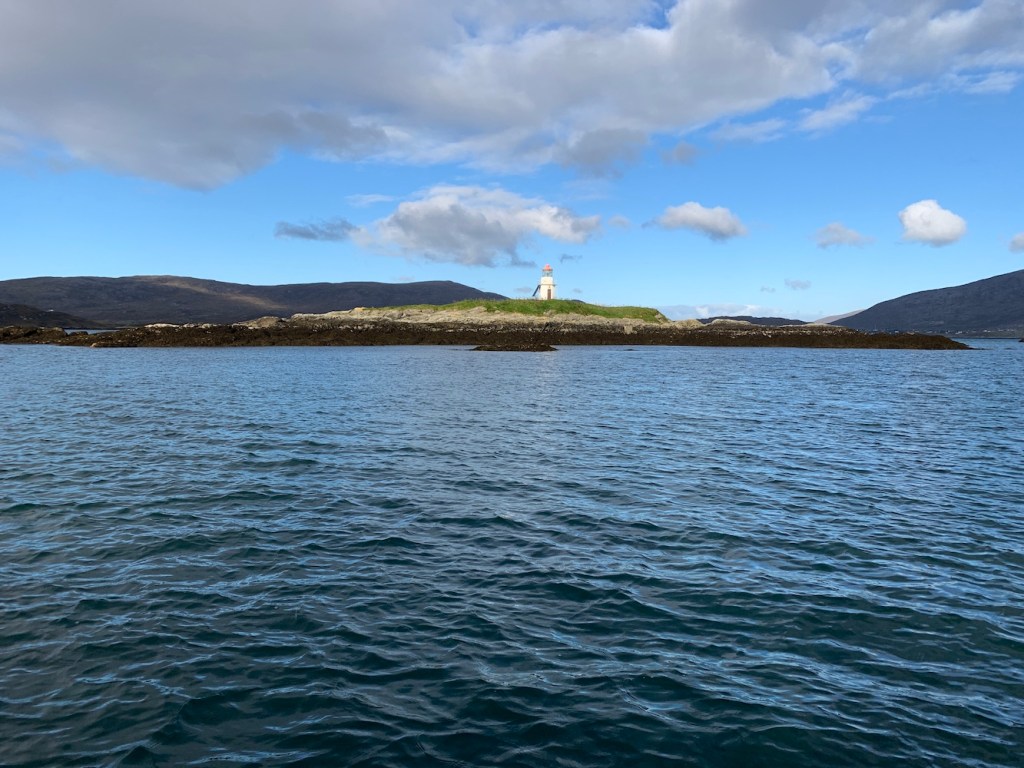
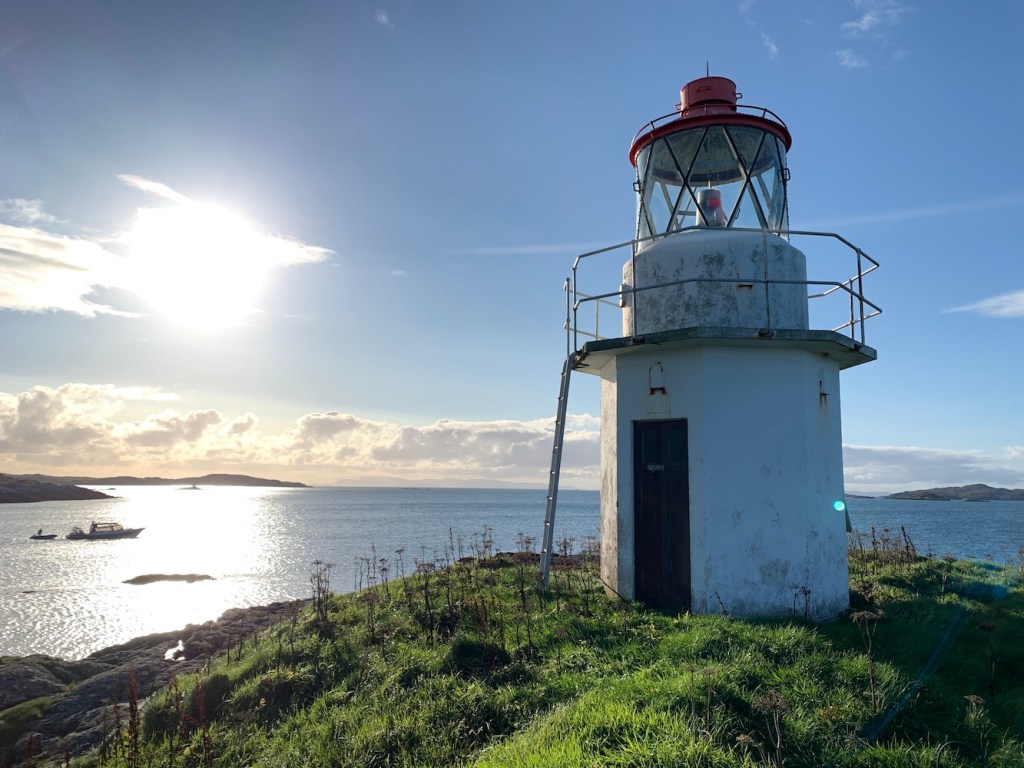
Off we set from Scalpay and our first stop was one I was very excited about. Sgeir Ghlas is a bit different with the red top – and it’s one of those older towers introduced by the Northern Lighthouse Board around the turn of the 19th/20th centuries.
Sgeir Ghlas lighthouse
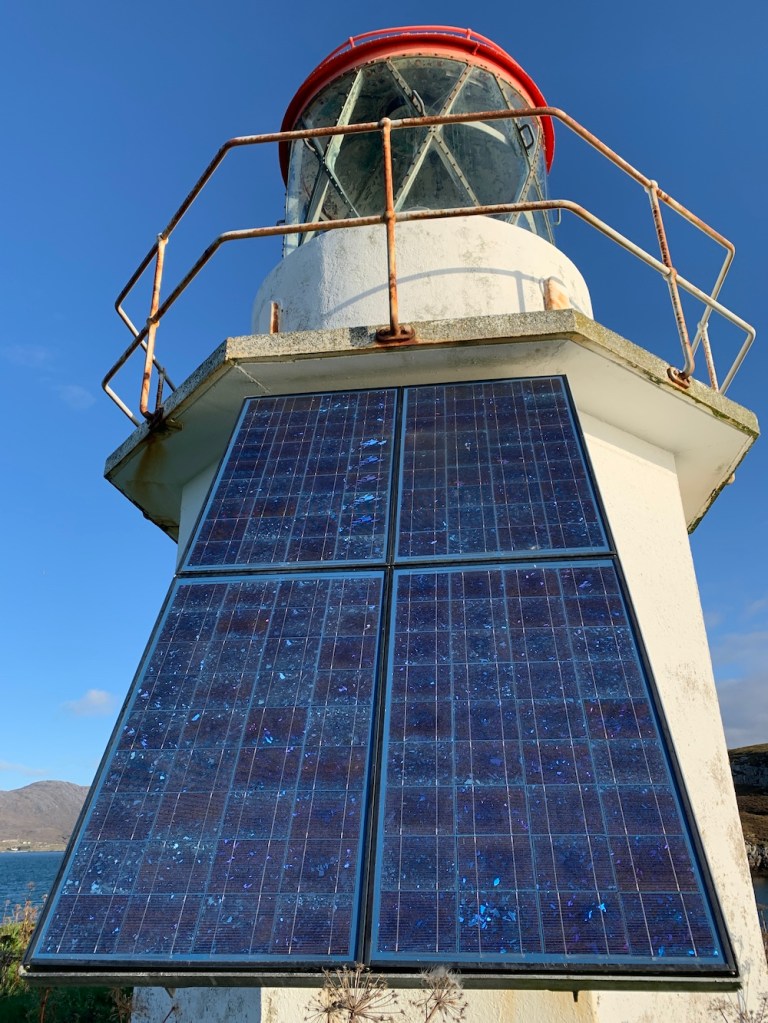
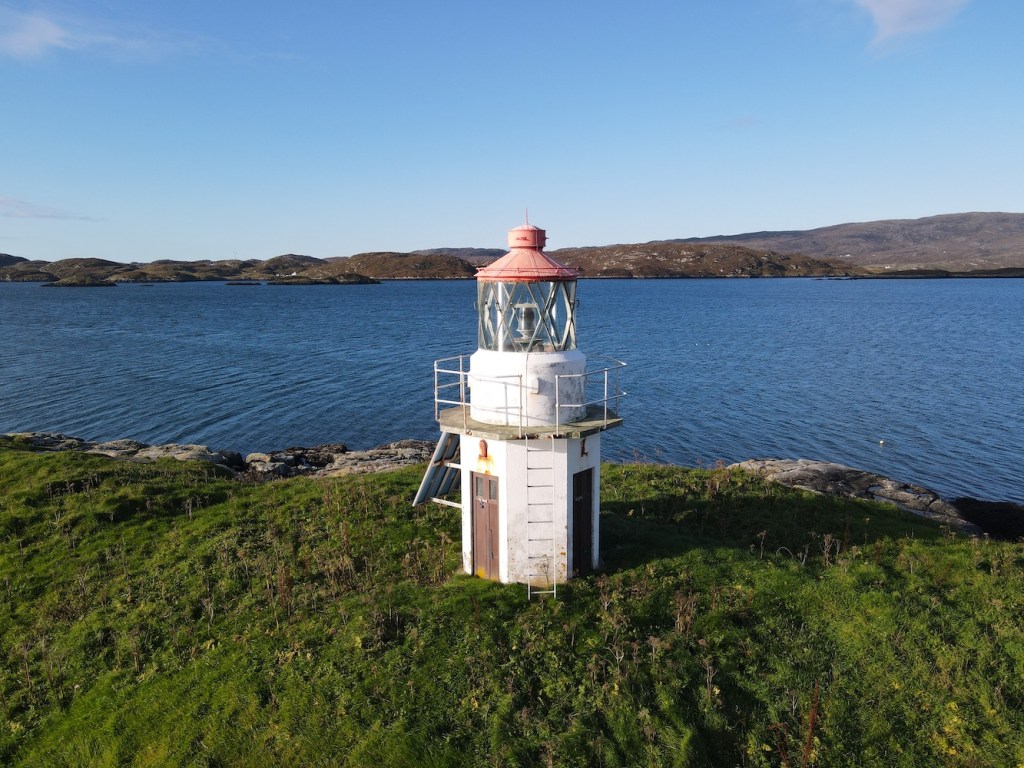
Landing on the island was fine as the sea was calm and the seaweed covering the rocks wasn’t too slippy. Being a very small and relatively flat piece of land it was only a short stroll to the lighthouse. It’s looking a little weather beaten, but apparently much better than when our skipper was last there. That time it didn’t have a door and there were birds nesting inside. It’s good to see that it now has both doors intact and reminds me of Rubh’an Eun on Bute which has also had a bit of improvement work done to it in recent years.
Bob flew Joe the Drone for a while and, as usual, got some great shots.
Sgeir Ghlas from above
Sgeir Ghlas with Sea Harris’s RIB Pabbay
Leaving the island behind we headed out into The Minch and then northwards along the east coast. The change in sea conditions became very obvious as soon as we were out of the shelter of Harris. Up the coast we passed Rubh Uisenis lighthouse which I had previously only seen from a great distance on the way to Eilean Glas lighthouse. We decided to first tackle Milaid Point lighthouse, which we all knew would be the trickiest of the day and come back to Rubh Uisenis.
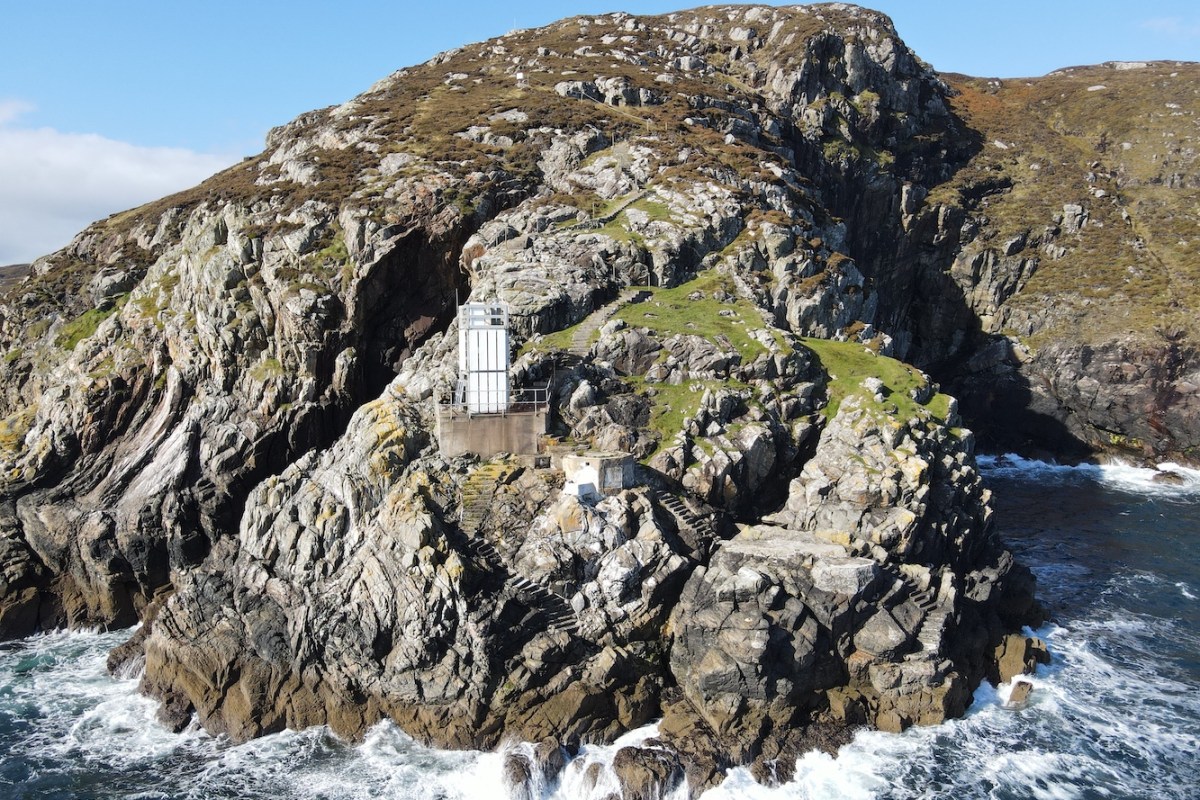
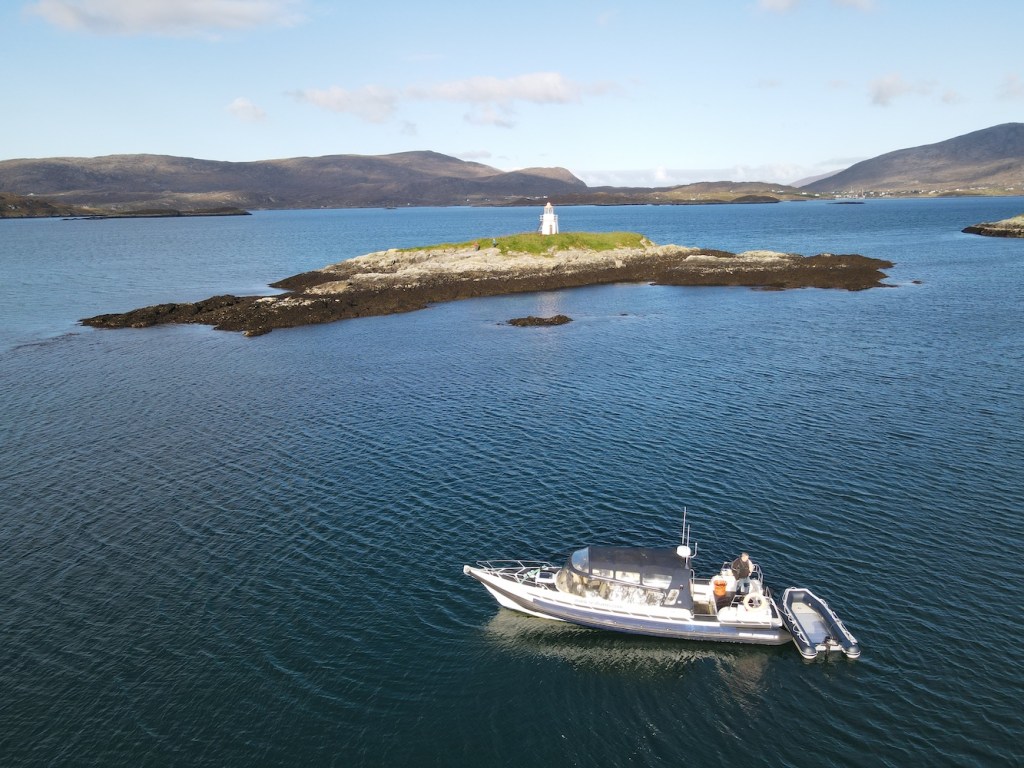
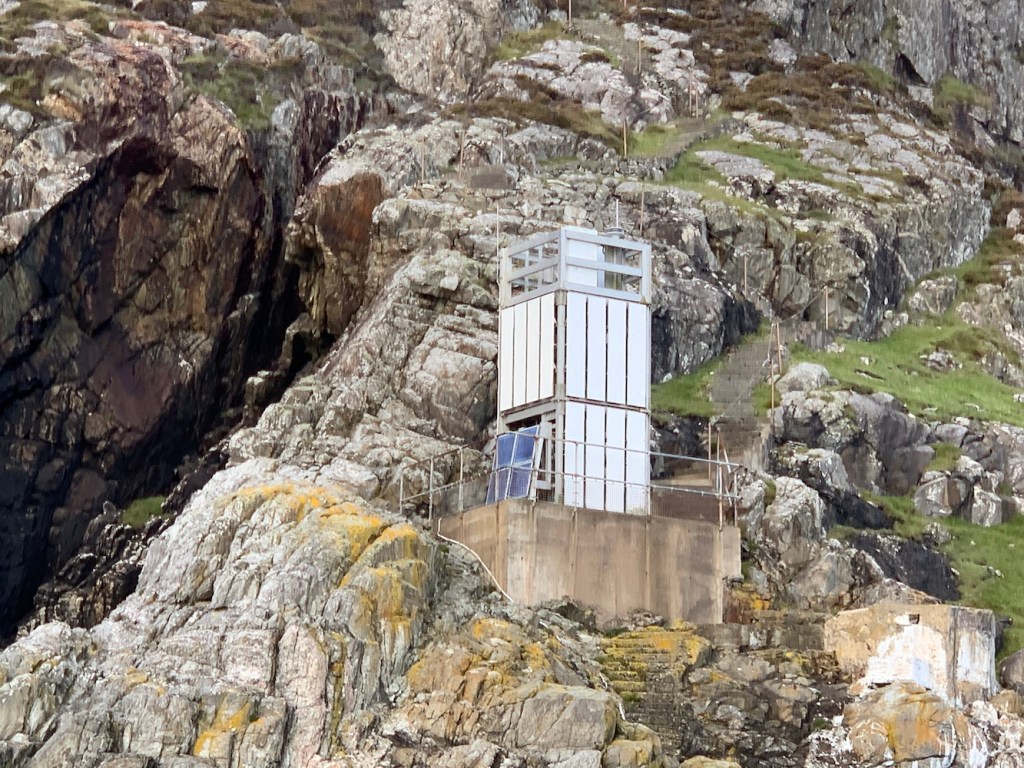
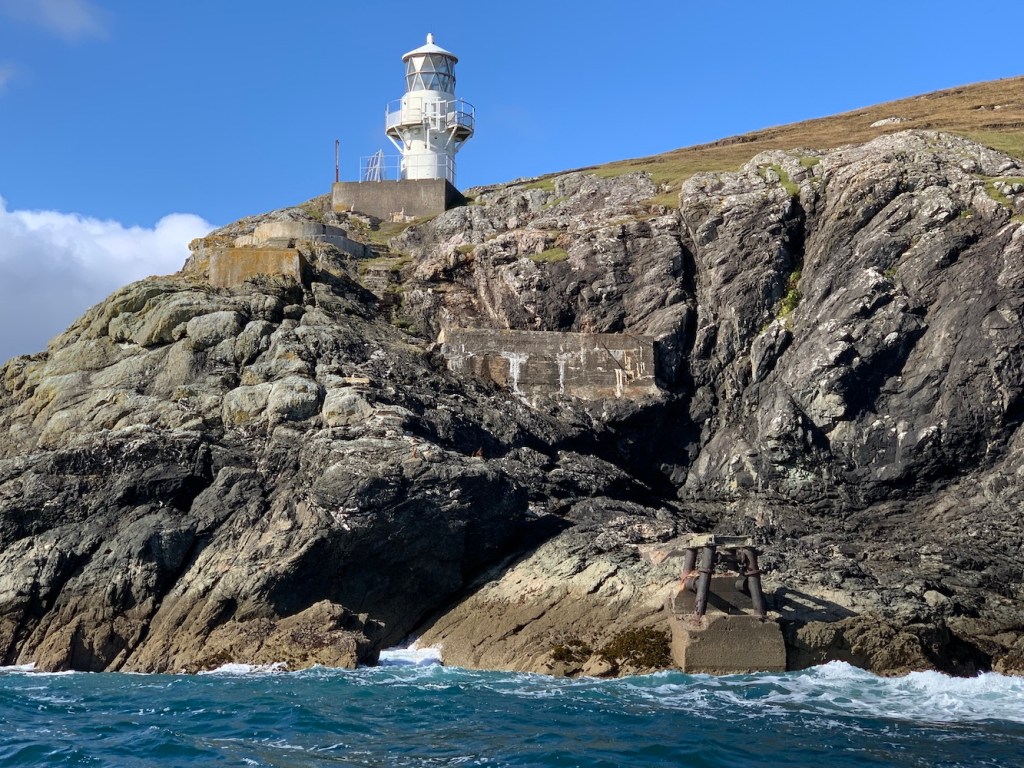
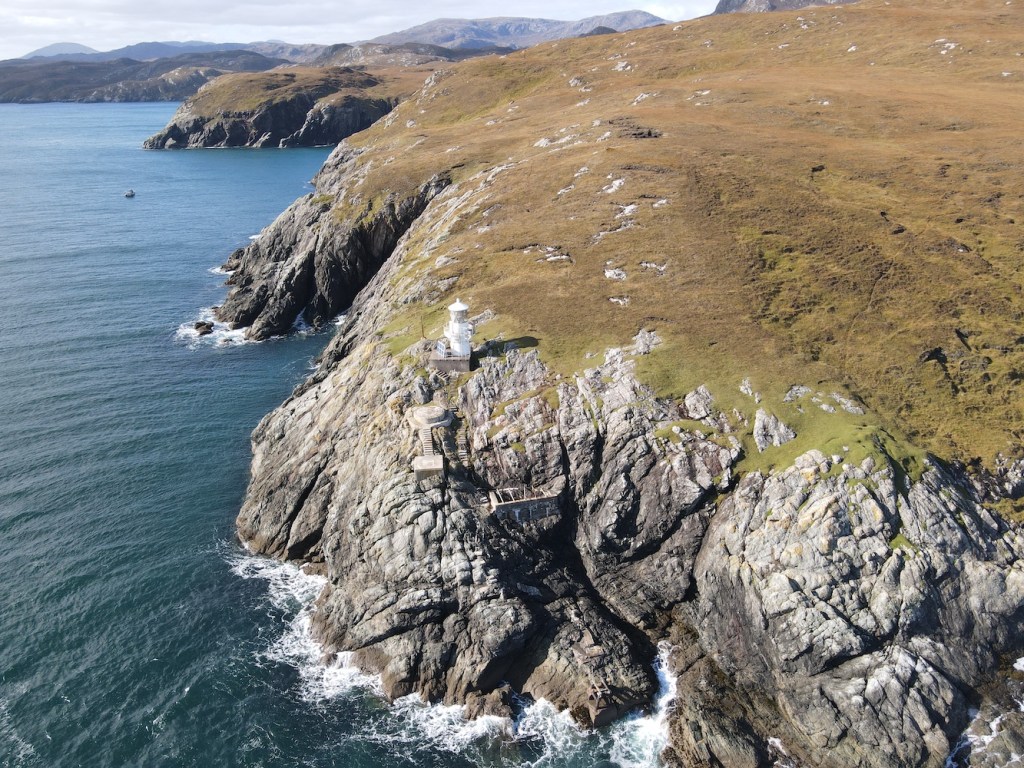
Milaid Point lighthouse is a flat-pack style and these are usually not the most interesting looking. This one is a bit different though and reminded me a little of the one on the Garvellachs which is also in a fantastic location. Milaid Point lighthouse is set down on the cliff with steps leading down to it from the cliff top. As a result it’s actually not so far above the sea. The view from the sea is great with the light, the steps and two old platforms, one of which was presumably where the previous lighthouse tower was located, and the skipper recalled there being some sort of radar station there at some point which probably explains the other platform.
Milaid Point lighthouse
It was fairly obvious that we weren’t going to be able to land near the lighthouse with the rise and fall of the swell so we sailed around the corner to the south to see if we could find somewhere to land and then walk up and along. Once we were in the tender we realised just how steep the cliffs in the area were. A couple of times we spotted sections we thought we might be able to make it up, but once we were in the small tender we realised just how steep it would be. Bob landed at one place and walked/scrambled up the sections of rock to see if it would be a suitable way up. He ended up descending back down one particular section, a flat slope, using a rope as it was so slippery. So that was not an option, but I was very grateful that he had tried to find a way that I could manage.
We took the tender back around to the rocks below the steps near the lighthouse, but we all agreed that it wasn’t going to be possible to land. It was a shame, but we’d got great views of it and Bob managed to fly Joe the Drone around it a bit too.
Milaid Point lighthouse from above
We’d spent longer than expected at Milaid Point and it was time to sail back down towards Rubh Uisenis lighthouse. Although there was a landing below the lighthouse here, again there was just too much swell. We anchored just to the south in a sheltered area and hopped into the tender to see if there was anywhere here that would make it slightly more accessible than Milaid Point.
Sailing back around to the landing area for a closer look we thought it was just too much of a risk with quite a significant rise and fall in the water level. We’d spotted a potential point around the corner and so went along to that. Thankfully we both managed to get ashore, but the hardest bit was to come. I am not a climber and never will be, or even a scrambler. I’ve just scrambled a bit on very few occasions when reaching a lighthouse requires it. I think the best way to describe the section of rocks we needed to climb up is with a picture so here is one.
Our route up the cliff
It was slow going getting up there, but we made it and then there was a short walk along to the lighthouse, although there was a hill in the way so we had to go over that. I was surprised not to be able to see the lighthouse once we reached the top of the hill, but it’s another one that’s set down a bit and so we had to walk a bit further before it came into view. Once we reached the top of the slope where the ground dropped down to the lighthouse the scrambling and uphill walk were forgotten. I know you are supposed to look up at lighthouses, but there’s always something special about looking down on them, particular when it’s one of these types of towers.
Looking down on Rubh Uisenis
These round white towers were introduced by the Northern Lighthouse Board to replace some of the older small lighthouses (like the one on Sgeir Ghlas shown above), but before they started to use the flat-pack type. The Shiants Isles in the background helped to make the view even more enjoyable. Also knowing that this was a place that very few people would have been added to my appreciation of it. Rubh Uisenis is believed to be the most remote land-based lighthouse in Britain with hours and hours of walking over hills and bog to endure if you attempt it from the land.
We wandered around for a while, down some of the steps, taking a look at the platform the old lighthouse (I assume) would have sat on. There is a wonderful picture online of the previous lighthouse located here.
Reaching Rubh Uisenis felt like a great achievement. It had seemed so inaccessible previously. I was very pleased, but I also realised we needed to get back down the rocks!
Bob had brought along his trusty rope and for the descent tied it around my waist and held on tight while I went down. We did this in three sections with me stopping on a ledge part way down, pulling the rope down and then waiting for Bob to come down to where I was before I carried on. It was pretty hard going, moreso because I was struggling at times to pull the rope to take the next step, but that was a good sign as if I’d fallen I would have been glad of the tension in the rope! I didn’t fall though and we made it safely back down and onto the boat. It’s fair to say I was very relieved and very happy!
Joe the Drone enjoyed Rubh Uisenis too
Again we’d spent longer there than planned. Whizzing on down the coast we sailed past Eilean Glas lighthouse which was looking just as wonderful as it did by land on Friday.
Eilean Glas from the sea
Onwards to North Uist and this next one marked my first visit to the Uists, and what a dignified one it was.
Weaver Point lighthouse
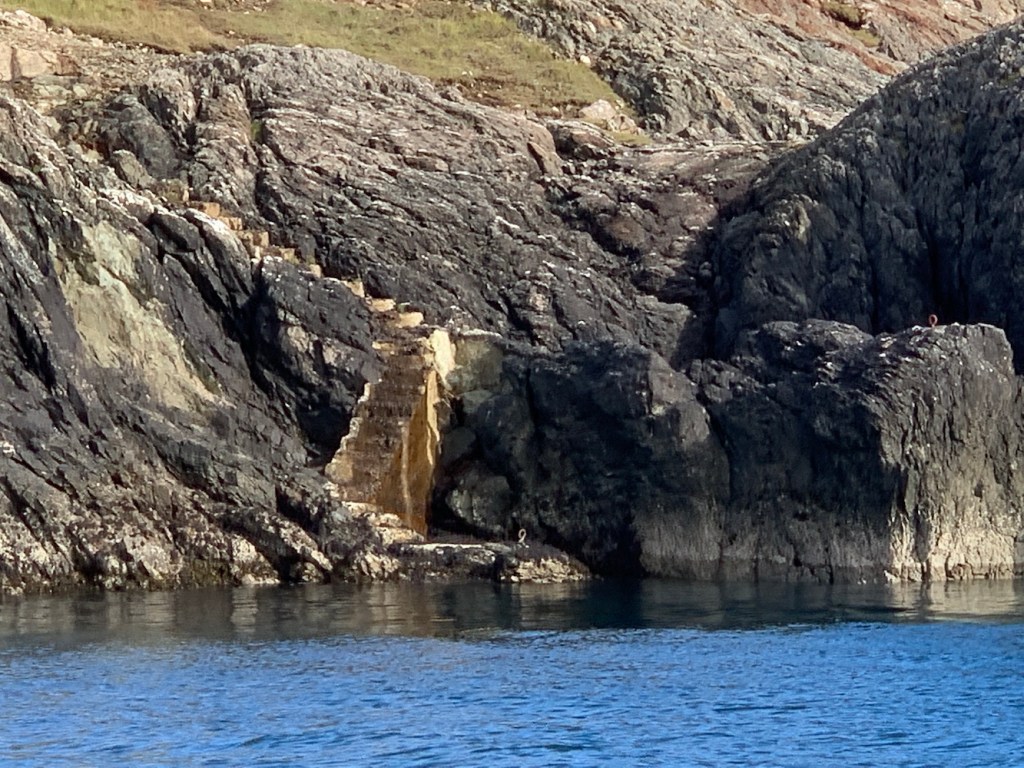
Weavers Point, or Weaver Point lighthouse, is another one that involved a fairly long walk across difficult terrain if approached by land so what better way to arrive than by boat, especially when there are some wonderful steps leading up the cliff. Quite a treat that was, especially after the last one!
The steps at Weavers Point
Weaver Point lighthouse is another flat-pack structure and a fairly standard one, but it was good to see it up close and enjoy the surrounding scenery too. I’m looking forward to spending more time on the Uists in the coming days.
Weaver Point lighthouse
At this point I was feeling like I was hogging all of the boat time so it was Bob’s turn to enjoy a couple of islands he’d not been to before. In true goat fashion he was up and down both in no time at all.
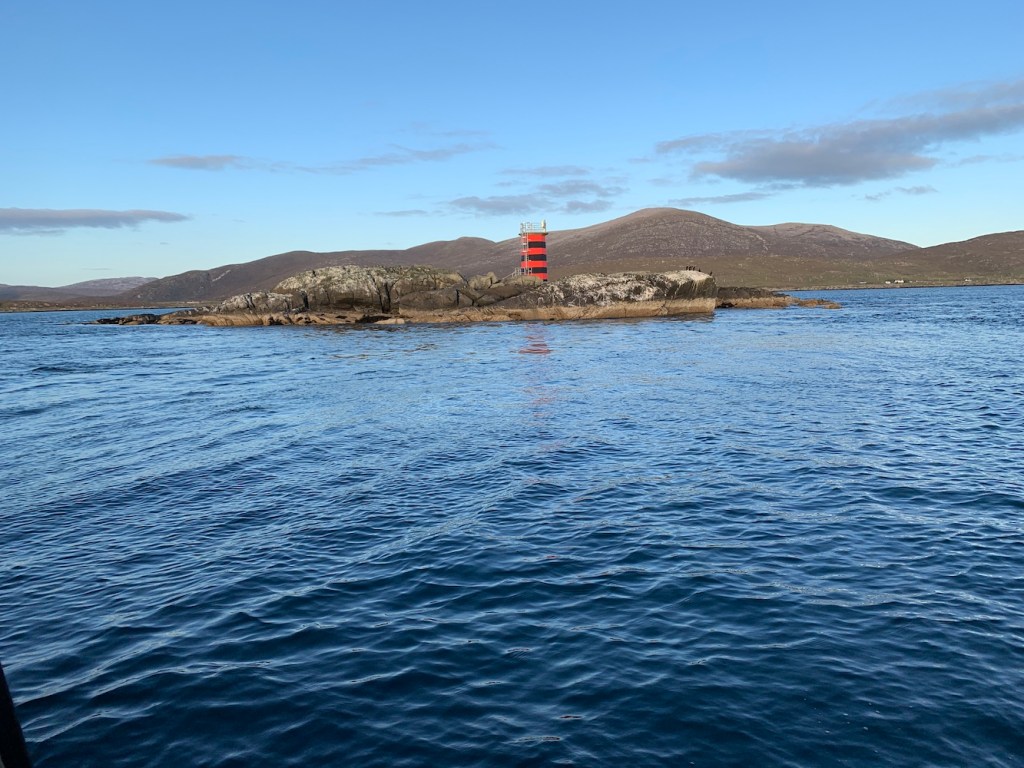
By now the sun was going down, but there was one more stop for the day. We’ve sailed out of Leverburgh a number of times and so regularly passed the red and black Dubh Sgeir light. We were both keen to investigate it a bit more so we landed on the rocks and slowly (because I am not a goat like Bob) made our way towards the tower. When Bob says “use these steps” or “walk on the path” you can almost guarantee that what is in front of you in no way resembles steps or a path. At one point we found a large long and fairly flat rock which Bob likened it to Sauchiehall Street (one of Glasgow’s main shopping streets)!
The light on Dubh Sgeir
Dubh Sgeir is an interesting light and though there’s not much to it, it was nice to visit. As I said to Bob it felt like the the Western Isles’ answer to Barrel of Butter (which is in Scapa Flow, Orkney – take a look at this post from last year to see that one).
The sun was setting so it was time to head back to Scalpay. We had a bit of an added bonus on the way back with some common dolphins leaping out of the water alongside the boat. Normally I’m not so excited when you see the occasional dolphin or whale fin sticking out of the sea, but to see them swimming and jumping alongside us was great. They obviously wanted to celebrate my successful day. As did a few of the lighthouses we’d seen as they were flashing away as we returned to Scalpay – always a delight to see.
The dolphins celebrating with me
It had been a very long day, with 11 hours on the boat, but a really successful one. I’d reached a few lights that had been bothering me for quite some time and also been as close as it was safe to get to all of the lighthouses on and around Lewis and Harris. Another fantastic day to add to the bank of memories I have of the area.
I hope to do at least one more post during this trip, but the second boat trip we had planned has had a rather large spanner thrown in the works. Fingers crossed plan B or Plan C will come together! 🙂
I’ve spent many a day out getting to the lighthouses on small islands off the coast of the Western Isles, but this means that I’ve somewhat abandoned the lights on the main islands of Lewis and Harris. With the exception of Butt of Lewis I’d not visited them since my first trip to the Western Isles in 2014. It felt like a good time to rectify that.
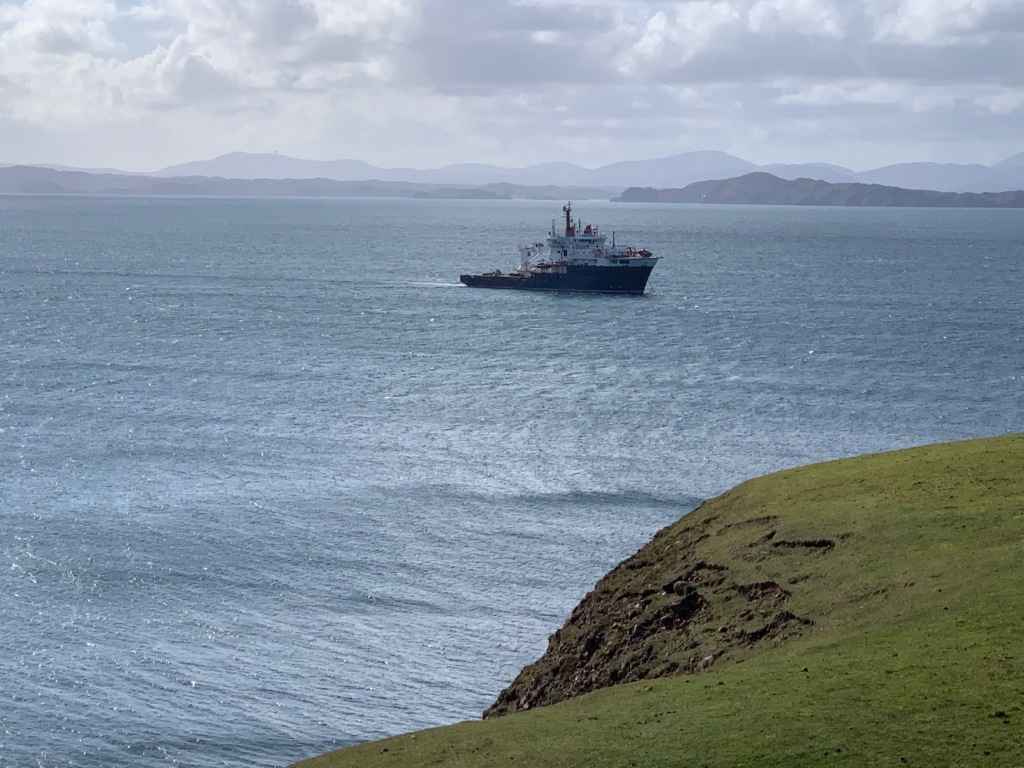
Having seen Tiumpan Head flashing last night I was keen to get a bit closer to it again. We set off and as we headed out of Stornoway I spotted a ship with a particularly recognisable shape just off the coast. I’ve seen the Northern Lighthouse Board’s maintenance vessel Pharos on many of my trips out and about, and was fortunate enough to have a look around her in Oban last year. The first time I saw her was at Bell Rock back in 2012, which was actually one of my first lighthouse boat trips.
I obviously wanted to get a closer view today if I could. Looking at the map I thought we’d be able to get the best view from Swordale. Luckily there was a nice gate with a “no dogs” sign on it leading to a field where we could get some nice views across to it. A bit of a bonus, although I did get wet feet as I walked across a rather boggy part of the field. No pain, no gain!
The Northern Lighthouse Board’s vessel Pharos
A short time later we arrived at Tiumpan Head. Last time we were there it was misty and overcast and the one lasting memory was of dogs barking and barking the whole time. This time the dog barks were still there, but the weather was much better, albeit quite windy.
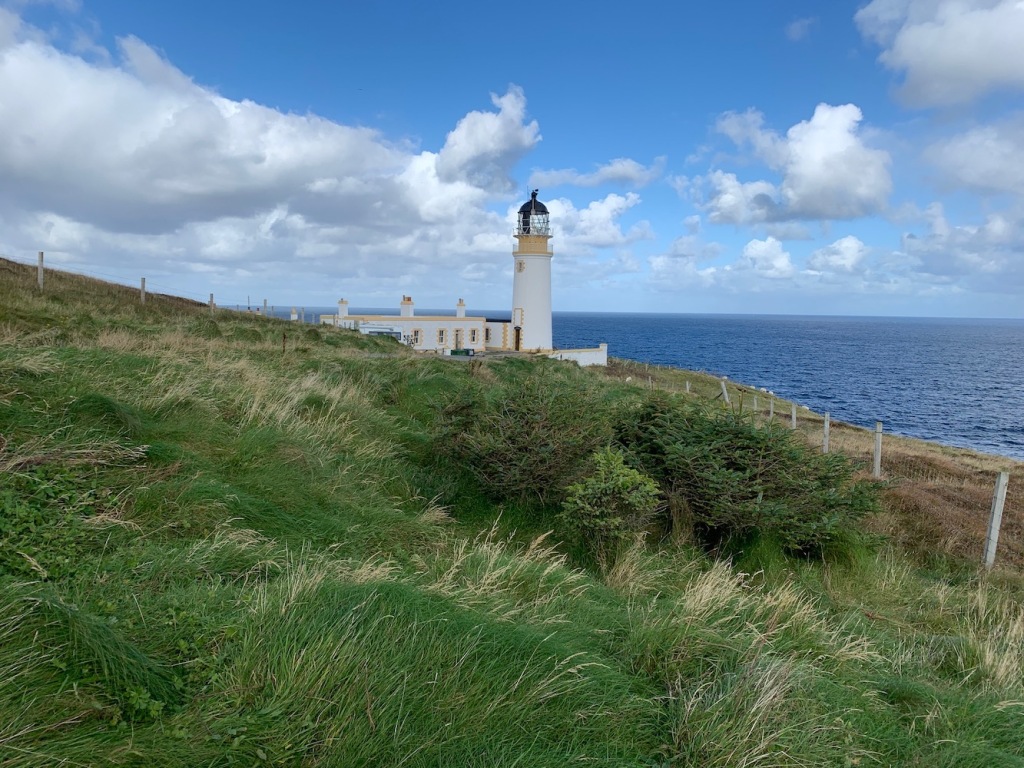
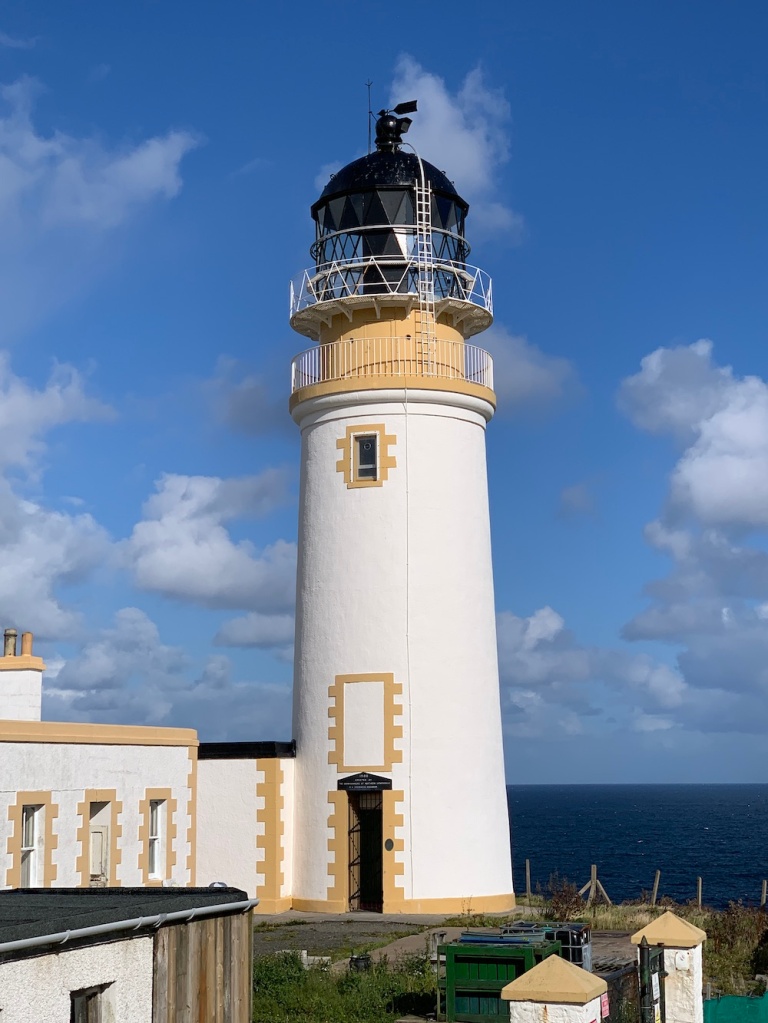
Tiumpan Head lighthouse
As well as the improved conditions my appreciation of the lighthouse was greater this time around. Much of the last few years of lighthouse visits has been spent dashing around like a headless chicken trying to do as much as possible in the limited time available. Now I find myself more and more spending longer at these places and enjoying them more, discovering more and letting them grow on me. In a message to a friend earlier I likened the lighthouses to people and how the more you see them and get to know them the more fond of them you become. Of course there are always exceptions!
The lighthouse tower at Tiumpan Head
The tower, which is maintained by the Northern Lighthouse Board is looking great, but it was sad to see that part of the outer wall of the complex has fallen away. It made me think of the builders all those years ago when the lighthouse was built making these wonderful solid structures. It is rare, in my experience, to see the walls falling down.
Tiumpan Head lighthouse was the damaged section of wall
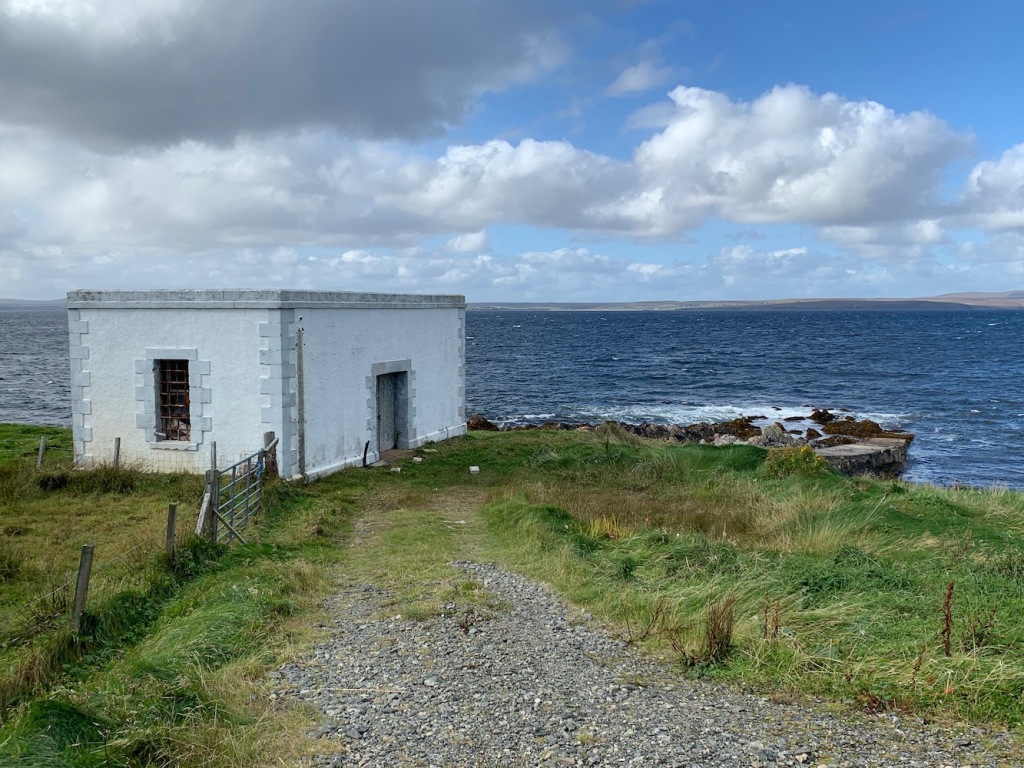
After I’d finished wandering around and taking some pictures, we drove west and discovered what looked remarkably like an old lighthouse building alongside a little slipway at Portnaguran. I got in touch with a friend who is knowledgeable on the history of the Northern Lighthouse Board and he agreed that it most likely was related to the lighthouse and used as an equipment or materials store coming in from, or going out by, boat from the slipway. I also checked with my friend and he confirmed that the grey colour of the quoins were what the Northern Lighthouse Board used before they introduced the yellow/beige colour, which goes by many names. These discoveries teach you that you really do need to keep your eyes open as you never know what you might discover.
The old Tiumpan Head store and slipway in Portnaguran
On the way to our next destination, we stopped by to check access to Arnish Point lighthouse for a friend of mine who plans to visit it next year. We found the road that we’d driven up 6 years ago and decided against going up there this time due to the large puddles/potholes on it. Thankfully it looked like access would still be fine, but we decided against the 1km walk to the lighthouse today as we had somewhere else to be. We did find a nice vantage point on the way out of the industrial estate though that offered wonderful views of the lighthouse and all the way over to where the Pharos was anchored.
Arnish Point lighthouse and the Pharos in the distance
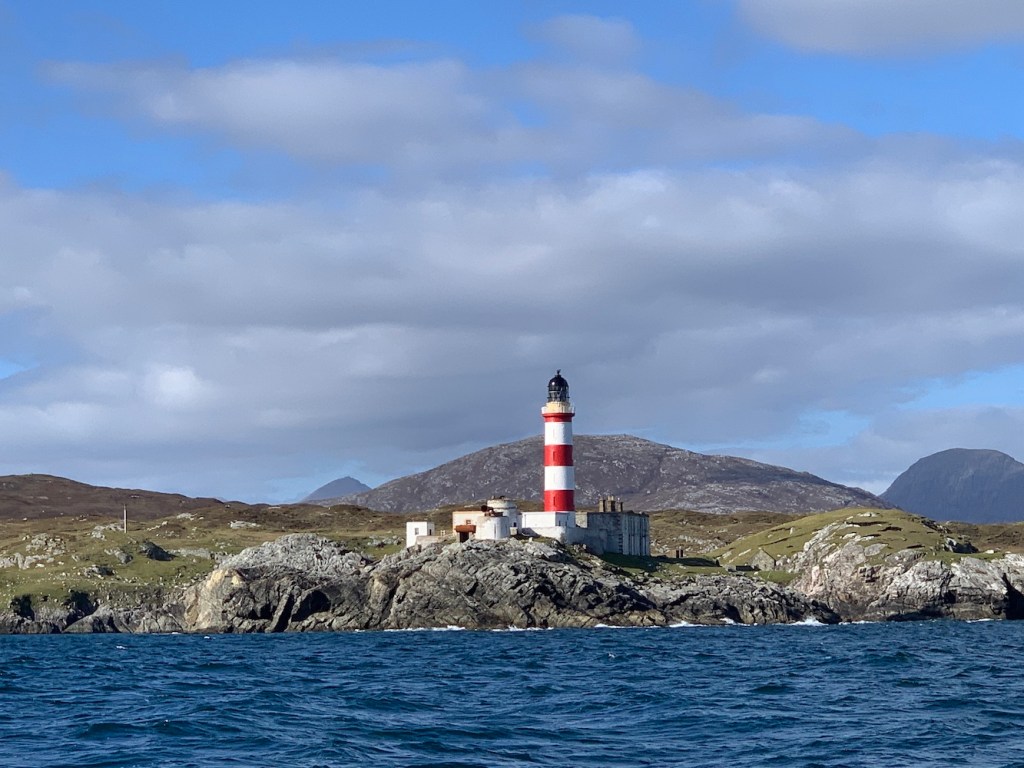
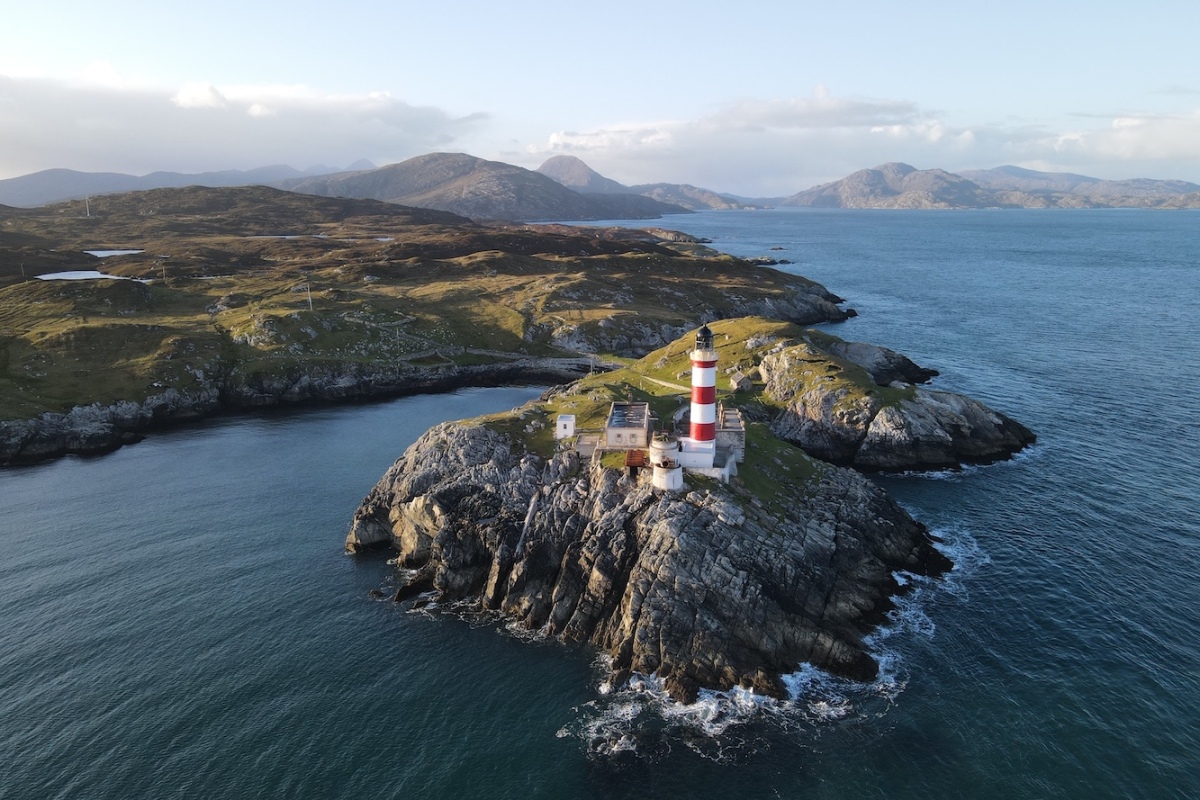
Our final destination of the day, and by chance we arrived there later than planned, was Eilean Glas on Scalpay. This one is so often photographed and you can really see why. For a start everyone loves a red and white lighthouse, and when it is located here with panoramic vistas in every direction what is not to like?
I had read a few days earlier that the improvement works to the cottages at Eilean Glas were now forging ahead and that a new guidebook about the lighthouse had just been published. The sign near the parking area also mentioned tea and coffee being available – there aren’t many lighthouses where you can get that!
The track out to the lighthouse is fantastic. Last time we visited we didn’t realise there was a track and so took the coastal route, which was nice but a bit more challenging – especially at 6 months pregnant! There’s obviously a considerable amount of work gone into the track and signposting. It certainly makes it a much more accessible place than it probably was previously.
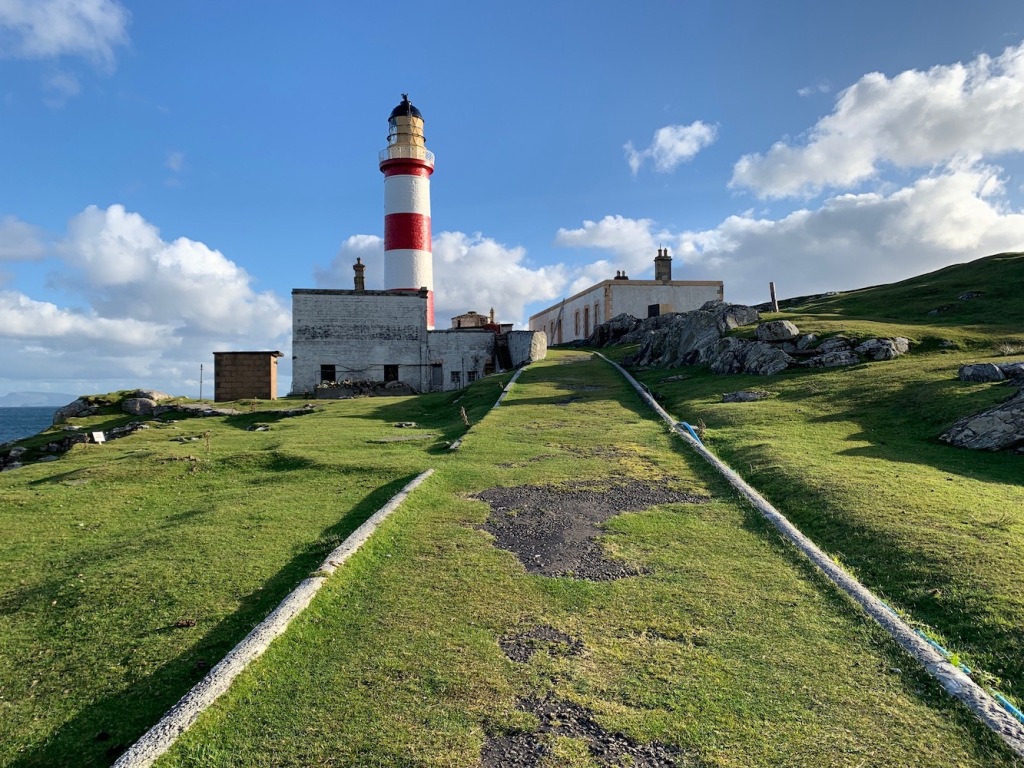
The track that leads to the lighthouse
With the sun going down we had that wonderful warm glow on the lighthouse and we are both now converted to the idea of visiting lighthouses at sunset. Fortunately we weren’t there too late to see the lady who is coordinating the effort to renovate the cottages. Once we’d bought a copy of the guidebook and a cup of tea we got chatting to her about the work going on there. The work actually began in 1983 so the effort is as old as I am, but it’s been a little stop/start since then. The current push is sounding positive though and let’s hope it continues.
There’s a lot to see there and, as always, this is best shown in picture form, so here are a few from today.
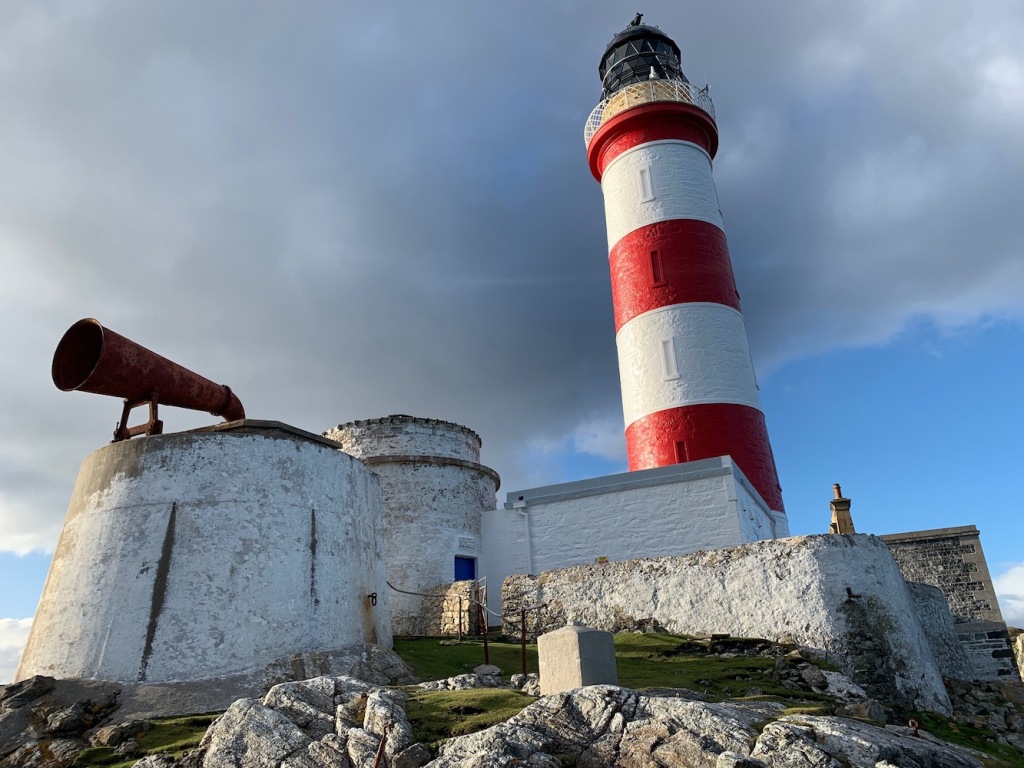
Eilean Glas lighthouse
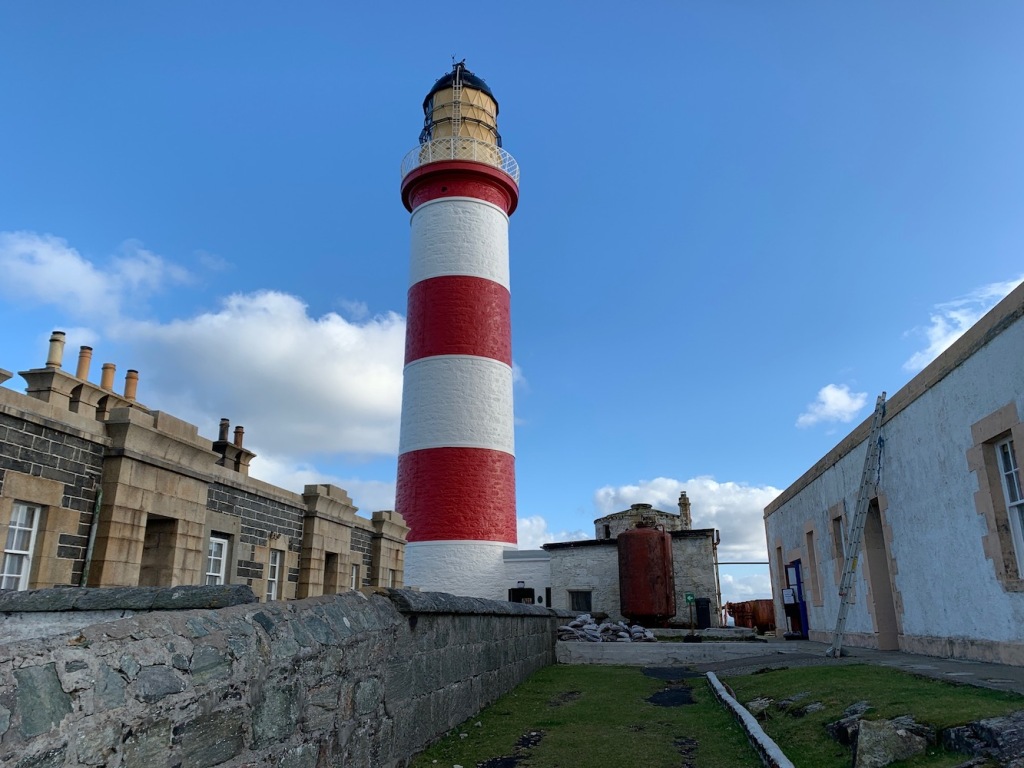
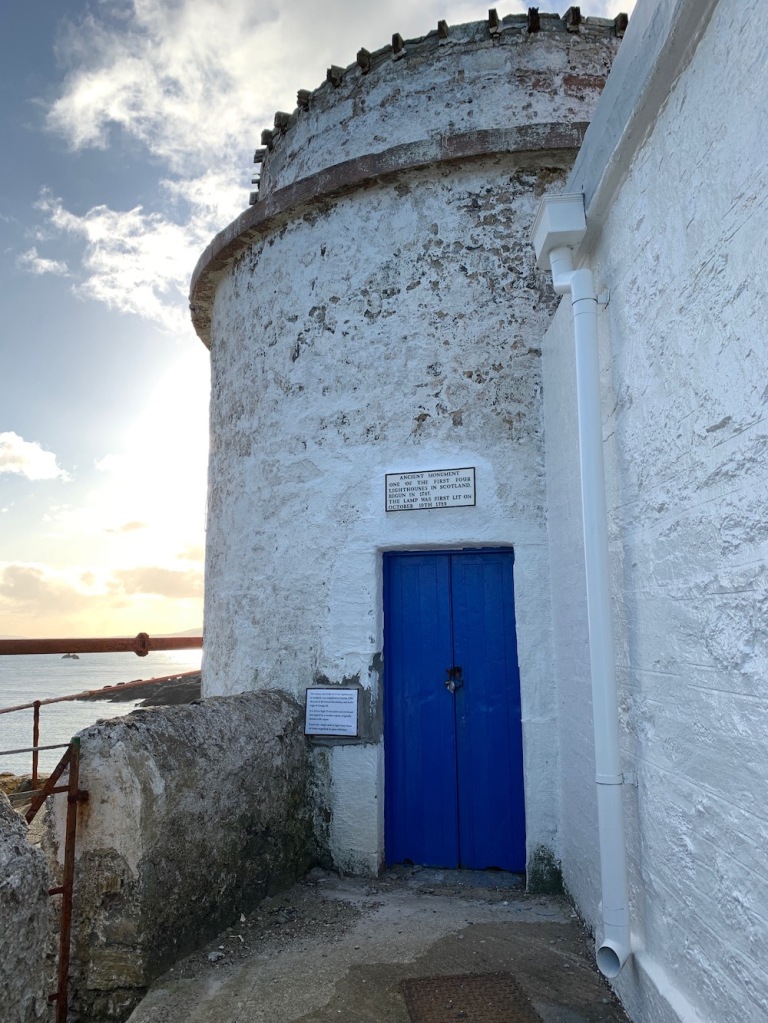
The old Eilean Glas lighthouse – one of the oldest in Scotland
Some of the more recently installed windows
Bob had taken Joe the Drone along with us, although we weren’t sure if it would be too windy to use it. He decided to give it a go anyway and Joe seemed to cope fine with any gusts. He had to come back down briefly as it began to rain, but the shower didn’t last long and he was back up again in no time. Often when you are taking pictures of something you can see if it’s going to make for a particularly good image. It’s slightly different with the drone though as you really just put it up, fly around and see what looks good once you are up there.
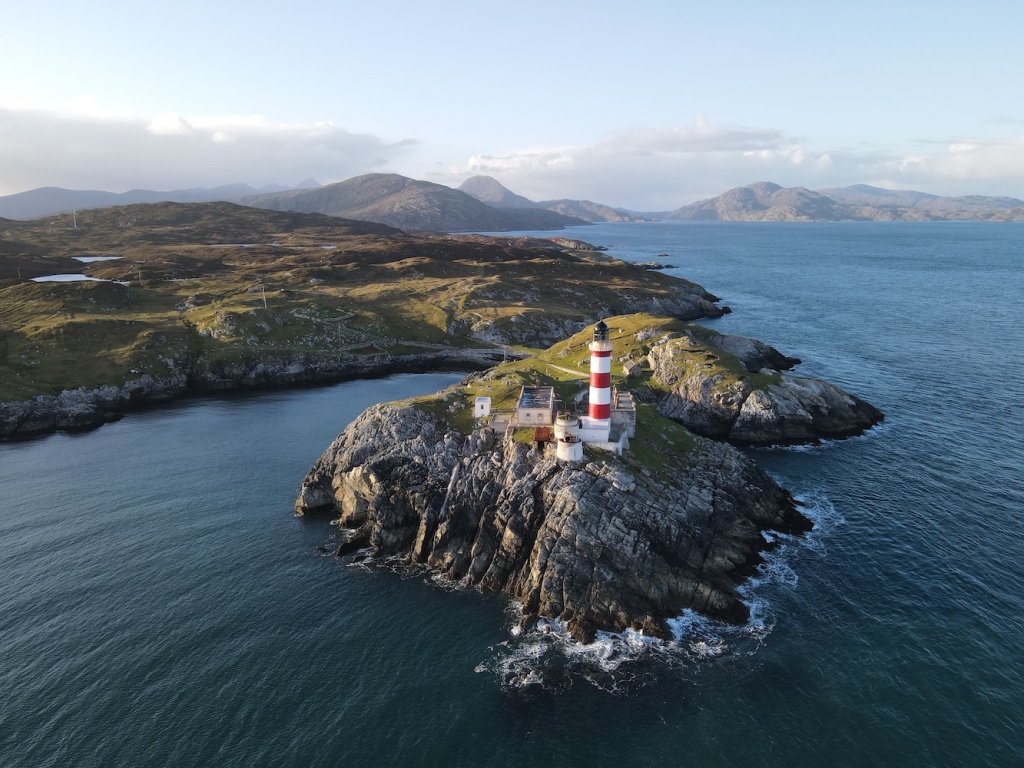
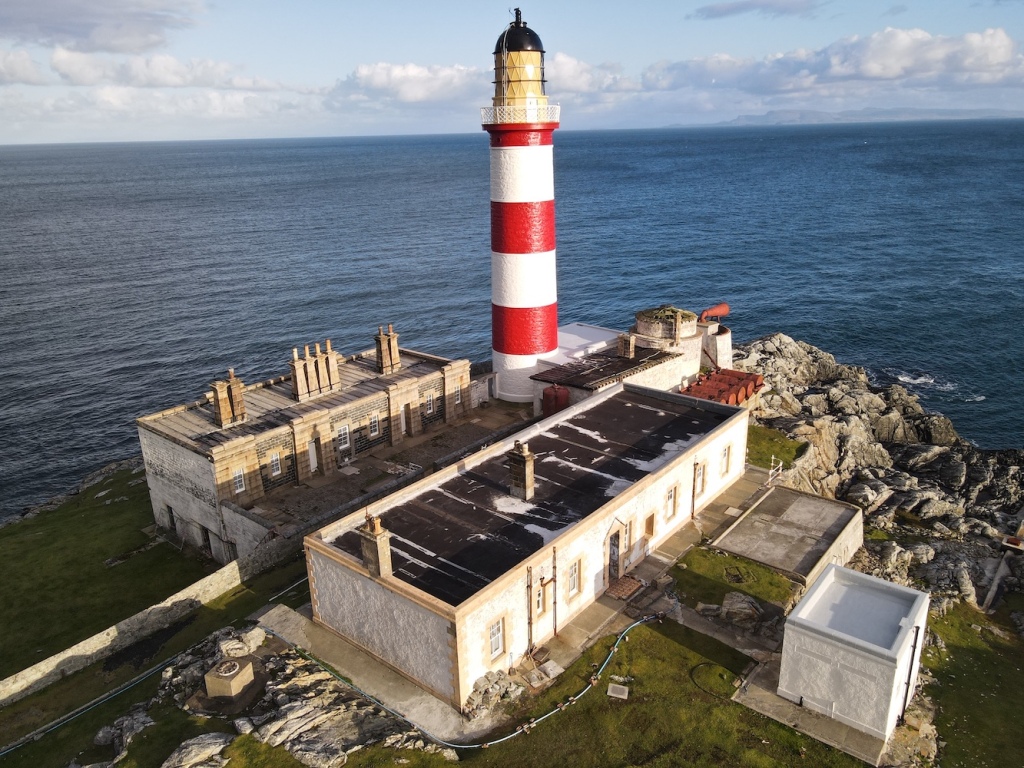
At first the drone was struggling with automatically flying in a circle around the lighthouse as the brightness of the white bands were causing the drone to lose its focus. After trying a few different angles, Bob flew it around the seaward side on the south east, looking back towards the lighthouse. Looking at the picture on the screen we knew that this was the angle it had to be taken from with the mountains of Harris in the background. Here are a few of Joe’s pictures.
My favourite picture of the day
I heard earlier today that a friend had shared some of Joe’s pictures from the Butt of Lewis yesterday with one of his friends. One of the comments that came back was that it was interesting how the lighthouse dominates when seen from the ground, but some of the drone images make it look so small in comparison to the landscape surrounding it. It is so true and one of the joys of the drone images is that it reminds you that no matter how big or tall manmade structures are, nature will always dwarf them. I think that’s a nice note to end on today. More to come tomorrow… 🙂































































 uklighthousetour