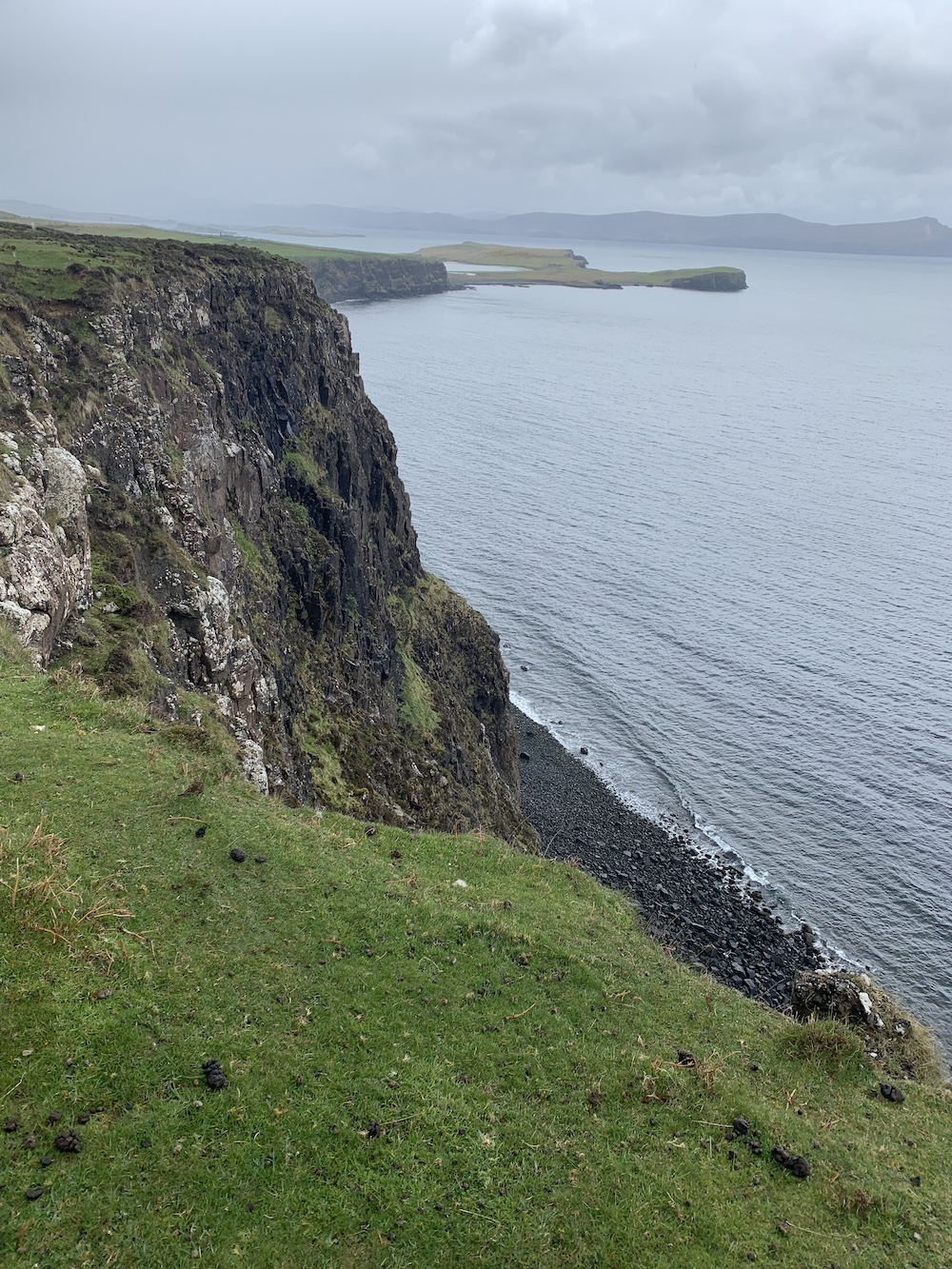
Completing the Shetland walks at Vaila Sound

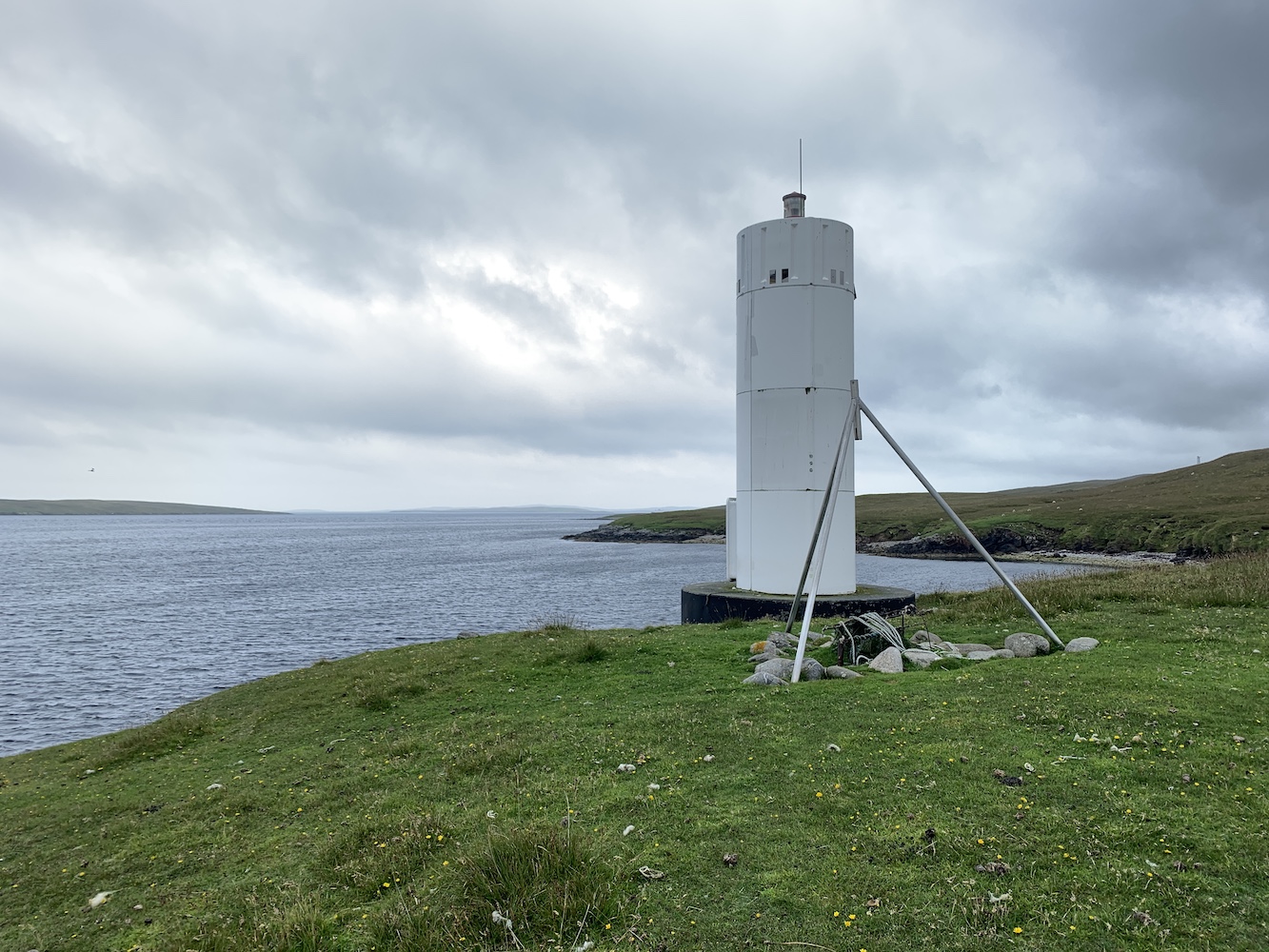
Contrary to what yesterday’s post suggested, today didn’t turn out to be as exciting as I’d mentioned (that’s now planned for tomorrow – fingers crossed). However, it did feature some success: the completion of the ‘walkable from the main islands of Shetland lighthouses’. This doesn’t actually sound like much of an achievement, but given that they aren’t necessarily the easiest or shortest of walks (see the recent Bagi Stack post for the most extreme example) it’s quite a good milestone. This completion took place at ‘the light with many names’, also known as Vaila Sound, Ram’s Head or Whites Ness Lighthouse – whichever takes your fancy. To be a bit more specific, the lighthouse is officially known as Vaila Sound Lighthouse by the Northern Lighthouse Board. It is located on Ram’s Head which is a part of the Whites Ness circular walk. Hence how it ends up with so many names.

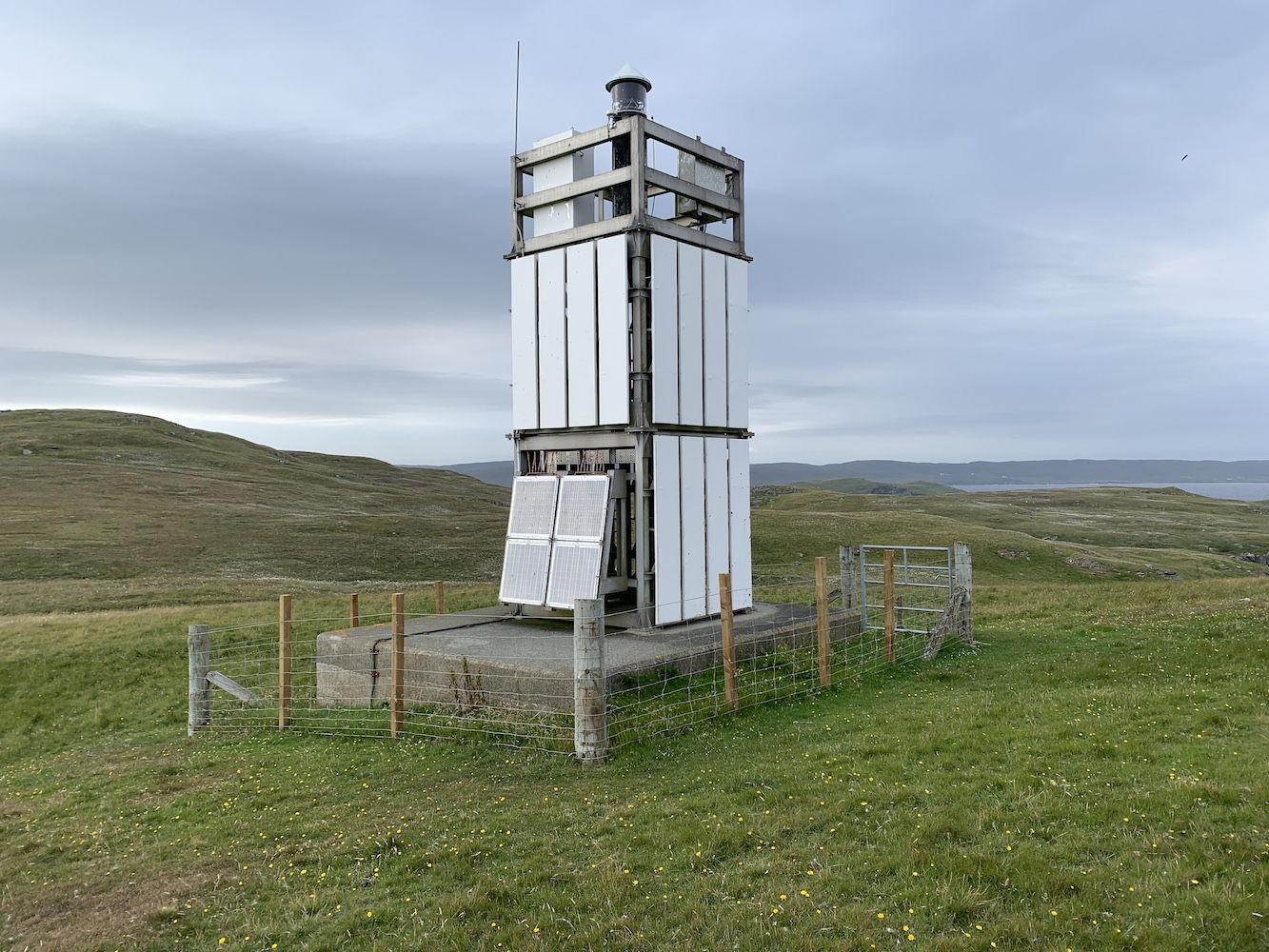
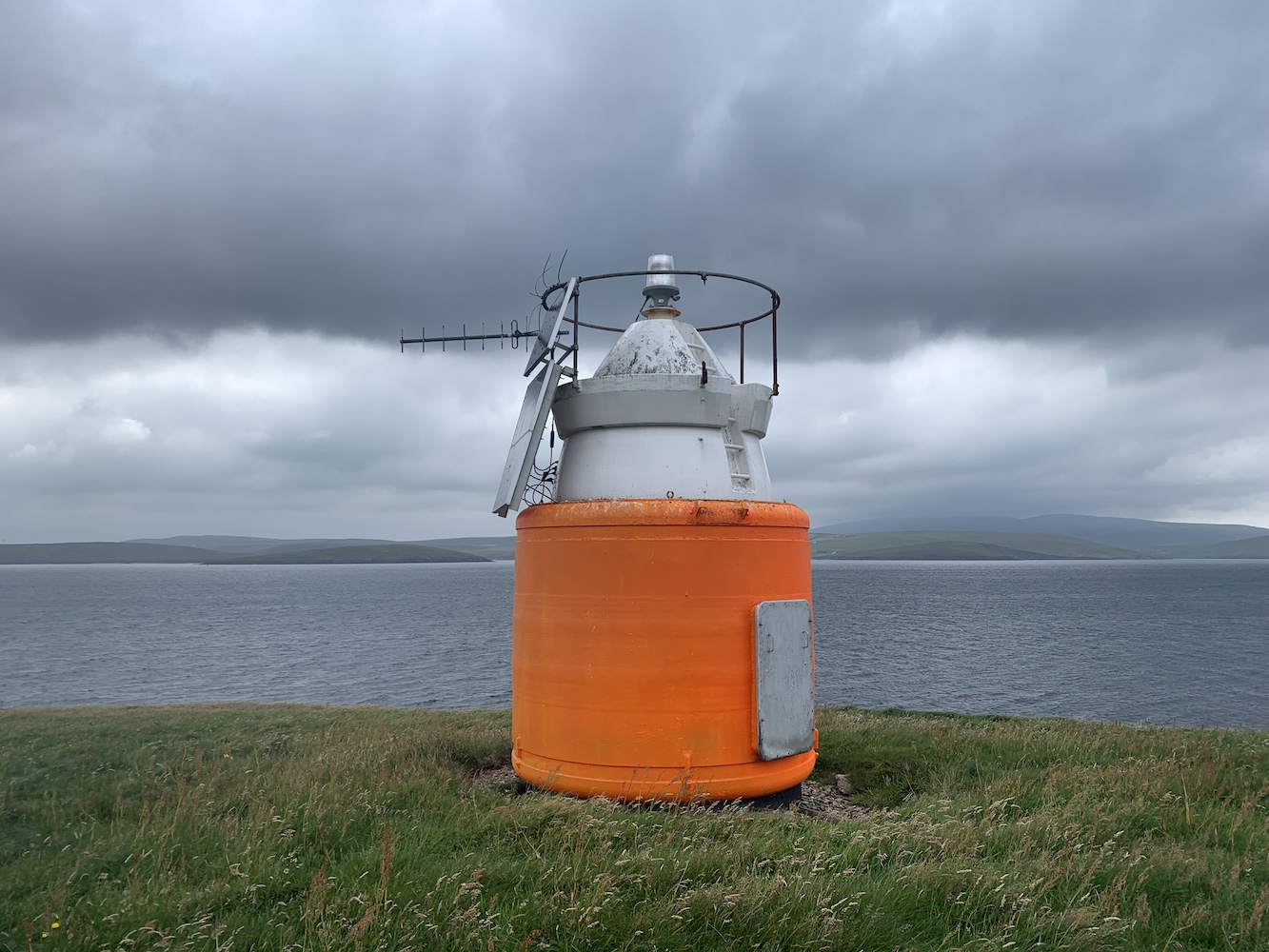
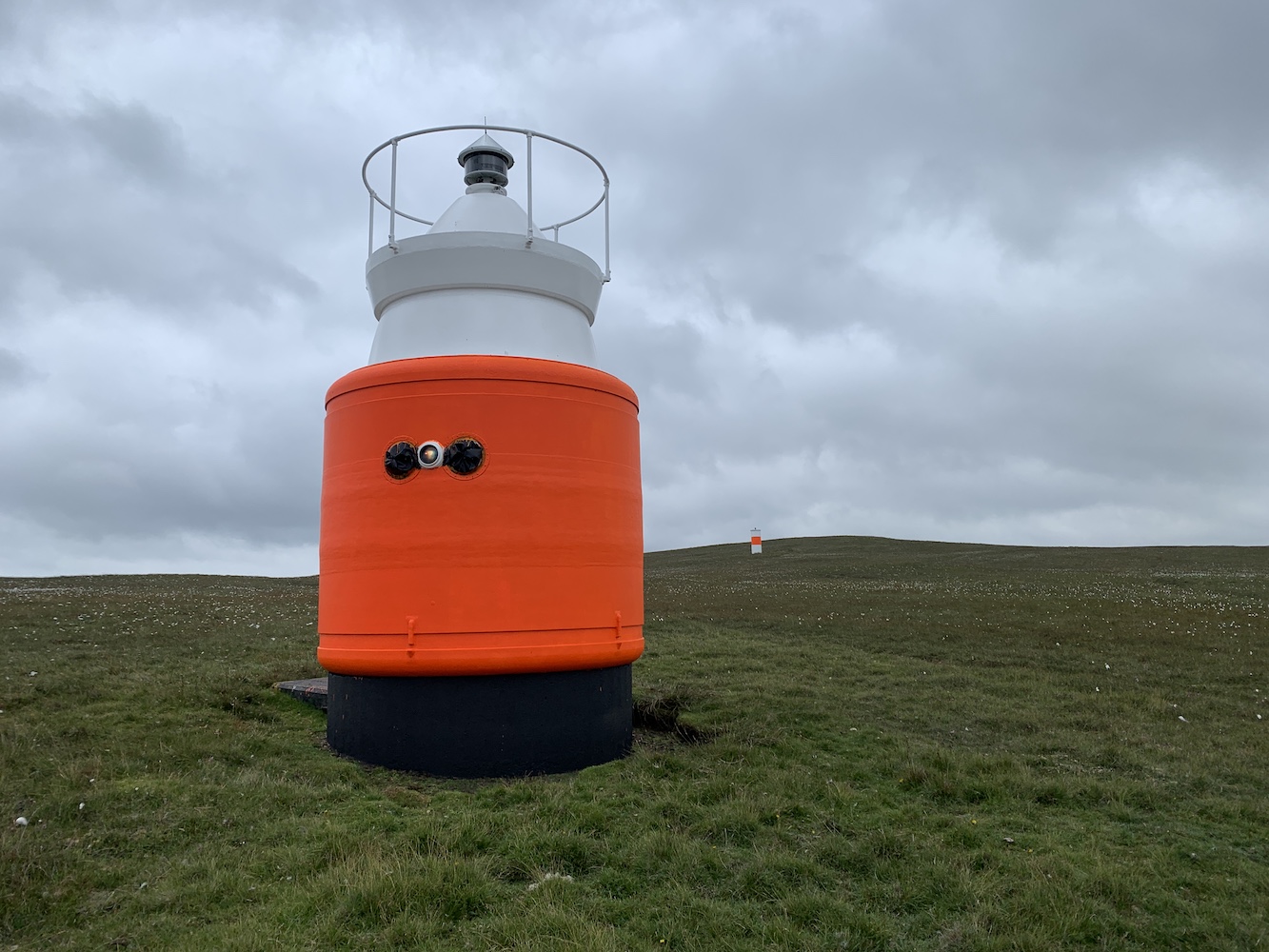
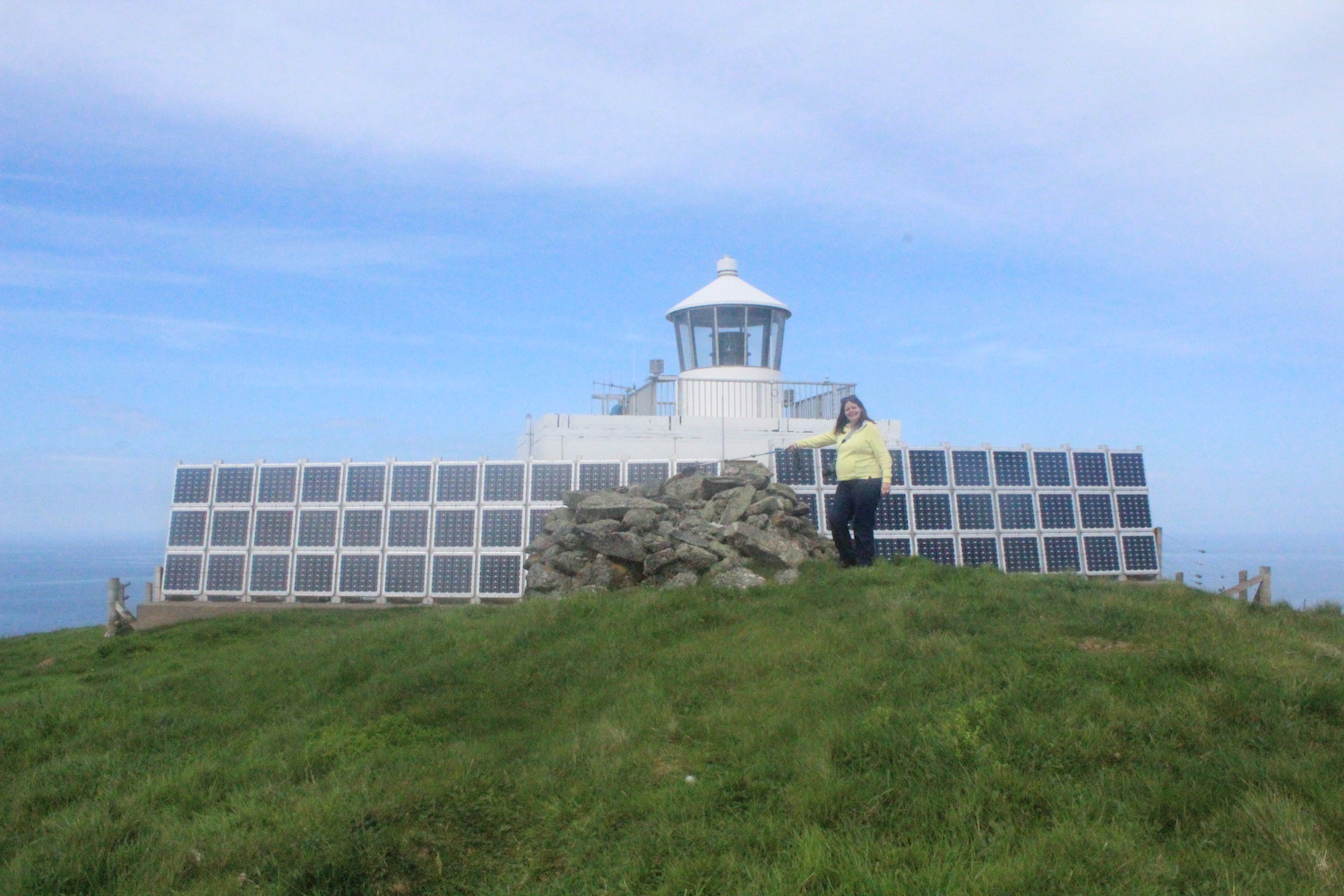
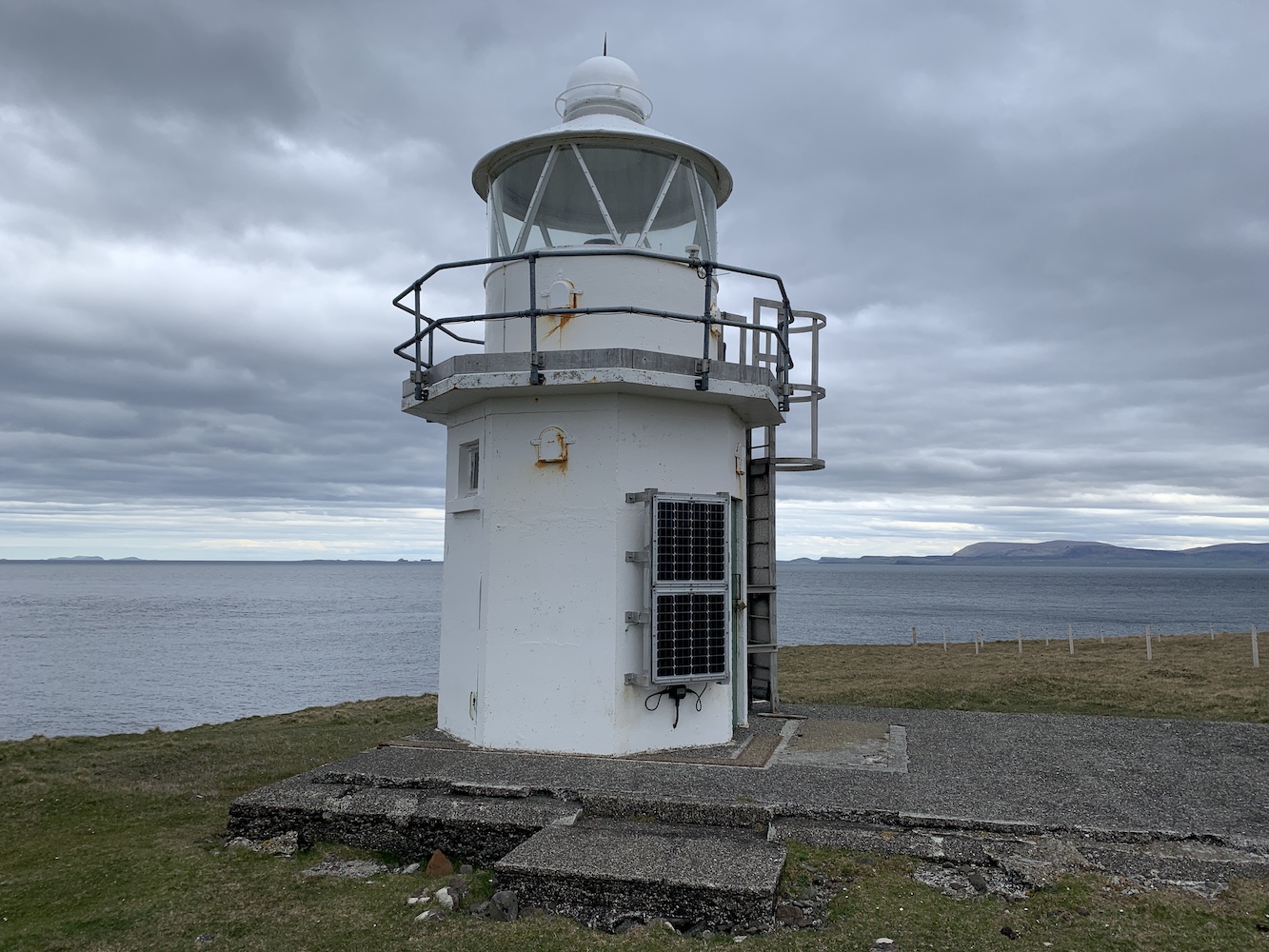
Vaila Sound Lighthouse very much reminds me of this wonderful post I saw last year, which includes a beautiful sketch of the lighthouse – not a style that is very often sketched I’m sure! This is one of the Solar Powered Lattice Aluminium Towers and they grow on me more and more every time I see a new one. This is particularly the case when they involve a great and not too challenging walk. A couple I know through the Association of Lighthouse Keepers moved to Shetland last year and they have visited Vaila Sound Lighthouse a couple of times so we enlisted one of them, who I named Tour Guide Andrew, to lead the way.

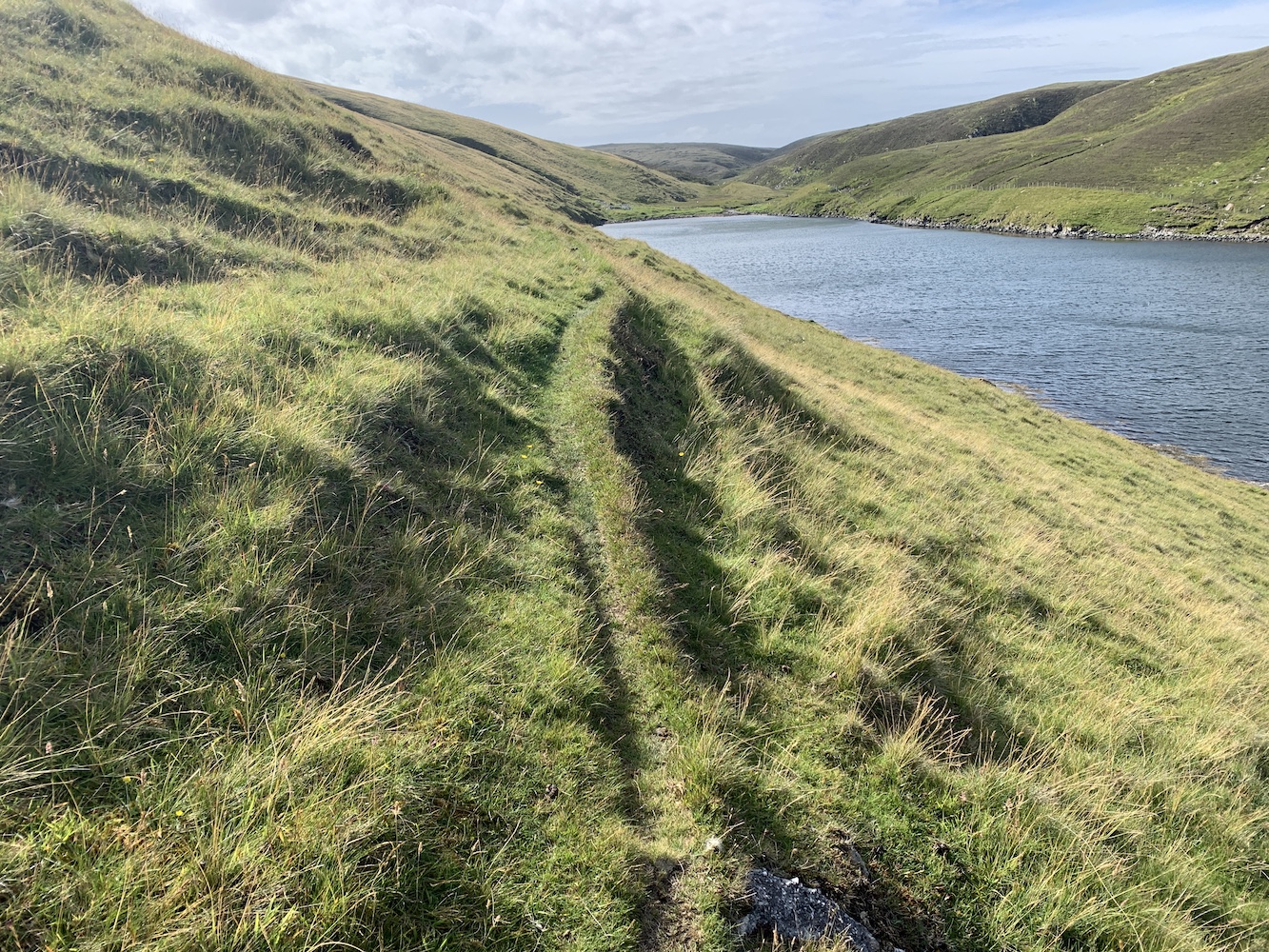
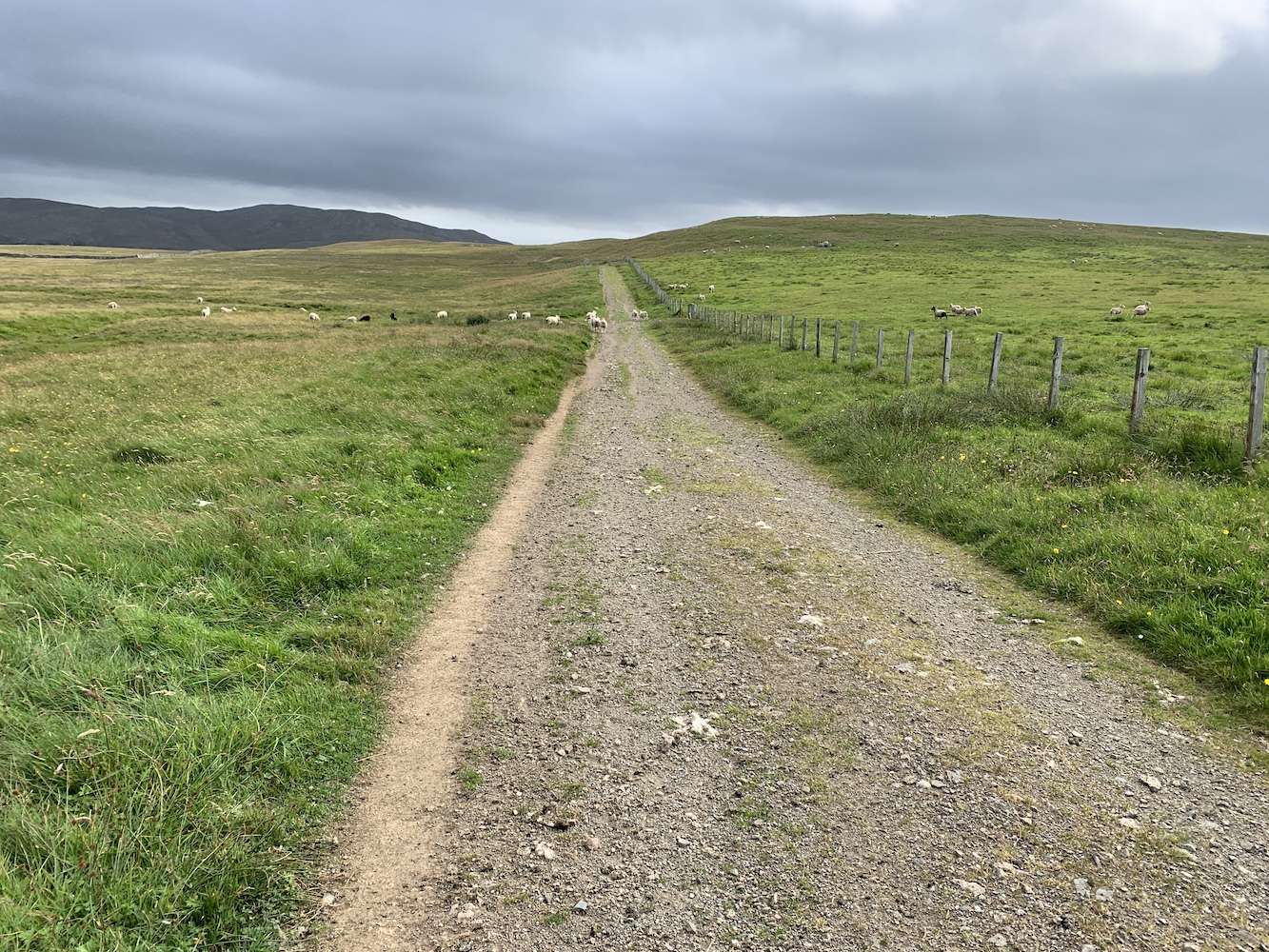
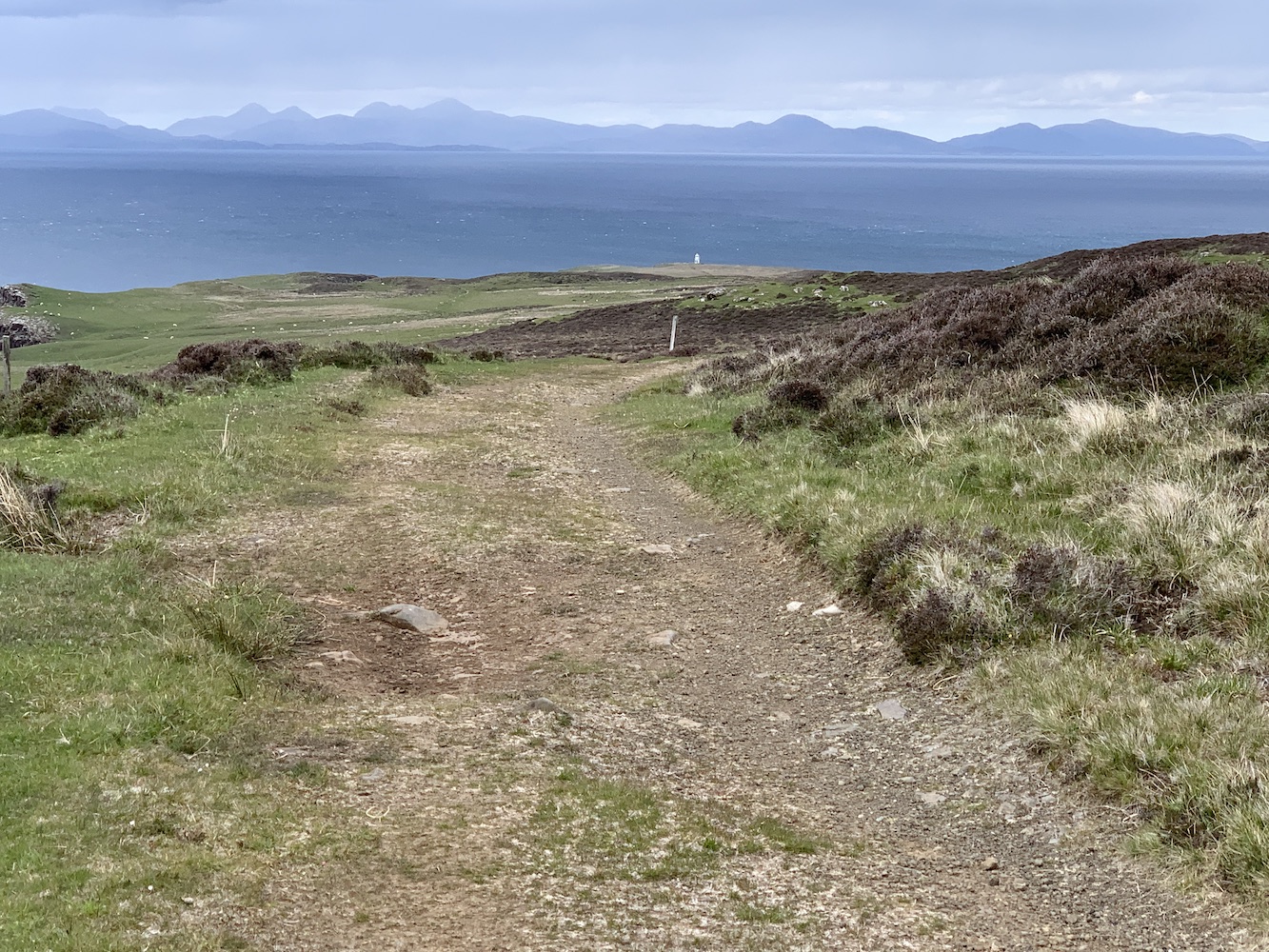
There’s a great area for parking just up the hill from the start of the walk at Whiteness and then it’s following a farm track signposted ‘Coastal walk’ for the first part. This track felt like luxury after some of the recent walks.

The starting point for the walk

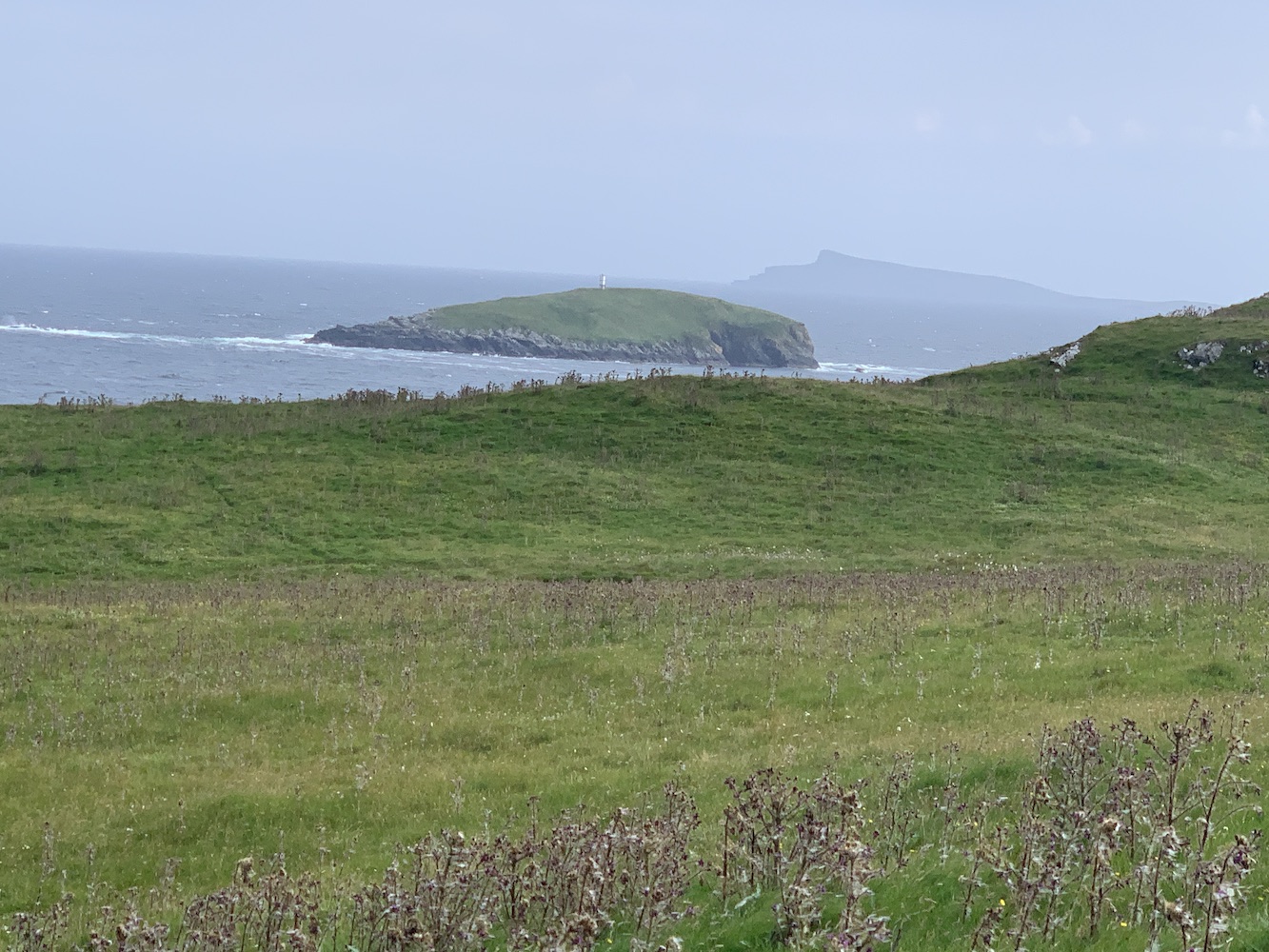
After passing a couple of buildings it’s not long before you get some stunning views of Vaila Sound and the island of Linga.
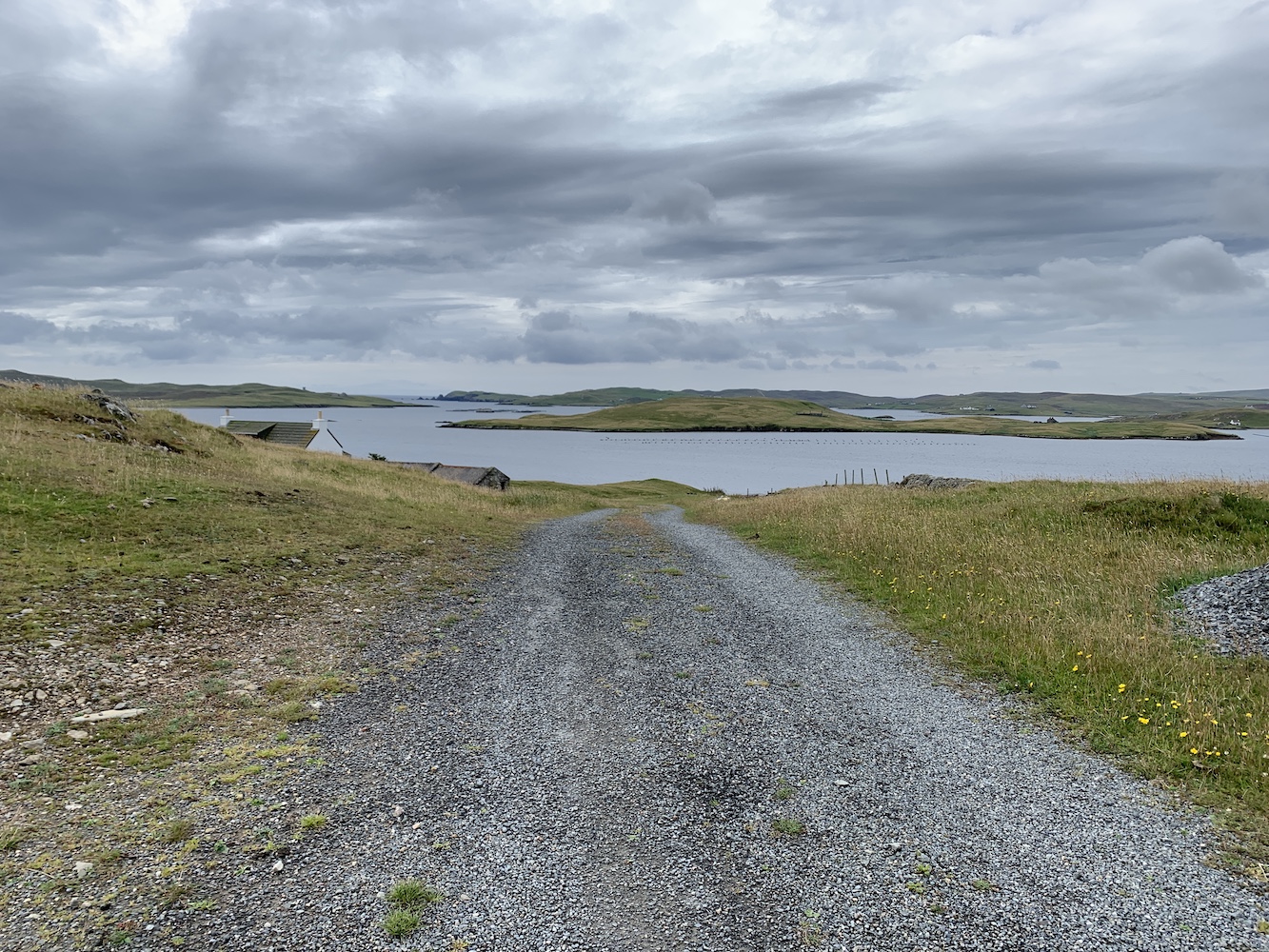
The first view across Vaila Sound

Beyond the mast the track continues and you begin to get views of the island of Vaila itself, which I have very fond memories of visiting a couple of years ago. It’s a beautiful island with a really interesting little garden to explore.
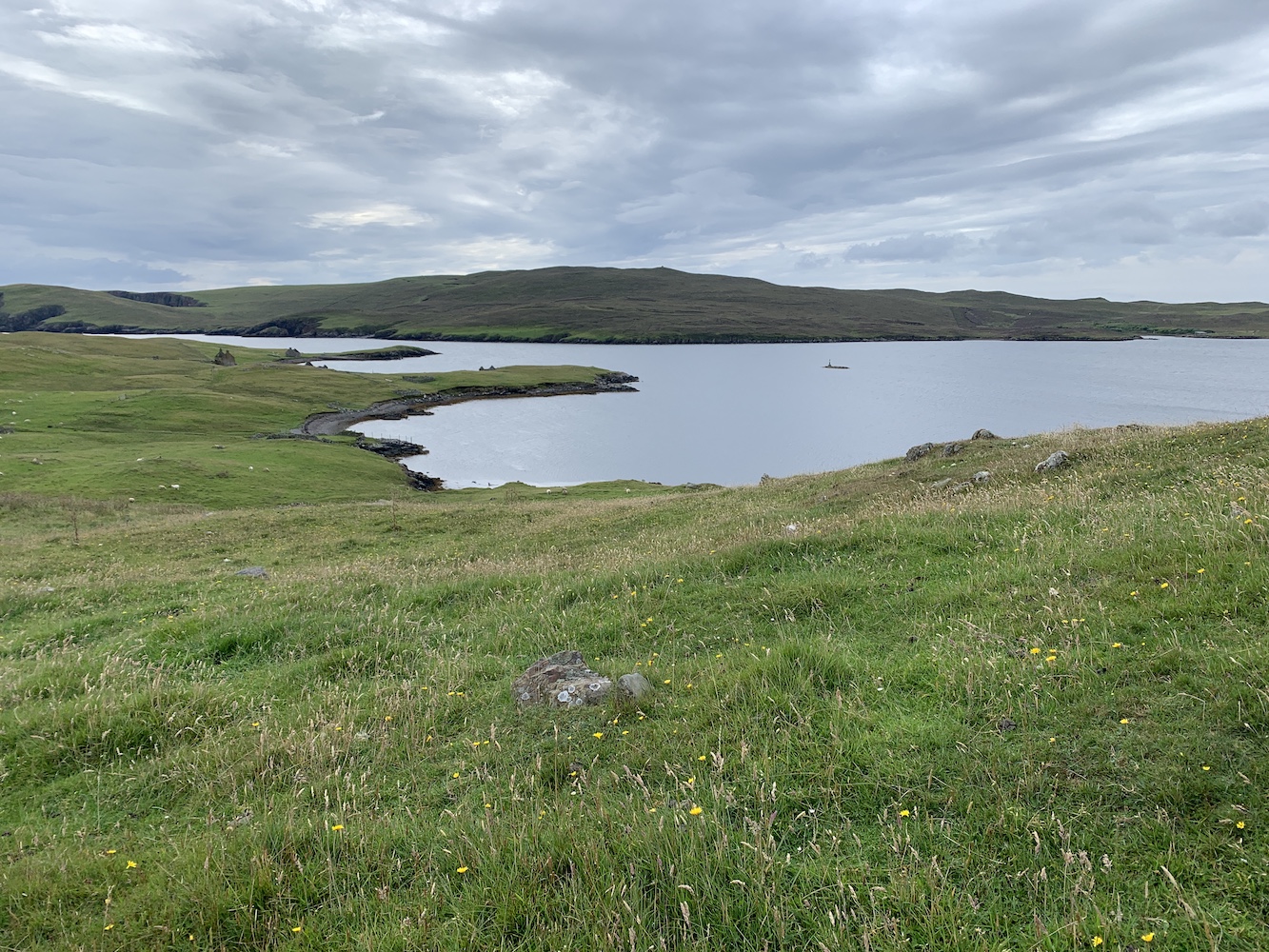
Vaila from across the sound

The track then ends at a farm gate and we walked through the field a short way, ending up closer to the coastline. The views looking back towards Walls from here with the yellow flowers in the foreground were excellent.

The view towards Walls

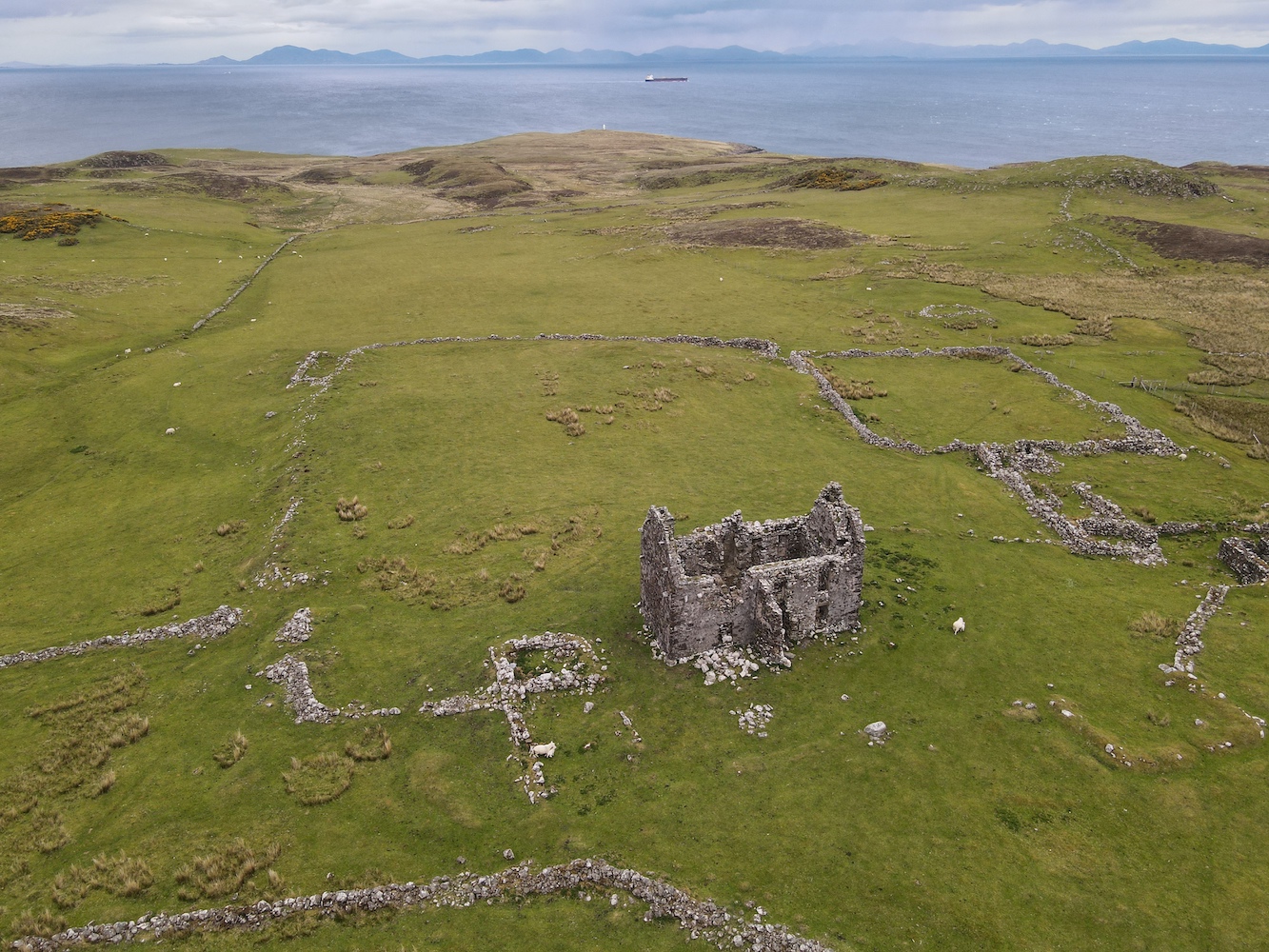
We then arrived at an area of old ruined houses near the shoreline. One of them didn’t look as old as the rest and I thought ‘what an amazing location to live’, but of course it’s relative remoteness would have its drawbacks.
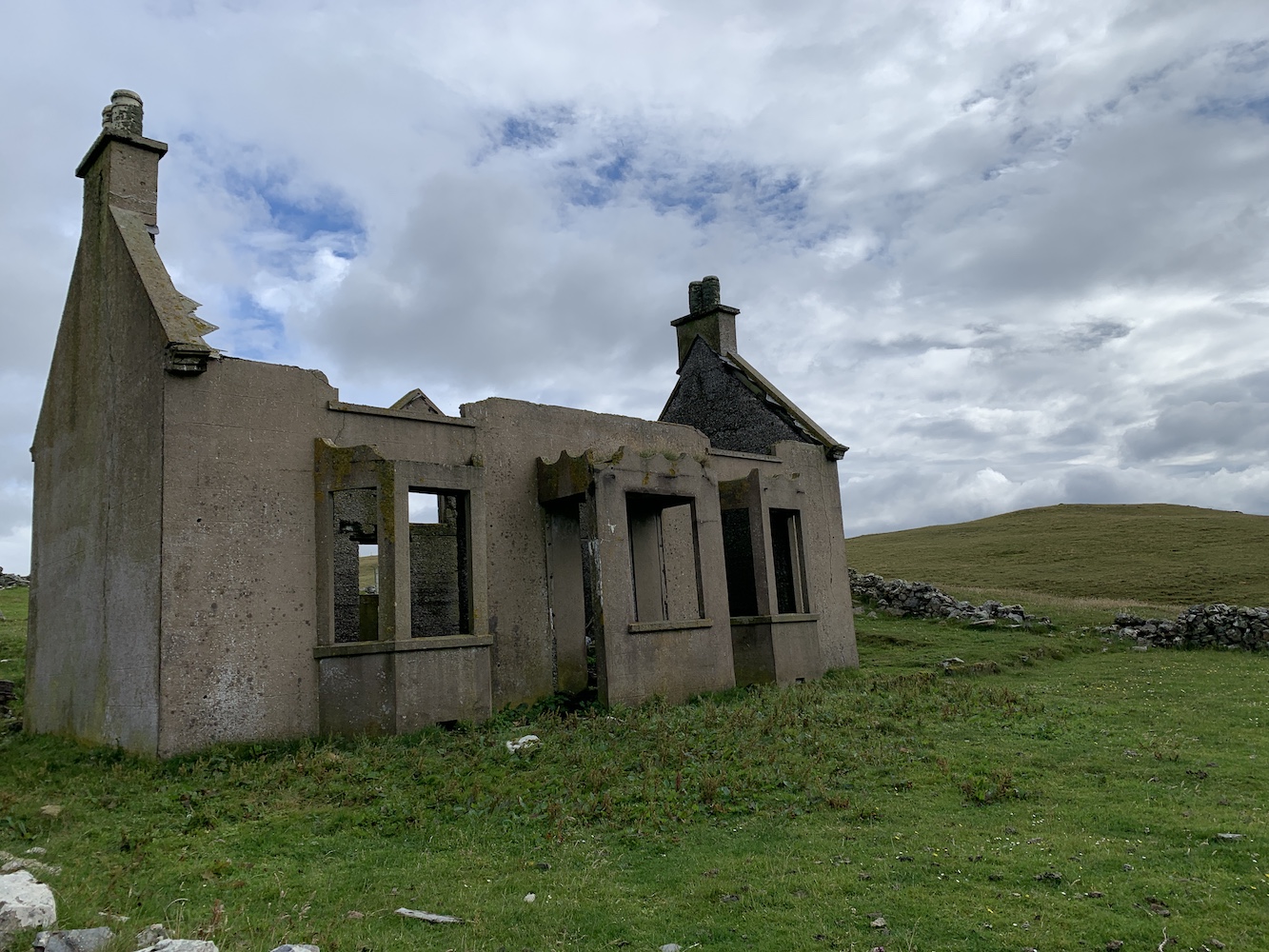
The more modern-looking property

From here we then took a short walk along the small, pebbly beach and took a look at the little stone jetty beyond it.

The old stone jetty near the ruined houses

From here the terrain gets a bit more undulating and after a stile, there is some uphill followed by downhill, but the uphills are so worth it for the views from the top.

One of the wonderful views from a higher point on the peninsula

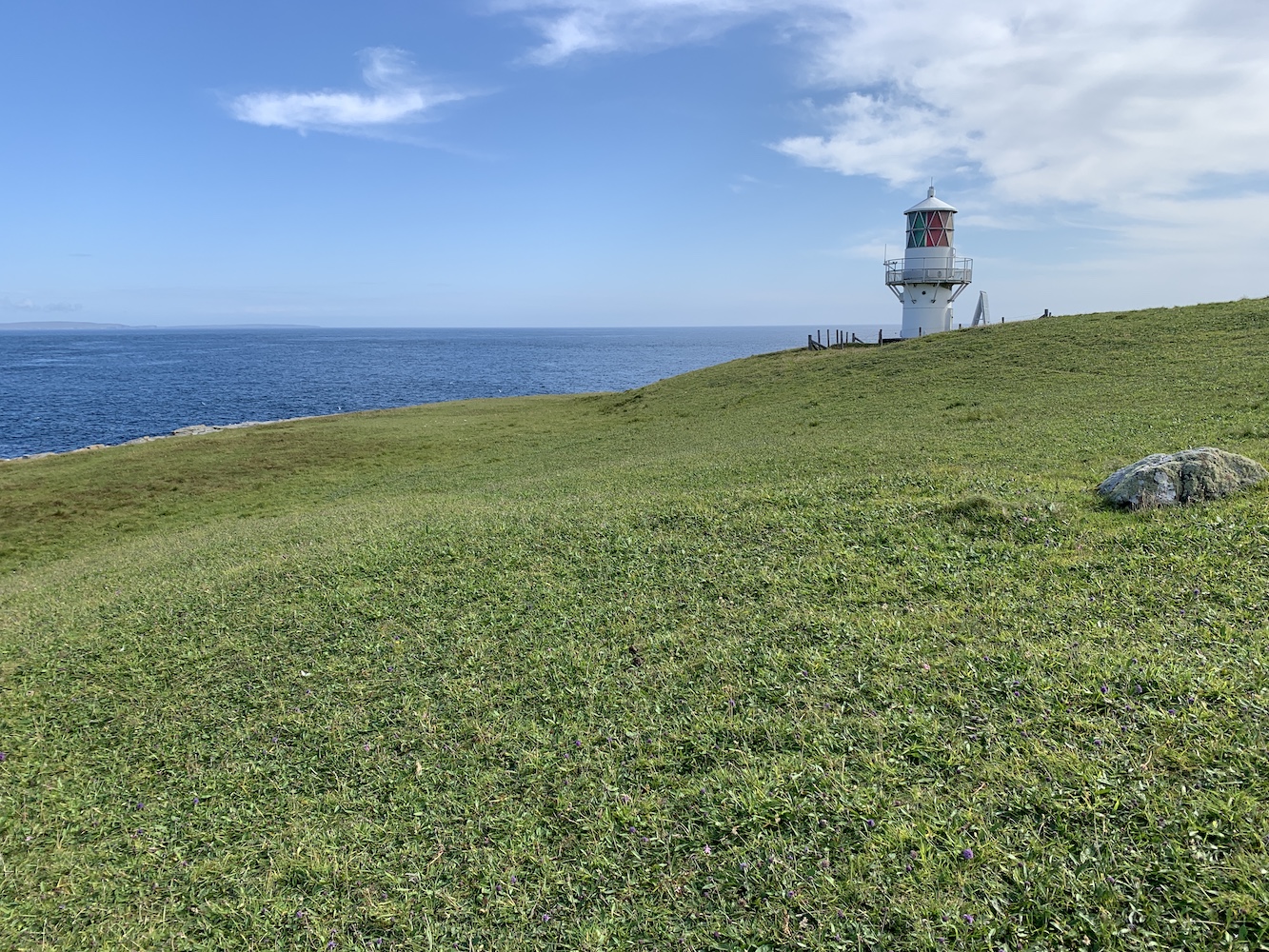
A little more up and down later and the lighthouse suddenly comes into sight – and what a sight it is.
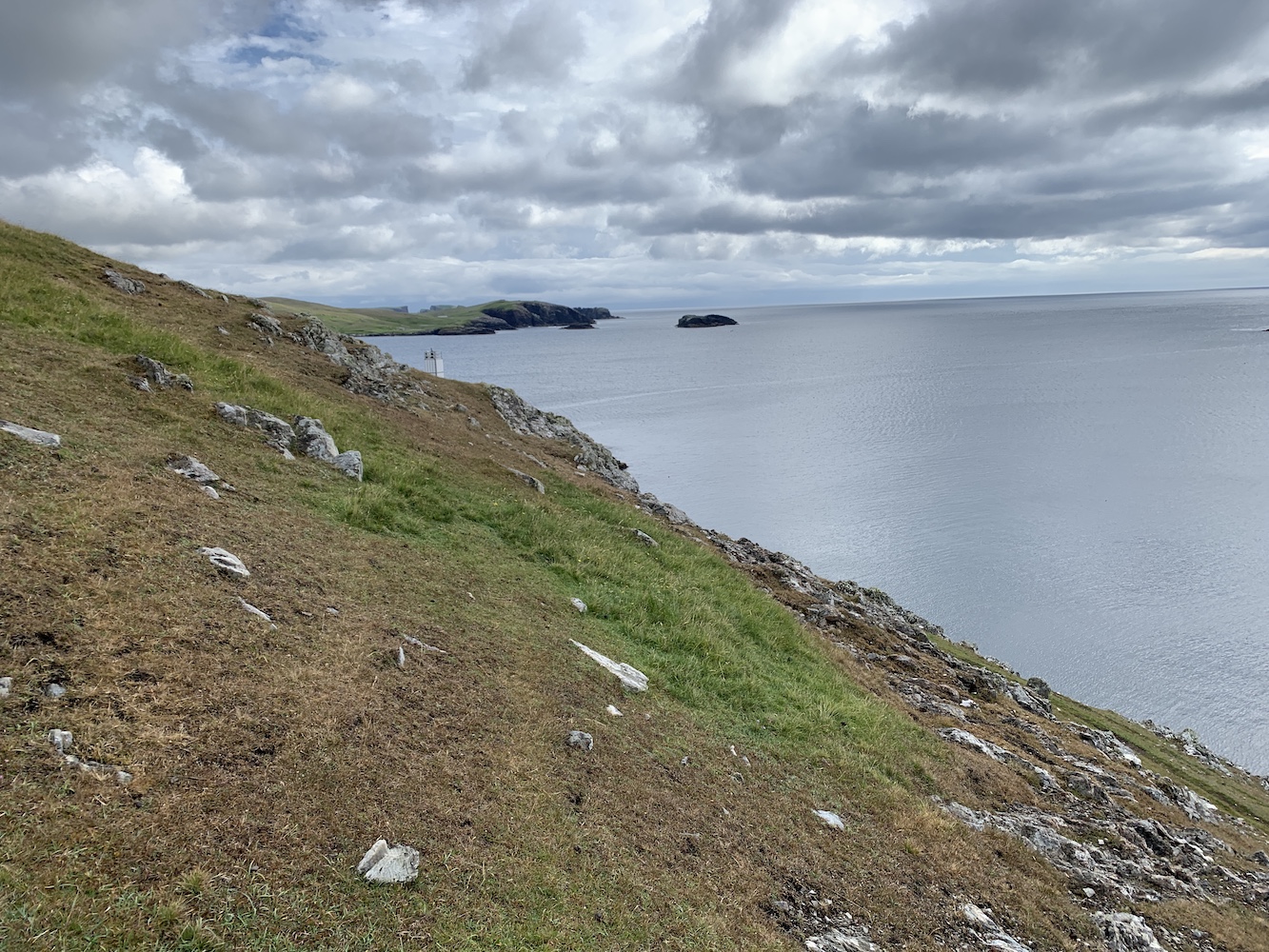
Vaila Sound Lighthouse comes into view

Bob set about preparing Joe the Drone while Andrew, John and I made our way towards the lighthouse.

Tour Guide Andrew on the approach to Vaila Sound Lighthouse

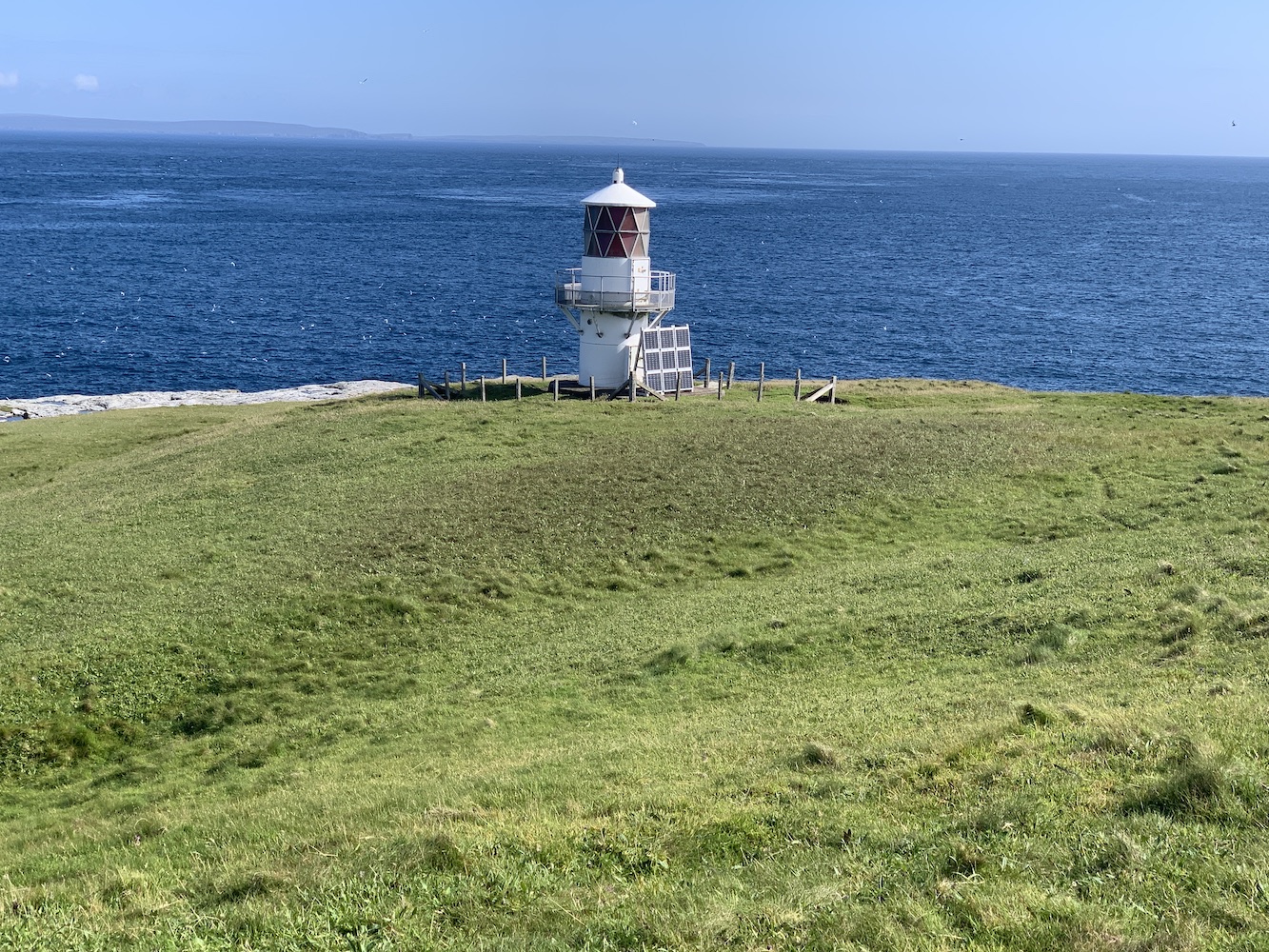
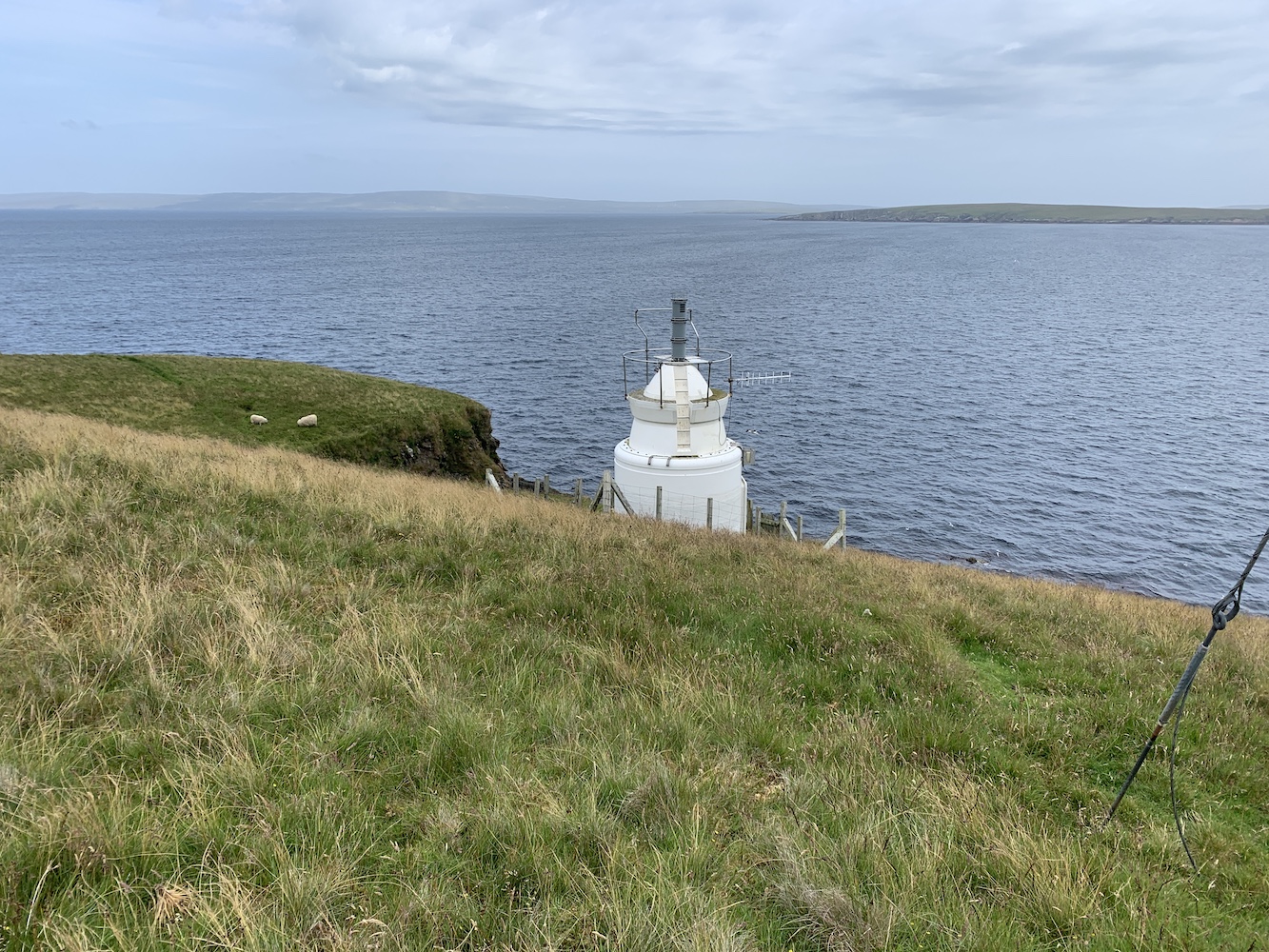
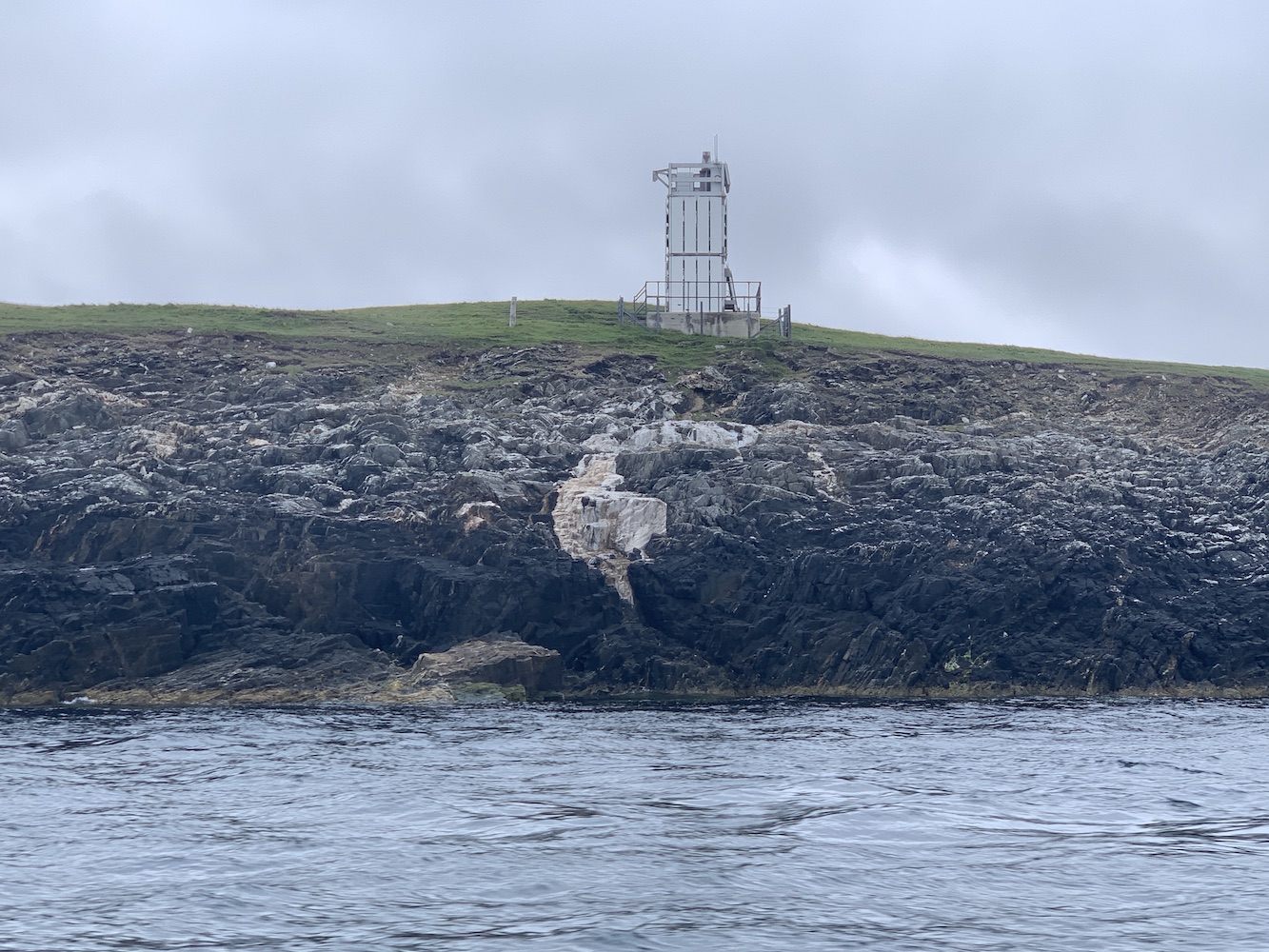
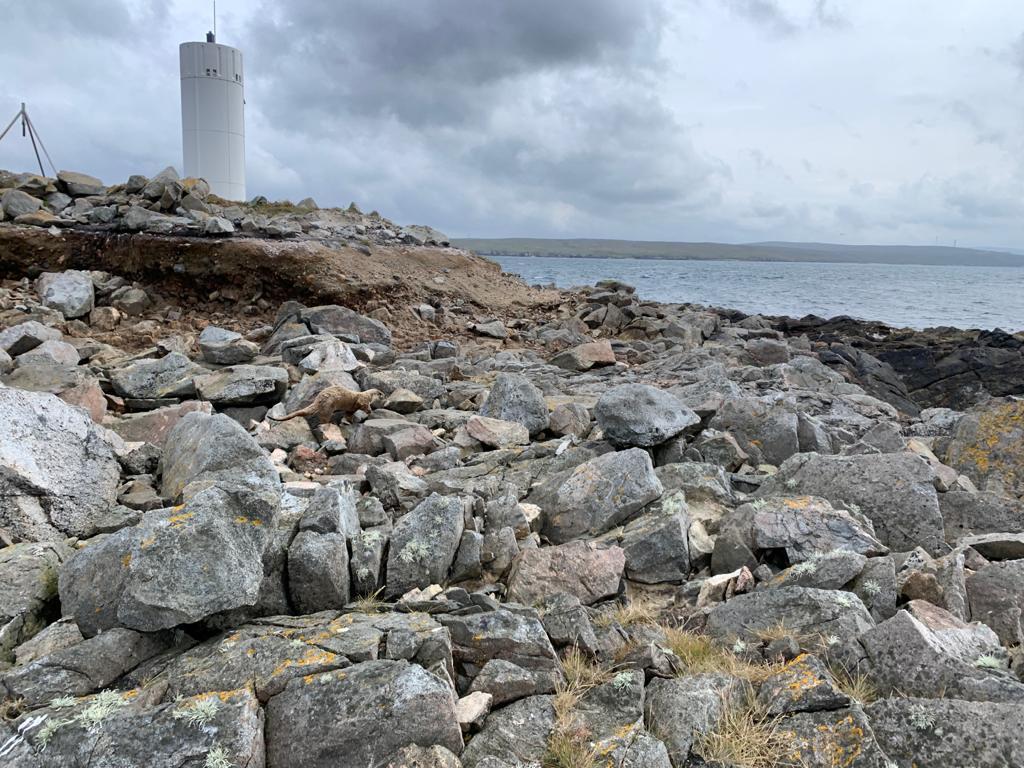
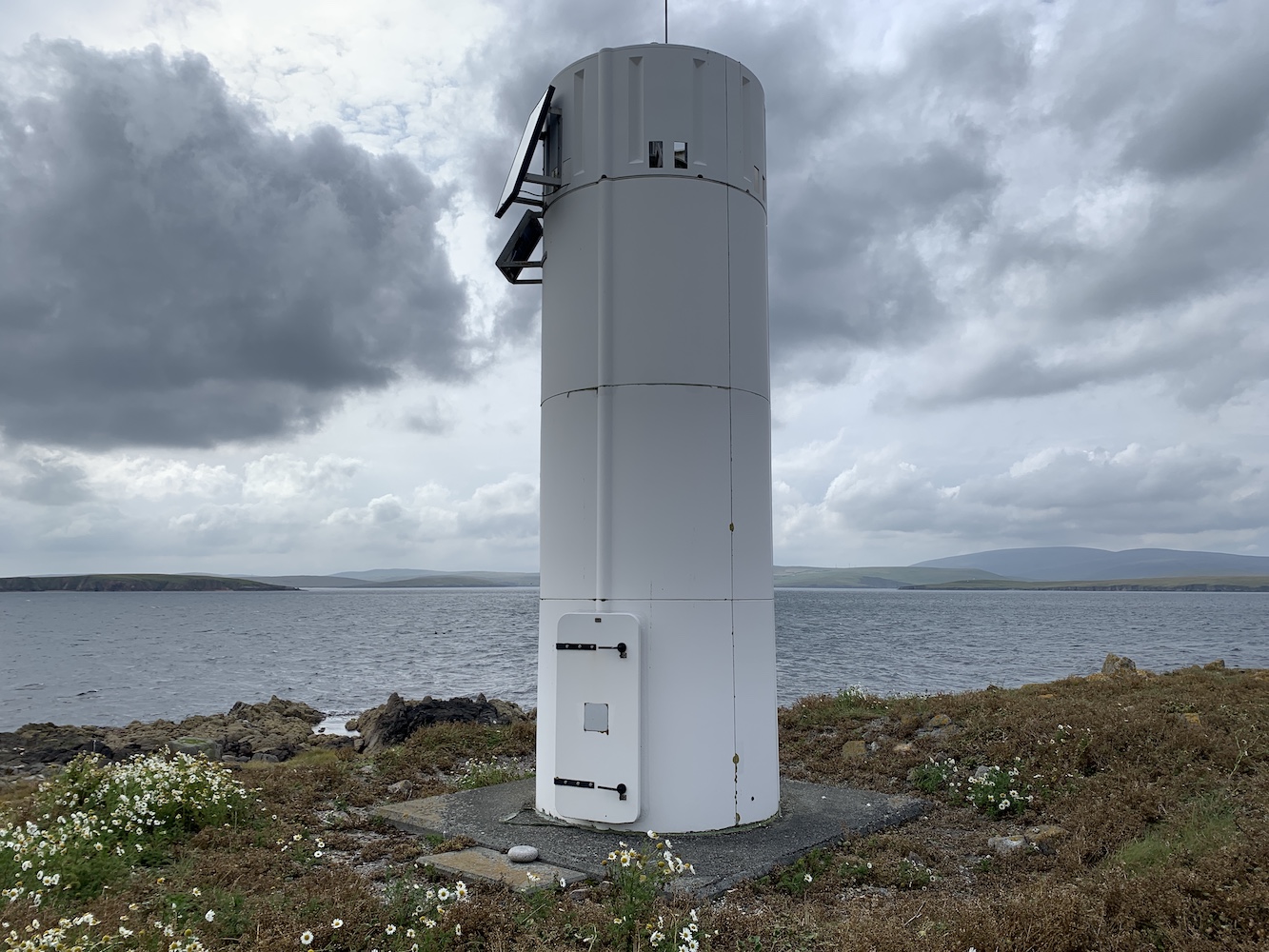
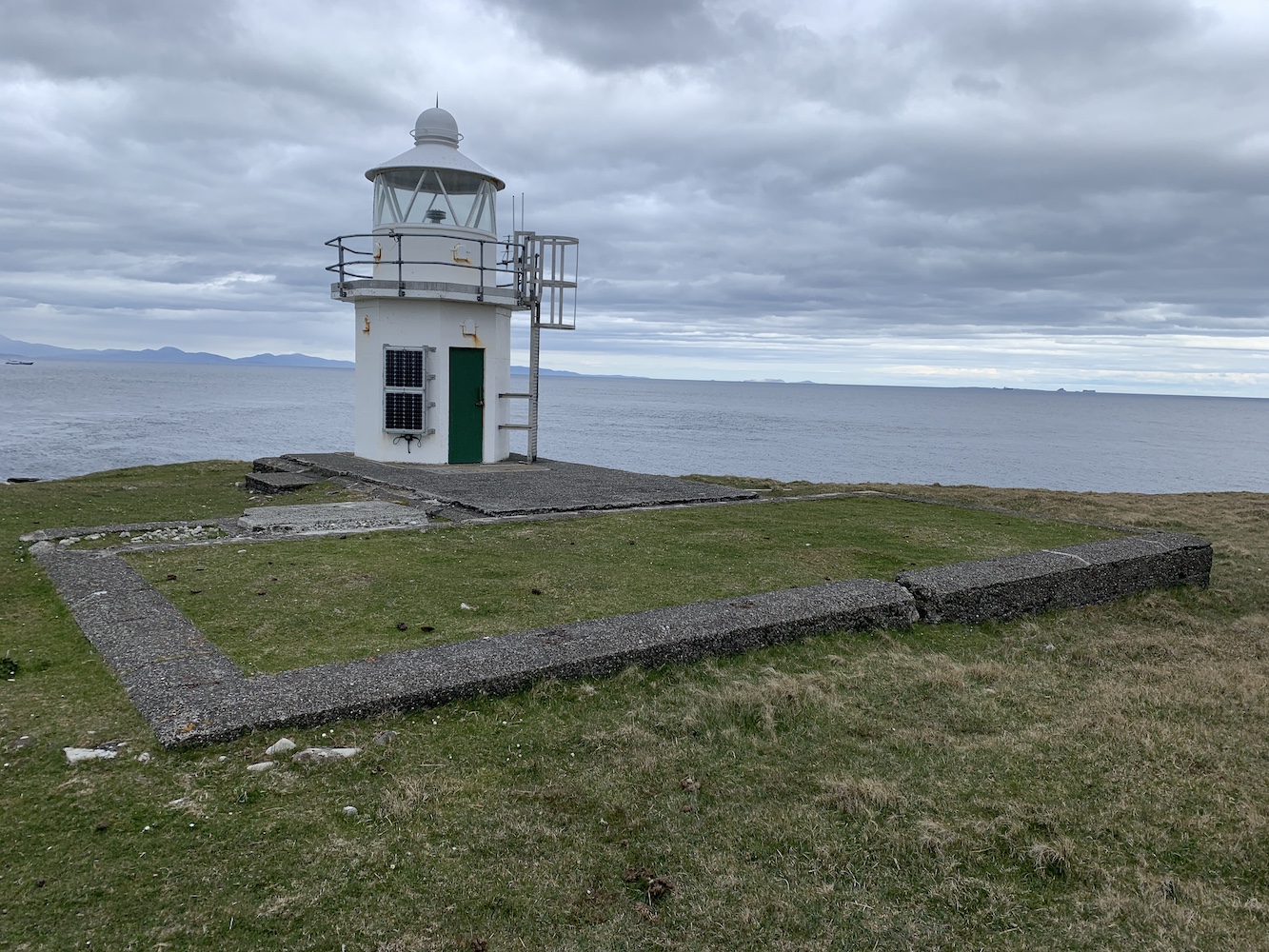
Unlike Hillswick and Bagi Stack lighthouses, this one is set fairly low down near the water and so it was possible to stand on the rocks behind it and get a great view of it against the serene waters of the Sound.
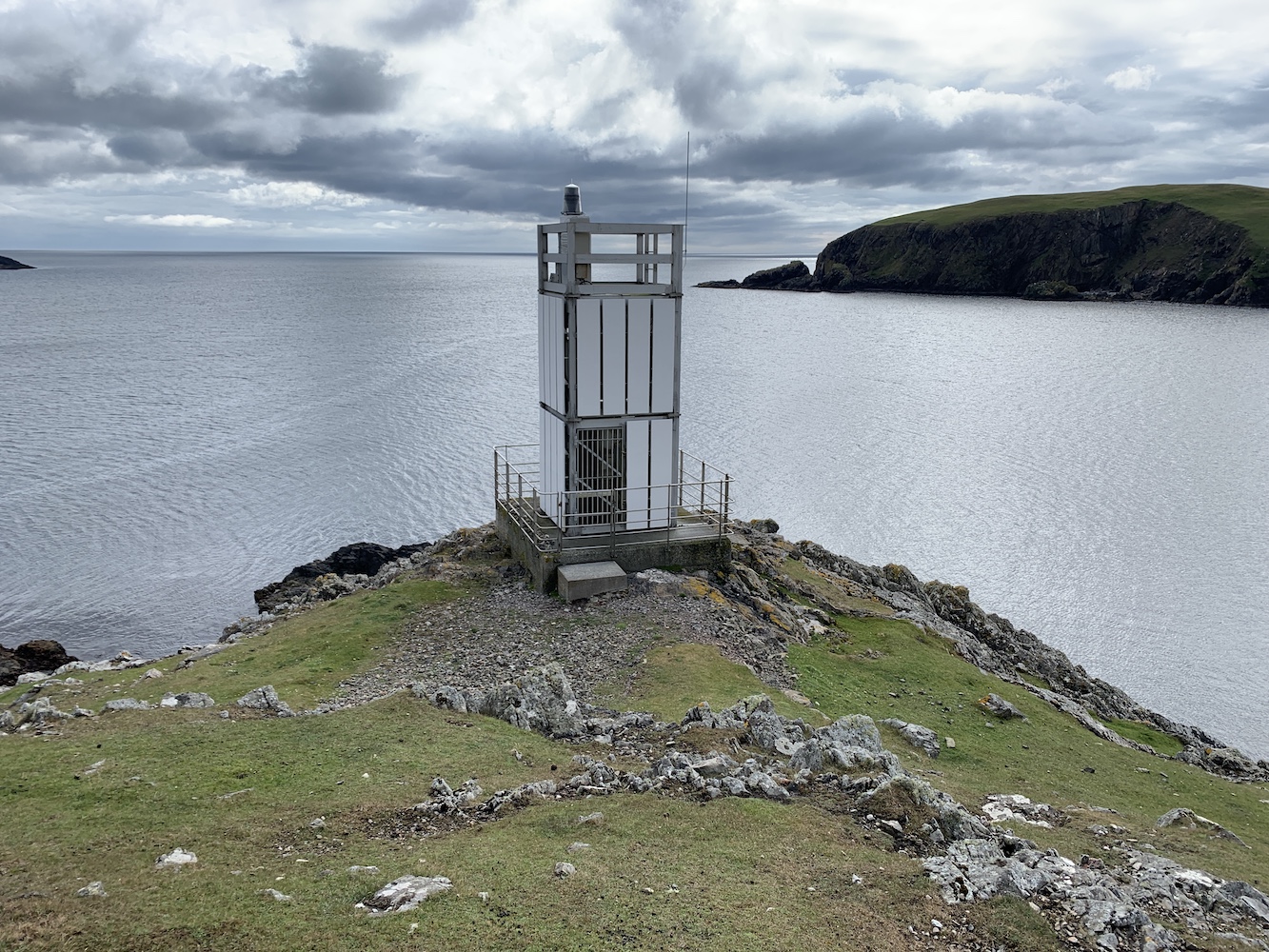
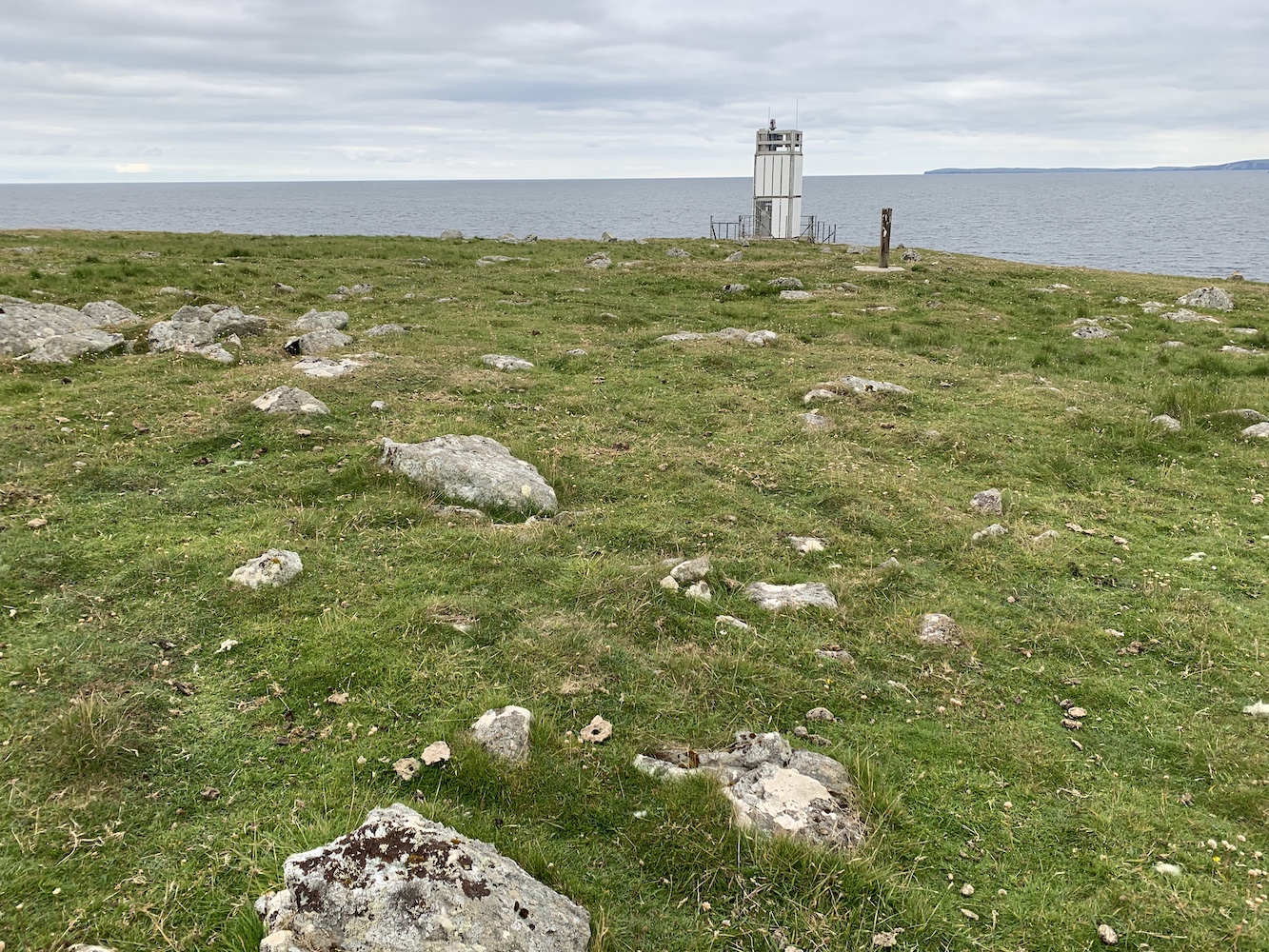
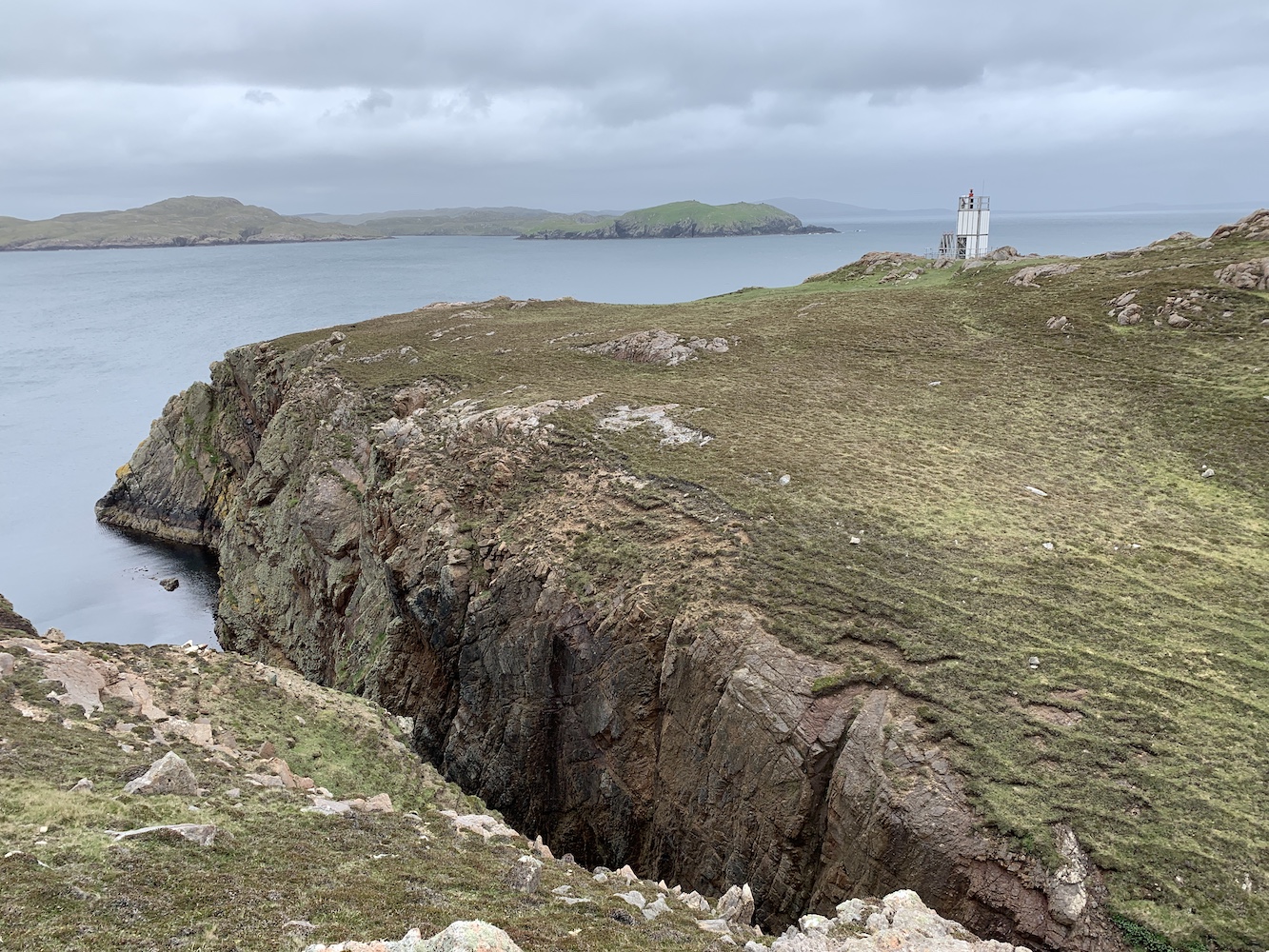
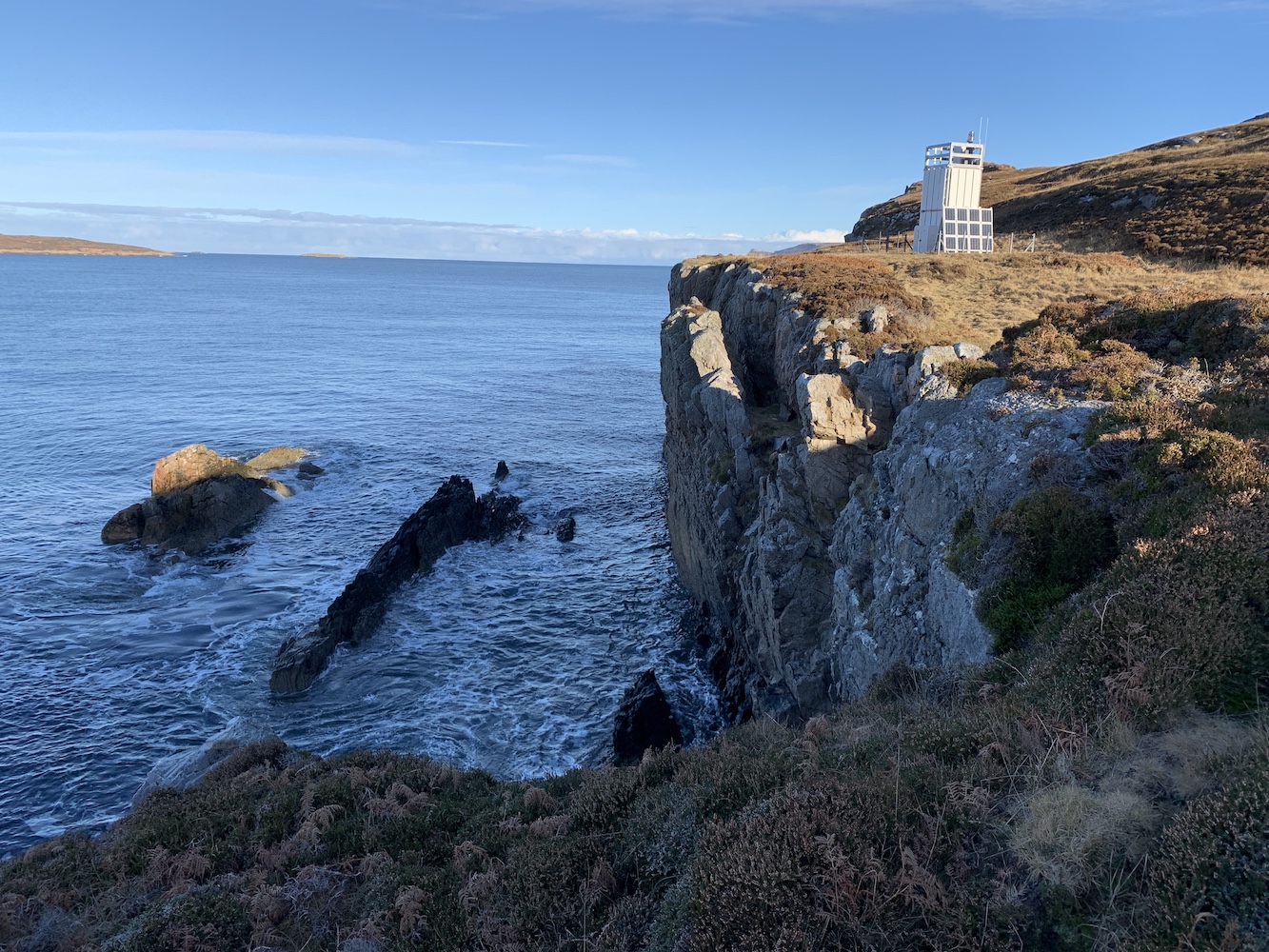
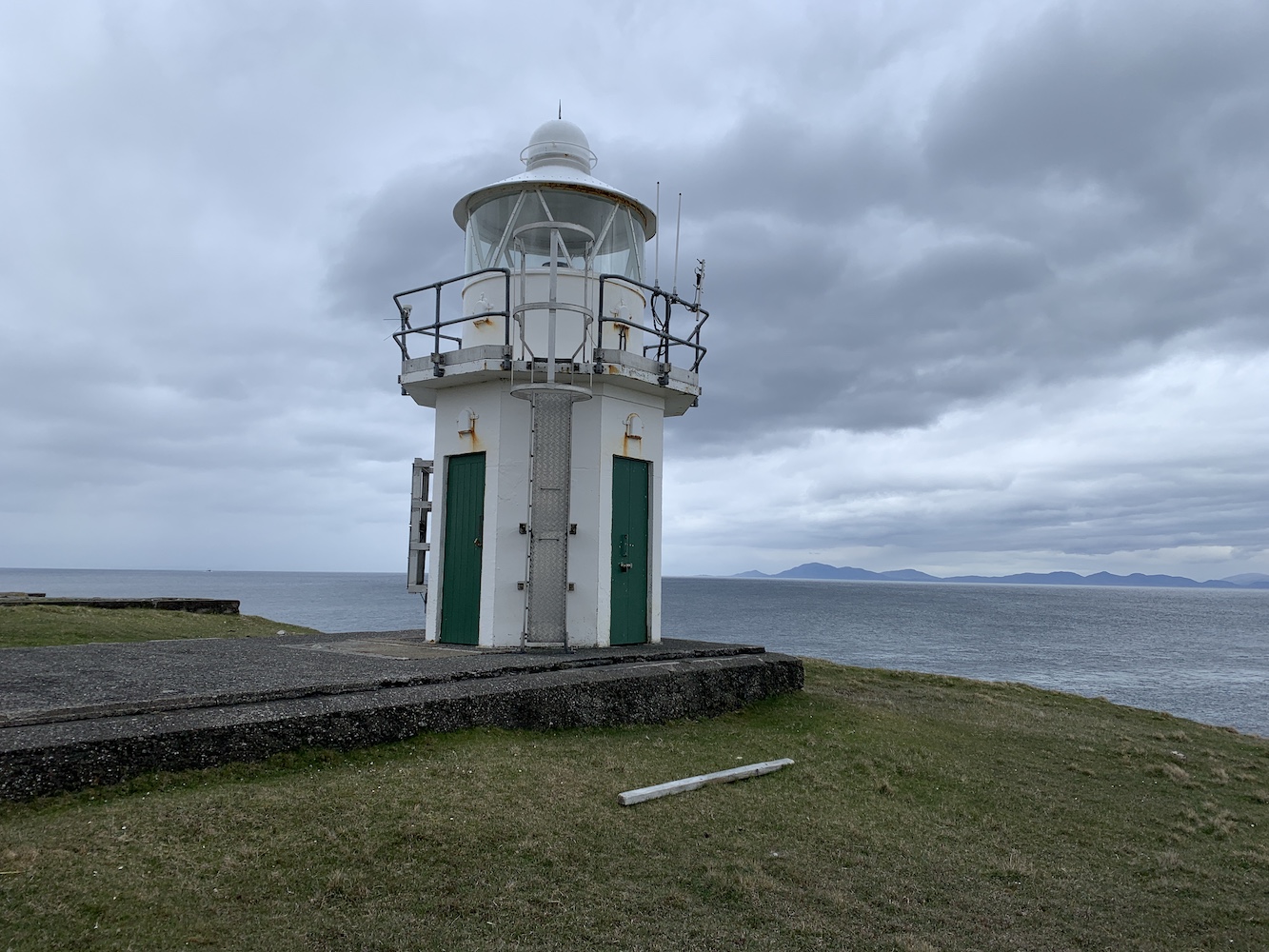
Vaila Sound Lighthouse

While we were gazing at the lighthouse a little fishing catamaran sailed past and honked its horn at us. It’s not often you get an opportunity to see a boat moving near one of these little lights so it was a perfect picture opportunity.

The little boat passing the lighthouse

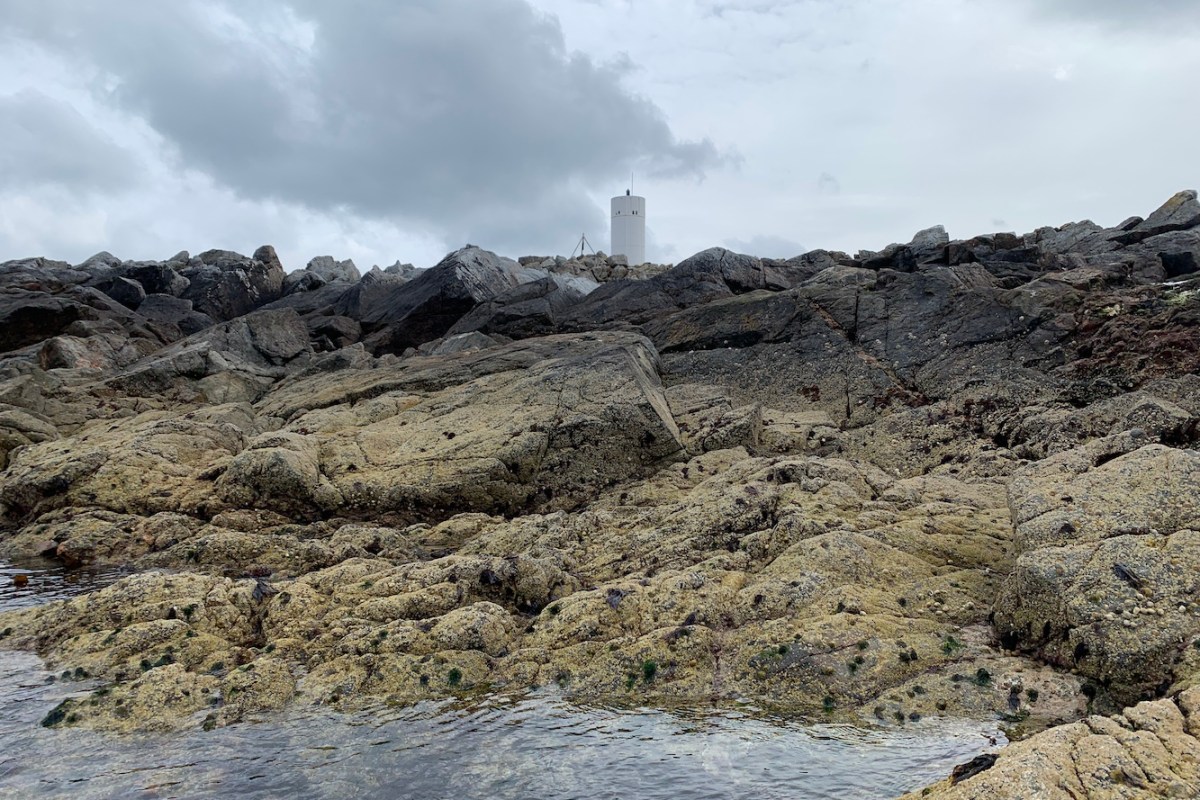
The rocky terrain in front of the lighthouse is lovely and the jagged rocks compared to the calm waters in the area were a striking, but great contrast. I imagine it’s not always so calm!
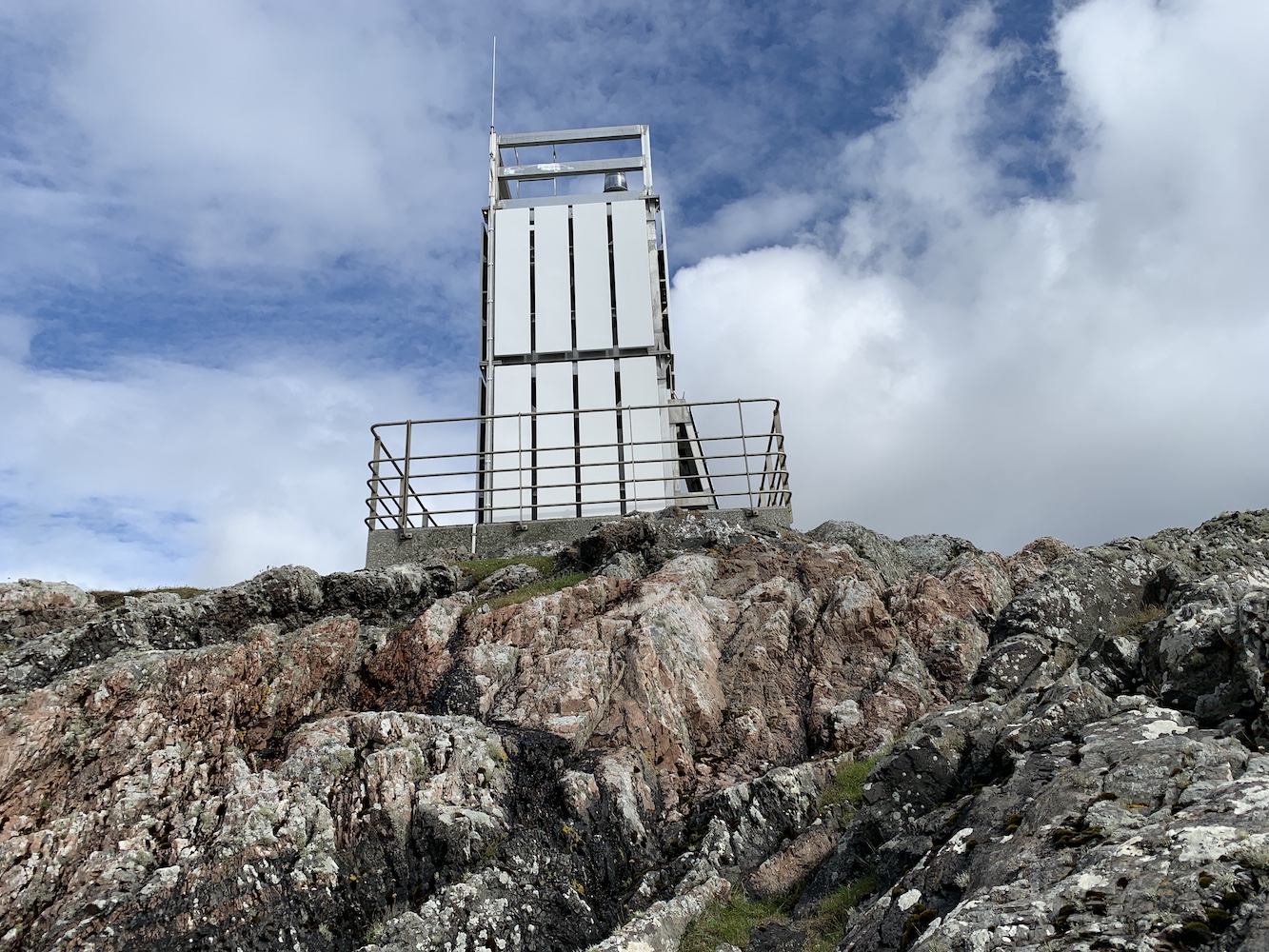
Vaila Sound Lighthouse from below

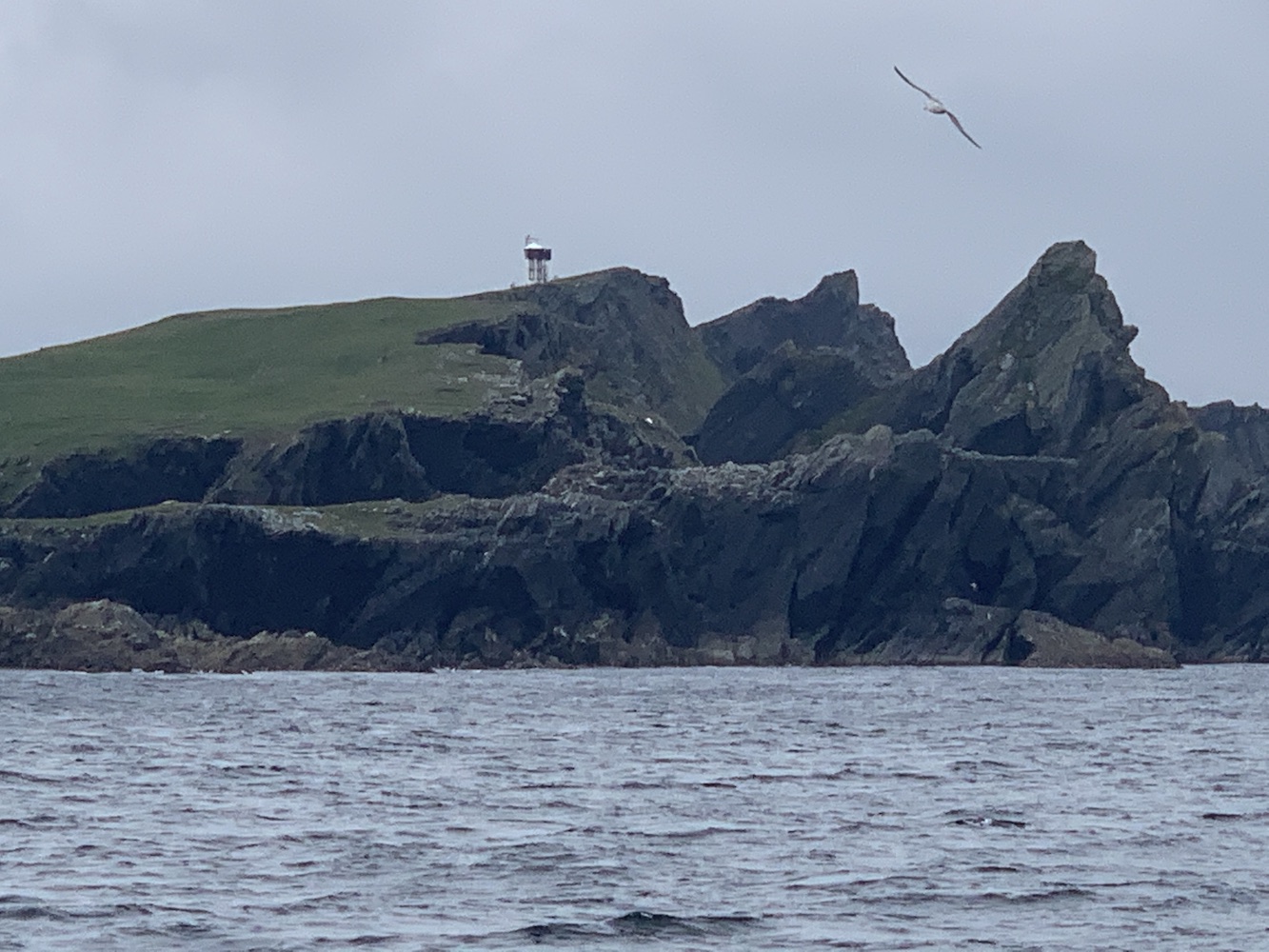
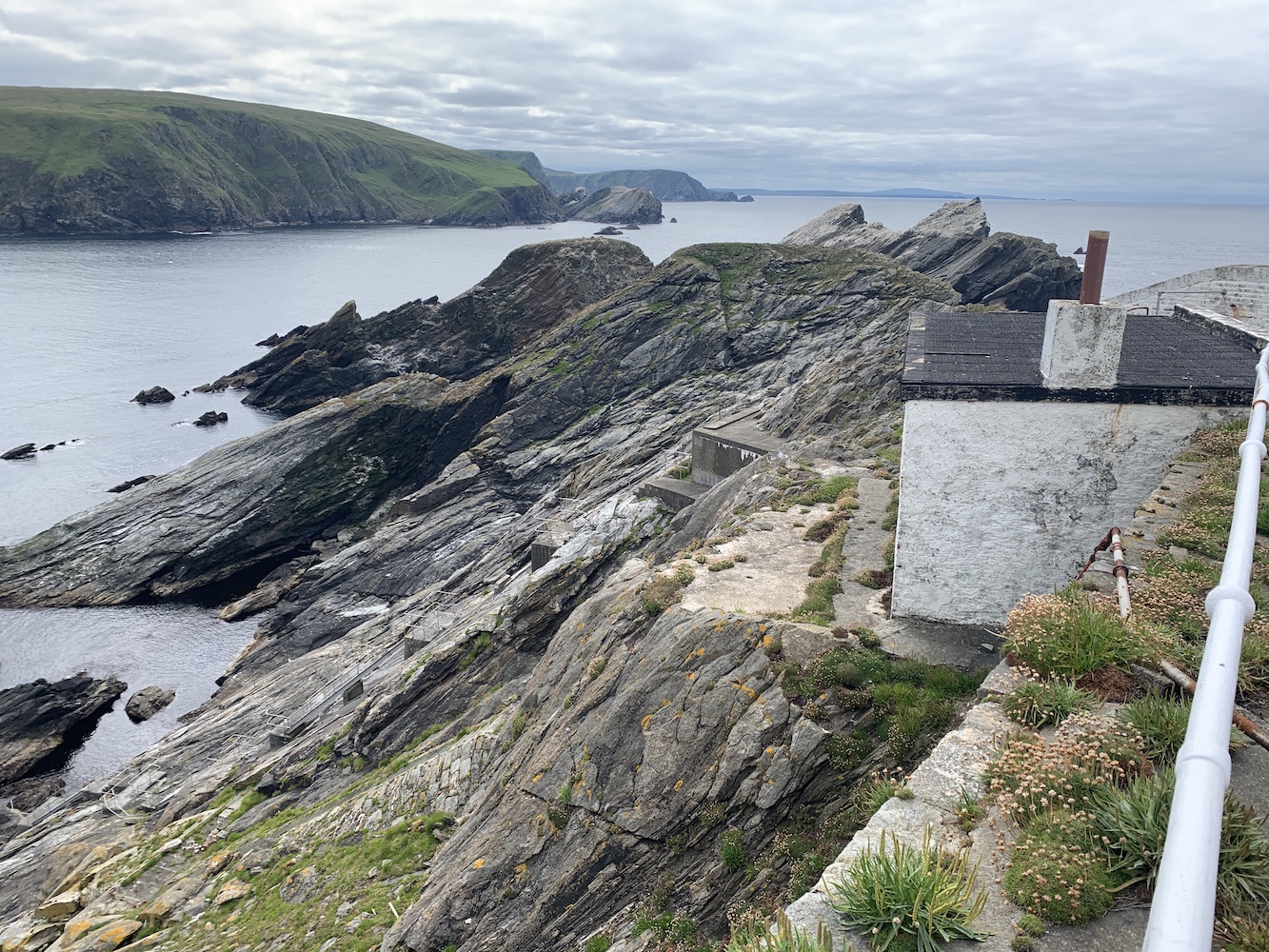
It was possible to see the old boat landing area nearby and it looks like a little leap may be required to get from the flat landing area to the surrounding rocks to avoid wet feet!

Looking west across Vaila Sound with the landing platform just visible in the dark brown rocky area

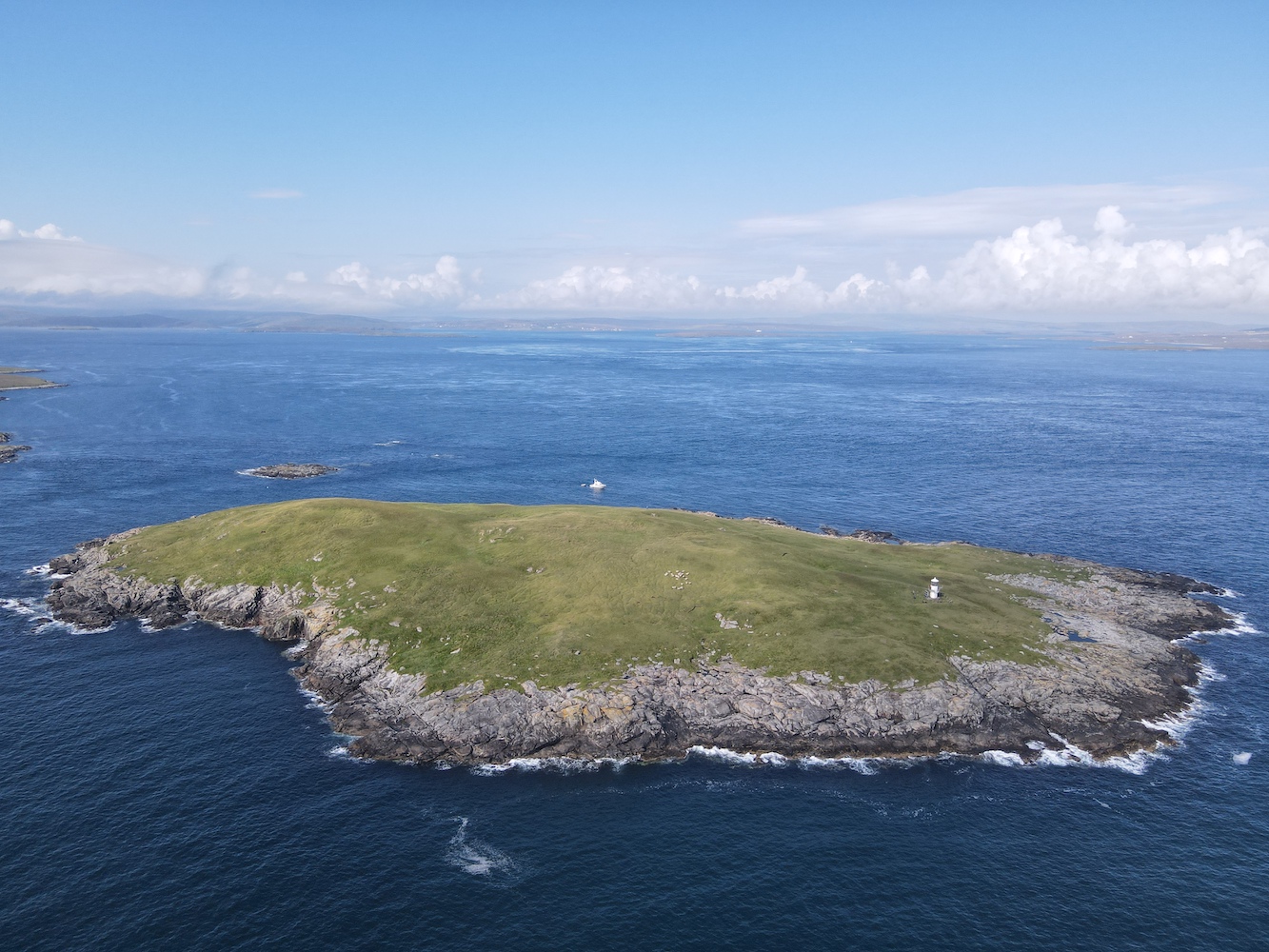
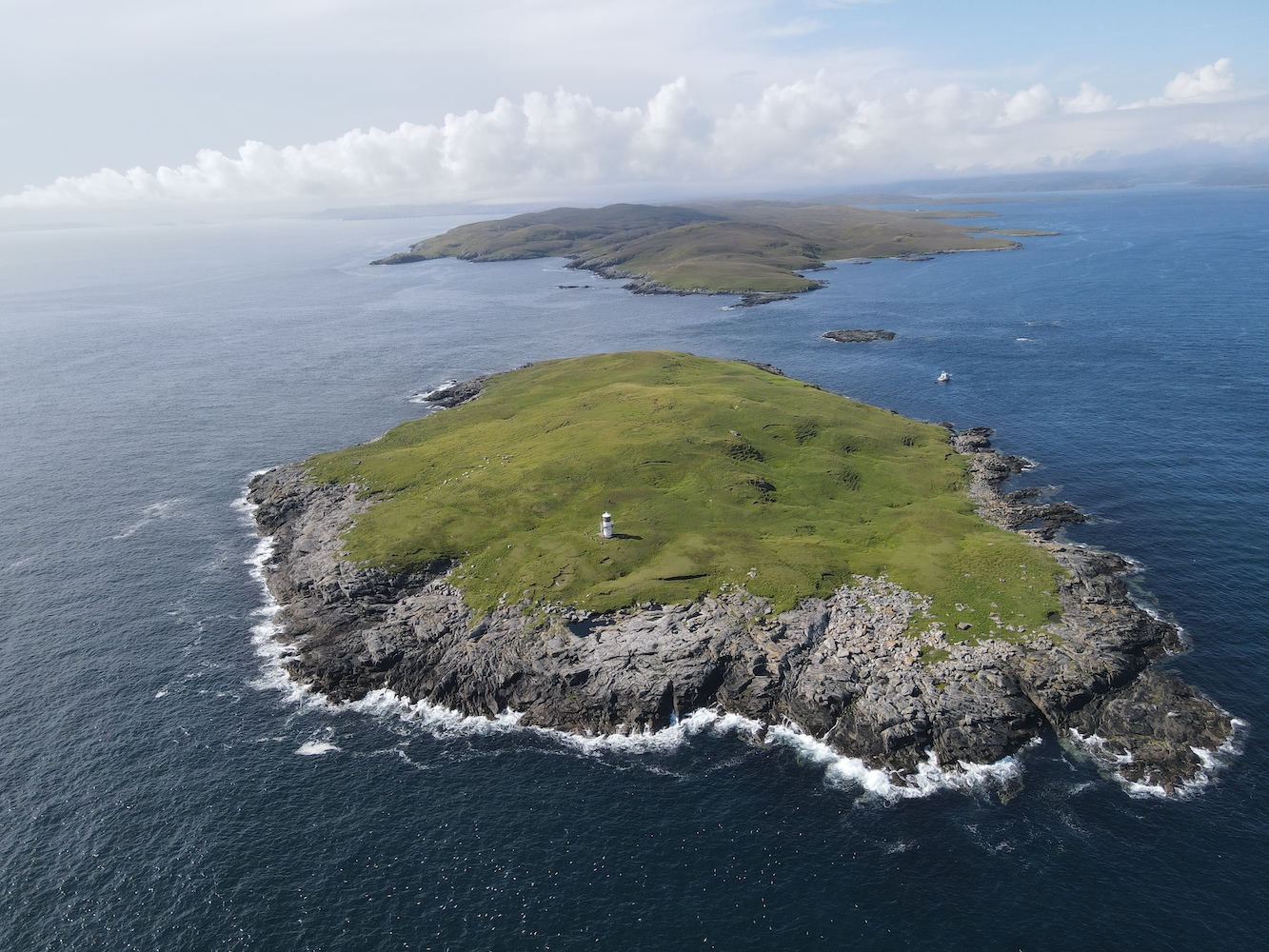
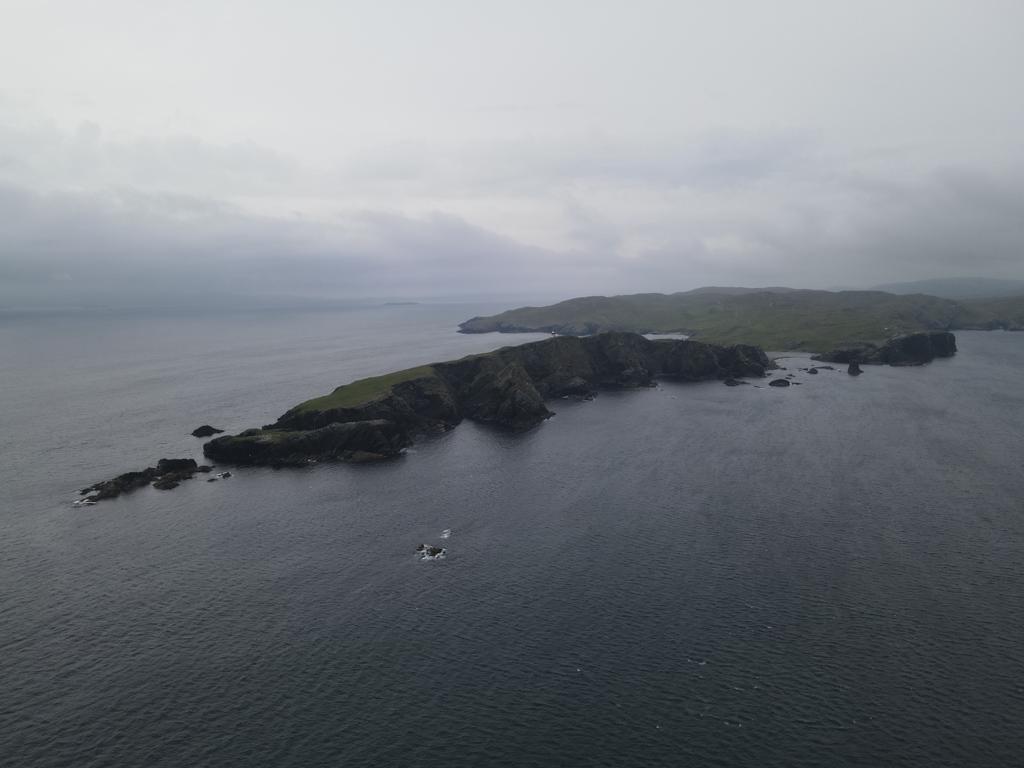
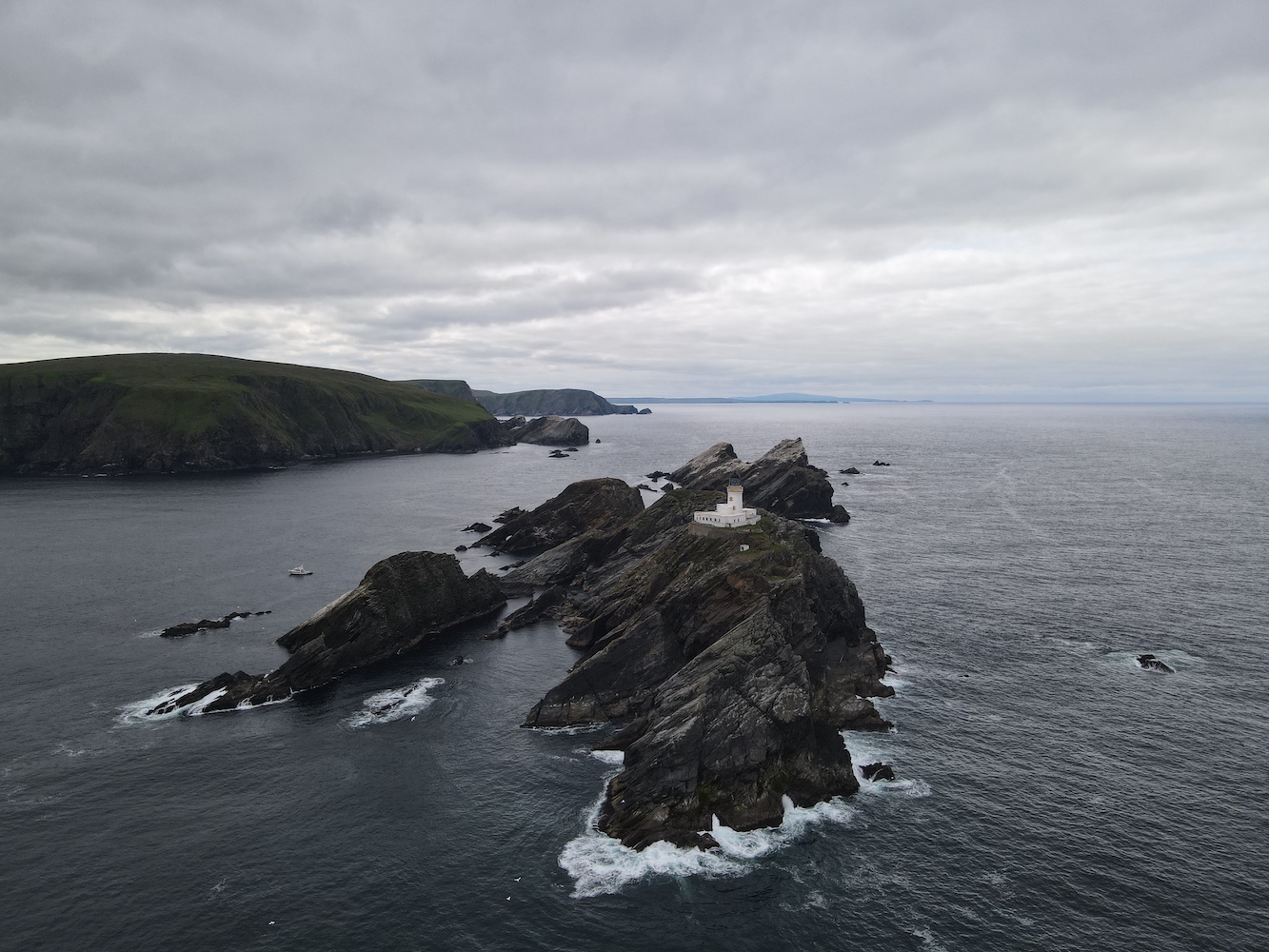
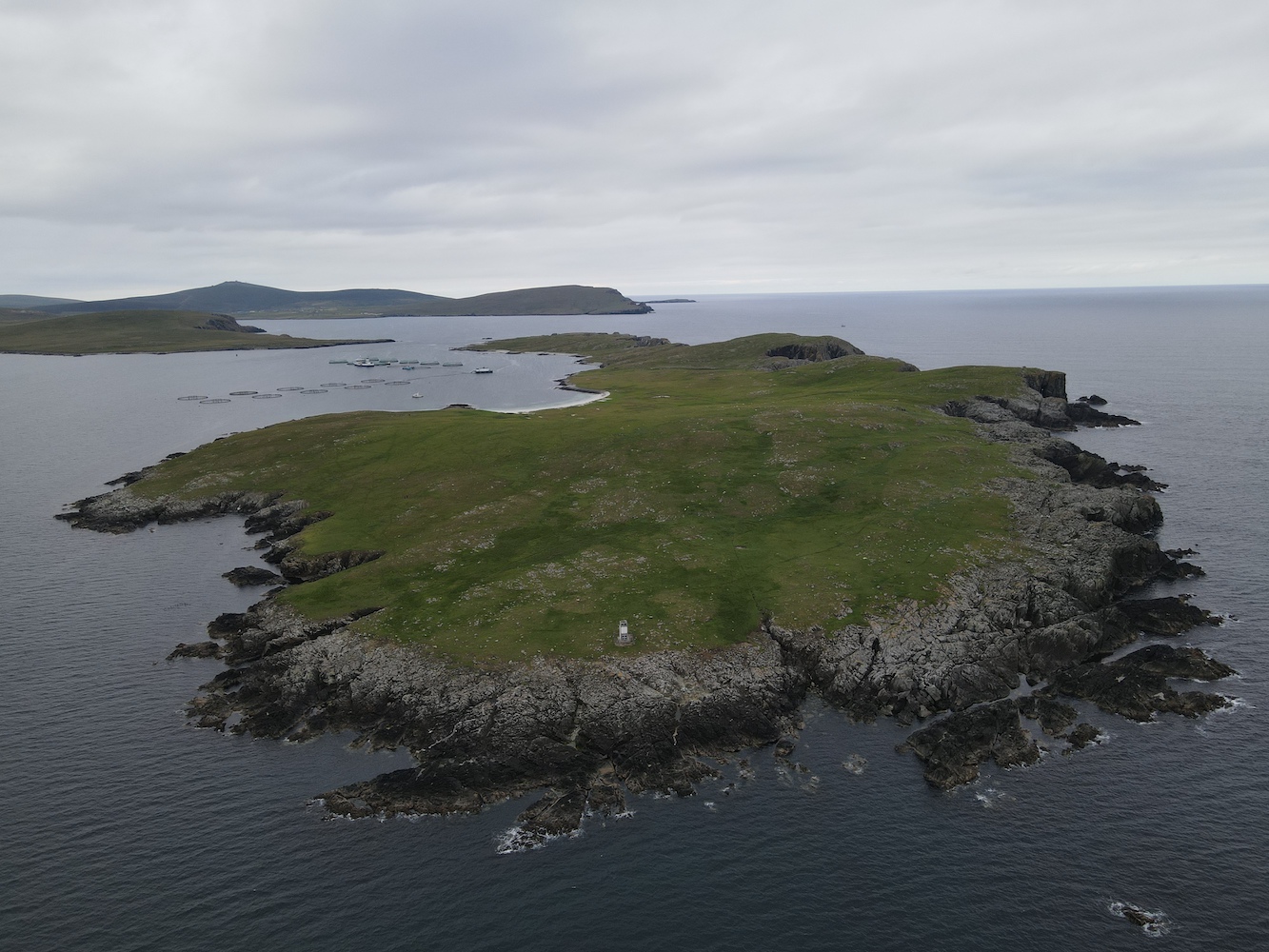
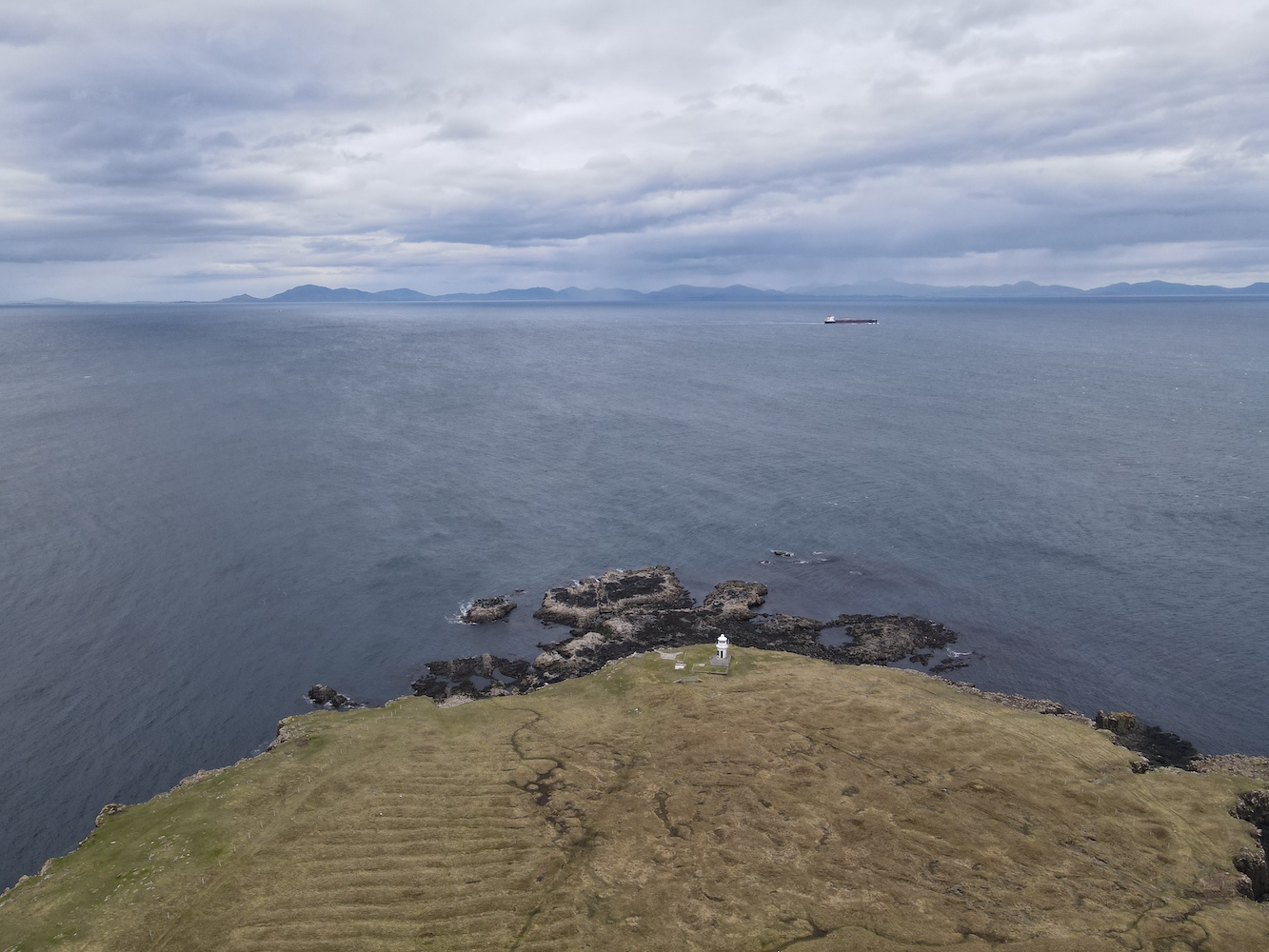
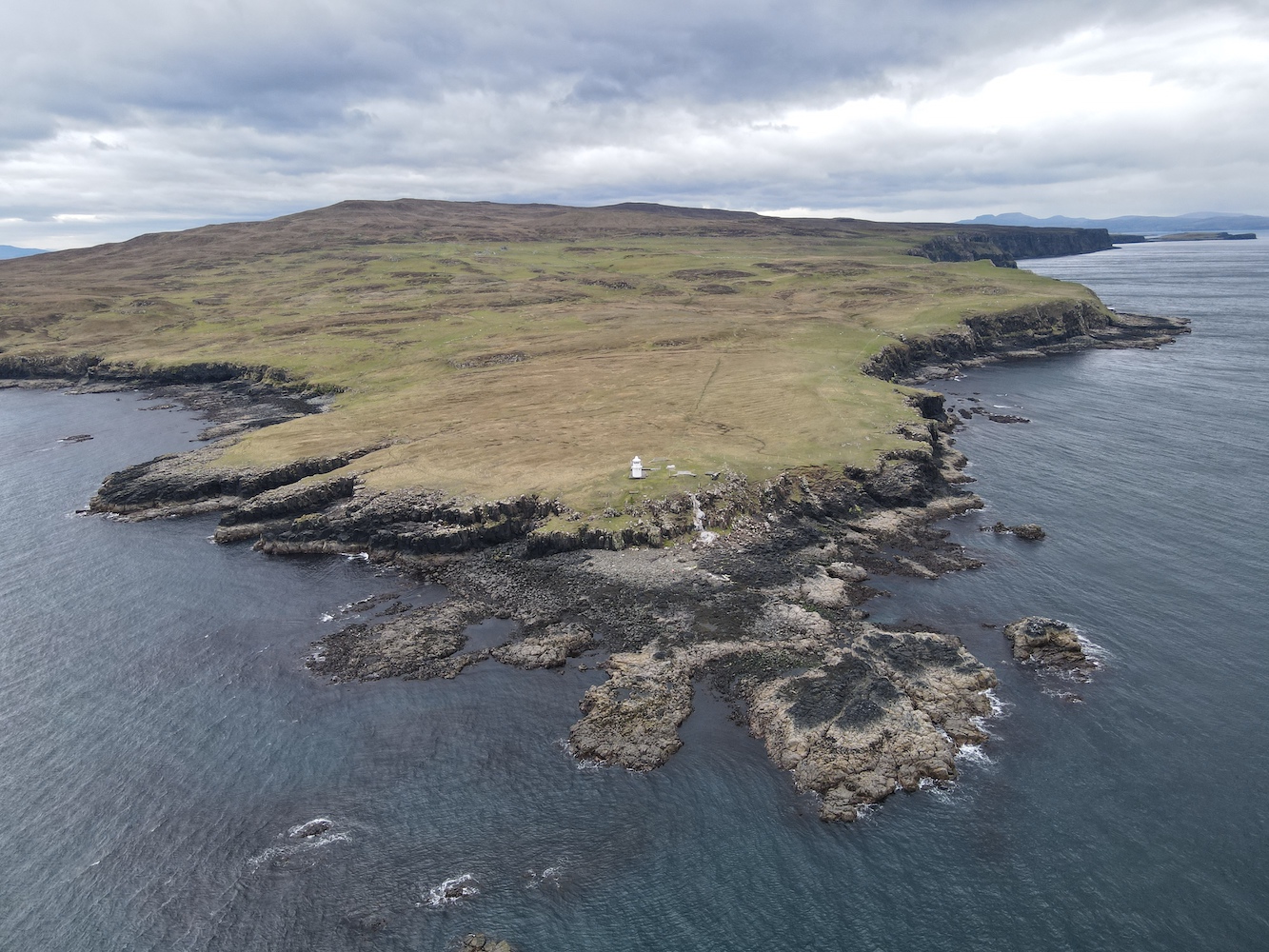
Joe the drone, as ever, got some super scenic shots from above, including this one, which I absolutely love. Little did I realise at that point what was around the corner!
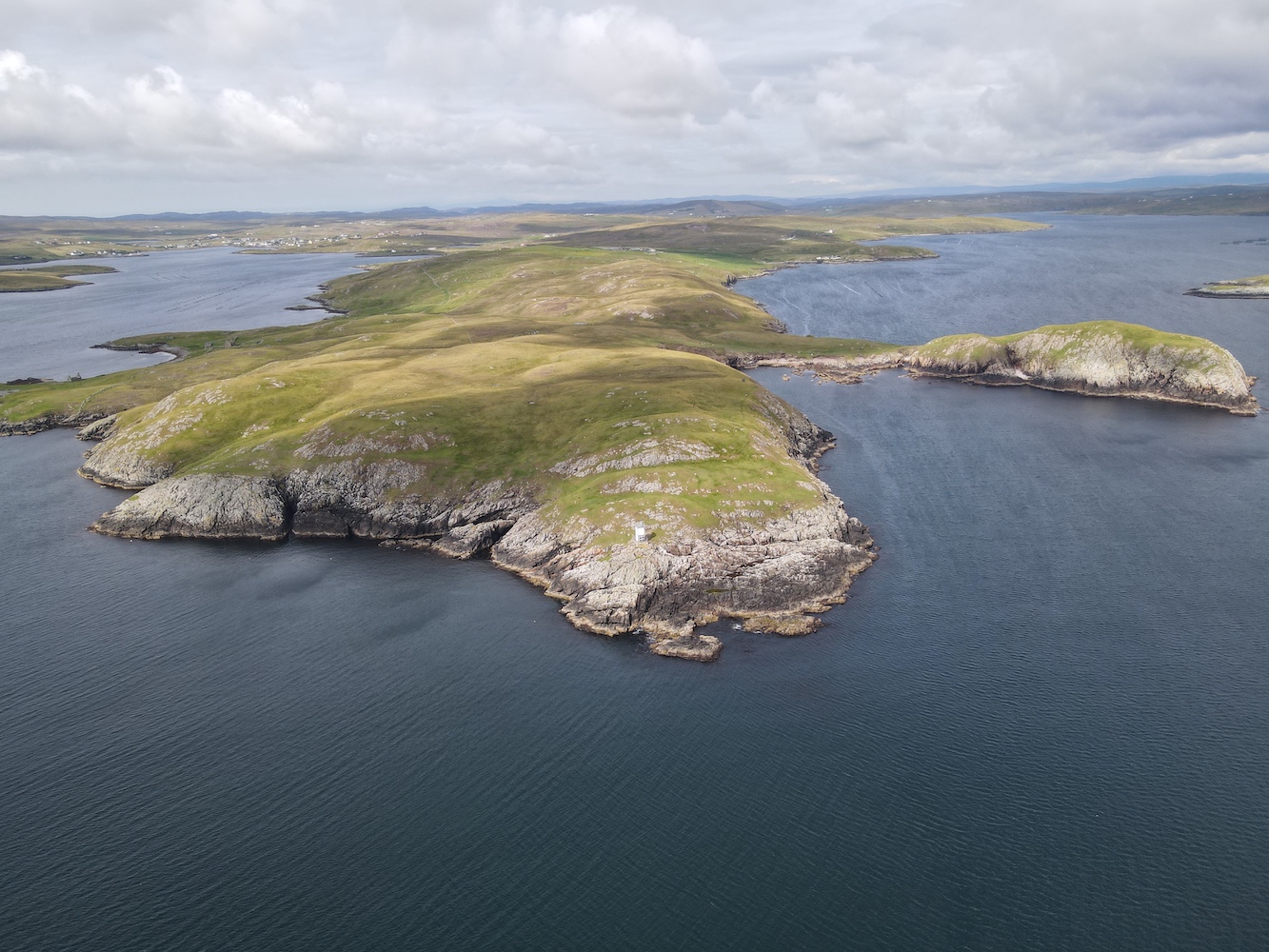
Ram’s Head and the Whites Ness peninsula from above

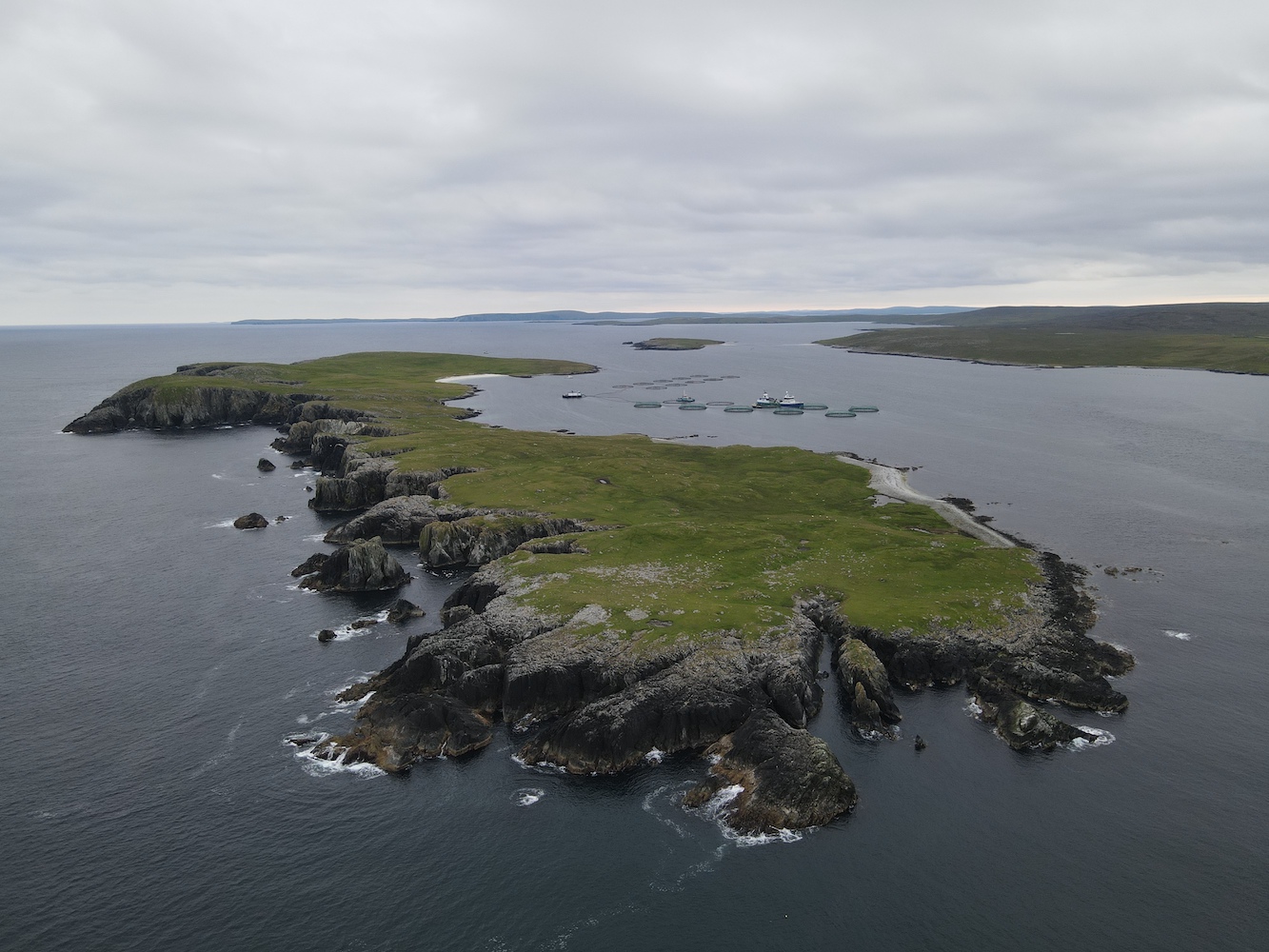
Sometimes you come across a view that just makes you say ‘wow’ (or in my case ‘wowzers!’) and the fabulous promontory of Green Head was a perfect example of that – and yes, I did indeed say ‘wowzers’ out loud when I first saw it.

Green Head

As you walk further around the coast you see more and more of the promontory and realise it’s actually joined to the Whites Ness peninsula by a narrow section of land.

Green Head from a different angle

From here we headed inland across a slightly boggy section of land before returning to the field we passed through and then onto the track.

A little wet underfoot at this point

This felt like a stroll in the park in comparison to some of the other recent walks to see lights. If there is anyone who happens to be in the Shetland area who isn’t sure about whether or not to visit a flat-pack lighthouse then this one is a great one to start with. It has many of the benefits of a flat-pack lighthouse – with the main one being that it’s in a stunning location – but without the tough walk. Just brilliant, and a really enjoyable way to get those ‘walkable lights’ done.

I should also mention here that I went on a short trip to Sumburgh Head Lighthouse this morning with my kids. They were delighted to see the Light the North Shetland map lighthouse on display here and, of course, had a wonderful time pressing the button in the museum that blasts out a foghorn’s bellow. I’m not sure the museum staff were so delighted!

Sumburgh Head Lighthouse with the Light the North lighthouse

Another great day in Shetland, but what will tomorrow bring…! 🙂

A stop off at Lunna Holm

The wind had dropped for us in Shetland overnight and, although we knew it may be a while before the sea recovered from 48 hours of strong wind, we decided to head out on Lysander again today and see what we could achieve.

Today’s trip started off at Ulsta on Yell and the agenda featured a number of islands including Lunna Holm which I’d been keen to get to for a while.

A few islands were visited and we got a closer look at the light on Rumble too. The tide in the area made it a very rocky little detour.

The Rumble light

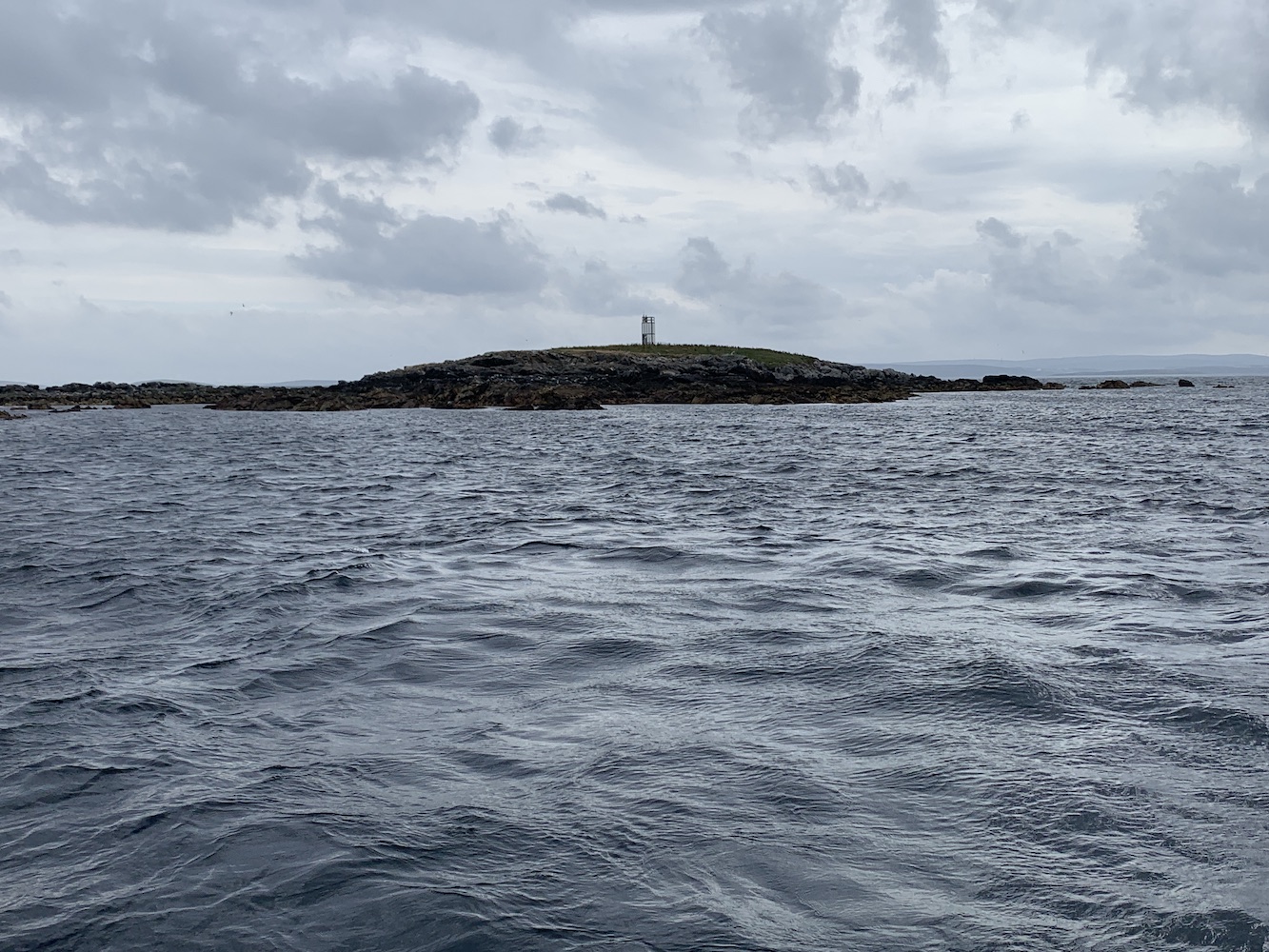
A little while later we arrived at Lunna Holm. There was still plenty of movement in the water, but it didn’t prevent us landing thankfully. It‘s a nice little island and we wandered up towards the high point and then cut across in the direction of the lighthouse.

The first sighting of Lunna Holm lighthouse after landing

The lighthouse on Lunna Holm dates back to 1985 and it was introduced to mark the south eastern approaches to Sullom Voe during the hours of darkness. The foundations were prepared in the first half of 1985 and by the end of that year the structure was complete and the light operational.

Lunna Holm in the sunshine

The lighthouse, which is still the original 1985 tower, and it’s surrounding fence look like they could do with some attention so I was pleased to find that, in June this year, the Northern Lighthouse Board put out a tender for full refurbishment of the lighthouse. This is due to include not only a refurb of the tower and concrete base, but also replacement of the lighting system and the fence that surrounds the structure.

Lunna Holm Lighthouse

One of the crew on board informed us that a former inter-island ferries, The Earls, ran aground on Lunna Holm back in the 1980s, which may well have occurred before the lighthouse was installed.

The island reminded me a lot of Cava in Scapa Flow, Orkney. The lighthouse is the same type, the island has a similar sort of layout (for want of a better word), and the grassy terrain was the same. I always see Shetland and Orkney as being completely different, but there are definitely some similarities in certain areas, which geographically makes sense due to their relatively close proximity.

Joe the Drone went for a spin while we were there too.

Lunna Holm from above
Lunna Holm with Lunna Ness beyond

It was just the single lighthouse for me today, but I was happy. After a couple of busy walking days I was more than willing to spend a day on the boat and I even managed to fit in a nap, lying on the comfy seat, while the others ticked off another 6 islands in one go.

Tomorrow has the potential to be a very exciting day and I cannot wait! 🙂

The Bagi Stack experience

In the effort to visit every lighthouse in Shetland at some point I was going to have to do the walk out to Bagi Stack on the north west point of Yell. There was no boat trip today due to crazy wind and, as a result, far too much swell. Though the wind might make walks in exposed locations a bit less pleasant, my lighthouse pal John and I decided to give it a try today, knowing full well from the very start that it wasn’t going to be easy.

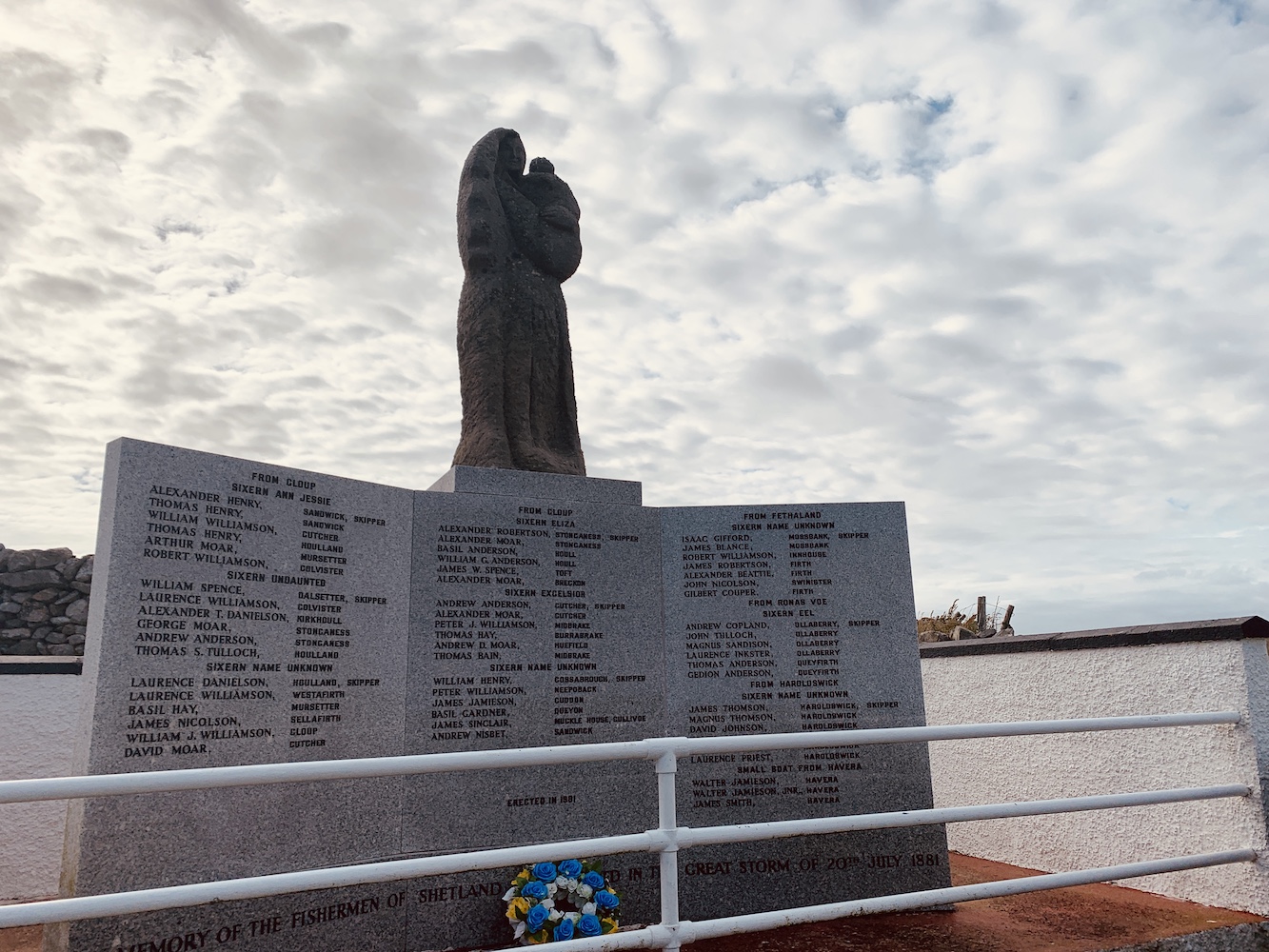
The start point for the walk is at Gloup, beyond Cullivoe. There’s a memorial here to the 58 local fishermen who were lost just off the coast in July 1881. The loss had a massive impact on the community with so many women and children left behind and cleared from the area after the disaster.

The Gloup Disaster Memorial

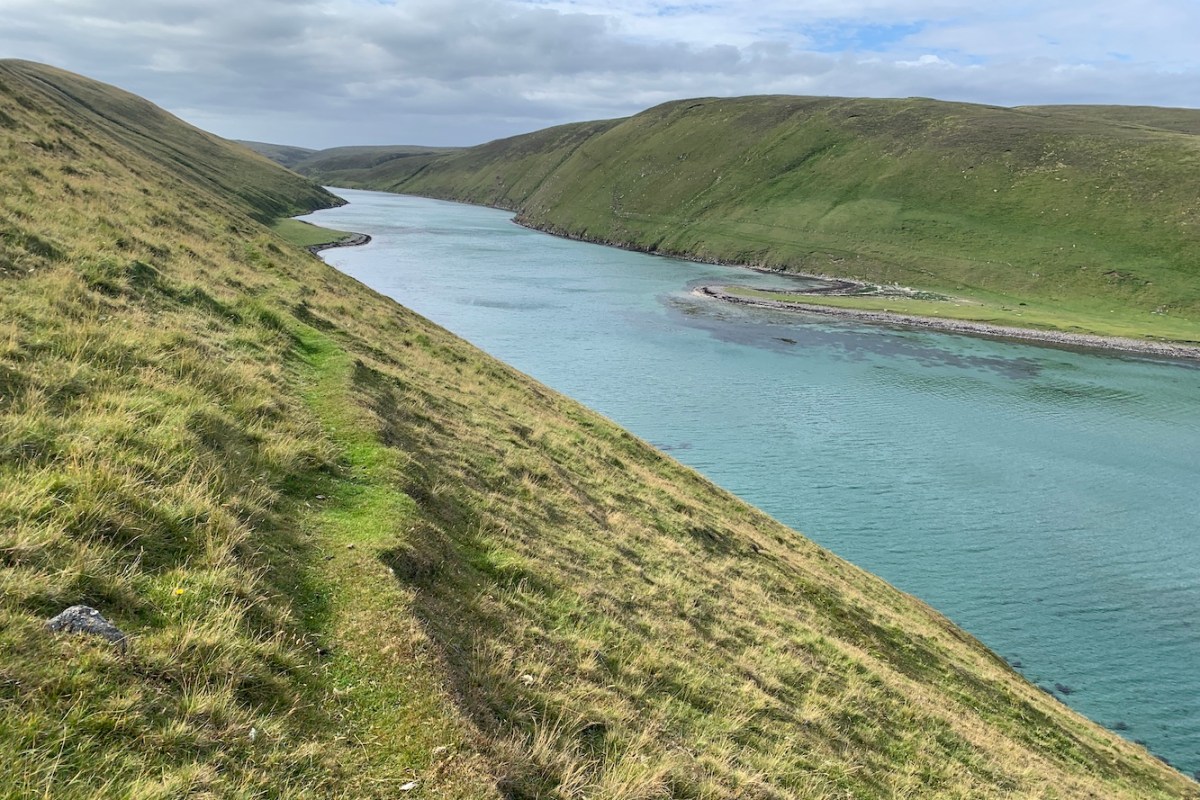
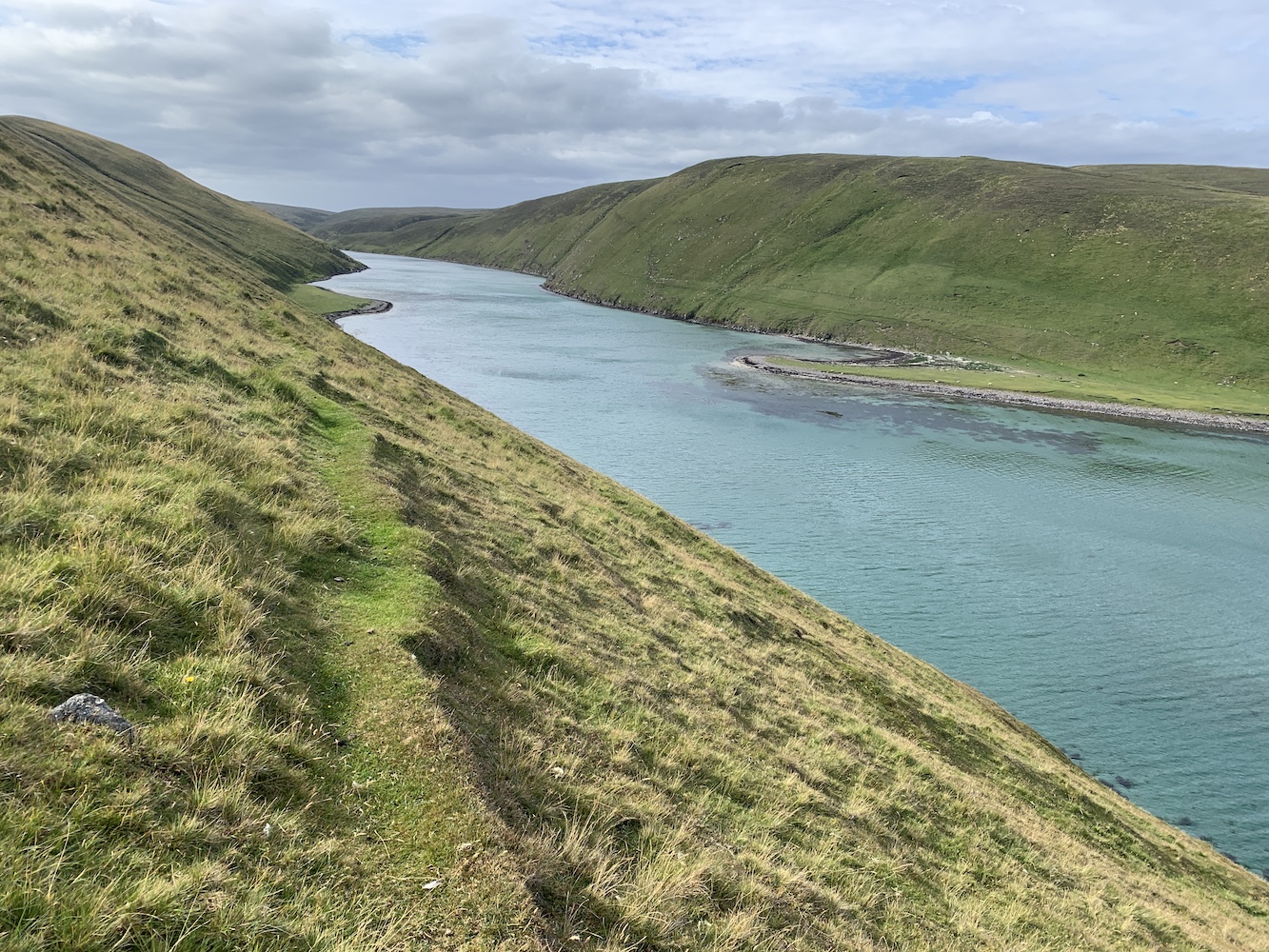
From here we set off to the south, passing some ruined buildings, and then continuing straight on we went through a small gate. The reason for heading south was that you need to get around Gloup Voe and Mare’s Pool before you can begin heading towards the lighthouse. After the gate the path got very narrow and was barely more than a sheep track, which wasn’t too bad to begin with, but it quickly became a bit more worrying as the land was steep and if you were to lose your footing it was highly likely you’d end up sliding down the slope and into the water below. Concentration was key at this point and enjoying the views fully involved stopping to look around every now and then, which was well worth doing.

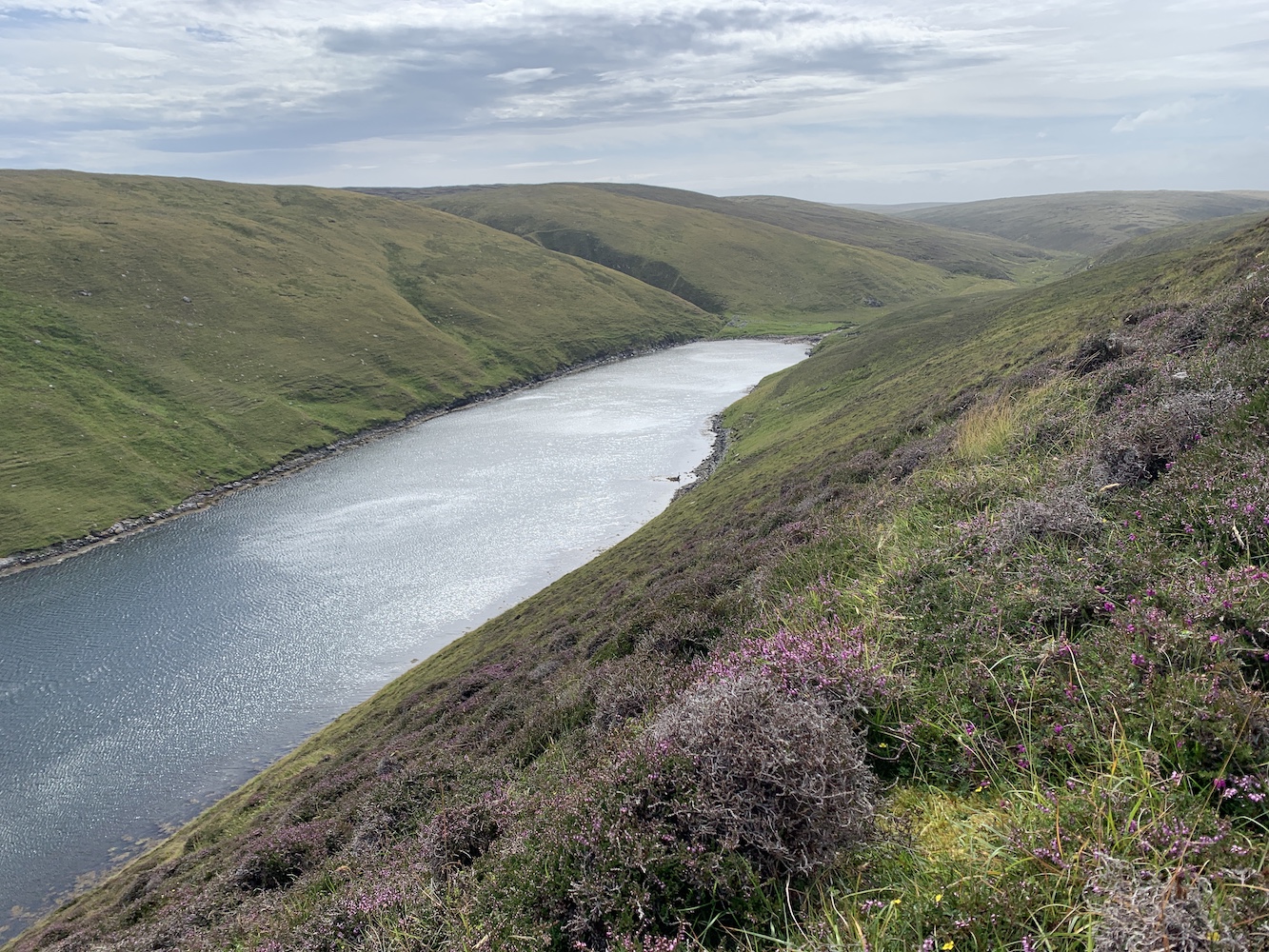
The view down Gloup Voe and Mare’s Pool
Looking across Gloup Voe
The path on the Easter Lee of Gloup

Reaching the end of the Easter Lee of Gloup it was time to turn the corner and work out which route we wanted to take from there. The Ordnance Survey map shows a small path running up the Wester Lee of Gloup and ending slightly inland near some old houses. I must admit I was tempted to head straight uphill from there, but we decided to follow what looked like a sheep track along the west side of Mare’s Pool. There was no doubt from quite early on that the west side was steeper and I was increasingly uncomfortable walking on such a tiny sheep track along it. The track, in places, was hard to follow too. After a while we established that the path marked on the map was actually further up than where we were. At this point we found a little ledge, had a sit down and chat, and agreed to begin heading up the slope towards the ridge line and then assess from there. Thank goodness for the heather as the grip it offers certainly helped to get to the top. To say I was relieved to get off that slope would be a bit of an understatement, but I also knew that there was some distance to go to get to the lighthouse.

The steep side – Wester Lee of Gloup

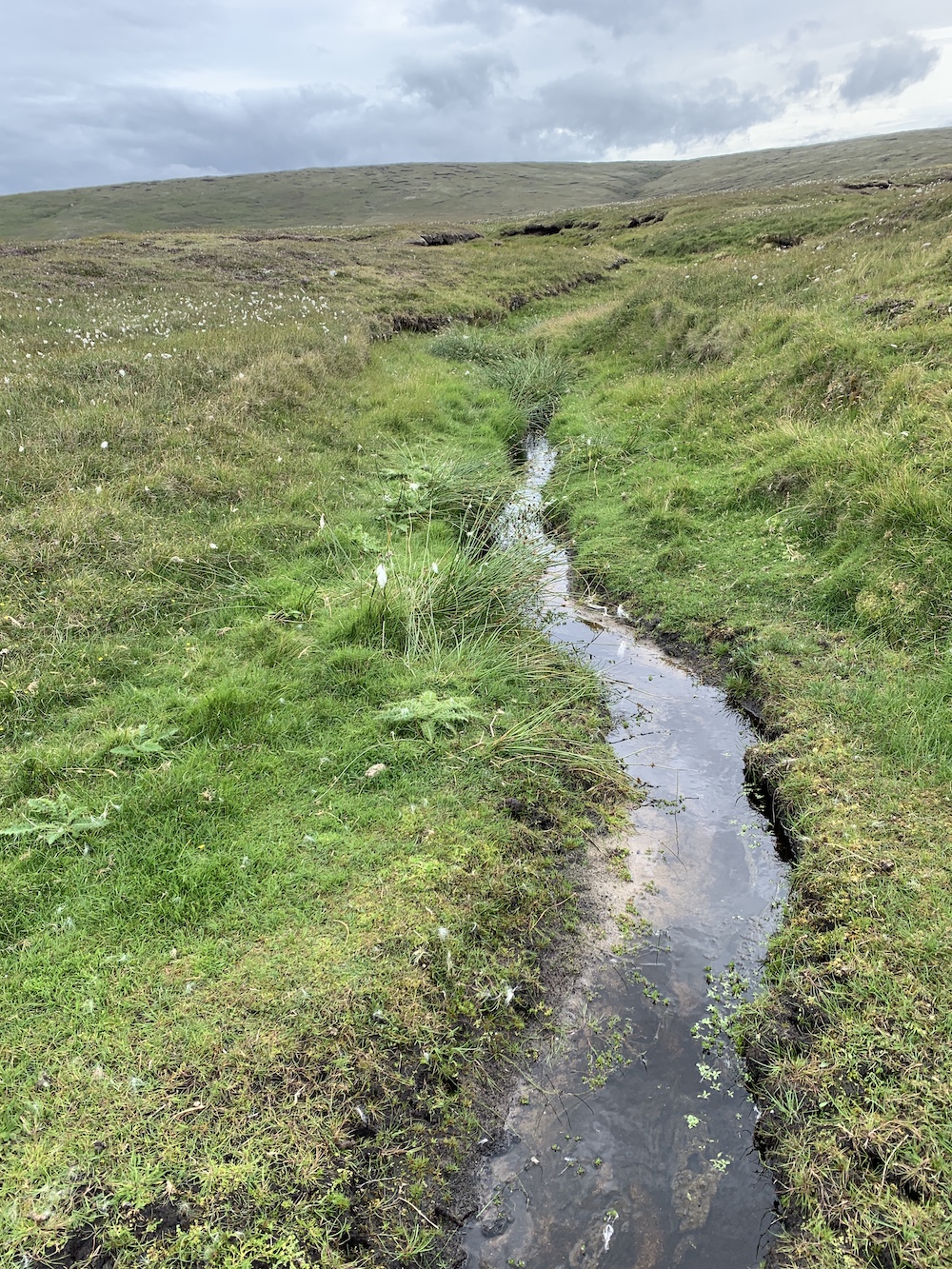
Trudging over the grass and heather wasn’t too bad, but there was plenty of spongey-looking ground and bog cotton about. Fortunately there has been a spell of dry weather in the area of late and so many of the little burns and pools were completely dry as were the extra boggy bits of terrain (which was nearly everywhere really). Having been there now it is not a walk I would even consider doing when the ground is wet. The walk was really just up and down, skirting around or going straight through dry bogs and was a fair amount of effort, but we had the wind blowing at 40mph behind us which probably helped.

Water was so rare here today that I had to photograph it
So much bog cotton around
A rare water-filled burn

At one point we began to spot some skuas flying about. I’ve seen quite a few already on this trip and thankfully, although they fly about when you go near them, they seem to have decided now their young have grown that they don’t need to attack people anymore. It’s still quite unnerving though.

Making it to the coast

After an age (or almost 5 miles) we finally spotted Bagi Stack Lighthouse ahead of us. It looked tiny in comparison to the vast surroundings and the beautifully dramatic coastline around it. There are stacks aplenty in the area and also views over to Point of Fethaland and Gruney (oh, we also spotted Muckle Flugga from a distance on the walk too). The lighthouse, unsurprisingly given its location, is looking a little weather beaten. Two sides of the white cladding on the tower have begun to turn yellow – and while I love yellow I recognise it’s not the best colour for a lighthouse with daymark requirements. The plaque on the door also looks like it’s seen some weather. Thankfully, although they have gaps between the white panels, these lighthouses offer a surprising amount of shelter from the wind. It was a great place to eat lunch and I also managed to make a phone call to Sumburgh Head Lighthouse while here too!

Finally catching sight of Bagi Stack Lighthouse
The lighthouse looks tiny next to the nearby coastline.
Bagi Stack Lighthouse
A picture showing the yellowing of some of the white panels

The return walk was never going to be easy, but given our experience of the landscape so far I felt comfortable suggesting we set the GPS device for the bottom end of Mare’s Pool and follow the direct route as much as we could. This seemed sensible based on the fact that it was so dry underfoot and so we wouldn’t need to worry so much about avoiding boggy areas. This was all prepared and off we set with the wind full in our faces, which I actually found rather refreshing if a bit much at times.

Evidence of former habitation in this remote spot
Looking back the way we’d been

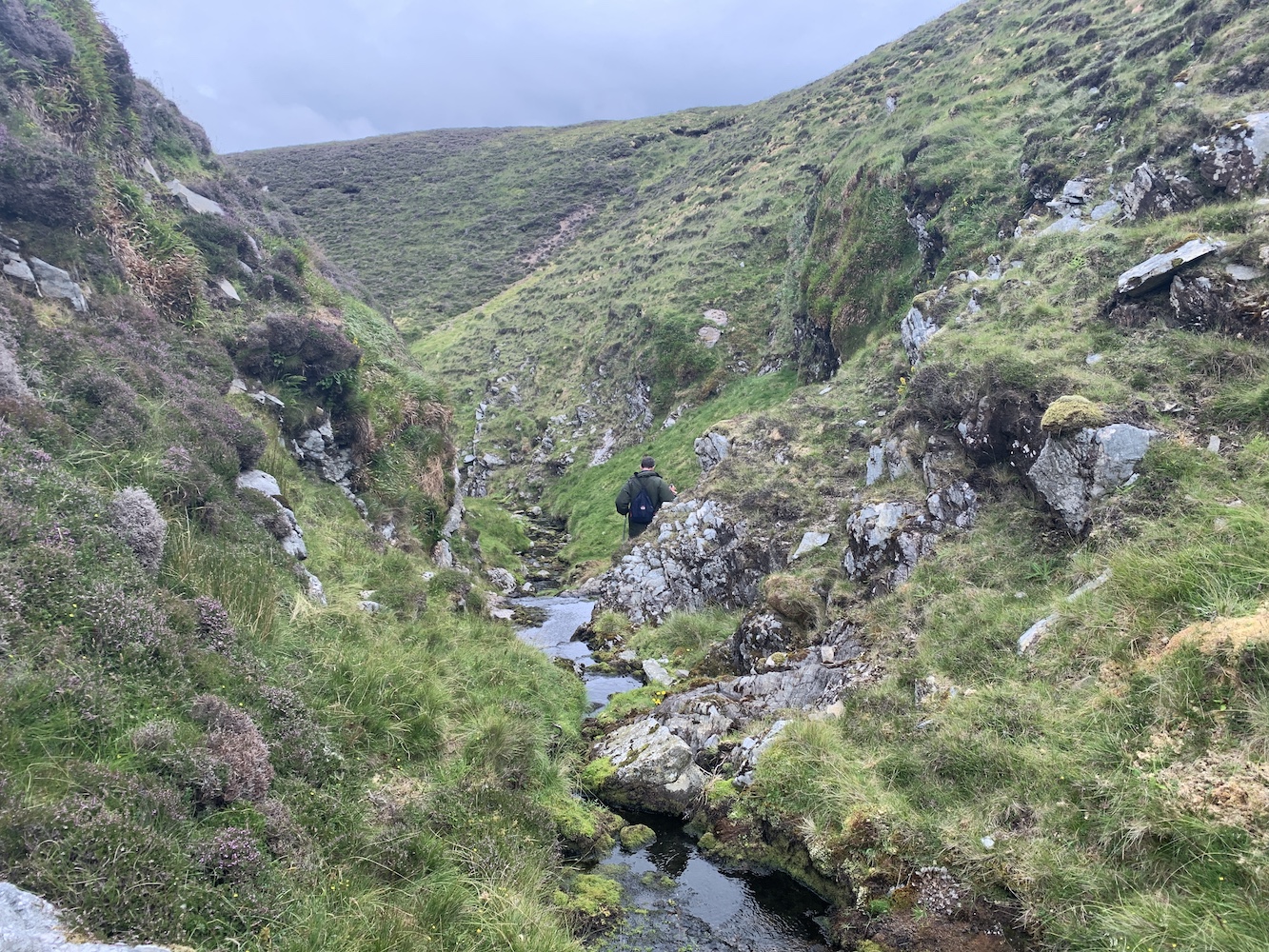
It was mainly a slog to get back, but towards the end we spotted a lovely-looking glen that weaved left and right a bit before coming out at the bottom of Mare’s Pool. The burn that ran down the glen did have water in it, but thankfully wasn’t a raging torrent and was narrow enough to step over most of the time to avoid any narrow or difficult terrain. At one point we needed to cross at the top of a tiny waterfall, but this was straightforward enough and it didn’t feel like long at all until we could see some familiar ground at the bottom.

Approaching the glen
A little water in the burn, but evidence that much more flows at times

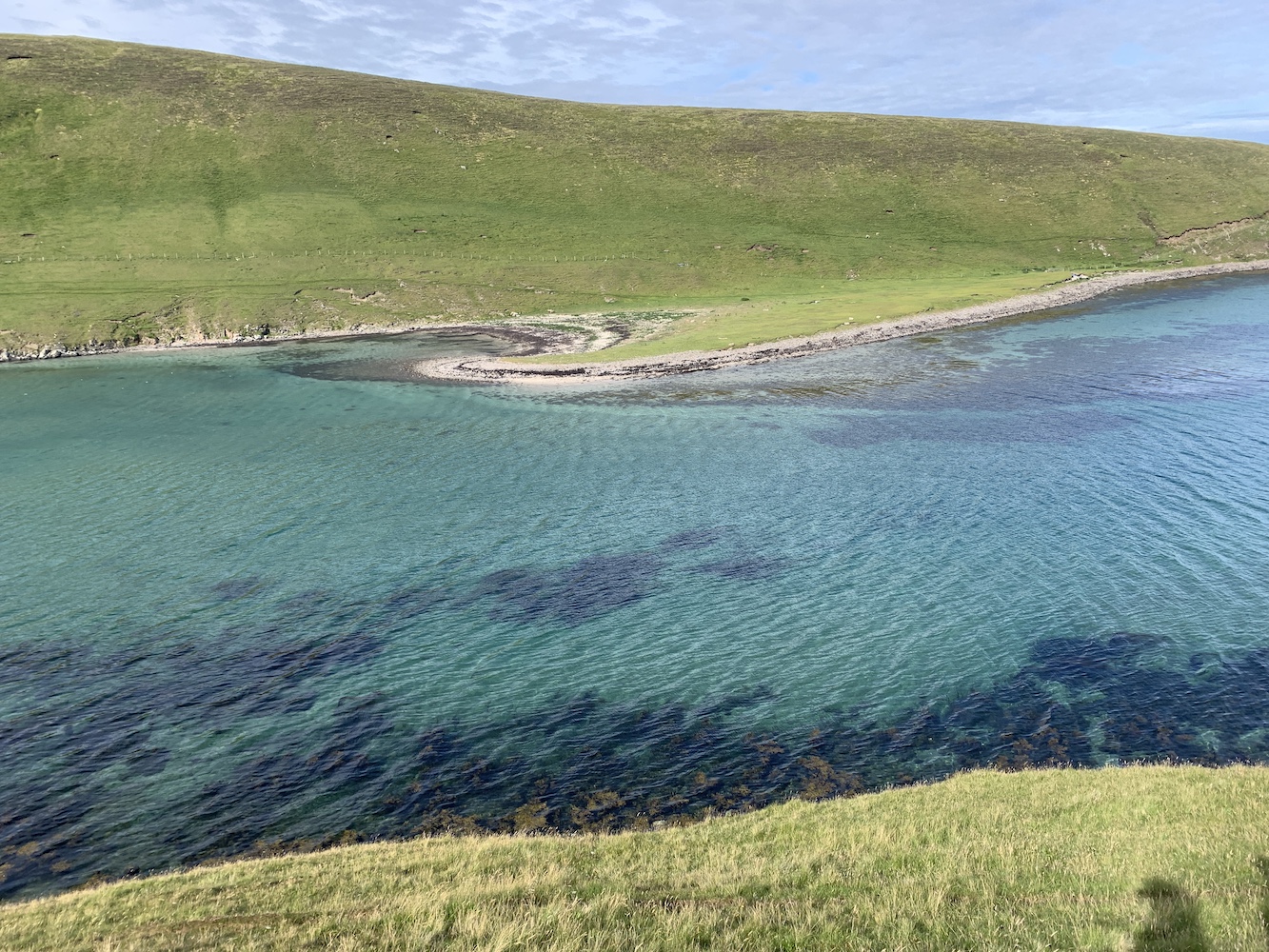
After a brief stop we just had the final section to go along the Easter Lee of Gloup. After the experience on the west side this felt so much easier a second time and I really rather enjoyed it. I still had to stop to take any pictures and look around, of course, but it was just as beautiful as it had been on the outward journey, but with the tide much lower so it all looked a little different.

A lower tide in Gloup Voe

Arriving back at John’s van was great and we had already begun to feel the need to celebrate successfully getting to and from the lighthouse without any major mishaps. A cup of tea seemed like a sensible celebratory drink at the time.

It was quite a walk – over 8 miles in total – and a good test of navigation skills, including making decisions about which route to take and realising that sometimes taking the high route gives you better perspective even if it does involve more effort to get up there, but also enjoying some of the lower routes where possible too. Maps can tell you a lot, but there’s nothing like being there and seeing the lie of the land for yourself at the time.

My advice for anyone looking to walk to Bagi Stack Lighthouse would be simply take whatever route you feel most comfortable with, but make sure you have a map and compass (that you know how to work with) or a GPS device – don’t rely on your mobile phone as signal is patchy once you are away from Gloup. It is best done after a period of dry weather as bog trotting is never fun if you can avoid it. Other than that I can’t offer much else in the way of directions. Oh, and it’s probably best avoided during skua attacking season! 🙂

A day with Shetland’s land-based lights

The wind picked up during the day yesterday and overnight meaning there were no boat trips today. It seemed a perfect time to reach some of those lighthouses that involved a walk on Shetland Mainland.

Being based in Lerwick, with three particular lighthouses in mind, my lighthouse pal John and I decided to begin with those furthest from the accommodation and the longest walk, which took us to Hillswick on the west coast. Finding a place to park here wasn’t a problem with a nice little area close to the farm gate which marks the start of the walk, and what a walk it was.

Initially following a farm track, which though not the most direct route avoided going through fields and some pretty overgrown terrain.

The track made the first section of the walk very easy

After leaving the wide track there was a section with no clear route, but once down by the coast we found the route. This is clearly a popular walk and very understandably. The coastline around here is absolutely stunning. There are some fairly steep sections, but the effort is quickly rewarded by the views. I can’t do them justice by just describing them so will just add some pictures here instead.

It was a long time before we saw the flat-pack Hillswick Lighthouse. In fact we were relatively close to it before it appeared. As we arrived at the lighthouse a couple were just leaving and the man informed us that he had been involved in the building of the lighthouse when it was solarised.

The lighthouse comes into view

The lighthouse is in an incredible position with views of St Magnus Bay to the south, and some very dramatic coastal scenery to the west with views towards Esha Ness and its couple of islands. We even managed to spot part of The Drongs, that glorious collection of sea stacks, at one point during the walk.

Hillswick Lighthouse looking excellent
Saying goodbye to the lighthouse

I think we probably could have done the walk a bit faster if I hadn’t been quite so in awe of the views, stopping frequently to get pictures of the views. Typically we made it back slightly faster as I’d taken most of my pictures by that point.

One of the views on the return from Hillswick Lighthouse

The next stop saw us off to the east coast to walk to Ness of Queyfirth Lighthouse. After a bit of debating over where we should park we eventually stopped on a verge at the end of the public road. Fortunately a local man drove past and John spoke to him about walking over to the lighthouse. Apparently he was surprised we wanted to walk, but he said it would be fine to follow the fence around the outside of a field a cows, which looked to me like it avoided entering any fields.

The cows near the starting point for Ness of Queyfirth

Early on in the walk we spotted what looked like a quad track (one of the benefits of walking on farm land) so we followed this until it petered out. It was a bit of a slog up the hill, made harder by the terrain being very overgrown, but thankfully it was mainly grass and dry bog. I can imagine it would be a much less enjoyable walk after a prolonged period of rain, but the ground seems very dry at the moment.

The route towards Ness of Queyfirth lighthouse

This was another one that seemed to take a long time to catch sight of the lighthouse and we were almost upon it when we finally spotted the top of it emerging as the land went downhill. It is fairly steep in places on that peninsula and on the way out we were getting slightly sore ankles from walking on sloped ground. We found a power line which we thought would lead us to the lighthouse, and thankfully it did. In the meantime though we had some wonderful panoramic views, including Quey Firth itself, the hills to the west and out to Lamba and other islands in Yell Sound.

The view of Yell Sound from the walk to Queyfirth Lighthouse

The lighthouse is the same type as Gruney, or like Little Roe and Skaw Taing Front, which we saw yesterday, but without the orange section. They really are quite funny structures, but once you’ve seen a couple they really grow on you, as is the case with most of the smaller lighthouses – or it certainly is for me anyway. It was nice to have a sit down at the lighthouse and enjoy the views for a bit.

Ness of Queyfirth Lighthouse

The journey back was tough going but we made it and were very glad to meet the original track and see John’s van not too far away. The sky had cleared a bit which made for much brighter conditions.

The view to the west on our way back from Ness of Queyfirth

The timing was perfect here as it began to rain just after we go into the van. Fortunately it had stopped before we reached our final stop of the day, Eswick.

We weren’t sure if we would fit a walk to Moul of Eswick in today, but there was still enough time to give it a go. This was the shortest walk of the day, but parking was a bit of a problem as the only place at the end of the road we could have parked was already taken so we had to drive back along the road almost half a mile and set off from there. As with the other two, this one involved a walk over farmland initially and was actually quite straightforward. Passing through one field, we continued to follow the track which brought us out by the side of Muckle Loch, which is beautiful.

Muckle Loch at Eswick

I wasn’t sure how easy it would be to cross a burn that was showing on the map, but it was completely dry so we continued on our way. We then went over another gate only realising as we headed in the direction of the lighthouse that we were then on the wrong side of the fence. This was quickly rectified and with the lighthouse in sight we headed straight for it.

Approaching Moul of Eswick Lighthouse

The lighthouse is a flat-pack which I always think are nice to see, but one of the most enjoyable aspects of this visit were the views.

Moul of Eswick Lighthouse

With the wind really picking up there was plenty of swell around the islands to the east, one of which was Hoo Stack, which I very much enjoyed visiting back in 2019. Not only that, but there was the amazing 17 metre high Fru Stack just off the cliffs here, which was brilliant to watch with the waves breaking against it. A gorgeously dramatic scene.

Fru Stac just off the coast of Moul of Eswick
Hoo Stack, as seen from Ness of Queyfirth

The return journey, during which John did his celebratory dance at having achieved three new lighthouses today, was straightforward if a little slow after a long day. It was a great day though and really good to get to these ones which were always due to be on my back-up plan list should there be days without boat trips. One more tomorrow – hopefully! 🙂

Adventures on Yell Sound

Phew, what a day it’s been, out on a boat on Yell Sound picking up more lighthouses and islands.

Leaving the cars at Toft we crossed to Yell on the ferry and met Michael the skipper and the boat just over the other side in Ulsta. We passed the very beautifully-located Ness of Sound Lighthouse as we journeyed up Yell Sound.

Ness of Sound Lighthouse

We made our way right up to the north entrance and around Point of Fethaland. This was a perfect chance to see this very unique lighthouse from the sea where it looks so small compared to the dramatic natural surroundings. On the return later this morning I thought it looked rather Faroese from a certain angle. It was particularly good to see from the north east with the jagged rocks in the foreground and lighthouse sticking up on the top of the cliff. I don’t know anyone who has been to Point of Fethaland that has anything bad to say about it. The walk is superb.

Point of Fethaland with its lighthouse

Joe the Drone also took a spin here too.

Point of Fethaland from above

Heading around also gave us a chance to see Gruney, which was a reminder of the scary landing on a flat, sloped rock there back in 2019. However it did also bring back memories of the stunning views from the island that day too.

Gruney island and lighthouse

After some island bagging around the corner from Point of Fethaland, including a tidal island which had proven to be rather tricky to reach by land, we returned to Yell Sound. We were heading into the wind now and it was clear from the water conditions that the sea was getting a little more interesting. The skippers weren’t sure what we would manage from this point and a couple of group members set off to set foot on three islands, but only managed one before the swell was getting too heavy causing them to return to the main boat.

Then it was well and truly onto the lighthouses. The first stop was Muckle Holm, which was one I’d visited in 2019, but my lighthouse pal John had yet to do. I decided to go ashore for a revisit and I’m so glad I did. I’d forgotten how fascinating the island is with some stunning geos in both the middle and the west side and a fairly narrow section of grass leading to the east section of the island. Of course it was good to see the flat-pack lighthouse again.

The calm landing area on Muckle Holm
The seaward end of the landing geo on Muckle Holm, which has been used by Sullom Voe pilot boats for shelter in the past
One of the amazing geos on Muckle Holm
And another
Muckle Holm Lighthouse
Saying goodbye to Muckle Holm

What I found upon returning from the island was that, while sitting to move down the rocks, I managed to tear my waterproof trousers in two places. Normally this would be a pain, but I actually didn’t mind it as it made me feel like a proper island bagger. So many of them have holes in clothing from their exploits!

I stood aside for the next two islands, Little Holm and Brother Isle, as – although they both have lights on them – I have been to them before and there were others who hadn’t. Due to the sea conditions we could only really take three in the tender at one time so I settled for a view from the main boat with these two.

Little Holm

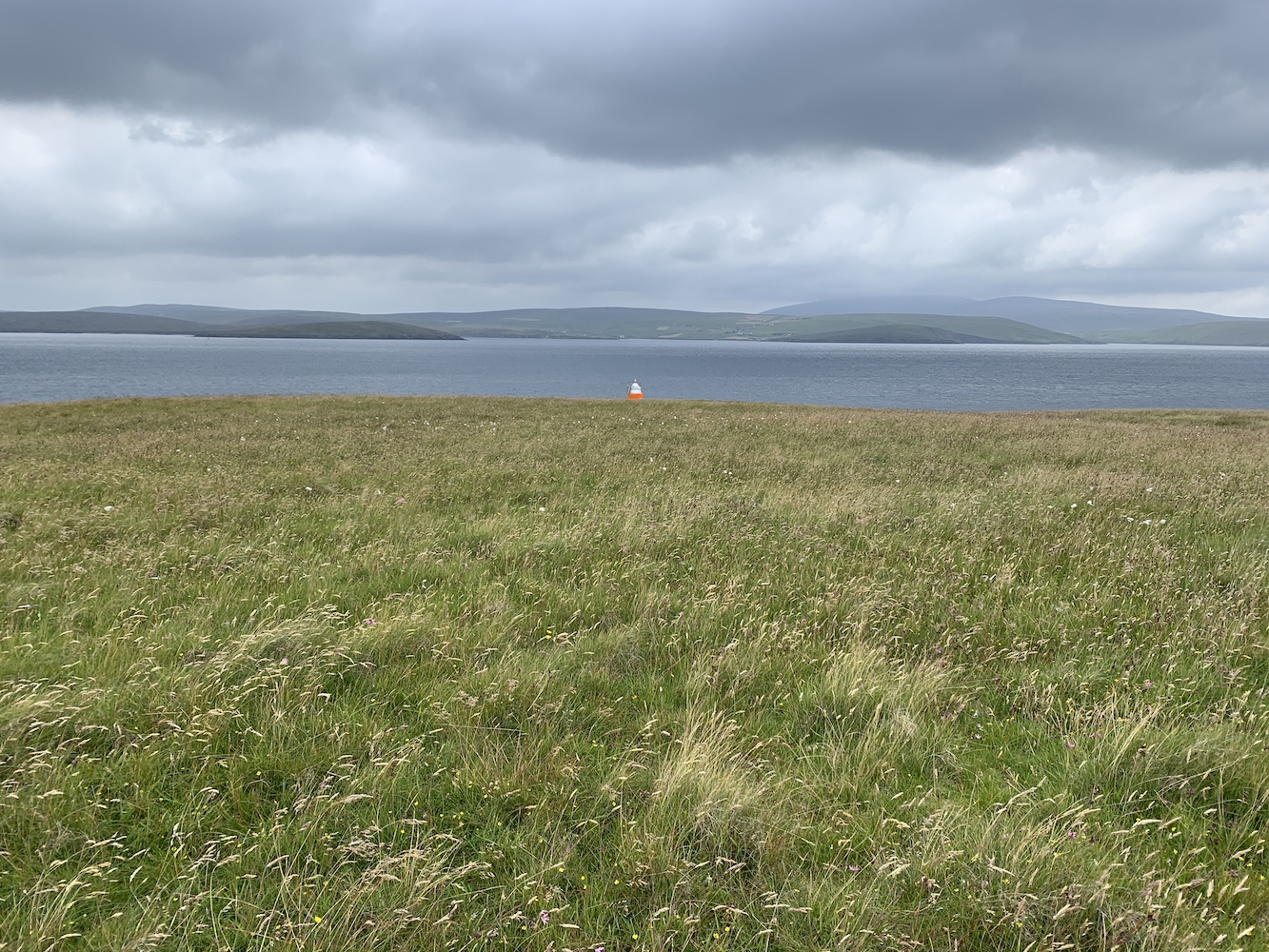
Next we got to the really interesting bit, the lights I’d not been close to before. The first of these was on Tinga Skerry. I wasn’t sure what to expect here as I recalled when I last saw it from a distance that it was just very low-lying rock and I didn’t know if landing would be possible. I was nicely surprised to see it was actually far more substantial than I’d given it credit for. After wandering up towards the lighthouse we spotted a male otter dashing away across the rocks. It was fantastic to see and a great start to a small, but interesting little skerry. The lighthouse isn’t the most interesting of structures, really just practical, but as I’ve said many times before (and particularly in this post) it’s so often the places these lights take you to that makes visiting them so enjoyable.

Tinga Skerry
Tinga Skerry with the otter on the rocks (see if you can spot him)
Tinga Skerry Lighthouse
Tinga Skerry from the landing

Then it was something entirely different with a visit to Little Roe. I’d not known about Little Roe until my last visit to Shetland, which thankfully occurred before my book was published. This was also a little unexpected as, contrary to what its name suggests Little Roe isn’t very “little” and certainly not in comparison to many of the other islands in the area. From the landing area at the rocky beach it was quite a walk on ground that alternated between long grass and squidgy moss, which fortunately was dry today. As we reached the highest point of the island we spotted the top of the lighthouse appearing ahead of us and set off for it. This is the first one of this type that I’ve been too and it’s bright orange paint was a real contrast to the grey skies at that point. It’s a very strange light, similar in shape to the one on Gruney. I always enjoy seeing these different style of towers though as seeing the same thing all the time could get a bit tedious. Just to the south of the lighthouse was what I originally thought was a single geo with beautiful cliffs. Walking a bit further on though I discovered there were two geos next to each other, resulting in a wonderfully shaped promontory in the middle. I also spotted a great little arch in one of the geos. Walking back was slightly easier with much more downhill, and rather strangely the remains of a fence. There are ruins of a building on the island so my guess would be that it was once home to someone who dug the peat and may well have had a fence! Back at the landing it was nice to have a sit down and enjoy the area while the first pair were taken back to the main boat. I found a fun bit of sloped grass to slide down. With the Balta seesaw and Little Roe grass slide I really do seem to be behaving like a child while out bagging these days.

Approaching Little Roe Lighthouse
Little Roe Lighthouse
Little Roe geos and the arch on the right

The final two stops of the day I was very keen to get to as it would save a particularly long walk at another time. The reason there are so many lights in Yell Sound is because it is used as an entry/exit route for Sullom Voe oil terminal. To get to these next lights involves walking around the coastline to avoid Sullom Voe, which is surrounded by fencing anyway so there is no shortcut. There are two lights at Skaw Taing and the skippers were very pleased to find some relatively calm water for a change where the boats weren’t constantly drifting unless underway. After a smooth landing we made the short walk to the front light, which would have been a twin of Little Roe, except it had a directional sector light on the front as well as the light on the top, which was also different to Little Roe. The rear light was a bit of a slog, but a fairly short slog so not too bad. This is an entirely different type of structure, stone-built and with an entrance hatch on top rather than a door on the side. Again there was plenty of soft ground to walk on here, but that didn’t stop me from just being glad that I didn’t need to undertake the very long and boggy walk around the coast.

Skaw Taing Front light with the rear in the background
Skaw Taing Rear looking up Yell Sound

There was one final stopping point and that was Mio Ness. Very similar to the light on Tinga Skerry, it wasn’t the most beautiful, but it was easy enough to land nearby with an even shorter walk than Skaw Taing to reach the lighthouse. I’d seen this one from the ferry before as well as a chartered boat in 2019, plus from the coastal road on Yell – it’s very easy to see from a distance, but not so easy to get a closer look. It seemed like a very successful end to today’s trip for me which involved achieving more than we thought we might given the gusting wind.

On the approach to Mio Ness Lighthouse
Mio Ness Lighthouse

It was just great to have seen these ones closer now and spent some time exploring some of these very different islands and skerries 🙂

Around Unst and to Muckle Flugga

Yesterday marked the first day of a holiday in Shetland and it certainly got off to an excellent start with a chartered boat trip around Unst.

It was all a bit of a rush in the morning with a fairly short window of opportunity for getting off the ferry, offloading the kids with my parents at our amazing accommodation, and then getting to the ferry at Toft to head to Yell by 8.45am. It was a tall order, but we made it and our small group gathered at Cullivoe to head out on board Lysander, the new boat owned by the same company as the Compass Rose which took us to Muckle Flugga and numerous islands in the area in 2019.

We climbed on board and off we set. It was very good to be back out with bagging friends after such a long time without being part of a group beyond just a few people. The plan was to sail clockwise around Unst and visit a number of islands on the way. We got off to a good start and after a few members of the group had set foot on some islands it was time to head for the main event of the day, an attempt to land on Muckle Flugga. The skipper reported the conditions up there the previous day had been very rough and so he didn’t hold out much hope of landing. Ever the optimist I was willing to withhold judgement until we got closer. The further north we got the more surprised we became at how calm it still seemed. Finally Muckle Flugga with its majestic lighthouse came into view and us lighthouse baggers waited patiently – well, not actually very patiently at all.

Approaching Muckle Flugga

As we edged closer it became more obvious that landing was likely to be possible, although we still needed to check out the landing area a bit closer as there was still a little bit of swell running in there. A few of us keen beans hopped into the brilliant ‘tin bath’ tender and set off for the landing. There was quite a bit of movement in the water, but thankfully not enough to stop us getting safely onto the rocks.

Looking up on the approach to the landing

After a brief celebration we were keen to get going up those historical steps. It was a real delight to see so many puffins around and although many were scared off as we made our way up the steps, we were still able to see them at fairly close range. There were some fulmar chicks around too threatening to spit at us, but we left them in peace and moved on.

Puffins on Muckle Flugga
Out Stack and the puffins

Although I’d been before and so knew the lie of the land there, it was still a real pleasure to see the stunning views towards Out Stack and to the east. Added to this was the pure joy emanating from those I was with who felt just as awe-inspired as I had the first time around, enjoying the combination of getting to this so rarely visited corner of the British Isles and seeing the incredible lighthouse and landscape of the area.

The view south from Muckle Flugga
Muckle Flugga Lighthouse
The lighthouse from the helipad

There was no way we could have gone to Muckle Flugga without Joe the Drone coming along. I’ll let those pictures speak for themselves.

Muckle Flugga and its neighbouring rocks
A Joe the Drone view of Muckle Flugga Lighthouse
Muckle Flugga Lighthouse and Out Stack

Knowing our work was not done for the day, we enjoyed the last moments of exploring before descending back down to the boat. After leaving Muckle Flugga we headed down Burra Firth for a few of the group to set foot on another island. This was rather fortuitous as it gave us a chance to see the Muckle Flugga Shore Station from the sea.

Muckle Flugga Shore Station at Burrafirth

I was particularly excited about our next stop as it was an island I knew wouldn’t be easy to get to. Holm of Skaw is home to the lighthouse that replaced an old sector light which was within the Muckle Flugga complex. The structure here is a flat-pack lighthouse and very much a standard one. There was a bit of swell at the landing point we went for on the west side of the island. The rocks were covered in barnacles, which certainly helped to prevent slipping, but wasn’t too easy on the hands. Once up on the grass it was actually quite a surprising island, which reminded me a lot of some of the islands in Yell Sound, like Little Holm and Muckle Holm with some really surprising flora and fauna about. The island is fairly flat and grass-covered, but there are some reminders of its harsh location with some impressive geology on the east side. I found this particularly interesting as I always expect the west side of islands to be the more rugged, but I suppose its location gives it a little protection from the west.

Approaching Holm of Skaw Lighthouse
Holm of Skaw Lighthouse
A geo on the east side of Holm of Skaw

Joe the Drone refuses to miss an opportunity so got some excellent images of the island.

Holm of Skaw from above
Holm of Skaw

After the challenges of landing on the west, we used a calmer spot on the south of the island for returning to the tender. I had missed getting a bit wet on a tender so was actually quite pleased, sitting at the very front of the tender, to get a bit of a splashing. You don’t get the fully experience if you aren’t splashed along the way on these boat days.

Down the east side of Unst we had our final stop of the day, which was Balta island. I’d visited this one and its lighthouse in 2019, but it was great to approach the island from the north this time and see how just long it is. It’s a pretty special island and somehow stands out from many others. It boasts some very impressive little beaches and it was only from seeing the drone shots later on that day that I appreciated just how rugged it is on the east side. Again it surprised me, but this one is very much more sheltered on the west side with Balta Sound being only a relatively narrow channel between the island and Unst.

Balta island from the north
Balta from the south

We landed on the rocks below the little breakwater and set off, heading south to the lighthouse for the lighthouse baggers to visit Balta Sound Lighthouse. This is another easy island to walk about on and the sheep have left some nice little tracks all over the place. There are remains of old buildings on the island and I imagine there is plenty of history there and it once was home to a fairly good-sized population.

On the approach to Balta Sound Lighthouse
Balta Sound Lighthouse

It was great to see the lighthouse again and to be joined by the rest of the lighthouse bagging group there too. It’s another standard flat-pack, but it’s a really lovely location. I could spend a lot longer on the island just walking around its coastline.

Balta island

It was then time to head back to Cullivoe and rest after an enjoyable but tiring day 🙂

Thoughts on modern Scottish lighthouses

In recent years while I’ve been visiting lighthouse of all shapes and sizes, particularly those smaller lights in Scotland, I’ve seen a number of very negative comments about these modern lighthouses. What I am referring to here are the Northern Lighthouse Board’s SPLATs (solar powered lattice aluminium towers). That acronym describes it rather perfectly actually, although regular readers of my blog will be aware that I personally refer to them as flat-pack lighthouses.

A standard flat-pack lighthouse. This one is on Hoxa Head in Orkney.

These towers are limited to only the north and west of Scotland, which gives a good indication of their often remote locations, on islands or tucked away on headlands. There are 53 of these structures in Scotland: 18 in Shetland, 2 in Orkney, 1 on the North Coast, 7 in the Outer Hebrides, 11 in the Inner Hebrides and West Highlands, 13 between Mull and Islay, and 1 in South West Scotland.

To start with, some history. My recent research suggests that, although it was around 1996 that these structures began to replace the older, small lighthouses, the two towers of this type on Gasay and Calvay – found on the approach to Lochboisdale in South Uist – were actually installed in 1985. These two framework towers aren’t as enclosed by the white cladding as many of the newer versions are, but they are still very much the same arrangement.

Gasay, one of the original flat-pack lighthouses.

I’ve been fascinated to find that the history of these towers actually goes back a lot further than I’d originally thought. Along with being left off most lighthouse lists, and left out of near enough all books on Scottish lighthouses, they are so rarely mentioned anywhere which is a shame as it appears they played a key role in shaping the future direction of small Northern Lighthouse Board structures for many years to come when those first two were installed.

For a good few years now I’ve had a growing appreciation of these structures. To begin my defence of them, I want to highlight the purpose of a lighthouse. Lighthouses, unless purely decorative, were never built for us land-based folk to gaze at adoringly. That is certainly the case for many of us now who travel to admire the big, old lighthouses. However, their primary purpose was to exhibit a light that could be seen at night and would help to guide ships. At night you can’t see the structure, all you know is that it’s a light helping to guide you or assisting you with working out exactly where you are. If it achieves that, regardless of what the structure looks like, then it is fulfilling its core purpose.

A variation on the typical flat-pack style lighthouse at Ornsay East Rock, Skye.

In an ideal world money would be no object, but of course cost plays a role when deciding what type of structure will be installed. As much as I love a large, dramatic lighthouse I recognise that, for any lighthouse authority, paying out hundreds of thousands (or more likely millions) of pounds to build a new one is not a wise financial decision.

Financial restrictions force a company to look at what is required for the new or replacement structure in this case. The big lighthouses we all know and love were built to be lived in and to contain a considerable amount of machinery and equipment too. If you’ve ever been in a lighthouse that contains the old equipment you will see that even then a lot was squeezed into a small space.

The island of Siolaigh in the Monach Isles, Outer Hebrides, boasts both a traditional and modern lighthouse.

If you have ever visited one of the flat-pack type lighthouses you will see just how little equipment is in them, usually just one or two cabinets on the ground or first floor and then the external light and another small cabinet on top. There is no need for bedrooms, a kitchen, a bathroom etc. so it’s understandable that the decision wouldn’t be made to build a lighthouse that has the space to accommodate those.

The walk to Muckle Roe Lighthouse in Shetland is one of the best I’ve done.

I’ve often seen mentions of ‘The Stevensons would be turning in their graves if they saw these’ and I’m not so sure they would. The Stevensons were engineers. Yes, engineers probably like to design the most awe-inspiring buildings which would give them a big personal boost, but practicality is key for them and if they were having to work within today’s budgets I’m sure they would opt for this type too. The final generation of Stevenson lighthouse engineers designed a range of smaller wholly practical lighthouses, such as the former Sandaig Islands Lighthouse (pictured below). These lighthouses are not grand, although I am still very keen on them myself. They were a sign of the times and reflected the changes in what was needed for new and unmanned lighthouses as well as availability of more cost-effective materials.

The original Sandaig Islands Lighthouse was designed by the last generation of Stevensons. It is now located in Glenelg near the turntable ferry.

On a final and personal point, I’ve visited a considerable number of these flat-pack towers over the past 9 years and I’ve had some of the best days out with them as my objective. I’d like to share a few examples. The light on Loch Eriboll, my first flat-pack, is one of those I’m most fond of. It’s a relatively short walk compared to many of the others, as long as you know where to start and the right direction to head in. The coastline of Loch Eriboll is top class and my first walk to the lighthouse really kicked off my ever-growing appreciation of that loch.

Loch Eriboll lighthouse in the winter sun

These lighthouses aren’t often easy to get to. You can’t drive to them as you can with some of the larger towers and they certainly don’t have obvious tracks or paths leading to many of them as all of the older lights do. Getting to the flat-pack now located on Cailleach Head near Scoraig was a massive personal achievement. I wasn’t sure I’d ever make it as I knew it involved a long walk in from the nearest road or making arrangements with a local boatman. This was also the case with Hoo Stack in Shetland, which was great fun to visit alongside some island bagging pals. The shared enjoyment with friends could very much also be said of Glas Eileanan (Grey Rocks Lighthouse) in the Sound of Mull, the Sandaig Islands light and Bunessan Lighthouse on the west coast of Mull.

Grey Rocks Lighthouse in the Sound of Mull

It’s not just friends though, my son visited his first flat-pack lighthouse when we walked to Point of Sleat. It was a great walk, but was super windy and I remember well us setting up a little pop-up shelter not far from the lighthouse to hide away in at lunchtime with the little man. My daughter only recently bagged her first flat-pack lighthouse, the newest one, Rubha Cuil-Cheanna near Onich. That was a great walk made slightly more challenging by having the kids to keep safe, but still good fun.

Rubha Cuil-Cheanna, the Northern Lighthouse Board’s newest addition.

There have been some fairly unique experiences involved in reaching them too. Wading through a channel of water to get to the flat-pack on Hestan Island was great fun. Visiting Papa Stronsay was also an interesting experience with the island being home to the Golgotha Monastery and having a long history of occupation by religious groups.

The tidal section, taken from Hestan Island

There have been so many great times getting out to these small but really important little structures. I suppose if there was one final thought I would like to end on it’s that, with the recent addition of the Rubha Cuil-Cheanna light, I’m just glad they are still adding new lighthouses, even if it is only one every 11 or so years 🙂

Joe goes to Pentland Skerries

On our way to Orkney last weekend we took a detour to John O’Groats to check on the developments around the old Duncansby Head foghorn. The area has really come on over the past year which is great to see.

The old Duncansby Head foghorn at the start and finish of the John O’Groats Trail

While we were there we spotted a black RIB zooming about just off the coast and noticed a little cabin for OceanTrek who operate the RIB. Never one to ever miss an opportunity to fly Joe the Drone, once the skipper was back on land Bob approached him and asked if he would be willing to take us out to Pentland Skerries during the week coming. After exchanges of pictures of the landing area there between Bob and Alex the skipper, it was agreed we would head out on Tuesday morning.

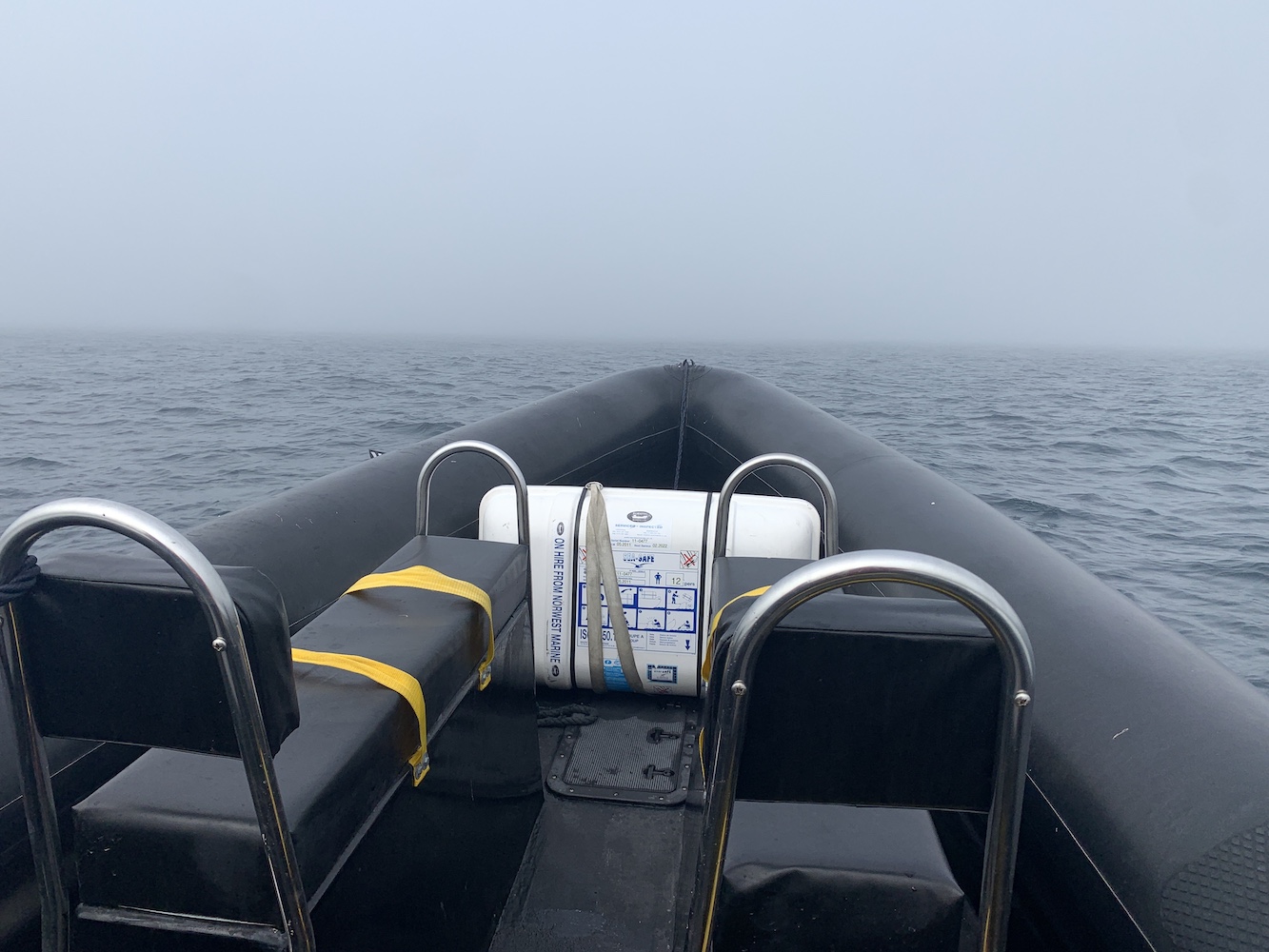
Arriving on Tuesday we got ready to go and set off. About five minutes or so into the journey it became very clear that a large and never ending bank of mist was creeping in from the east as it so often does. Within another few minutes we were in it and the decision was made to return to John O’Groats and try again another time. The speed at which the mist came in was really quite incredible. Even the lady who works in the little food cabin said she’d just left the hatch for a couple of minutes and came back and it was there. The joys of the east coast!

The mist emerging over the Pentland Firth

After numerous checks on the weather later in the day on Tuesday it was agreed that we would try again on Thursday morning. Waking up to mist at home this morning it wasn’t looking likely we would make it out again, but thankfully Alex reported no mist over in Wick, which would give a far better indication of what it was like at John O’Groats.

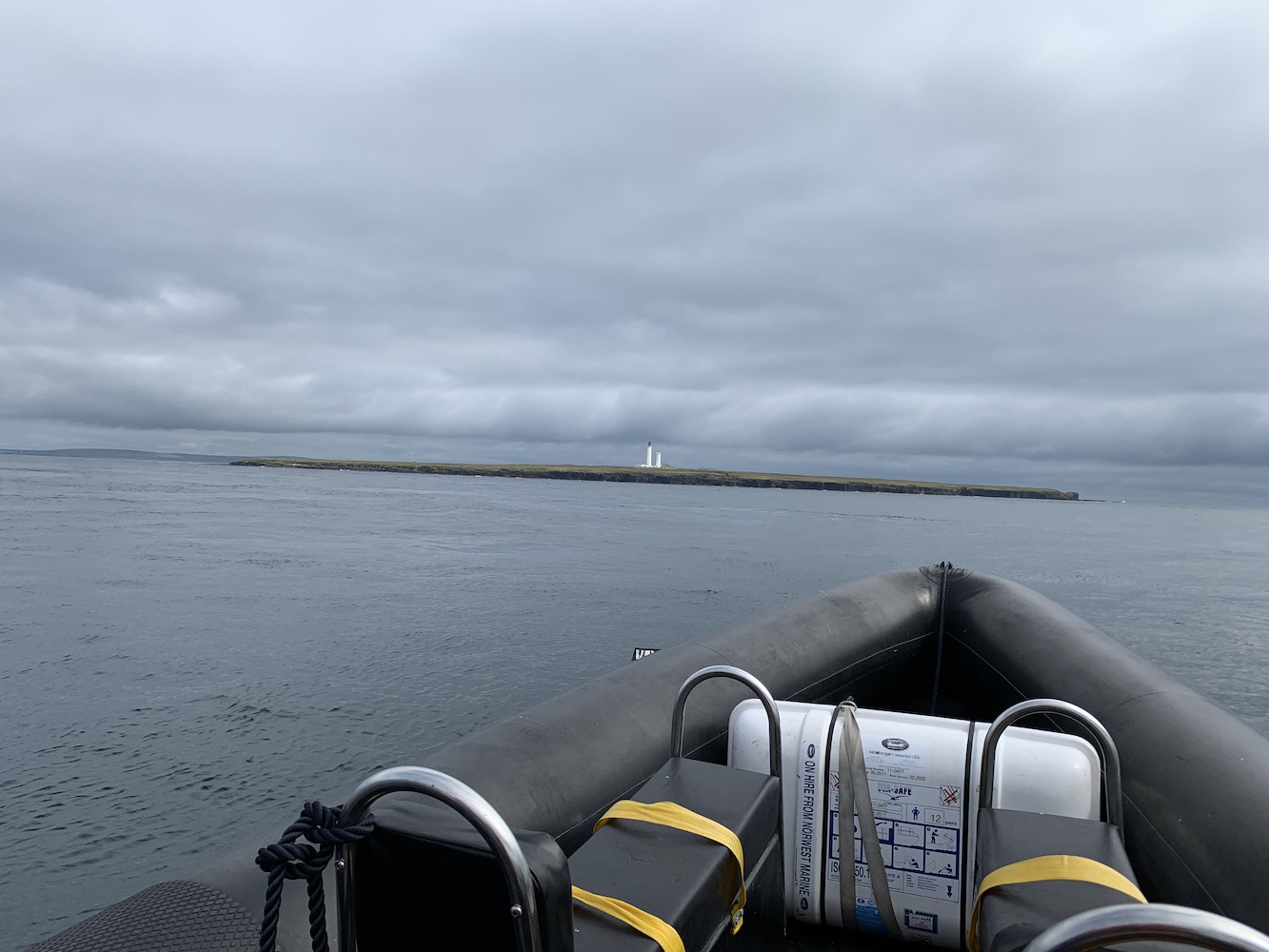
Conditions were great for the trip today and we hopped onboard the RIB and off we went. We knew conditions were better as we could see the two towers on the island of Muckle Skerry, the largest of the Pentland Skerries group. Between John O’Groats and Pentland Skerries the sea gets really interesting for a while. I recalled being told about it by the skipper for Caithness Seacoast in Wick when we went out with them back in 2013 (a note for anyone looking to visit in future, Caithness Seacoast will no longer land people on the island) and thinking at the time ‘I’m glad we’re not going through that!’ Today, however, we did go through it and it was expertly handled by Alex.

Much clearer today approaching Muckle Skerry

A short while later we arrived at the landing area and edged in slowly to avoid any rocks just under the surface. It was a bit of a step up, but Bob threw himself up and then he and Alex helped me (and my short legs) up. There we were on the island again.

The view from above the geo where we landed on the island

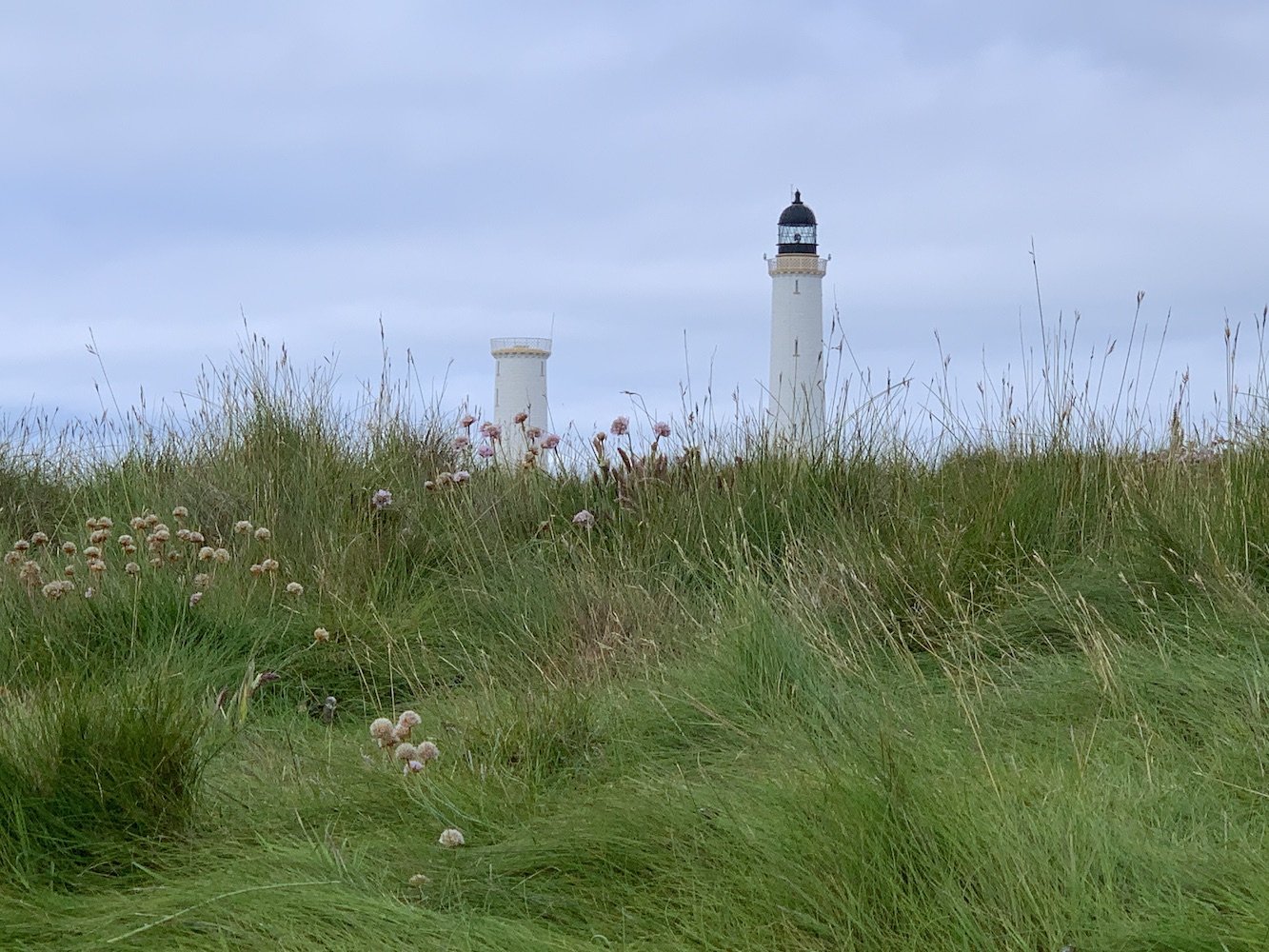
It was great to see those two towers again and the various views of them on the approach are always superb.

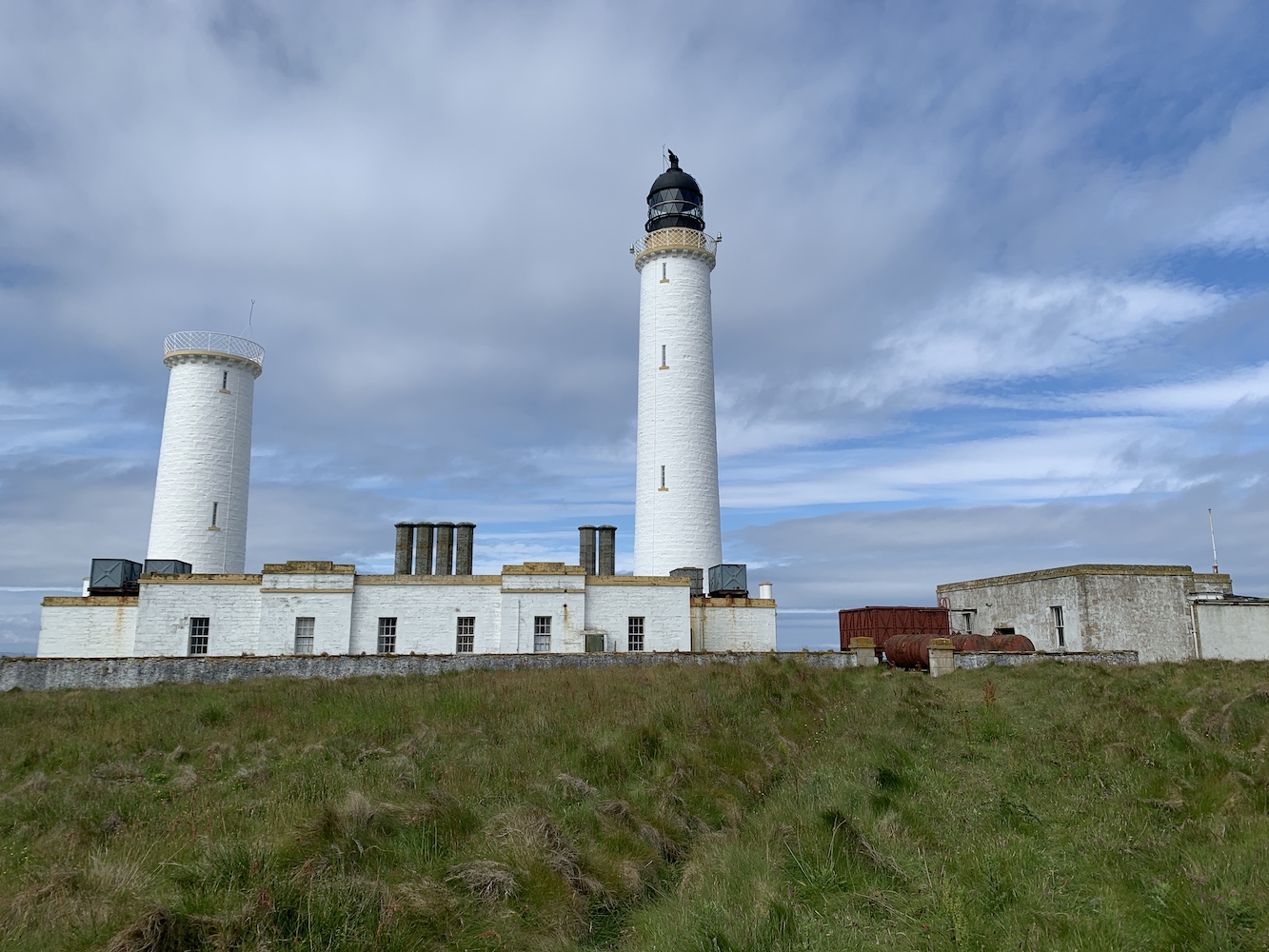
Of course the main purpose for this visit was so Joe the Drone could get some of his usual spectacular shots and he certainly did that.

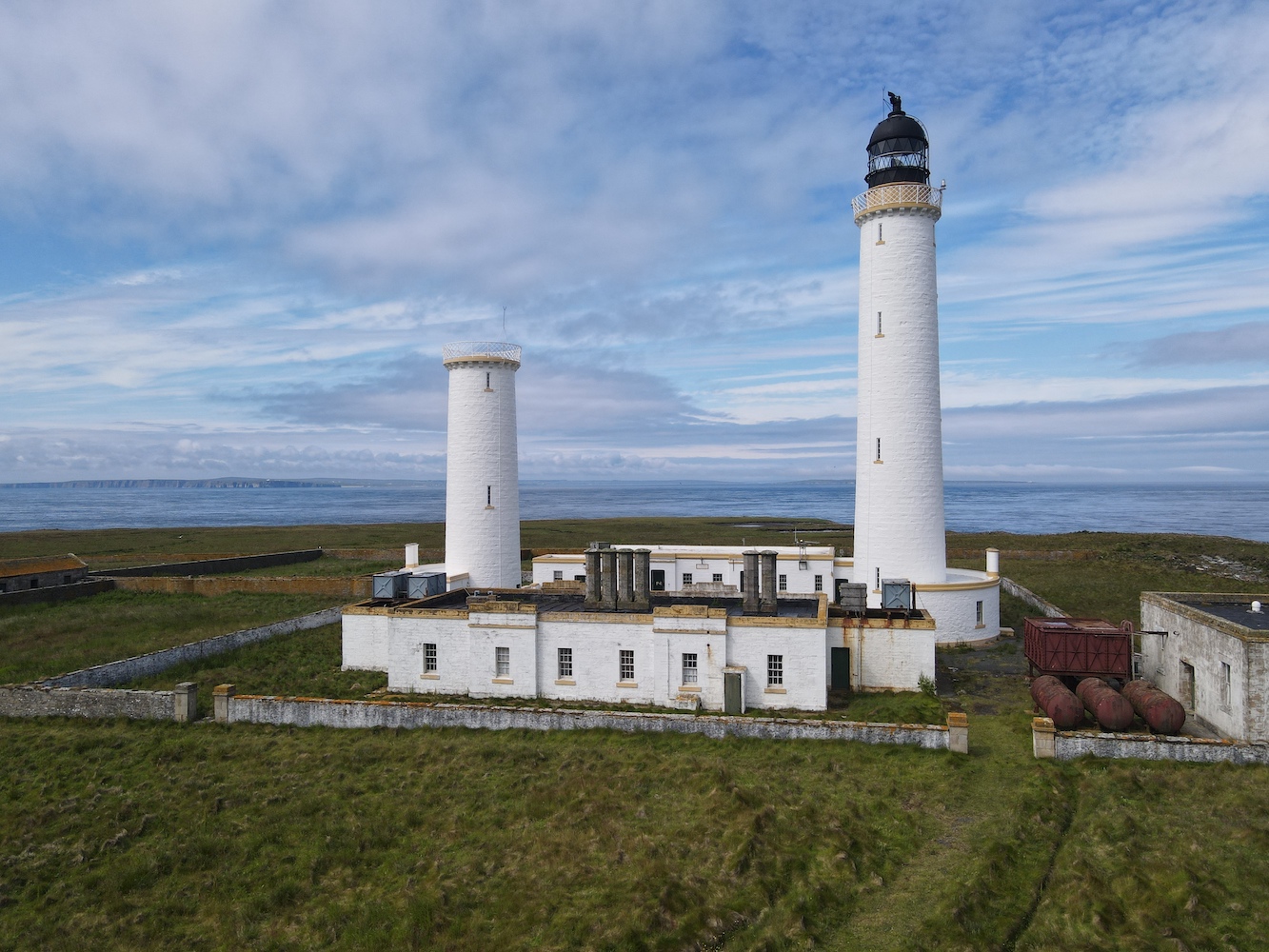
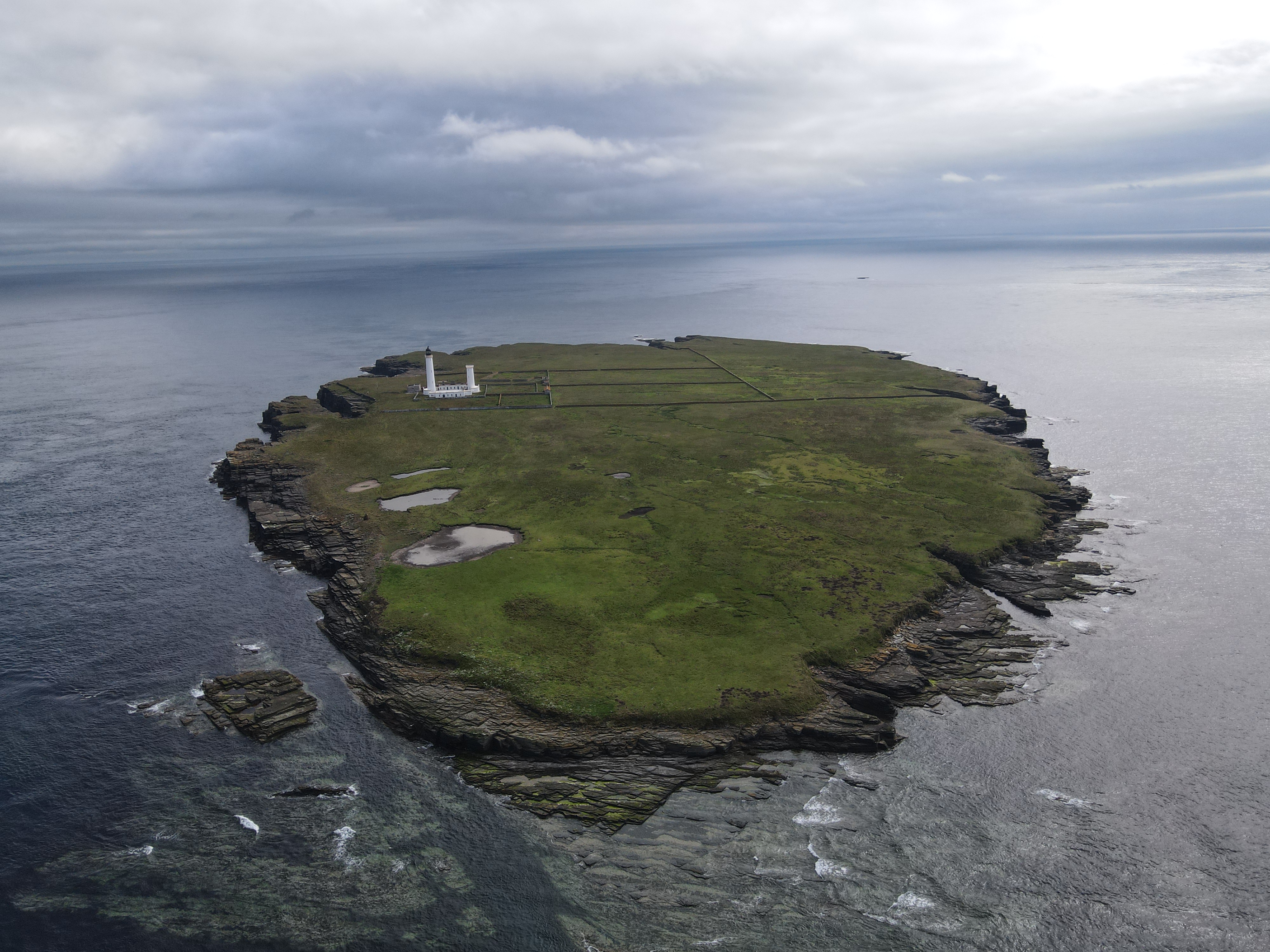
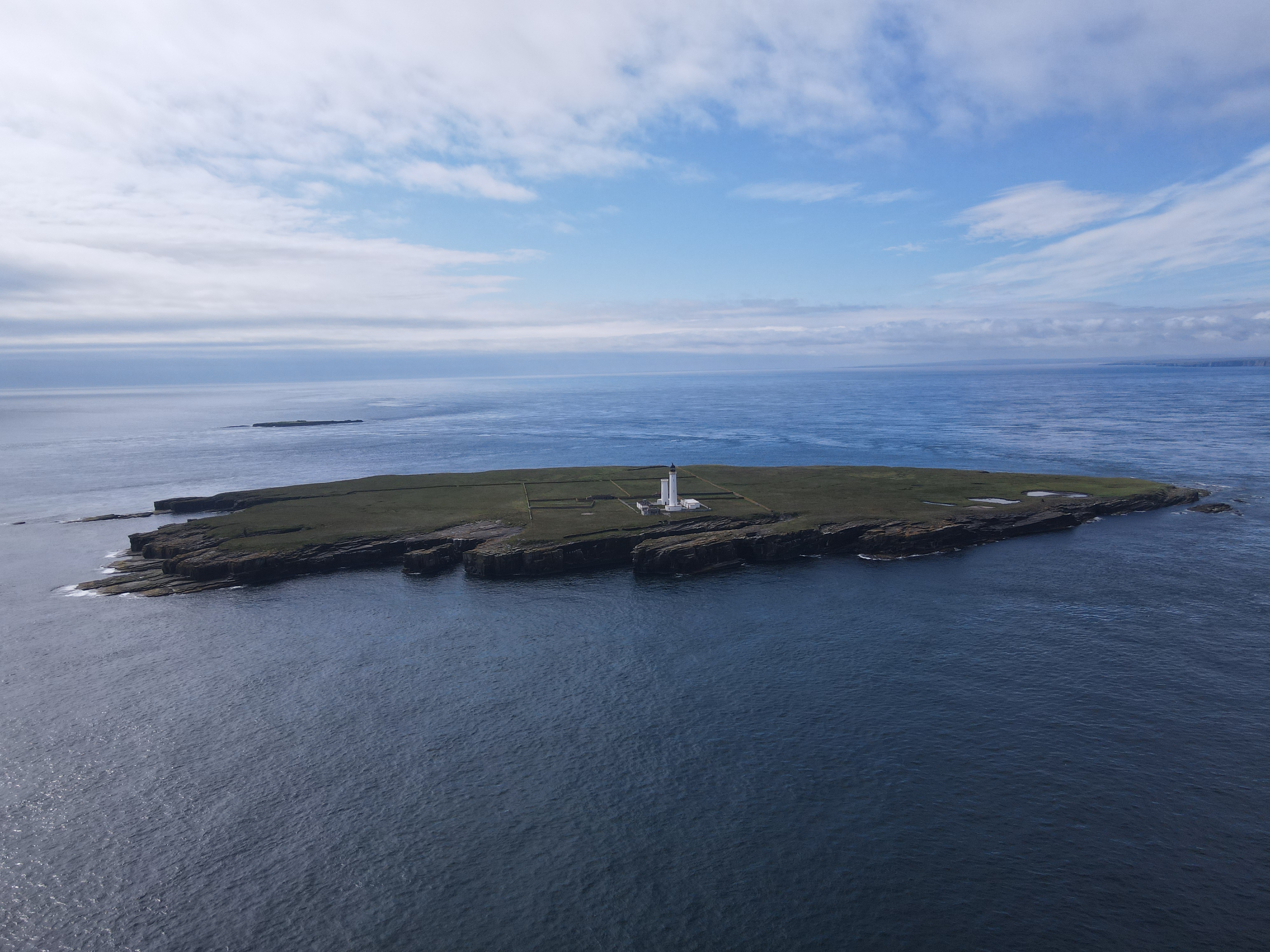
Pentland Skerries Lighthouse and the former Low Light tower

We had a really good amount of time to explore the island today too and one of the most interesting parts I’d not seen before was the natural geo just to the north of the lighthouse. Muckle Skerry looks like a fairly low lying island from afar, but the cliffs in the group are impressively high. There is evidence here too that it may have been used at times for landing and lifting goods up for the lighthouse.

The view down into the geo
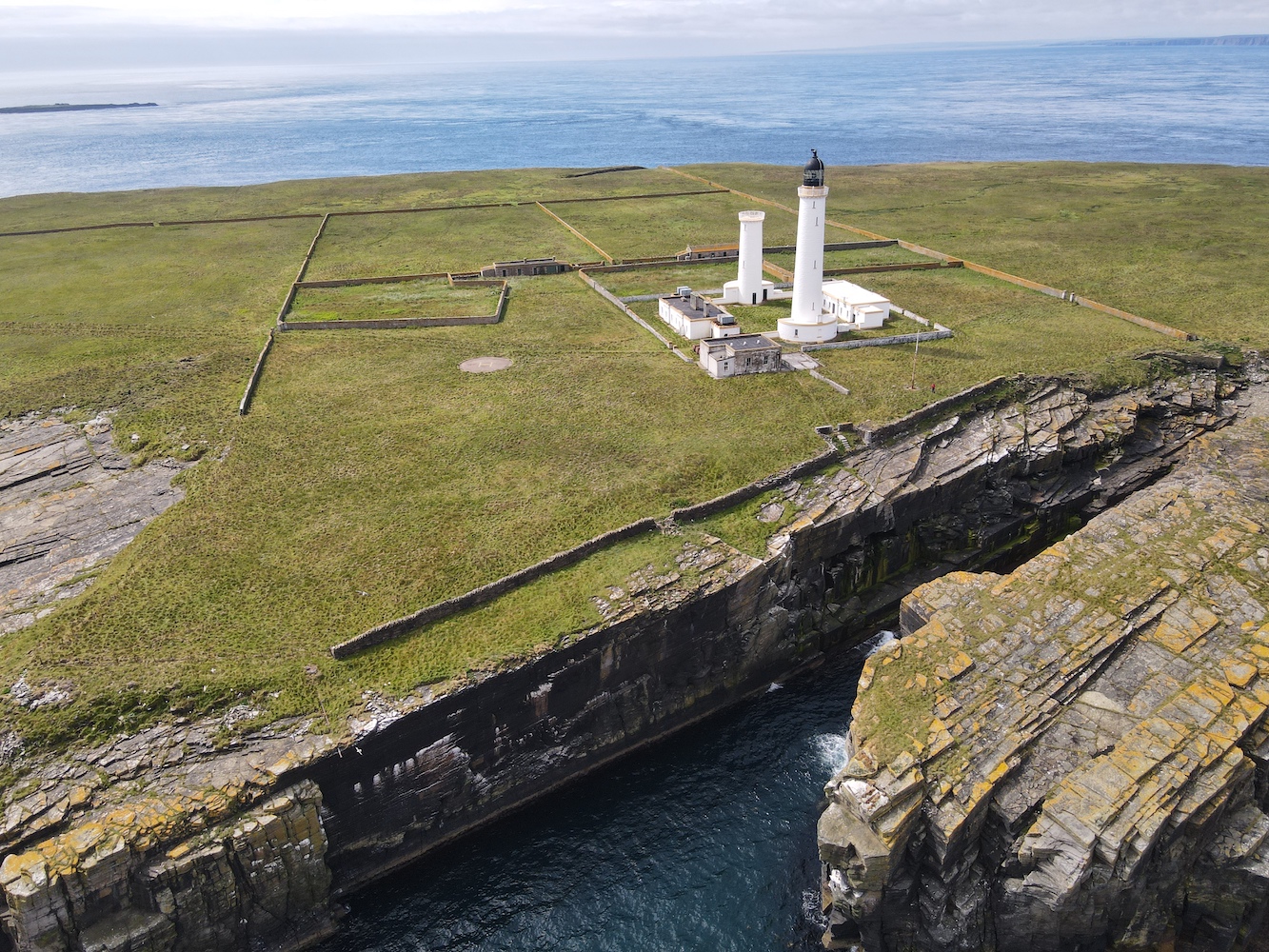
The lighthouse and geo from above
The view of Pentland Skerries Lighthouse from the geo

Since my last visit two years ago little has changed. The lighthouse and old tower are still looking glorious while the old keepers cottages are clearly not being maintained. The thing I find really frustrating about this is that someone has clearly bought the island including the cottages and yet is doing nothing with them. At the same time the owner doesn’t want anyone to go there, which they can’t enforce given Scotland’s freedom to roam legislation. It is yet another case of people buying things, not looking after them while not wanting anyone else to enjoy them. But we go there anyway so I can’t complain too much!

This time I really wanted to find the graveyard and old memorial stone that marks the loss of seven crew members from the Vicksburg, which was wrecked off the Pentland Skerries in 1884. While some of the crew were helped ashore by the lighthouse keepers those buried on the island weren’t so fortunate. The memorial stone also marks the loss of two of a Principal Lighthouse Keeper’s children who passed away on the island. Unfortunately, yet again I had no luck in finding it, but next time I will make sure I’ve done my research.

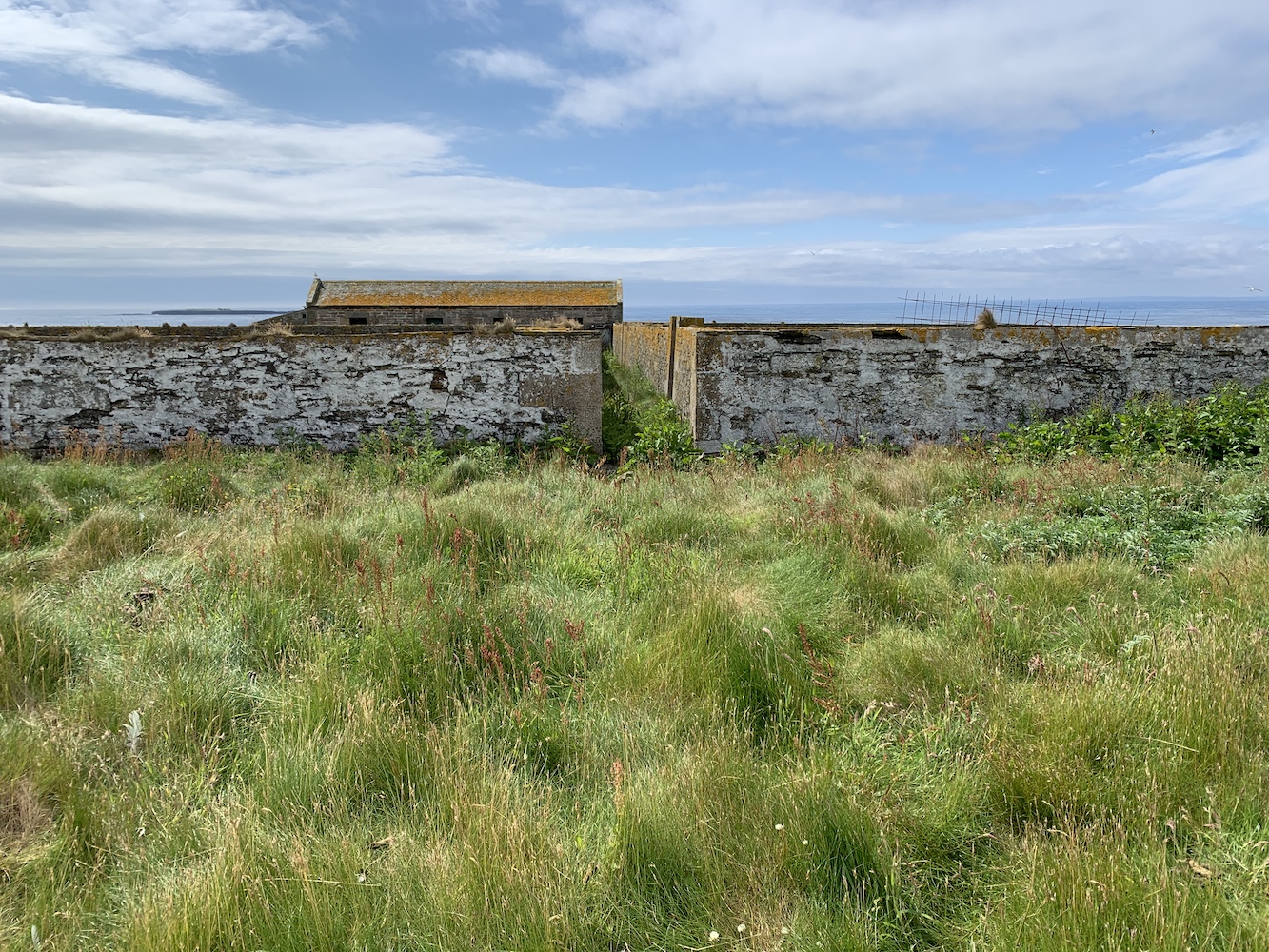
Considering the lighthouse grounds and buildings take up a relatively small area on the island there are plenty of old buildings and walls in various states of repair

There was plenty of bird life around today with gulls, terns, skuas, puffins, fulmar, razorbills and various smaller birds too. We tried to minimise any disturbance to them and thankfully the terns and skuas didn’t swoop, which is always a worry.

Arriving back at the boat it was great to hear that the crew had enjoyed their visit too, particularly seeing the number of puffins around and enjoying the sunshine which very kindly made an appearance not long after our arrival. We hopped back down into the boat and Alex sailed around the north of the island for a different view on the way back. It was a pretty short journey back to John O’Groats – the boat can certainly go fast, but we took it a bit easy going back through the bumpy section, which wasn’t too bad.

Enjoying the journey back

It was an excellent hour and a half spent on a really interesting island. Although I’ve been there three times now it doesn’t lose its appeal and actually it becomes more and more fascinating each time. I’ve only just got back, but would love another chance to go out there again 🙂

A backup plan with a bonus

For the last couple of months we’d had a lovely long weekend away to the Western Isles planned, including being on a chartered boat out to Sula Sgeir and North Rona, which I’d previously visited back in 2014. We had accommodation organised, ferries booked and had got the green light from the organiser of the trip. All was well, but actually it wasn’t, which I realised the day before we were due to leave when my good pal John called to check which ferry we were booked on as the time I’d told him didn’t tie in with any of the sailings. It was then that I discovered somehow we’d managed to book the ferries the wrong way around and we were due to sail from Stornoway to Ullapool instead of the other direction on Friday. We made a hasty call to Calmac having checked all sailings to the Western Isles to find nothing was available. The man on the other end of the phone confirmed this was the case and apologised, to which I reminded him it was our fault for getting the booking wrong in the first place so he had no need to apologise. With no way to get across there (due to COVID-19 related restrictions we couldn’t even hop into a friend’s car as they had no space even for extra foot passengers), the decision was made that we needed a backup plan.

6 months pregnant at North Rona back in 2014. A revisit this time just wasn’t meant to be

I didn’t want to drive for hours as that’s an easy way to waste a weekend and so I began researching Orkney and, more specifically Westray for Noup Head Lighthouse. The ferry times didn’t tie in and, wanting to leave North Ronaldsay for another time, I took a look at Start Point Lighthouse on a tidal island off Sanday. The fact that the island is tidal has made it a really tricky one to get to and I’d previously resigned myself to the fact that we’d need to stay overnight on Sanday sometime to be able to do it. Thankfully, looking at the tide times for Sunday, I found low tide in the area to be at 1.50pm with the ferry arriving 10.25am and then departing at 5.40pm. It seemed to me like an ideal day to get to Start Point Lighthouse finally.

Luckily Bob agreed to my suggestion and suggested I contact a friend who lives on Sanday to see if he knew of anyone who had a key to the lighthouse and could show us around. I thought it was probably a bit of a long-shot especially given the current pandemic, but it was worth a try. The lighthouse used to be open routinely with guided tours run by the Sanday Ranger, but these tours no longer take place. It didn’t take long to get a response from our friend with a couple of people to contact. I called and left a message with the man suggested as the best place to start and he got back to me later that day (this was Friday so there wasn’t much time to organise it) and said I’d need to get permission from his manager, but that he’s be willing to show us up the tower if his boss said yes. Rather fortunately I had met his boss on a couple of occasions over the past two years and when I called him he said he was happy. So it was all planned and I was going to get inside a lighthouse for the first time in 17 months!

The (correct) ferries for Orkney and Sanday were booked and camping arranged in Kirkwall so on Saturday we set off. Upon arriving we took a drive up to Birsay for a look at Brough of Birsay and its lighthouse.

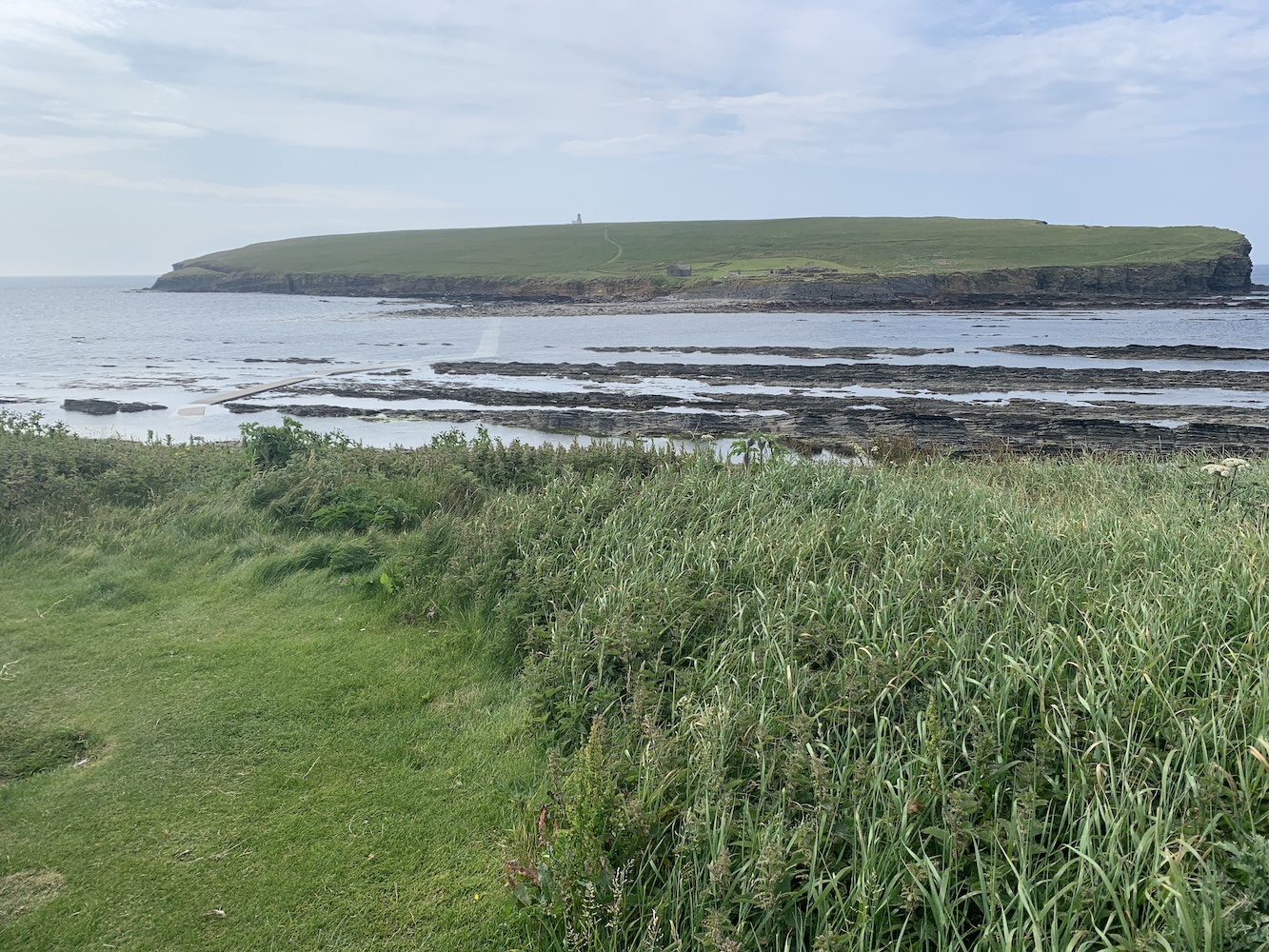
Brough of Birsay
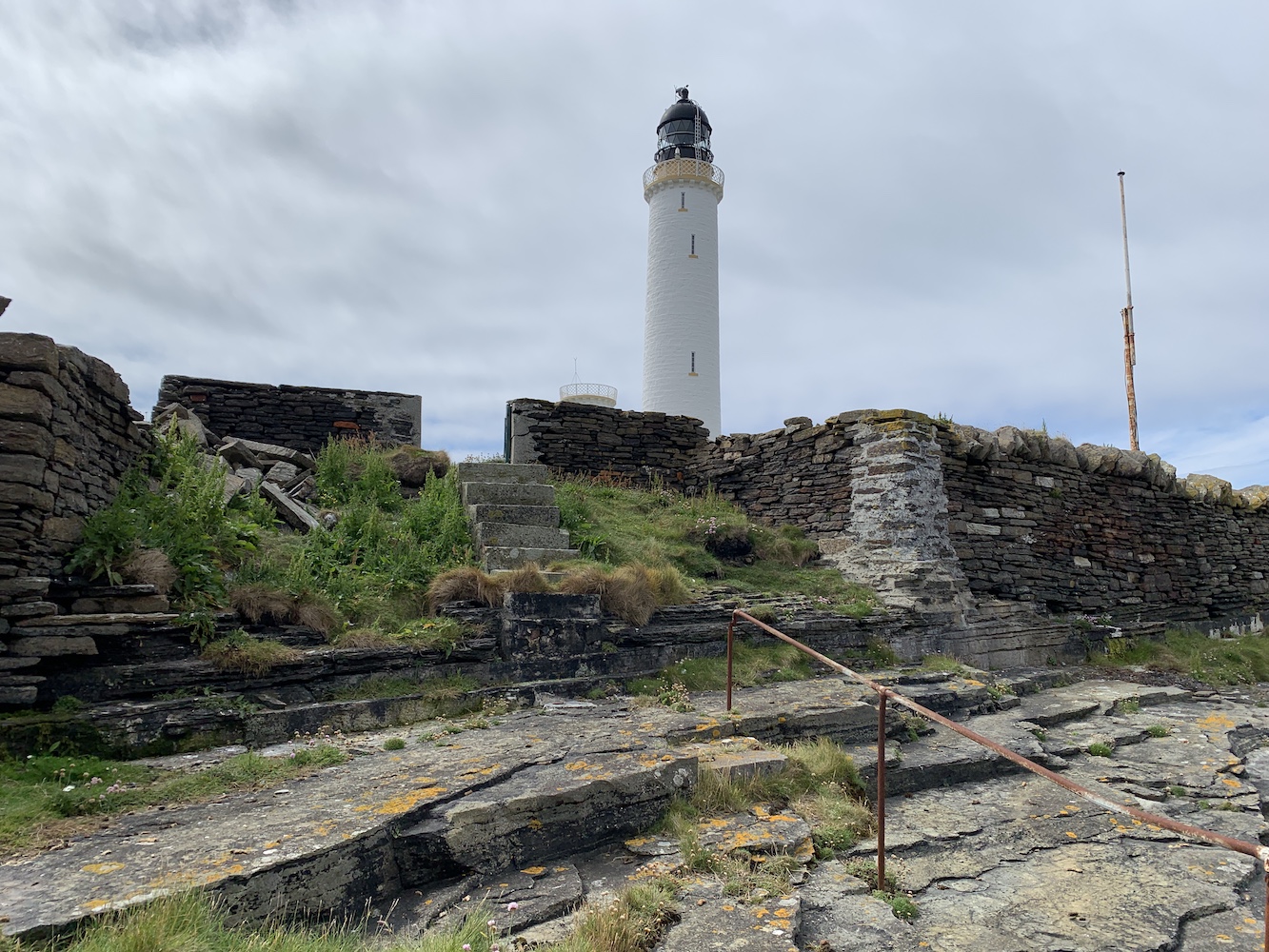
Brough of Birsay Lighthouse

Joe the Drone took a fly around his first Orkney lighthouse there too.

A Joe the Drone’s eye view of Brough of Birsay

Sunday morning came and it was off to Sanday. Heading straight for Start Point, I contacted Ian to say we were on the island and he confirmed he was just heading over to the lighthouse. Reaching the end of the public road we found the three spaces in the parking area already full so we found a verge further back that wasn’t blocking any gates etc. and began the walk. The first bit was easy, following a good path along the coast.

On the way to Start Point with the lighthouse in sight

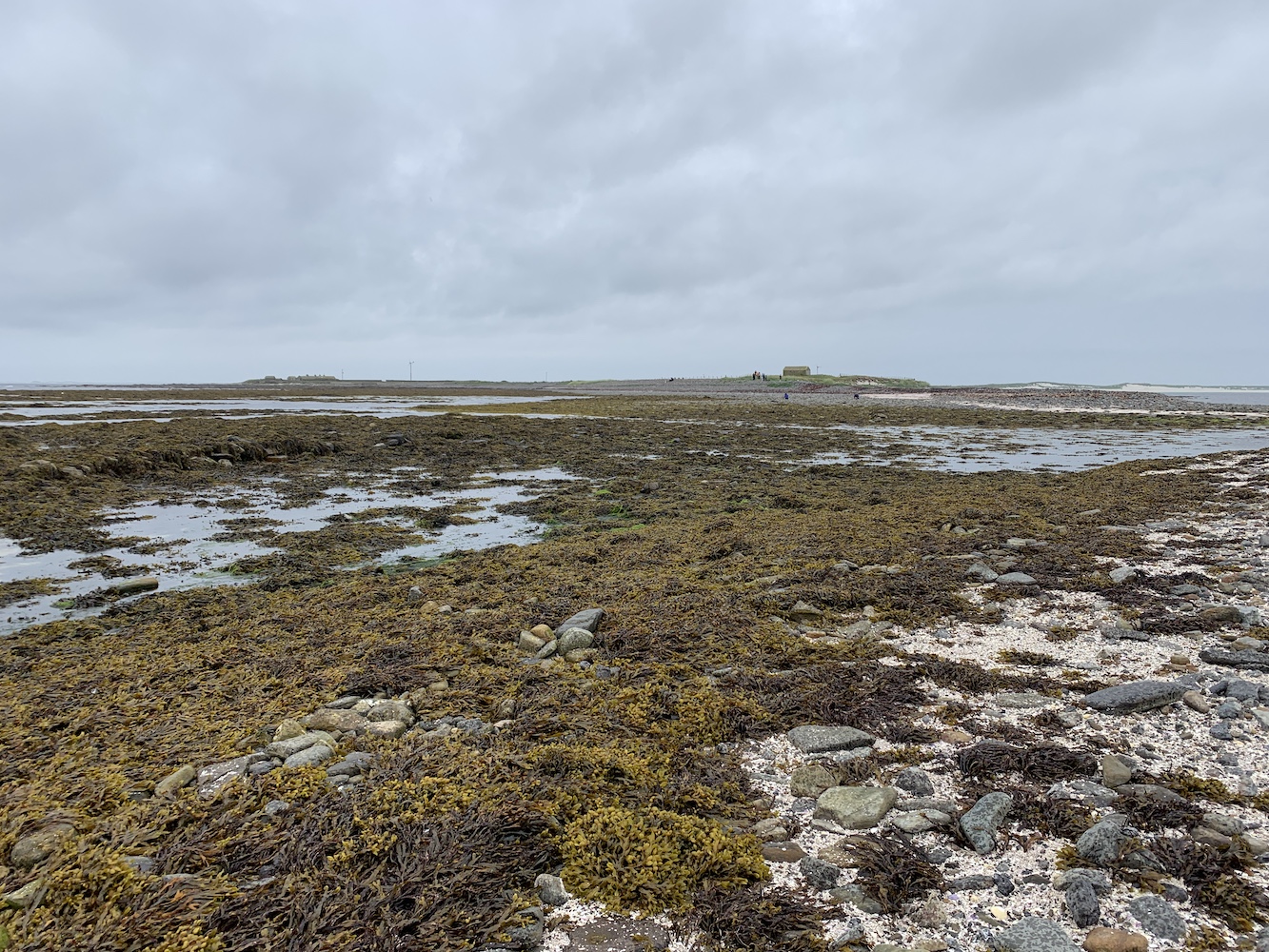
The section between the main island and Start Point is rather deceptive. Initially you see a seaweed-covered track leading towards the tidal bit and think ‘oh, that looks fine to cross’. It’s not until you get beyond it that you encounter the very tidal section, which was still very wet when we arrived. At this point it was 2.5 hours before low tide and, as Bob escorted me across the seaweed and very wet bits like I was an old lady, we both ended up with wet feet. We made it to the other side though with no mishaps and then the path was easy going as the lighthouse got closer and closer.

Looking back across the tidal section about 2.5 hours before low tide

As we approached the lighthouse Ian, our tour guide appeared, and after a short chat we were off into the tower. Ian was wearing wellies, which is something I would highly recommend to anyone considering visiting Start Point – not for the tower of course, but for the crossing.

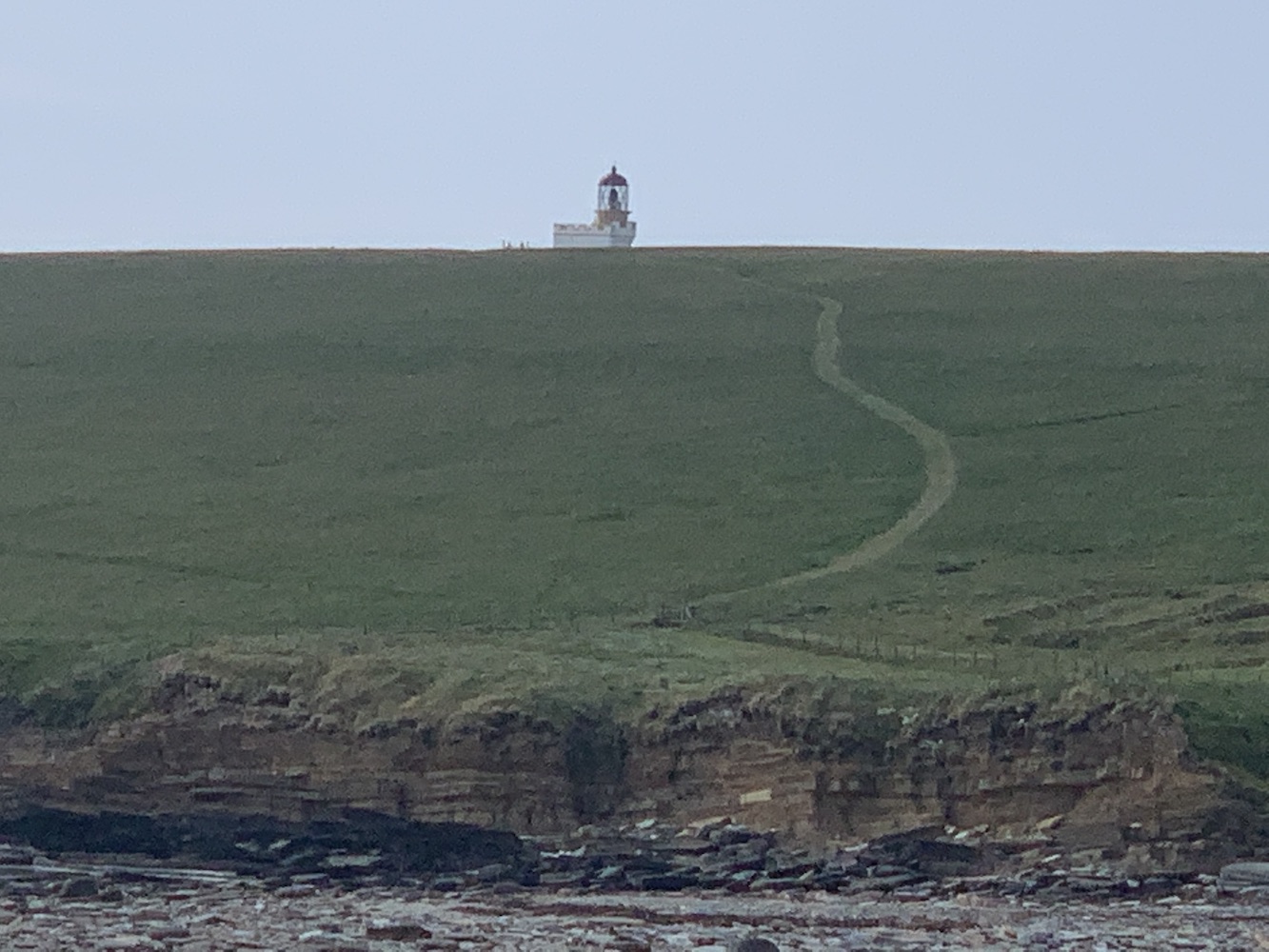
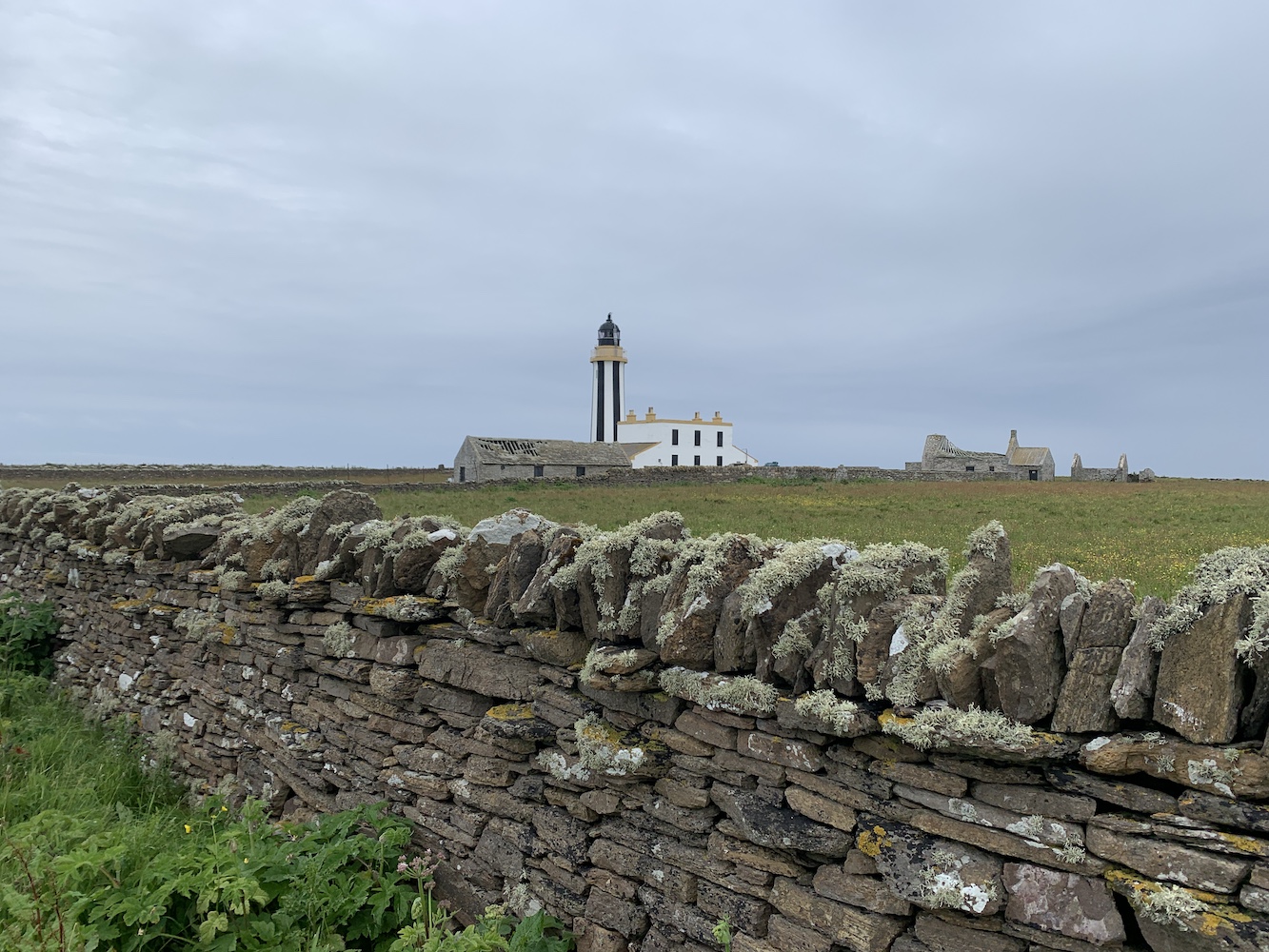
The unmistakable Start Point Lighthouse

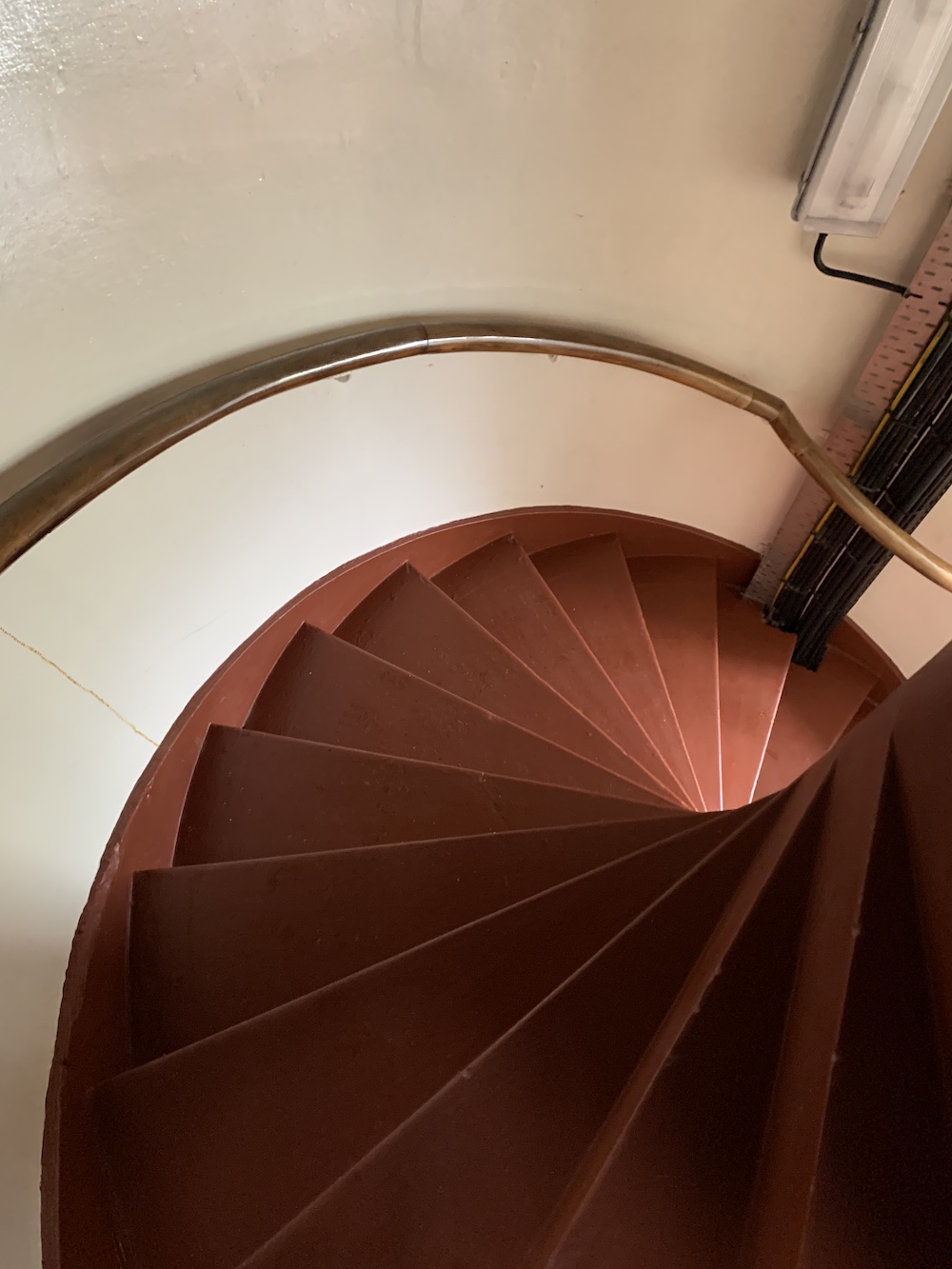
Now climbing a lighthouse can cause some breathlessness anyway, but climbing with a face mask on makes it a lot harder. It wasn’t so bad though and I was just glad it wasn’t North Ronaldsay (the tallest land-based tower in Britain) we were going up.

The staircase inside Start Point Lighthouse

After the spiral staircase there were the obligatory ladders to climb and then, there we were, right at the top with some stunning views in all directions. Looking back towards Sanday, out towards the sea, down on the old ruined buildings, there was plenty to see and Ian pointed out roughly where the previous lighthouse used to be.

Based on maps we later saw at Sanday Heritage Museum, the former lighthouse would have been in the top right hand corner of the square field, next to the old buildings

Start Point had confused me for some time. On the Northern Lighthouse Board’s website the tower/light is dated 1806, but other sources said the current tower replaced the 1806 tower in 1870. I thought there was no better way to find out the truth than to look and ask around locally. Ian confirmed the current tower is the second with the first one introduced as a day mark in 1802. When wrecks continued to occur in the area it was decided a light was required and so a lantern and light replaced the stone ball on top of the tower (the ball can now be found on top of the old North Ronaldsay lighthouse). It was the first lighthouse in Scotland to have revolving lighthouse apparatus, paving the way for the light characteristics used in all lighthouses today and listed in the Admiralty List of Lights.

Ian opened up the wonderful fourth order Fresnel lens to show us the bulbs and explained that, for a while, there had been the risk of the lens being removed from the tower and replaced with a modern LED. It now sounds like this is not going to be the case, which is always a pleasure to hear.

Start Point Lighthouse lens
Inside the lens

Back down on the next floor Ian opened up the door to the balcony and we were blessed with even better views of the surrounding area. The tide at Start Point is really interesting. There is roughly 45 minutes in time difference between high and low tide on either side of the tidal section getting out to Start Point. Ian explained just how unpredictable the tides can be there and that he limits his visits to 2 hours maximum in order to make sure he can get back across to Sanday safely.

The view from the top of the lighthouse. Ian pointed out how the rocks almost look to be shaped like waves in places.
With Ian at the top of Start Point lighthouse

Back down the bottom of the tower I gave Ian a copy of my book as a little thank you gift. I think it’s safe to assume that anyone who signs up to be a Retained Lighthouse Keeper must have an interest in lighthouses. We bade farewell to Ian and set off to explore some of the ruined buildings in the area as well as getting some awesome views of the very unique striped lighthouse.

Start Point Lighthouse and part of the old mill buildings nearby
Start Point Lighthouse from the east

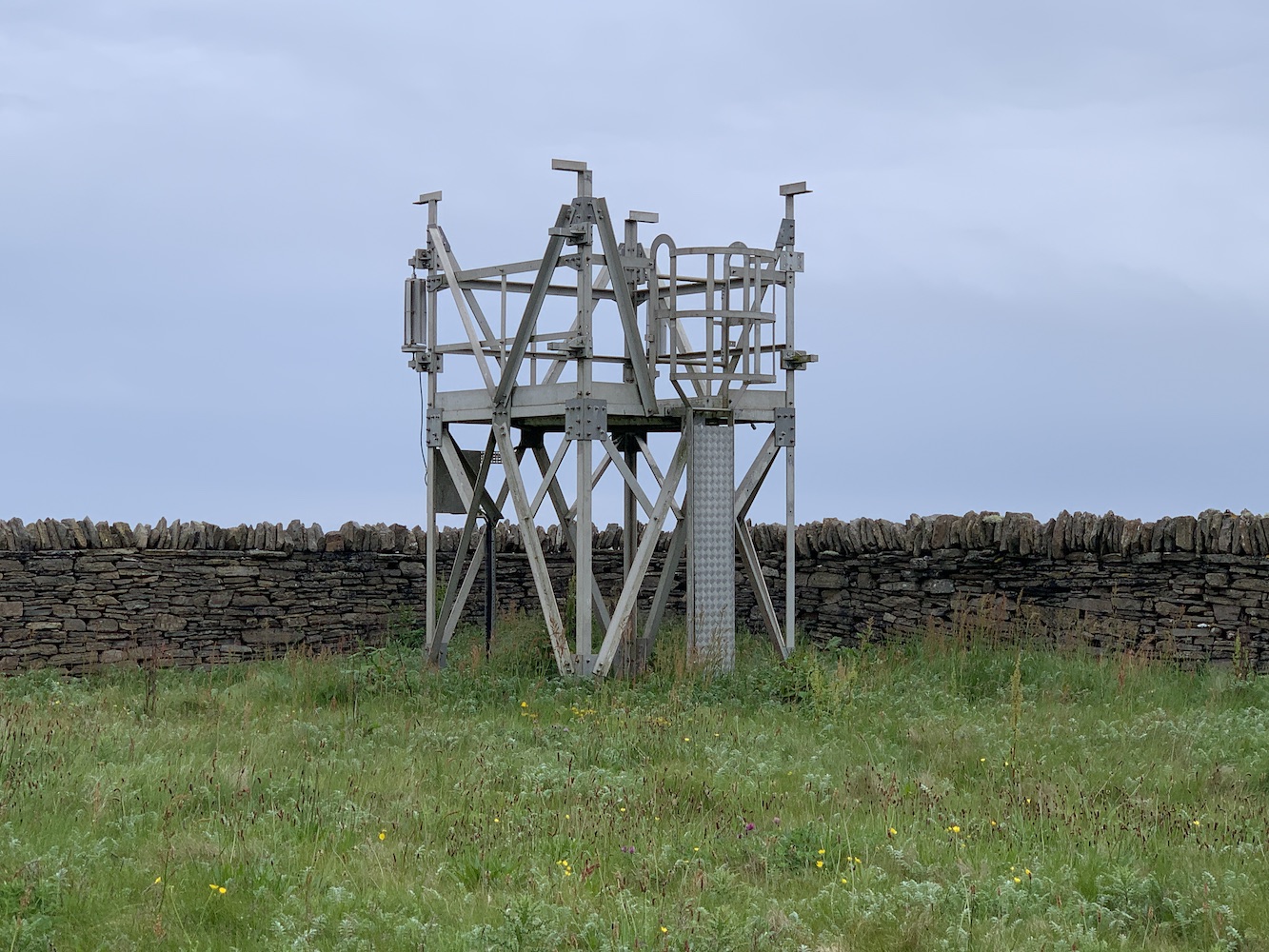
In the grounds of the lighthouse was a framework platform the type of which I’d seen at Ushenish last year. Since that visit I’ve been informed that it was a wind power trial the Northern Lighthouse Board has carried out, but (as at Ushenish) it had failed as it was blown to pieces within the first couple of weeks.

The platform used to test wind power generation at Start Point

Stopping for lunch it was time for Joe the Drone to have another flight and, as usual, he caught some fantastic shots from the sky.

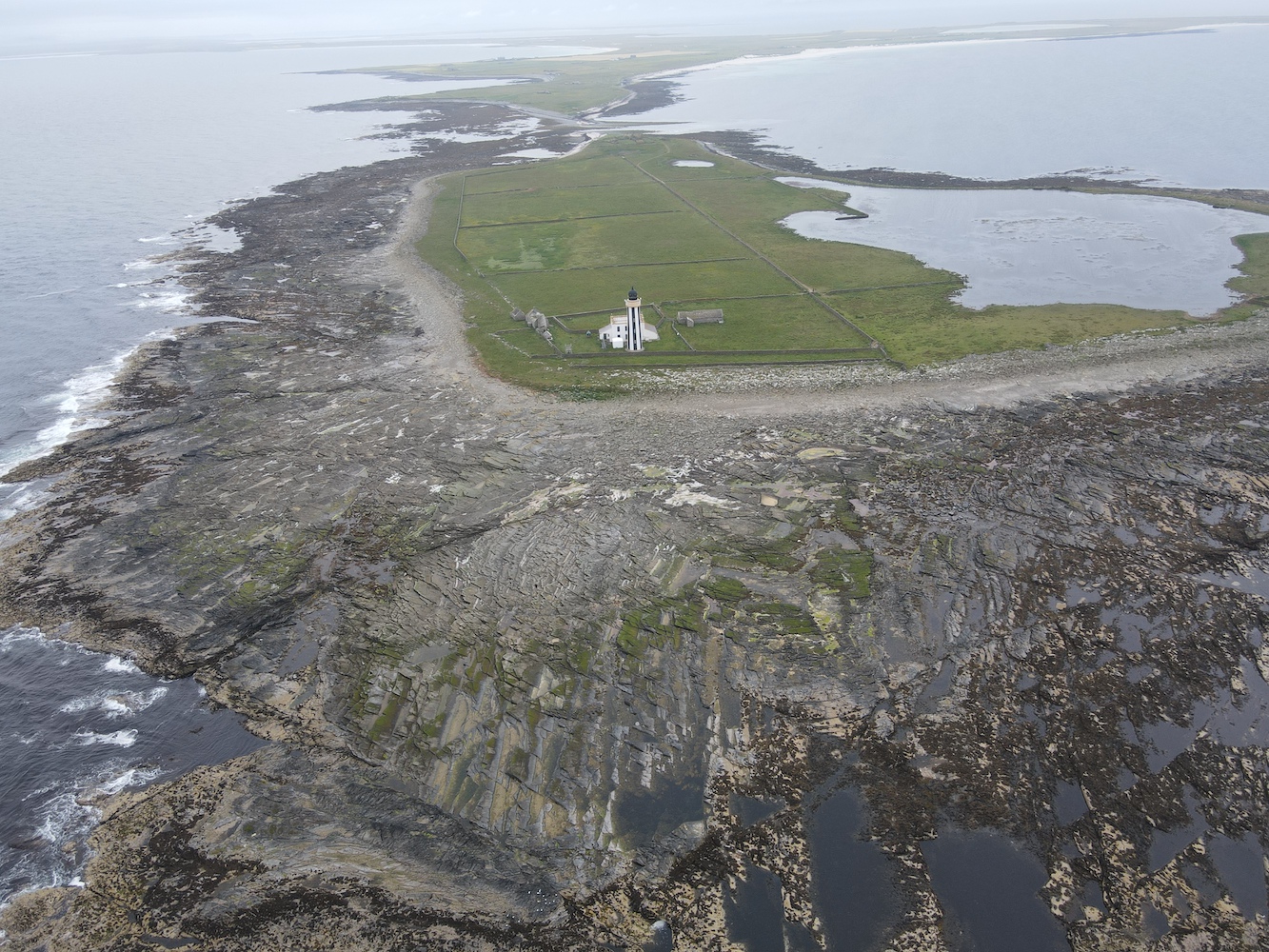
Start Point Lighthouse from above with Sanday in the background
Joe’s view of Start Point

Once Joe was safely back down it was time to head back. It was still 50 minutes before low tide, but the tidal section was significantly less wet than it had been on our outward journey. I wouldn’t go so far as to say dry as I imagine with all the rocks and seaweed it never really completely dries out.

We paid a visit to Sanday Heritage Centre on the way back and the lady handed us their reference book about the lighthouse, which had some great little pieces in it and further confirmed the history of the lighthouse(s) mentioned above. There was a large poster on display about the lighthouse, showing an old map with the location of the former lighthouse, which having been there, we were able to picture how it would have looked out there.

That evening, leaving Sanday behind, I was satisfied in the knowledge that sometimes things happen for a reason. If the reason for the incorrect Western Isles ferry booking was that I really should go to Start Point instead then I’m certainly not complaining 🙂

My final Skye light

As I mentioned in Friday’s post, I had just two lighthouses on Skye left to visit before this weekend. With Dunvegan Lighthouse bagged that just left one more: Waternish Point.

With rain forecast for this afternoon – and the need to get home today – a fairly early start was required. After the kayaking and then the added extras from yesterday it was a balance between setting off at a decent time and getting enough sleep.

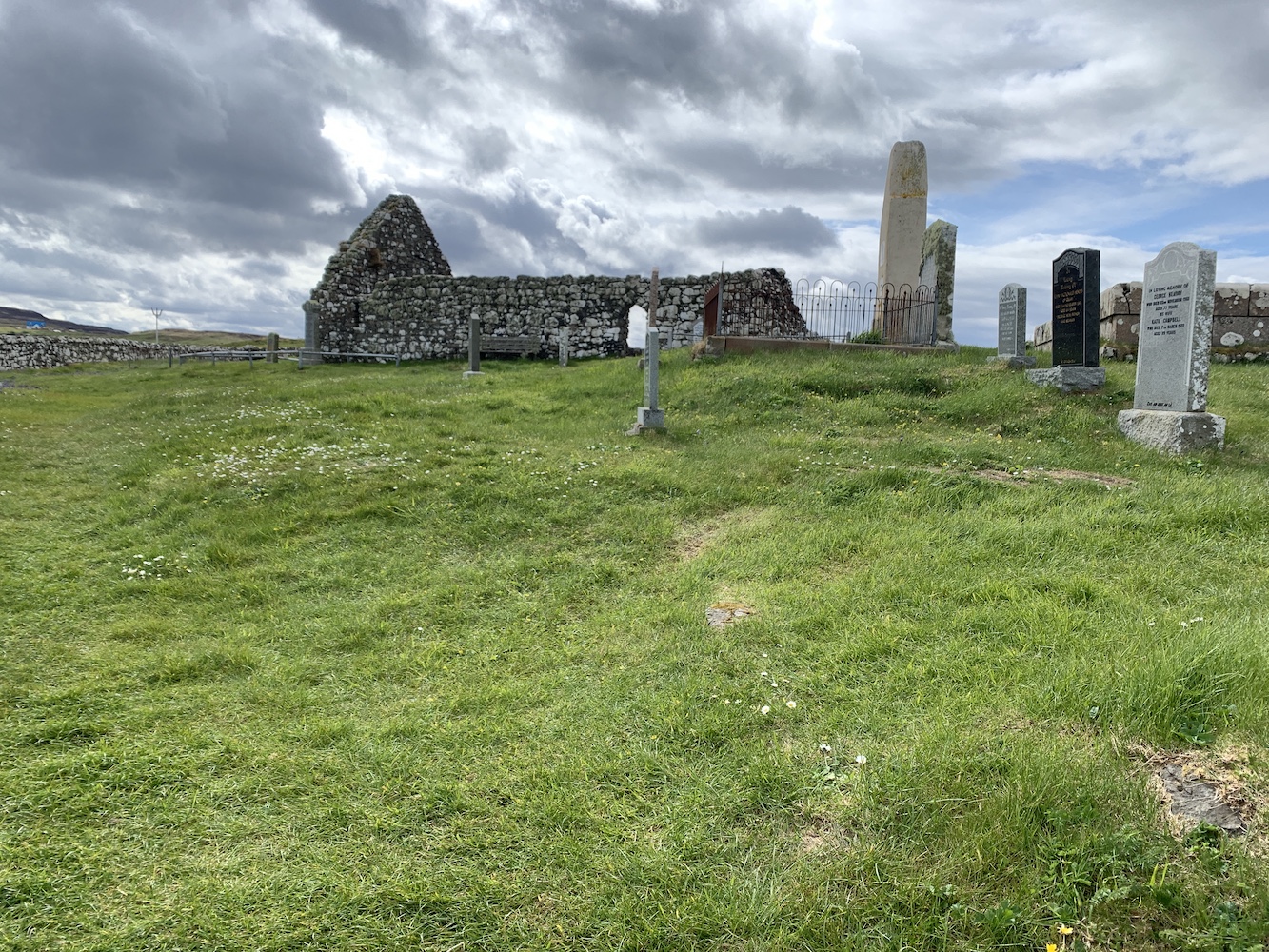
It was nice and dry when we set off and quite some time later we arrived in Trumpan (I’ve said it before, Skye is big). Spotting the starting point for the walk as we drove past we then parked up opposite the old church. This church was the scene of a particularly nasty episode in the long-running battles between the MacLeods of Skye and the MacDonalds of Uist. In revenge for an equally sinister event on the island of Eigg, the MacDonalds made their way to Trumpan and burned the church while it was full of local worshippers. The churchyard surrounding the ruins contains a number of graves, including some quite recent ones.

The remains of Trumpan church

There’s also a Dark Skies area next to the car park and I can imagine it gets very interesting there at night with the lack of light in almost every direction.

Once we were ready we set off along the road and through the gate. We were very much aware that cows could play a part in the day’s adventure, which is always enough to put Bob on edge certainly. He adopted the role of ‘cow lookout’ and went on ahead a little way, scanning the track and surrounding area. We reached a little mound featuring a cairn and Bob headed on up and ushered me up once he’s got to the top. He’d spotted the cows which had young with them and a couple had stood up when they spotted Bob. They weren’t far at all from the track so a bit of off-piste was required just to be sure we didn’t spook them.

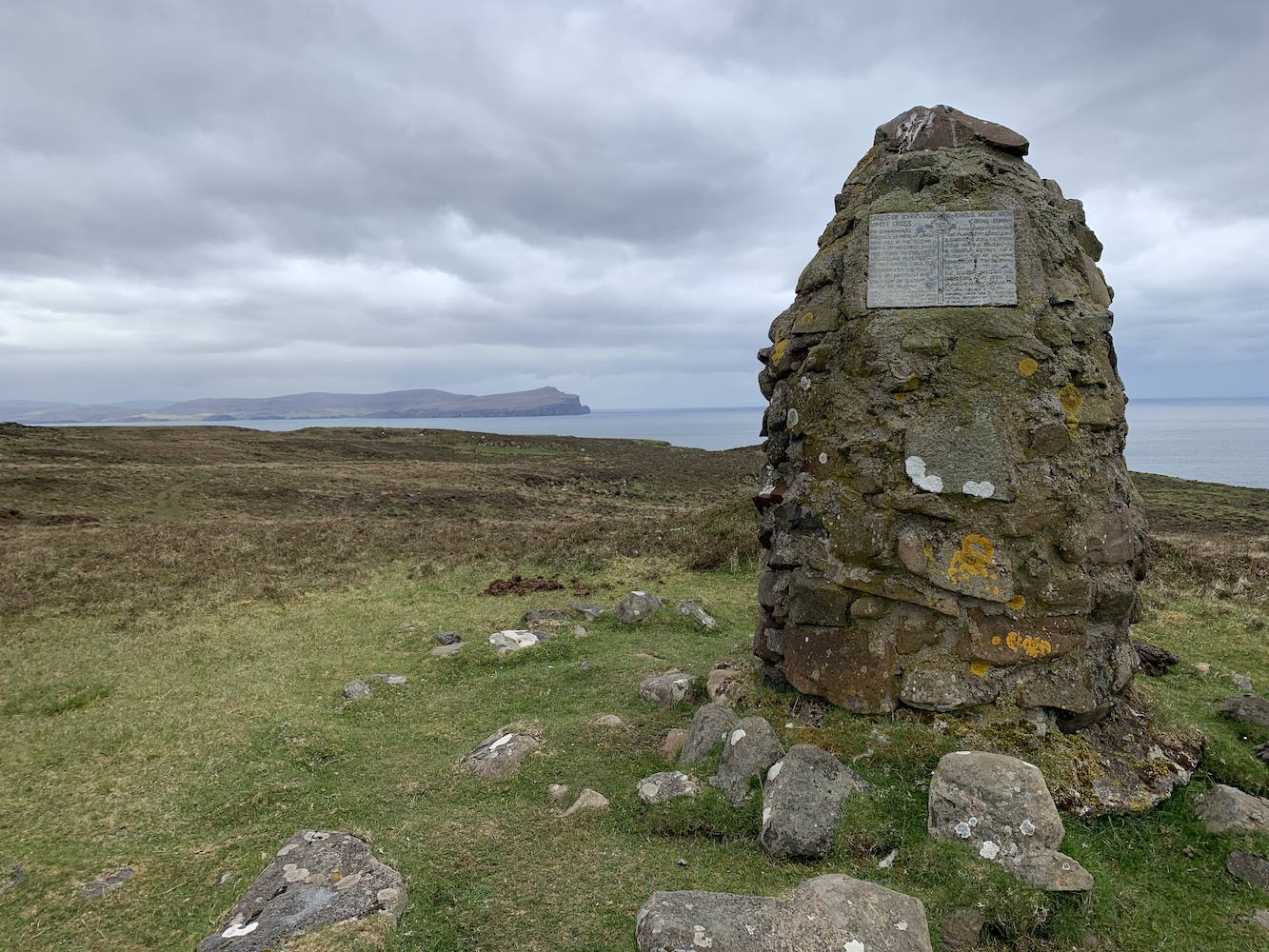
The cairn from which Bob spotted the cows (not shown in this picture)

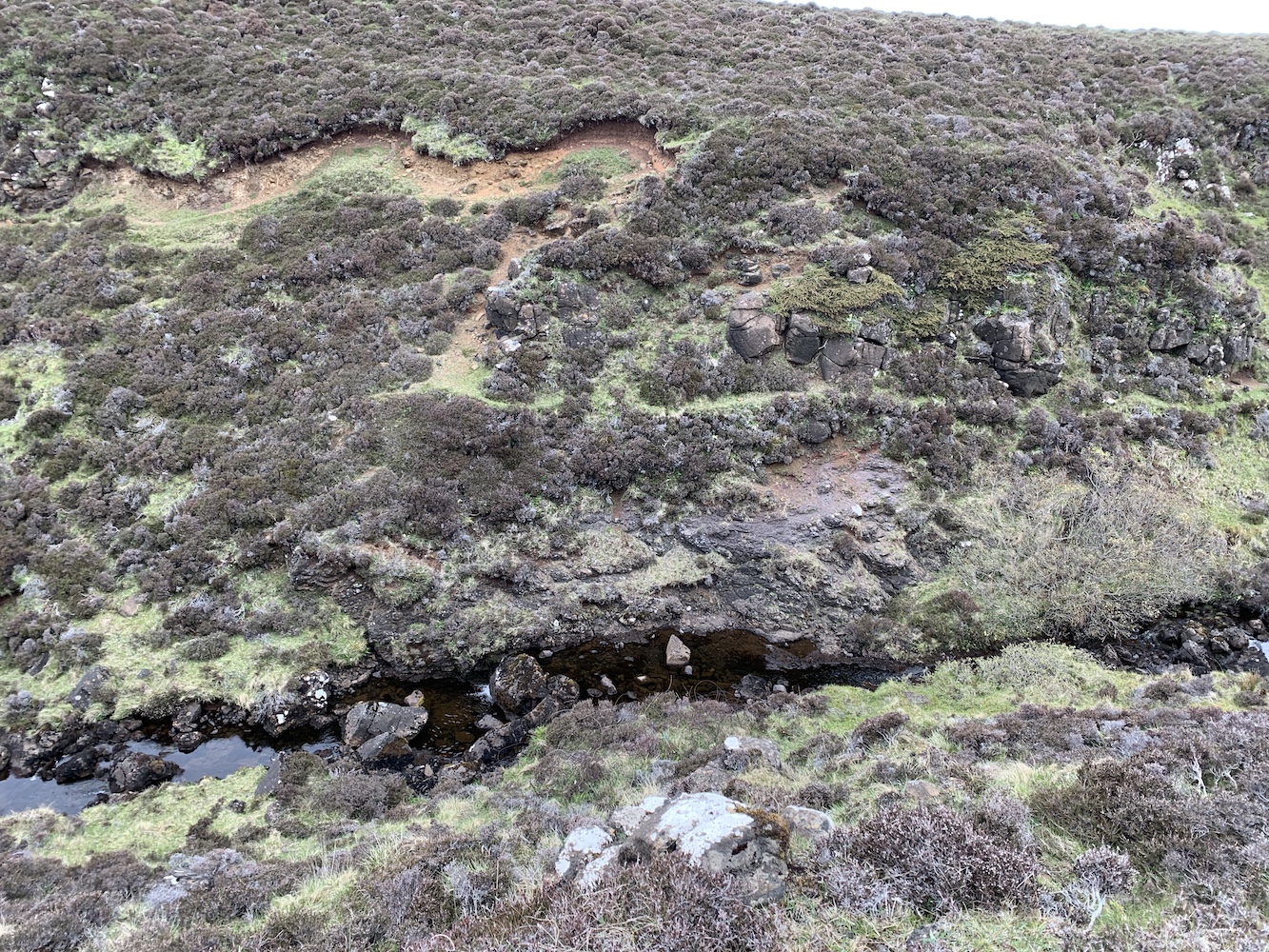
We headed for the coast across the heather and after a very short time encountered a gaping chasm (Bob called it a gully, but it was definitely a chasm). ‘Follow the sheep track’ Bob advised me as we started to scramble down into the chasm. My response was ‘But I’m not a sheep.’ Sheep manage to balance their way about on all sorts of skinny ledges – which isn’t so easy for me as a human. ‘Follow the staircase’ was another one of his comments and I didn’t even dignify that one with an answer.

This picture doesn’t show very well just how gaping the chasm really was!

We made it safely and slowly to the bottom of the chasm and, of course, then there was a burn to cross. I am rubbish at crossing rivers or streams, but thankfully this time I managed not to get wet. Then it was up the other side, which actually was much easier. More sheep must have been up that side of the chasm prior to my visit.

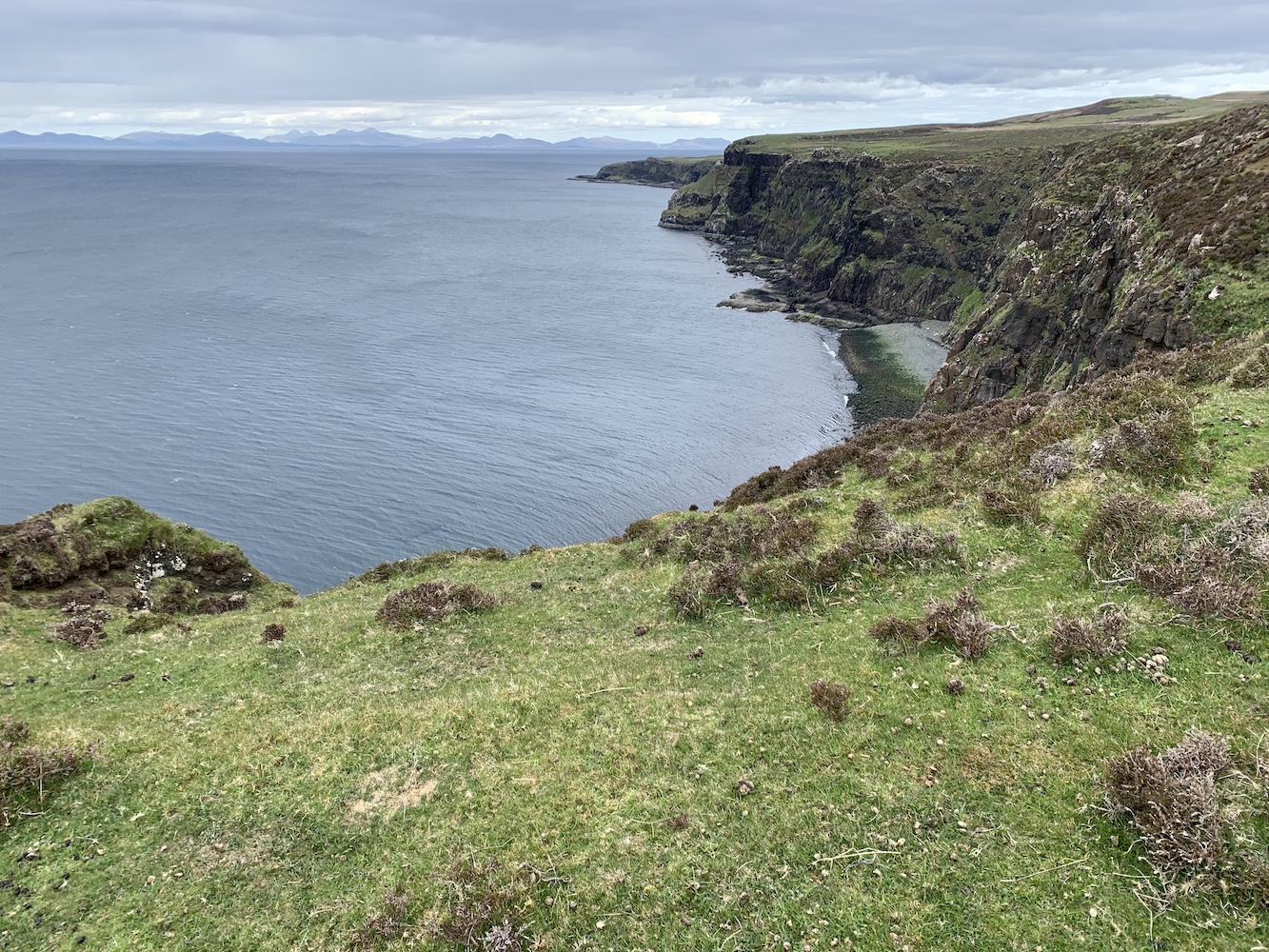
From here we followed the coast for a while to make sure we were out of sight of the cows. I’m usually always on the look out for silver linings when things don’t quite go to plan. I certainly wasn’t while in the chasm (although it did look nice), but once we were back on the well-trodden sheep track along the coast there were some spectacular views both to the west and onwards in our direction of travel to the north.

The view to the north with the hills of Harris in the distance

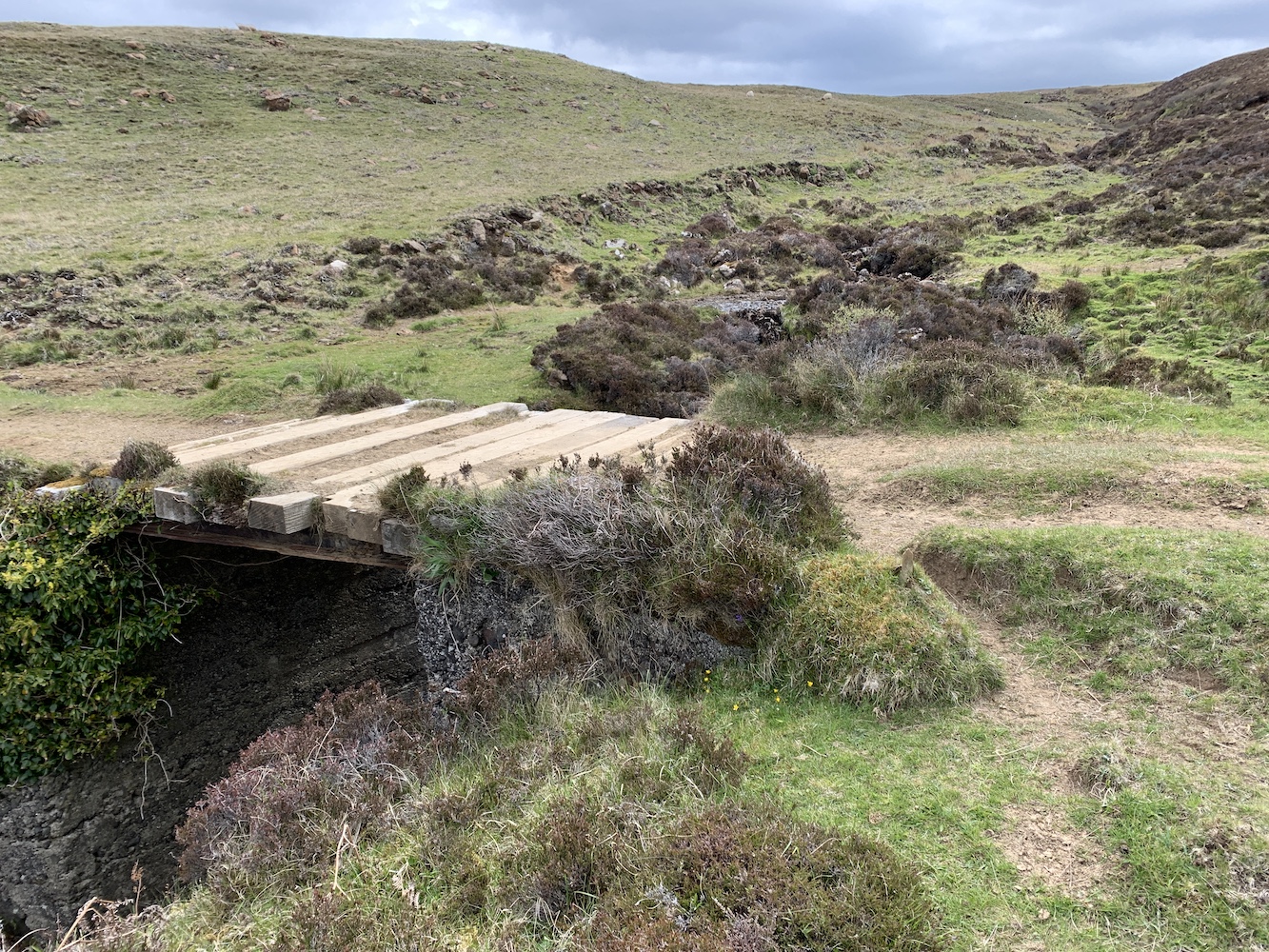
We ended up following the coast for far longer than I expected and our 1km off-piste detour came to an end as we joined the track again at a nice little bridge. From here it was just trudging on, passing sheep and their lambs occasionally.

The bridge where we rejoined the track

Eventually I got my first glimpse of our destination, Waternish Point Lighthouse. It did look about 500 miles away (I exaggerate), but it was a positive sign. We passed a couple of chaps who were just on their way back from the lighthouse and chatted to them for a few minutes before continuing on our way.

My very first glimpse of Waternish Point Lighthouse

Reaching the end of the track we encountered the remains of walls and most notably the ruins of a house, which Joe had a fly over.

The remains of the old house at Unish

From here it was all downhill to the lighthouse and the lower you got the boggier it became, but thankfully the ground wasn’t too wet today. The lighthouse gradually got closer and then finally I was there at my final lighthouse on Skye!

Waternish Point Lighthouse

What can I say about Waternish? Immediately you notice the stunning views across to the Outer Hebrides with the incredible hills of Harris on display and then a flurry of islands (I’m not sure at all that’s the correct name for a group of islands, but we’ll go with it) including the Shiants and the interestingly shaped and very appropriately named Lord Macdonald’s Table. Sadly the Uists had disappeared into the distance by then, but there was plenty to keep you occupied. Apparently it’s a great place for spotting whales and dolphins, but we didn’t see any of them, but we did see a Calmac ferry passing en route to Uig and the men we met on the way there had seen a submarine come up above the surface. Who needs whales and dolphins, eh!?

Waternish Point Lighthouse with the Shiants and other islands visible to its left

Onto the lighthouse. The current structure was built in 1980 and like just a few others has more than one door – presumably this is so you can access the inside of the tower safely without the door flying off in the wind and you would use the appropriate door based on the wind direction. This tower replaced the 1924 tower, designed by David and Charles Stevenson. It’s clear when you are there that there must originally have been a fair number of buildings on the site and now all that remains of them are the foundations. I really like the current tower as it is. There are very few like it left standing now so it’s always a pleasure to see one.

Waternish Point Lighthouse and the Harris hills beyond

Of course Joe the Drone had to have another little fly around.

Waternish Point from above
A fabulous view of the Waternish (or Vaternish) peninsula

Just before we left I decided, for no apparent reason, to give the lighthouse a ‘high five’. Even as I was doing it I said ‘Can you give a lighthouse a high five?’ Anyway, I did. I even added a bonus ‘on the side’ high five! Then it was time to head back. The slog back up to the ruined house was tough. The energy from my lunch hadn’t quite kicked in at that point so I was slow and tired, and incredibly glad to get to the track when we eventually did. On the way we spotted a white-tailed eagle soaring around and being chased off by a smaller bird, who we imagined was defending its nest. There were also the remains of a small sheep and tiny lamb in the area, further evidence that we were on eagle hunting ground.

Back on the track we retraced our steps, with the wind and rain in our faces, we got to the bridge and left the track again. The cows were in roughly the same place as before, but had moved even closer to the track and so we strolled on quickly while we were in sight of them. The gaping chasm wasn’t quite so gaping on the way back (still a chasm though – and wet this time too). I had expected us to head for the track again once we were past the cows, but Bob thought we should continue to follow the coastal route. Imagining even more gaping chasms opening up in front of me, I reluctantly followed. I’m actually very glad we did as there were even more wonderful views to behold in the final section. We followed the coast as far as we could before heading slightly inland and following a fence line which took us directly to the gate. Just a bit more track to go, one more gate and then we were back at the car.

The view to the south west
A great combination of towering cliffs and low lying land

It had been quite a walk and I’d struggled a bit at times, mainly I think because of tiredness from the weekend’s adventures. It was so worth doing though and I would definitely recommend doing that coastal route to anyone visiting. It really is superb for impressive panoramic views. Just mind the gaping chasm! 🙂