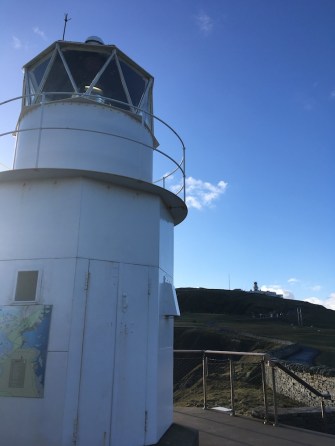
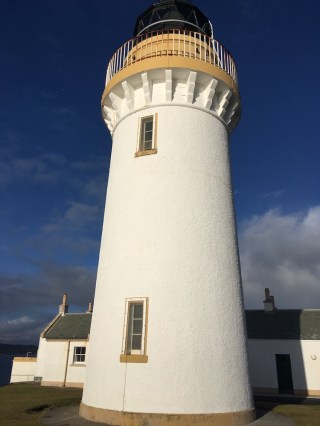
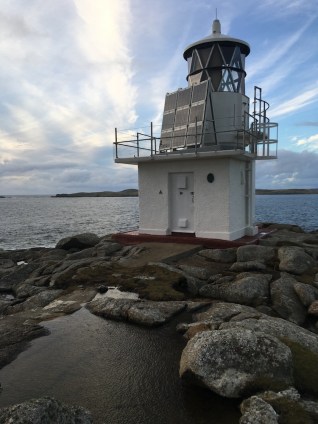
The mad plan: Shetland – part two

A second day of lighthouse bagging in Shetland today, but how could we really have followed the success of yesterday? Well, the truth is we probably couldn’t, but that wasn’t going to stop us, so we ventured out into the wind and rain this morning to meet Brian not far from the ferry to Yell. Today has felt a bit like the grand tour of Shetland, although this morning’s weather was really not in our favour when it came to spotting lighthouses on the numerous small islands that surround Mainland, Yell and Unst. Our ultimate aim today was to reach the very top of Unst for a glimpse of the lighthouse that seems to magically sit on the rock that is Muckle Flugga, making it the most northerly of all British lighthouses.

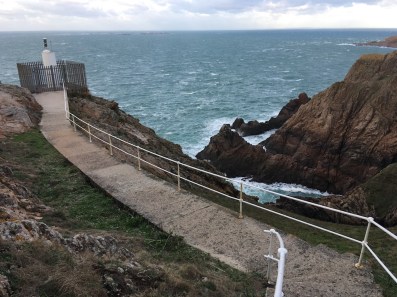
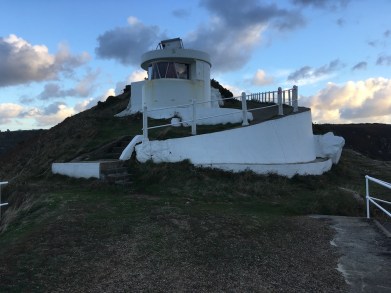
With a little while to wait until the ferry to Yell, we drove into Mossbank and had a brief look at Firths Voe lighthouse from the end of the road. We’d seen it flashing (or occulting really) as we’d driven up the main road to the south west. We didn’t have time this morning to walk to it, but we will return at some point as it’s an easy one to get to.
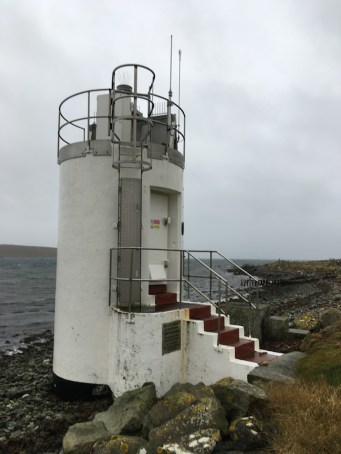
Uyeasound
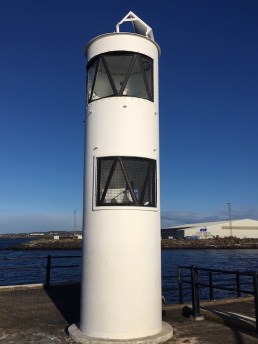
Uyeasound lighthouse

Once on Yell and driving north along the road that follows the west coast, Brian was informing us of all of the lights we would be able to see in Yell Sound if there wasn’t so much mist about. It was one of those mornings where you know it’s no use looking for something that’s any distance away. We were just hopeful that it might clear at some point. On the road north we saw the Ness of Sound lighthouse, which looks fantastic. A great little walk to do some day soon, but we were keen to get to Unst so continued the journey.

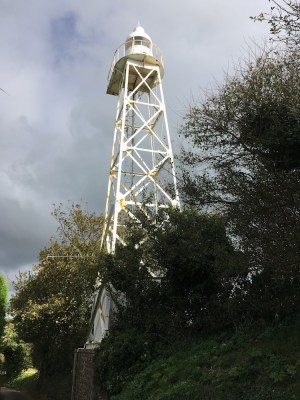
Arriving just in time for the ferry, we made the short crossing and decided to take a break from the car at Uyeasound to see the lighthouse there. Brian, having been to the lighthouse numerous times and not fancying the short walk in the wind and rain, very sensibly decided to watch us from the car. Uyeasound lighthouse isn’t your usual style of lighthouse, which is interesting for me! There are a few of this type dotted around Shetland and they are more substantial than they look when you are close up. It’s a really easy walk to the lighthouse and on a nice day it could be part of a really pleasant stroll along the beach.
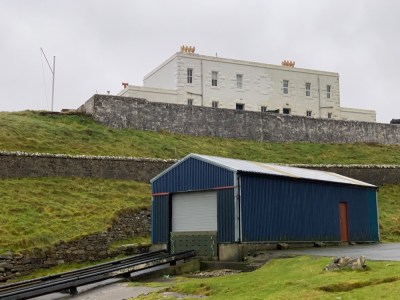
Flugga shore station
Muckle Flugga shore station

Continuing our journey to the very north we were very much still in the mist. Brian wasn’t convinced we would see Muckle Flugga, but we didn’t want to miss the opportunity if the weather cleared a bit as the forecast was predicting. As we neared Burrafirth there was no sign of improvement so Brian suggested we stop by the old shore station for Muckle Flugga. The shore station itself is in a great location with wonderful views of the coastal landscape of the area. The old boat shed is still very much there and it gave a really good idea of how the boats were launched and where the keepers began the final leg of the journey to “The Flugga”. Part of the cottages has been converted into the Hermaness Visitors Centre, although that is closed at this time of year. Another of the cottages is self-catering accommodation. Just beyond the main building is the helipad. It would be a wonderful place to depart from for getting to the lighthouse, although Brian’s undertaking of that journey on so many occasions in the past has considerably dampened his enjoyment of it.

So, it was time to see if we were going to have any luck seeing the lighthouse itself from beyond Saxa Vord. Once we were up there it became clear very quickly that the low cloud simply wasn’t going to allow it. We decided to stay in the area though and try again in a little while – we weren’t so easily discouraged.

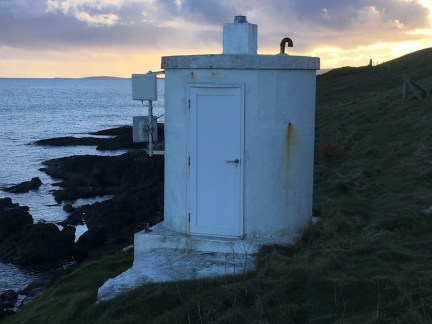
Brian suggested heading out to Holm of Skaw to see the most northerly house and I, of course, quickly pointed out that I recalled there being a lighthouse (the flat-pack IKEA type) out that way, which Brian confirmed was correct. On the approach to the most northerly house we could see the lighthouse in the distance. Interestingly, we learned from Brian that the dangers around the Holm of Skaw were originally covered by a red sector light within the Muckle Flugga lighthouse compound. The small building that housed this light is still there today, but the light was discontinued when Holm of Skaw lighthouse was introduced. Brian also informed us that Muckle Flugga was originally known as North Unst lighthouse.

After another quick and unsuccessful attempt at seeing The Flugga we decided to give the weather a little longer to sort itself out while we went for lunch. It was one of the most productive lunches I’ve ever experienced while we quizzed Brian, with mapping set up, for details of access to the lighthouses and the best viewpoints to see them from if they were a little more tricky to get to. Invaluable stuff, this. He really does know everything there is to know about Shetland and its lighthouses!
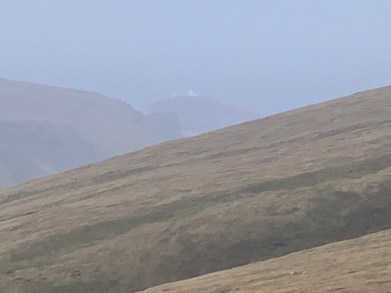
Flugga
Our view of Muckle Flugga lighthouse

Now, it was obvious that the sky had cleared by the time we left the very nice Final Checkout Cafe, so we went for a third and final attempt on The Flugga. As we got closer we were all feeling a lot more confident – I may have clapped with excitement at one point, something I do very rarely! Then when I spotted her (sorry, the lighthouse) as we came over the rise I might have squealed “There she is!” – something I do slightly more often, but not frequently! It was still a little misty, but the lighthouse was very definitely there between the two rising slopes. It wasn’t a view for getting stunning or detailed pictures, but I had seen it – or as Brian so eloquently put it, “eyeballed” The Flugga! I was, of course, very happy about this, particularly as we had tried and failed the first two times. You always appreciate things much more when you don’t succeed straight away, as was very much the case with the Flannans and the Monachs (I was getting quite used to our annual holidays to the Western Isles while we waited for the perfect conditions to get to them).

Satisfied, we began our journey back down the islands. On the way, and as a result of improved visibility, we were able to see the Balta Sound lighthouse, the light on Little Holm, Mio Ness lighthouse and The Rumble light beacon. A much more interesting return journey.
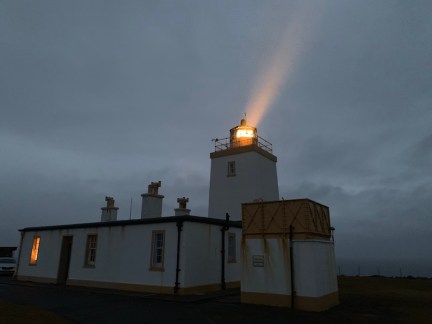
Eshaness2
Eshaness lighthouse this evening

We travelled straight back in order to see the final lighthouse that Brian had offered to show us: Eshaness. It’s a fair old drive out to Eshaness, but we were rewarded towards the end of the journey by views of the light flashing away, inviting us to continue on over and pay a visit. Brian informed us that once the light was on there would be no access to the lamp room. I was fine with that. With regularly visiting lighthouses, so often you are there during the day and don’t get to witness the light in action, so it was a great opportunity to do just that.

We sat with Brian for a while as he showed us pictures he has of Muckle Flugga, Ve Skerries (which you can often see at Eshaness flashing at night, but not today unfortunately), Out Skerries, Sule Skerry, Cape Wrath and the Flannans, among others. The pictures are fascinating and some have great stories to accompany them. While we were there a couple who run a lighthouse museum on Lake Erie in the USA joined us for a little while. After that we spent a while taking pictures of the lighthouse from outside before saying a very fond farewell to Eshaness. It was a wonderful end to another lighthouse-filled day. We have more time here tomorrow before our flight leaves so you can expect one more Shetland post coming very soon.
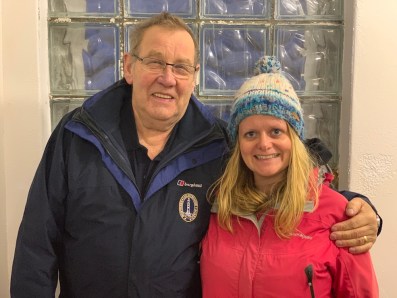
me and brian
Me with Brian

Leaving Eshaness also meant that it was time to say goodbye to Brian who had proven to be the most valuable of lighthouse tour guides there could possibly be. His experience and knowledge combined took his “tour” far beyond your average look around a place. He knows these lighthouses inside out and clearly has a real enjoyment of and enthusiasm for them. He’s also incredibly modest: I told him earlier that he was so helpful and great company too and his response was “I’m just me”. I will definitely be maintaining regular contact with Brian in the future. We’ve got a good new friend there! 🙂

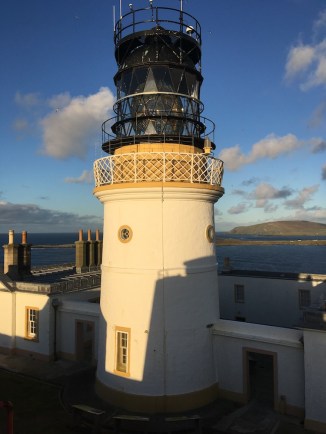
The mad plan: Shetland – part one

The mad plan for this week was introduced in my post from Sunday. We successfully completed the Jersey part of the week, and today the second half began: Shetland!

I’ve struggled a little with Shetland recently. Having never been there I was getting to the point with my lighthouse list where it felt like everything was miles apart with massively long walks to each of them. The reason for coming to Shetland for three days was to take pictures of some of its lighthouses, but after the first day it has already become one of my most exciting trips to date.

After just a couple of hours sleep last night and an early flight from Aberdeen to Sumburgh, I wasn’t quite bouncing off of the walls with excitement. That soon changed though as we spotted the lighthouse at Sumburgh Head flashing away as we came in to land. The start of our time here was also enhanced by meeting up with Brian who, in his “retirement”, carries out maintenance work on 37 lighthouses across Shetland. I had come into contact with Brian through my membership of the Association of Lighthouse Keepers and Ian Duff who joined us for the Skerryvore trip earier this year. Brian and Ian have known each other for many years and worked together in a number of lighthouses. Brian had very kindly offered to act as our tour guide for seeing some of the major lights, and he suggested heading straight to Sumburgh Head. I was, of course, delighted with this suggestion.

IMG_6167
Sumburgh Head lighthouse

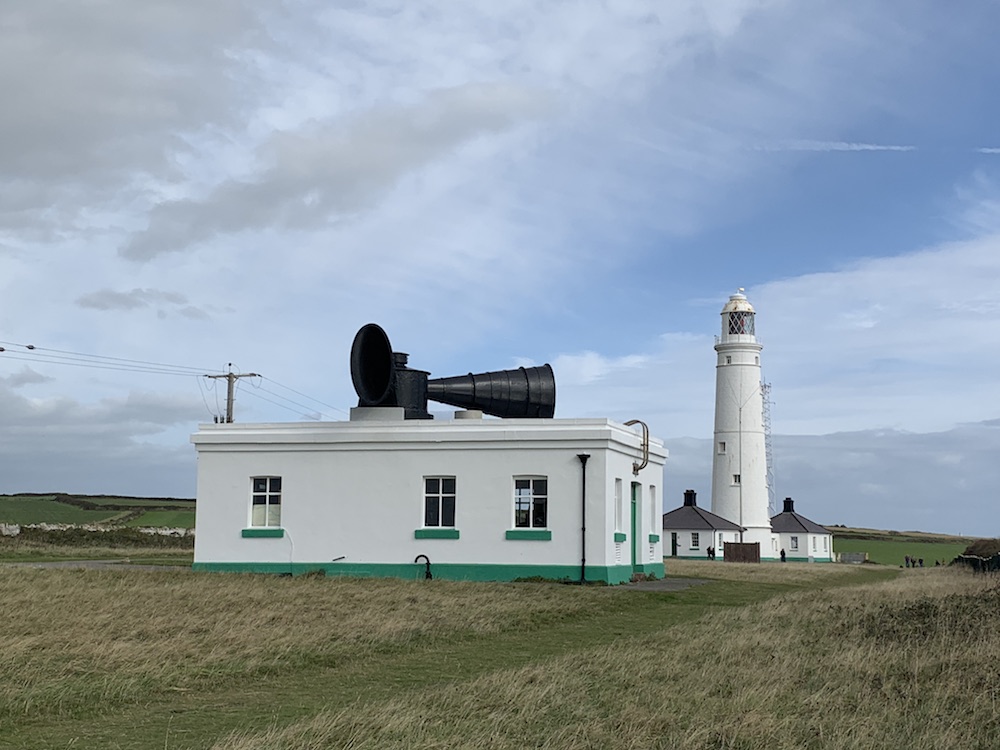
Brian made arrangements with the Northern Lighthouse Board for us to go up the tower. The day was just getting better and better already! Throwing into the mix the fact that the sun was just rising made it even more amazing! The tower at Sumburgh Head is fairly short – one of the benefits of sitting on top of high cliffs, I suppose. This made it particularly pleasant to climb up. The optic and light must be turned off before anyone goes up there. It is a massive optic and, partnered with the views from the tower, made for a really special experience. He also showed us how the foghorn equipment worked and we got to witness him starting the engines, which he routinely does just to keep them up and running.

It didn’t take us long to realise that Brian is an absolutely master of his trade. He knows everything about Shetland’s lighthouses as well as so many others. There are only a few he hasn’t been too, and by all accounts it sounds like he was often specifically chosen to address problems with the lights across Scotland. He’s served in some of the most impressive including Sule Skerry, Skerryvore, Chicken Rock and Ardnamurchan and has stories to tell about them all. Watching him doing anything within the lighthouse at Sumburgh as well as the foghorn was fascinating. His attention to detail and his knowledge are outstanding. Definitely the right person to have around if anything goes wrong!

IMG_6191
The old Muckle Roe lighthouse with Sumburgh Head in the background

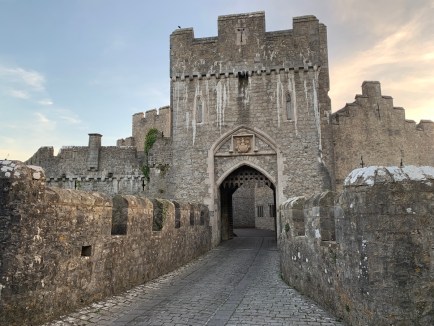
From Sumburgh we headed back down the road and stopped at the old Muckle Roe light which welcomes visitors to Sumburgh Head at the main parking area. Brian had already informed me that he and a colleague had re-built the tower in its current location – no mean feat considering most of the detail necessary to assist with building it had long gone. As if the day wasn’t exciting enough, we were able to get inside this little tower and climb to the top where we saw the small optic, more great views and got to spend some time in one of these lovely structures that I’d never had the opportunity to get inside before. I felt very privileged, especially as Brian had taken the time to show just the two of us around.

After lunch we hopped over on the very short ferry crossing to Bressay. As well as continuing to work for the Northern Lighthouse Board, Brian also does some work for the Shetland Amenities Trust who own both the old Muckle Roe light at Sumburgh and the old lighthouse at Bressay as well as the associated buildings. As soon as you arrive at Bressay lighthouse you know you are somewhere very special. I don’t even know where to begin in describing the coastline around it, and then with the lighthouse standing tall above it… There are really no words. If the geo and surrounding rocks next to the lighthouse weren’t enough, the tower itself stands not far away at all from a natural arch (known as the “Giant’s Knee” by the keepers). It’s places like Bressay that remind me of why I enjoy lighthouses so much. To actually explain why I enjoy them is tough – just go to Bressay and you will find out for yourself!

IMG_6215
Bressay lighthouse

Brian had warned us that the lamp room was now completely empty (the old optic can be seen in the Shetland Museum and Archives) and I was expecting to feel sad about it once we reached the top, but I felt anything but. Firstly, they’ve raised the floor level slightly making it exactly the perfect size of room for someone of my short stature. The views from every single angle are awe-inspiring and the acoustics inside are fascinating!

Standing around in the lamp room at Bressay was a brilliant opportunity to hear lots more of Brian’s stories from his days travelling the lights of Scotland. One question I asked which prompted numerous stories was “what do you think really happened to the keepers who missing from the Flannans?” He said that there is something very strange about the Flannans lighthouse and recalled various occurrences of things happening that made no sense. Some of the stories he told were particularly creepy, such as one of the keepers seeing a man in a storeroom and when he returned to Brian was clearly frightened. When they went back to the room there was no one there and the keeper pointed to the spot he’d seen this man and it was within a small area that always felt considerably colder than the rest of the room. Brian also felt like he was being watched sometimes when no one else was around. By this point I definitely wasn’t smiling anymore! There was one really funny story though when one of the keepers was outside the lighthouse on a very misty day and saw three man emerging from the mist and he thought it was the missing men. It turned out to be three fishermen from the Channel Islands who had landed on the island and wandered up to the lighthouse. We laughed about it, but it would have been pretty scary for him!

Anyway, I digress (very easy to do with Brian’s stories). We eventually pulled ourselves away from the lighthouse and took a drive up to the island high point in the hire car, as you do! It was quite bumpy and the road wasn’t really suitable for a Micra, but it’s still intact.

Before we left Brian for the day he had a look through my list and shared his knowledge of the best way(s) to access the lighthouses he regularly visits. There is no end to his knowledge!

Twageos
Twageos Point lighthouse

We decided to finish the day with a couple of stops off at some of the smaller lighthouses. Being in the Lerwick area anyway, the structure at Twageos Point was just begging us to visit. It turned out to be a very simple visit – the lighthouse basically has its own gate and a well-trodden path leading to it. In comparison with the lights we’d already seen that day it wasn’t the most amazing, but it has its own charm and was obviously built to be functional above anything else.

With just a short time left before the sun was due to go down, we obviously felt the need to cram in another lighthouse.

IMG_6249
Fugla Ness lighthouse

We opted for Fugla Ness based on it being fairly easy to access and not too far from where we were. The walk out there was a combination of easy grassy sections and big old boulders. Bob rushed off ahead with all of the abilities of a mountain goat to then have to wait for me to catch him up (or came back and accompany me along). As soon as I saw this one from the road I knew I loved it! The surrounding scenery probably helps, but it really is a beauty, sitting there on its own little grass and rock peninsula. I think I might just take that one home. I will let the picture speak for itself.

On top of the lighthouses we’ve visited, we also had distance glimpses of a number of other lights today, including Mousa, Hoo Stack and Moul of Eswick. We’ve seen the islands of Foula and Fair Isle too. So many islands still to do here…

I am hoping this post goes some way in conveying just how much I have enjoyed today. All of the smiling and fun of the day (and probably the lack of sleep last night) is catching up with me! We have another day lined up with Brian tomorrow. More on that tomorrow evening! 🙂
I should also note that, in my last blog post, I mentioned that we would be going on a RIB ride along the Clyde to catch a few of the lights there. For technical reasons relating to the boat we weren’t able to do this on Wednesday. It has instead been postponed until Monday.

The mad plan: Jersey – part two

In yesterday’s post I explained the plan for this week, and we built upon the success of the first day with another great day in Jersey today.

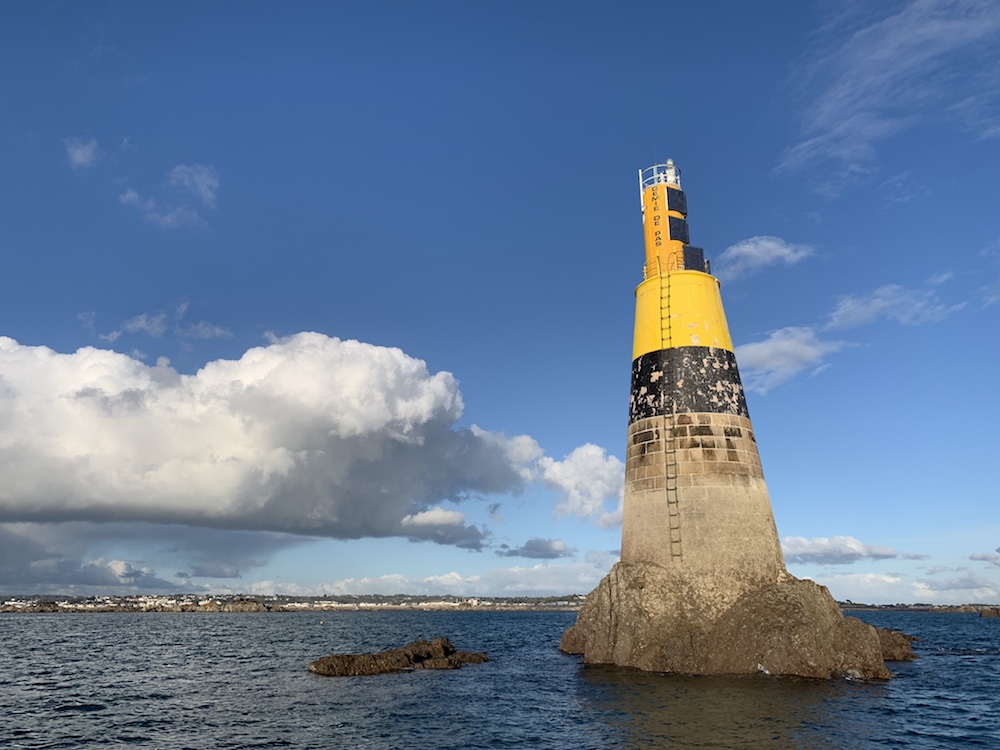
We started out the day with five more lighthouses to visit and one to view from the island, Demie de Pas, which is on the approach to St Helier.

IMG_5874
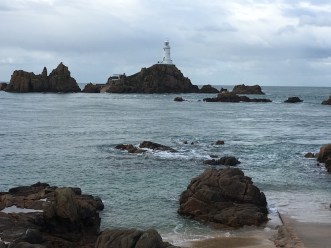
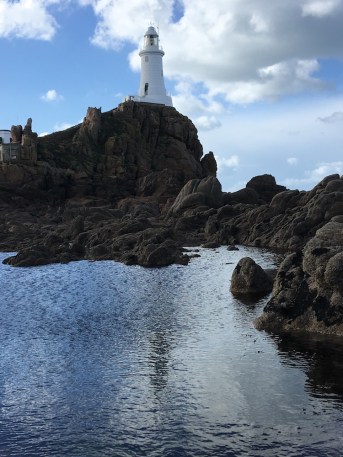
La Corbiere lighthouse at high tide

Before we got started on those though we were keen to head back to both La Corbiere and Noirmont Point lighthouses to see them when the tide was in. Being tidal, it adds an extra element of enjoyment to these islands to see them when they aren’t accessible on foot. La Corbiere was our first stop and as it magically appeared at the end of the road (as mentioned in yesterday’s post) I simply had to greet it with a jolly “Morning!” If it wasn’t magical enough at low tide it is even more enchanting when it can’t be reached. They say that often people want what they can’t have and this can certainly be applied to visiting lighthouses too.

IMG_5884
Noirmont Point at high tide – with fisherman!

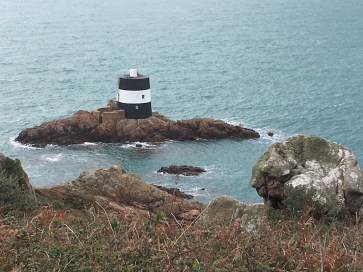
Noirmont Point is equally wonderful at high tide. You would never know that it was possible to access it and keep your feet dry. This may be why the Wikipedia entry for the tower says that the lighthouse can be accessed by wading! I can confirm that wading is definitely not necessary. One thing that possibly shattered the illusion of the island being unreachable was the fact that there was a fisherman out on the rock. He was obviously set up for the morning and would head back over at lunch time. Good for him!

IMG_5909
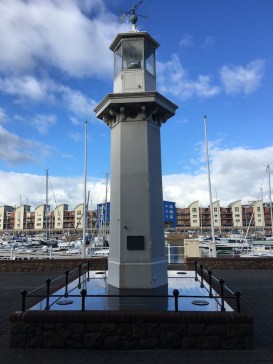
The old St Catherine’s lighthouse

We had planned to head straight to St Catherine’s to see the light on the end of the pier. As we passed back through St Helier we quickly stopped off so I could see the old St Catherine’s lighthouse, which is now located outside the entrance to Jersey Maritime Museum. It’s wonderful what they have done with it. One of the plates on the side of the lighthouse best explains its new purpose:

“Apart from the five years of German occupation this light, from St Catherine’s breakwater, shone brightly for over one hundred years to warn seamen of danger. Today, it stands as a monument to those islanders who died in concentration camps far from their island home. A symbol of remembrance and a beacon of hope for the future.”

The memorial was unveiled in November 1996. It really has been beautifully done. The shiny granite of the memorial panels reflect the lighthouse really nicely, which adds to the effect of the whole arrangement. Such a thoughtful idea.

IMG_5920
La Greve d’Azette lighthouse

Having missed our turn-off for the elusive A6 towards St Catherine’s, we decided to carry on around the south coast to see the La Greve d’Azette and Mont Ube lights. My research had highlighted that this would be a fairly easy task and it was. La Greve d’Azette sits happily at the side of the main coastal road and we used the nearby M&S car park to visit it. The tower actually begins on the beach, which was a perfect excuse for a short stroll on the sand. The tower has a spiral staircase and a daymark panel too. It’s not the most astounding tower by any stretch of the imagination, but when it is so easy to visit you really can’t complain! A little further along the road we stopped at the car park to get a distant view of Demie De Pas lighthouse. It was too far to get a decent view really, but the best we could manage (or so I thought – more on that to come).


IMG_5941
Mont Ube lighthouse

Mont Ube was a little more tricky, but mainly due to a road closure. I was surprised how long it took us at actually see this one as it’s at the side of a road. We were actually on the small road itself and almost at the light before I spotted it. It is very much the twin of La Greve d’Azette minus the spiral staircase and daymark panel. It turned out that if you approached this one from the north or east it would be very much visible from further away.

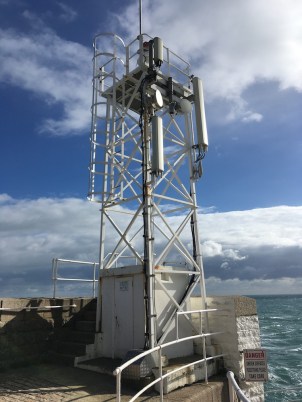
Our next stop was Gorey. My research told me that there was a light at the end of the pier and that is had a small “room” at the bottom within the lower framework section of the structure. As we approached Gorey and spotted the pier we both became sceptical of its status. We wandered along the pier and found that this small “room” has now been removed. This does mean that it no longer makes my list of lighthouses. You can see how it looked previously on the incredibly useful Lighthouse Directory website.

IMG_5958
The modern lighthouse on St Catherine’s breakwater

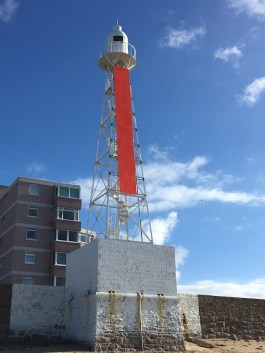
What I thought would be our final lighthouse of the day was the modern light on the end of the breakwater at St Catherine’s. This one was very straightforward. It’s a fairly long breakwater and as we walked along we noticed how similar it looked to the Gorey structure. I braced myself for another disappointment, but this one was fine with the “room” very much still there. There are a few steps at the side of the lighthouse, which lead up to the point where the old lighthouse was located. The history of the lighthouse is celebrated locally with an interpretive panel at its entrance detailing its construction. It seemed like a quiet little village, but I imagine it could get quite busy in the summer months.

With the completion of the Jersey lighthouses, we considered what to do next. As ever Bob was looking to make things happen and was determined to find a boatman to take us closer to Demie de Pas lighthouse. We headed back to St Helier for lunch and managed to get hold of Dan from Jersey Seafaris who offer chartered RIB trips. Dan was massively helpful and we arranged to meet him later in the afternoon to head out for a quick trip.

IMG_5985
Demie de Pas lighthouse

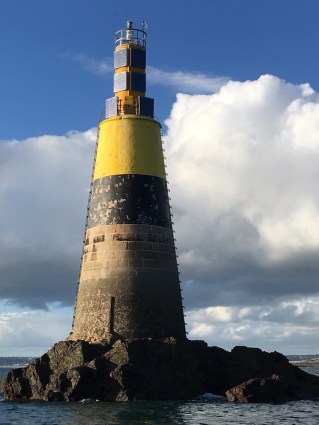
St Helier harbour is huge and we ended up walking the full length of it to get to their boat, a 12-seater RIB. The sea was nice and calm and within ten minutes we were at Demie de Pas! I’d seen some pictures of it online and I was concerned that the top section of the structure did not feature a door, which would mean it would not make my list. We circled around the light, which is much more significant than you would guess from the island. We finally spotted the door in amongst the solar panels and I am not ashamed to say that I was very pleased. Honestly, I am getting a bit ridiculous about doors on lighthouses now! It’s a really impressive tower and Dan informed us that it takes a real battering in its location.

Dan offered to take us for a quick spin over to Noirmont Point before we went back in. Of course we couldn’t resist. It was fantastic to see it from another angle where it looks even more imposing. Jersey really does have an impressive coastline and perfect settings for its lovely lighthouses. One thing that had been bothering me since yesterday was whether Noirmont Point met my lighthouse criteria as the tower itself was not built for the purpose of being a lighthouse. Having seen it from the sea though, we have now got a picture or two showing a door on the smaller white structure on top of the tower (I can only apologise for the door obsession!) I was, of course, delighted to find this. I was even considering adjusting my definition slightly so that Noirmont Point could be included!

On our way back from the boat we paid a quick visit to the Jersey Maritime Museum. It was only open for another hour so it was a bit of a whizz around, but it’s a brilliant museum. It’s really interactive. There are occasional lighthouse-related exhibits, including a model of La Corbiere next to a small Fresnel lens (the man at the museum didn’t know where it had come from). There were some paintings from a renowned local 19th century artist (Philip John Ouless) of both La Corbiere and the old St Catherine’s lighthouse in its position at the end of the breakwater. We learnt a lot at the museum, including the translation of “demie”, as in Demie de Pas. A demie is an offshore rock not visible until half tide!

So, that’s the Jersey lighthouses complete for me! A really successful two days and we’re back to Ayrshire tomorrow. We’re managing to arrange a trip along the Clyde on Wednesday with the kids and Bob’s mum. That will take in the four lighthouses on the Clyde (weather permitting). Then Friday it’s on to Shetland. Great fun! 🙂
The mad plan: Jersey – part one

Today marked the start of what I have recently being referring to as “the mad plan”. So, the mad plan came about as a result of my distinct lack of visited lighthouses in both the Channel Islands (outside of Guernsey, which I visited in 2013) and Shetland. I am working on a list of lighthouses in the UK, Isle of Man and Channel Islands to be published – a sort of travel companion, if you will, to help others who struggle (as I did in 2011/12) to pull together a physical list to help them on their bagging escapades. It’s been – and still is at times – a real challenge, but one I am thoroughly enjoying.

Anyway, this lack of pictures was a problem and the solution was to get some, of course. Which resulted in two trips within one week to the most southerly lighthouses on Jersey and the most northerly in Shetland.

Well, today we flew to Jersey (at this point I should thank Bob’s mum for very kindly enabling this trip to be child-free for us). We arrived, having spotted the 1874 La Corbiere lighthouse on the approach to the airport. It looked so incredibly tempting (and the causeway across to it also looked uncovered a few hours before low tide) that we decided to make it our first stop after picking up the hire car.

IMG_5697
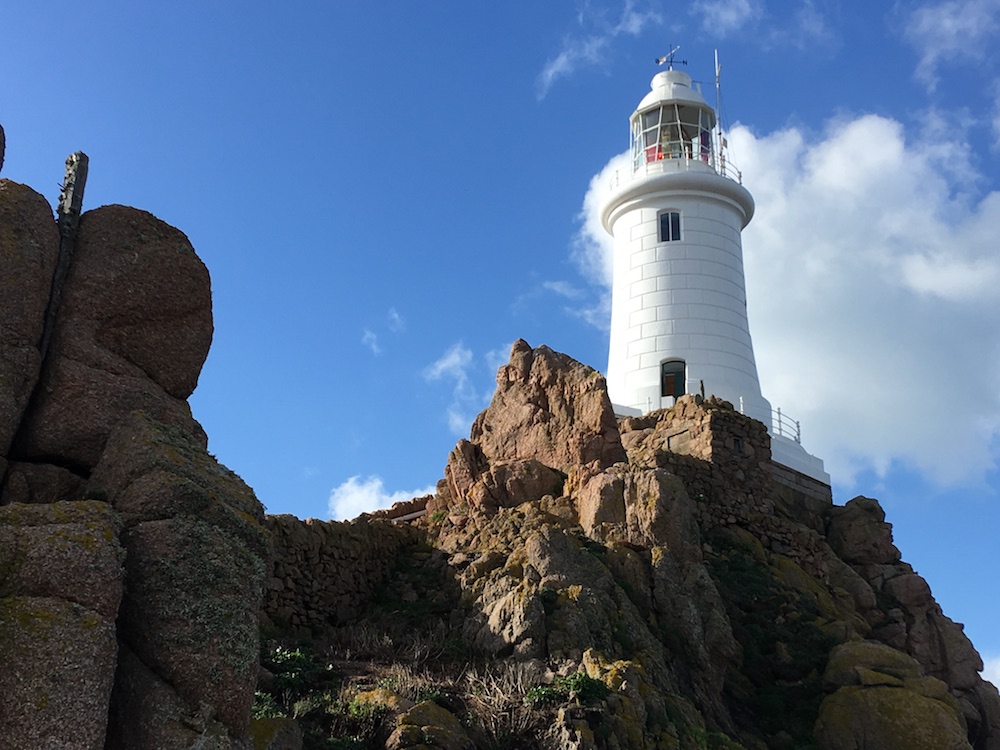
La Corbiere lighthouse

The first thing that is wonderful when you visit the lighthouse at Corbiere is your first view of it. It just suddenly appears at the end of the road in front of you, in a magical sort of way. That’s definitely not the only thing magical about it. The way it sits up high on its rock, the excitement of getting to it at low tide only, the wonderful brick-effect painted white, the almost fairytale steps that lead up to the tower… the list really is endless. The stroll to the lighthouse is easy thanks to the excellent causeway and there are countless places to stop on the way over to take pictures. We were already aware that the tours that operate at the lighthouse are currently not running due to maintenance, so we were unlucky in that way. It was absolutely worth visiting anyway though. As I write this I am sitting at Corbiere Phare drinking wine and watching the light flashing. There’s a French light in the distance too. Not my area of expertise so I wouldn’t know which one it is.

IMG_5687
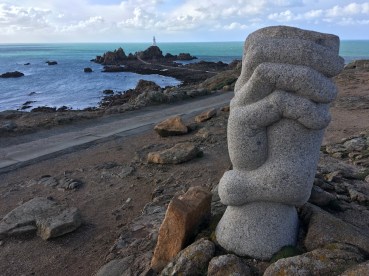
The sculpture with La Corbiere lighthouse in the background

We eventually dragged ourselves away from Corbiere, partly because we needed lunch and partly because we saw the opportunity to get to the Noirmont Point light before the tide started to rise. I also took a moment to look at the sculpture next to the car park, which features two hands holding each other, as if one is saving the other. There is a really interesting story behind it. When the French boat Saint-Malo ended up in trouble not far off of Corbiere in 1995, the lifeboat crew was deployed and saved all of the catamaran’s crew. The sculpture was installed in 1997 as a thank you to those who were involved in the rescue mission.

IMG_5761
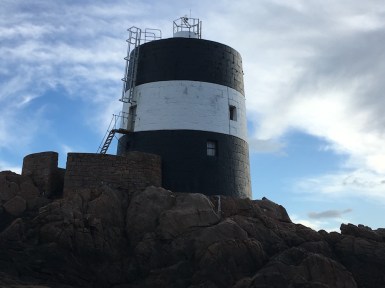
Noirmont Point lighthouse

Onwards we went to Noirmont Point, which was windy! I feel the need to say that first because it really was! Like all of the lighthouses on Jersey there is a nearby car park, which is a massive help. We quickly found the route down to the lighthouse, which was pretty easy, but would be very different in wet conditions. I almost got blown away a few times, but not quite thankfully. It would have been much easier going without the wind, but we made it across and without getting our feet wet. The lighthouse was originally a Martello tower, which has had a light placed on top. Anyway, it was a beautiful view with the big tower on its rocks getting ever closer. Slightly less magical than Corbiere, but no less enjoyable to visit in terms of views. If it was windy on the approach it was even more so at the lighthouse. I had been warned by my lighthouse pal John to look out for the outside toilet, which just happened to be at the windiest part. The only way I can describe it is to say that it looks like a big stone throne with some sort of china bowl in the “opening”! The views all around the lighthouse were beautiful, but I was glad to have my handrail (sorry, I mean husband) there at some of the most exposed parts! The walk back up was much easier.

IMG_5826
Grosnez Point lighthouse

On to our third lighthouse: Grosnez Point at the most north westerly point of Jersey. Again parking was no problem and we used my well-researched directions and headed through the old Grosnez Castle ruins. Beyond the ruins there are some steps and an actual handrail (not Bob this time) that takes you down to the lighthouse. It was windy here too, but having something sturdy to cling on to was nice. It’s a very small lighthouse surrounded by a metal fenced enclosure, so nothing as impressive as the previous two, but the surrounding area was impressive with great cliffs and a distant view across to Sorel Point, our final lighthouse destination for the day.

IMG_5844
Sorel Point lighthouse

Sorel Point, in comparison to the other lights we’d seen that day, was quiet. We saw one other car while we were there. At the other lights there were a number of people about (getting in the way of our pictures), although mainly around the car parks. Here it was just us. Sorel Point is an interesting light. A little like Fife Ness, it doesn’t make a fuss about being there. It’s pretty well obscured until you are at it and you’d probably not think to go there unless you are a bit of a fan of lighthouses. It’s a squat tower, which makes viewing the lamp room considerably easier from outside. I liked this one. I liked how understated it was. It also has CCTV – I’m sure I’ve read something about damage being done to it in the past. It’s such a shame.

So that was our lighthouse adventures today. I have also found today particularly useful for testing my descriptions of how to reach the lights on Jersey, which will be included in my book. It’s been good and I’m feeling quite confident that my instructions are fine and I’m just making a few small adjustments where necessary.

We finished our bagging day with Bob reaching the highest point of Jersey. So success all round. As mentioned before, we had dinner at Corbiere Phares this evening. It’s almost a little Corbiere Lighthouse museum, with an array of pictures hung on the walls from various stages of the lighthouse’s history. It includes a picture of Peter Edwin Larbalestier, the assistant keeper who went to save someone who was going to be cut off by the tide in 1946 and lost his life. It’s fascinating to see it in the early years when the causeway was essentially a bridge.

Having only done half of the island there is, of course, more to come tomorrow! 🙂
 

Clearing things up in Ayr

This afternoon, after a bit of research into the lighthouses in Ayr, we took a quick spin over to the town while in the area. I had previously been to Ayr on my 2012 tour. On that trip I had walked out to the lighthouse on the pier and seen the two lights on the north of the river from the south bank. I had also taken a picture of the structure on the end of the breakwater, which appeared at that point to have a small enclosed section on top of the framework base.

IMG_5653
The front and rear range lights in Ayr

Discussion about access to the two range lighthouses north of the river had brought about our visit. While I had said that the area in which the two lighthouses are located is private, Bob (though not disagreeing with me) felt that it was possible to get to them. I think this says a lot about our different approaches to “bagging”. Maybe it has something to do with my being from England where “private” means private, and Bob’s Scottish heritage – in Scotland the freedom to roam means you can go almost anywhere. Anyway, there was only one way to settle this particular debate!

IMG_5655
The light structure on Ayr breakwater

So that is how we came to be in Ayr. With regards to the lights on the north bank, it wasn’t quite as easy to prove Bob wrong than I had anticipated. They currently have roadworks, meaning that there is no way of accessing the lighthouses anyway at the moment, regardless of what the usual arrangement is.

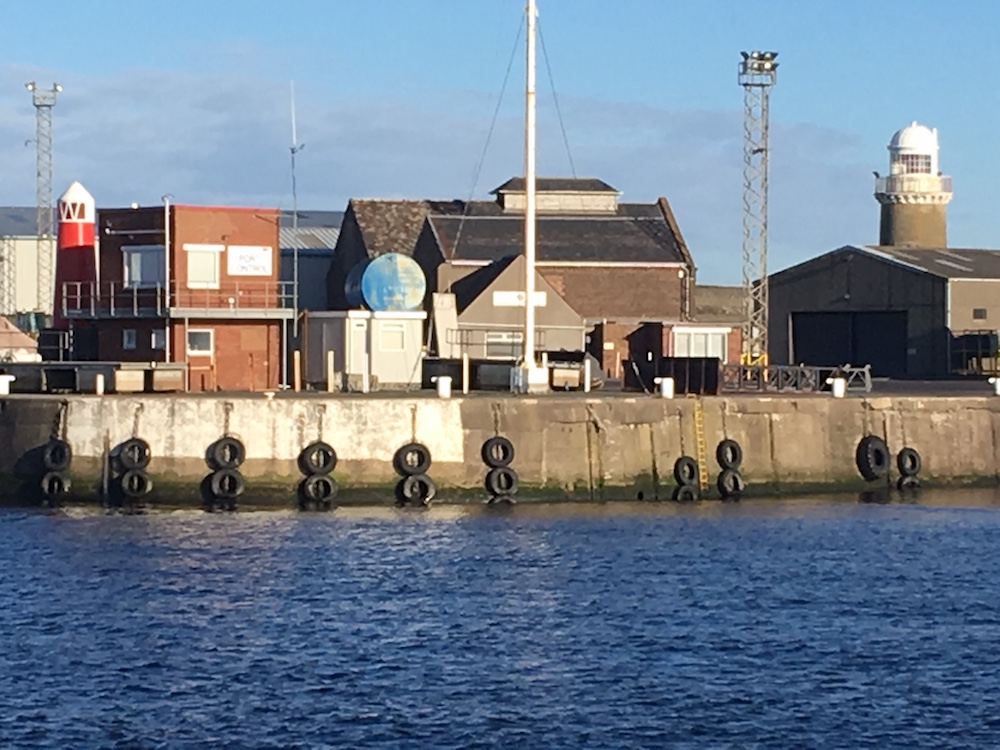
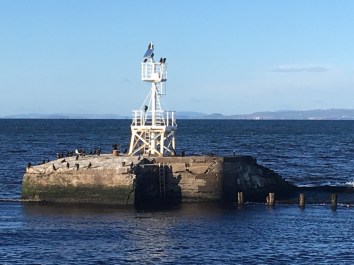
We then headed over to the south bank and I took a stroll out to the lighthouse on the end of the south pier. It quickly became apparent that there had been changes afoot on the breakwater as the light structure no longer features an enclosed area. It is now simply a framework tower with a light on a post on top.

IMG_5661
The lighthouse on Ayr south pier

Since my 2012 visit, the light on the end of the south pier has had a bit of attention and is looking good. The tower contains two lights, one near the top as you would expect, and another half way up. When you stand in front of the lighthouse you can get a picture of it alongside the much-debated range lights. Goes very nicely with blue skies!

After I’d returned to the car near the south pier Bob had another try at accessing the range lights via an alternative route. This was where we finally managed to come to some sort of agreement about getting close to the lighthouses. A large sign further north at the other entrance to the port states clearly that there is no unauthorised access. So that settled that then – or so I thought. Not wanting to entirely admit I was right, Bob had to get the last word: “I’m sure you could arrange to get in there with the port authority.” The annoying thing is he may well be right! 🙂

The grand finale in South Wales

Yesterday’s post was all about the excitement of visiting Flatholm last Sunday morning. This post is a continuation of the day, and the conclusion of the Association of Lighthouse Keepers (ALK) AGM weekend.

Leaving Cardiff Barrage behind we had a few hours to spare before we needed to be at Nash Point, so we thought Porthcawl would be a suitable place for lunch and a visit to the lighthouse on the end of the breakwater. We’d been warned that there was an Elvis convention in Porthcawl that weekend, but we had no problems getting around and sadly didn’t see any Elvis impersonators during our time there.

0
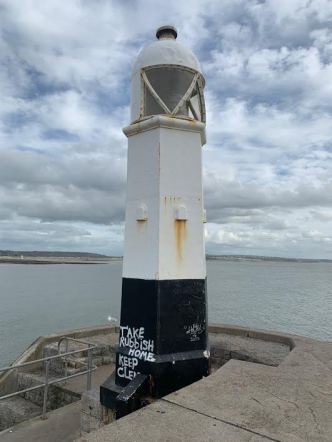
Porthcawl lighthouse

Porthcawl lighthouse, like so many others, has taken a fair old battering in its time. The reason I mention this specifically for this lighthouse is that almost all of the pictures you see online of Porthcawl lighthouse have a big wave smashing against the breakwater. There are just some lighthouses that become well-known for being wave-washed. I suppose it’s harder to get pictures of Skerryvore, Bishop Rock or any of the other rock lighthouses in a storm!

The lighthouse is in a poor state, considering it is still operational. One of the glass pains in the lantern is half gone – probably due to those big waves – and local “artists” have been carving their artwork (well, their names mostly) into the black section towards the bottom. It has also, rather oddly, had white instructions telling people to take their rubbish home with them painted onto this lower black section. I suppose it makes the message noticeable if nothing else. It is a shame as it has a lot of history, including only being converted to electricity in 1997.

Photo 2018-09-30 16.47.00
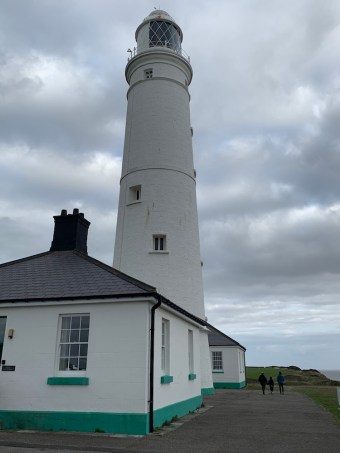
Nash Point lighthouse

Our final lighthouse visit of the weekend was Nash Point. I have a rather amusing picture of myself at Nash Point from a previous visit when the lighthouse was closed and I am looking sad next to the ‘lighthouse closed’ sign. This time we knew we’d definitely be getting in though as tours had been organised for us as members of the ALK. Half of our group were a bit rebellious and went off ahead while a few of us waited for the tour to start, and I’m glad I did. We started at a map showing the local area and our tour guide, whose name I failed to catch, explained the hazards of the sand bar to the west of Nash Point. As we arrived the tide was dropping so we were able to see the sandbar clearly. He also explained how the shifting sands in the area from north to south meant that over time the warning effect of the two lighthouses as range lights (including the tower now without its lantern a short distance away) was no longer working. With the lights in line it was no longer giving the necessary warning in the right place, hence why the second light was discontinued.

We left the ground floor and started to make our way up the tower. We stopped at each level including the wedding room and overflow wedding room! The most fascinating room on our way up, though, was the room that now houses the old optic. It was great to see the inside of the optic without having to peer through it. There were three bulbs inside, including the back-up light and a smaller bulb used in the event of power failure so the light then required less electricity. One member of our party had actually been in the lighthouse when they had moved the optic down from the lantern. She said it was amazing to watch.

Photo 2018-09-30 15.49.26
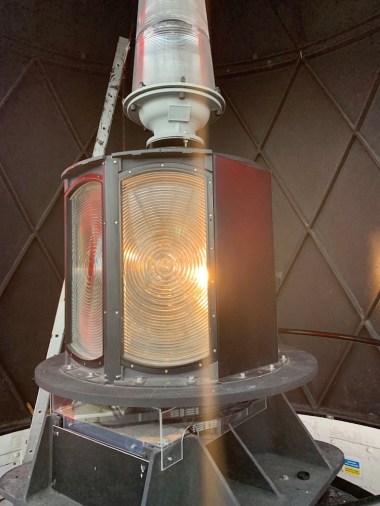
The light inside Nash Point

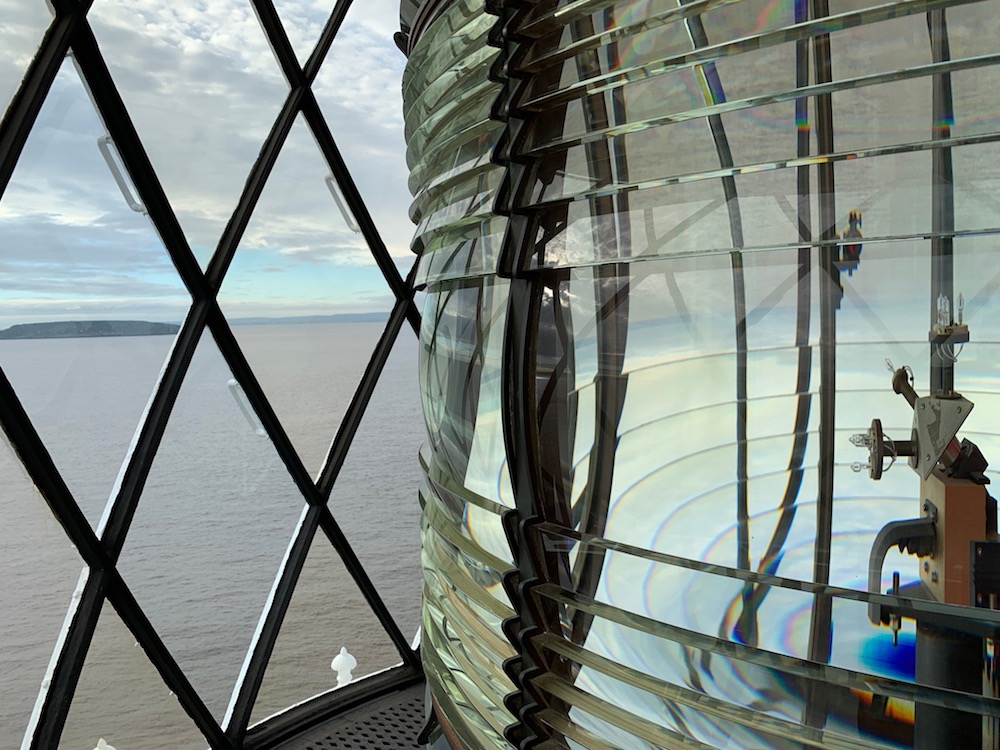
Literally the high point was inside the lantern, although it was definitely less inspiring than that of Flatholm as obviously the optic had been removed. In its place was an octagonal mechanism with rectangular optic-esque panels on six of the eight sides, as well as an emergency light on top. The views out of the windows were great and on a clear day, or that morning, you could see quite clearly across to Somerset and North Devon, including Foreland Point lighthouse.

We were left in the lamp room to make our way down in our own time. Once we got back to the bottom we met up with our tour guide again who offered us an opportunity to go inside the old foghorn station. By this point our party had dwindled to just three. As the tour guide said, since the foghorn was taken out of service very few people go into the station and, as a result, it is not as well-maintained as the lighthouse. The equipment is very much still there though, aside from a few very minor items that actually play a major role – the foghorn cannot function without them. The removal of them was all part of the closure of the station.

The need to get to Scotland that night had obviously not been at the forefront of our minds as we were among the last to leave Nash Point. But leave we did, eventually, and what a weekend it had been! I met so many people who share my interest in lighthouses – most people think it is odd, although friends and family definitely notice them a lot more now than they used to. But to spend time with people who have the same level of appreciation was wonderful. Of course, I will be attending again in the future, mostly because I am now part of their events team, but also because it makes for a thoroughly good weekend. Chatting away to someone about lighthouses without them only half-listening or looking at you a bit strangely is brilliant. And if you have any interest at all in lighthouses, beacons, lights on sticks, flat pack lighthouses, etc. then you should absolutely join the ALK. You will not regret it! 🙂

Top speed to Flatholm!

Not wanting to spend the final day of our Association of Lighthouse Keepers (ALK) AGM weekend relaxing or preparing for a long drive back to Scotland, we threw ourselves head first into more lighthouse bagging last Sunday. The weekend had already been a success (see my previous posts for more details of that), but the highlight – perhaps nestled happily alongside Caldey Island in first place – was going to be a trip to Flatholm. The trip had been organised by the ALK and a lot of hard work had gone into planning it.

Photo 2018-09-30 07.48.04
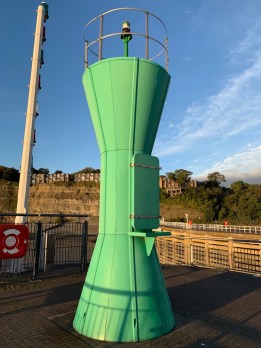
The light on Cardiff Bay Barrage

We were to head out on Bay Island Voyages RIBs from Cardiff Bay Barrage. We arrived in plenty of time, which meant we were able to watch the barrage in action. The barrage was opened in 1999 and was developed as a measure to deal with the extreme tidal range. It’s been fantastic for the area. For me though, it was the green structure on the end of the pier to the north of the entrance to the barrage that grabbed my attention. There appears to be very little information available about it. It obviously pales in comparison with the lighthouse we were about to see, but I’m glad we spotted it and took a closer look after we returned to the barrage that day.

Anyway, back to Flatholm. Once we had all settled onto the boats we were off. Although I say that, it was actually a fairly slow process getting out of the bay with having to go through the barrage, but it was significantly quicker than it would have been if the barrage wasn’t there and we needed to wait for tides to change! Once we were out the other side though our skipper wasted no time in getting us over to the island.

Photo 2018-09-30 09.47.25
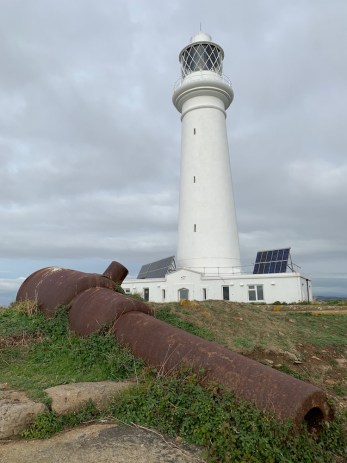
Flatholm lighthouse – and an old gun

Fortunately we were the first boatload to arrive so we were sent on our way to the lighthouse with our guide, Peter – the key holder! We immediately headed inside and had a wander about the old bedrooms and the battery room. Obviously having not been used for many years, since the lighthouse was automated in 1988, it has a disheveled look about it. Peter then led the way up the tower with us in tow. The lamp room is stunning, as they always are when fitted with a “proper” lens. What was equally stunning though were the views from the tower – particularly the landscape of the island. Aside from having a very beautiful lighthouse, Flatholm is filled with remnants and relics of times gone by. From the sea there looks to be very little there, but it hides a great deal. There is far too much history to cover here, more details can be found on the Cardiff Harbour Authority website. I found the old gun batteries, in particular, fascinating and the old guns can still be found laying about on the island.

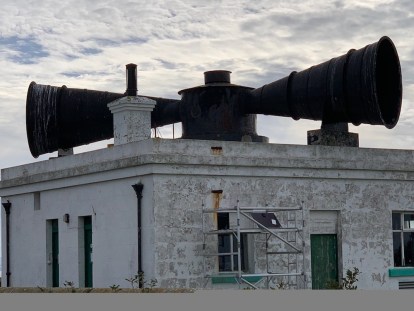
After leaving the lighthouse (and bagging the island high point), we paid a short visit to the old foghorn building. We weren’t able to get inside as the roof on the main building is unsafe, but we were informed that there were plans to replace the roof and allow access in future. In fact, just yesterday it was announced that funding has been secured that will preserve and improve what’s there (including the foghorn station) while bringing more visitors across the short stretch of water from Cardiff. Great news for Flatholm, although I much prefer a tourist-free island personally!

Photo 2018-09-30 10.08.15
The foghorn station on Flatholm

We had hoped to get a bit closer to Monkstone lighthouse on the return journey back to Cardiff, but unfortunately we needed to make sure we were back in time for our barrage slot, so that’ll keep for another time. What will also keep for another time (the next day or so, hopefully) is the rest of our lighthouse bagging antics that day.

It was a great morning on Flatholm. The landscape is very different from Caldey, which is one of things I most enjoy about bagging lighthouses. The variety of places it takes you to, and often in short spaces of time, is wondrous. If you’ve not already taken up the hobby then it comes highly recommended! 🙂


Dashing about on calming Caldey

Those who have been following my blog over the last few days will know that we spent the weekend in South Wales at the Association of Lighthouse Keepers (ALK) AGM in Cardiff. During the planning for the weekend I was aware that Saturday morning was free and, feeling ambitious, I proposed heading over to Caldey Island for the morning, and Bob agreed – not entirely knowing at the time just how long it takes to get from Cardiff to the boat at Tenby. I looked at the timings and then considered them again numerous times. Would we really have enough time?! The difficulty was that it didn’t seem possible to find out what time the first boat left Tenby in advance. A couple of days before I called the number I found online and the recorded message said that the boats would run from 10am. We would be fine, I thought.

Photo 2018-09-29 08.28.58
Saundersfoot lighthouse

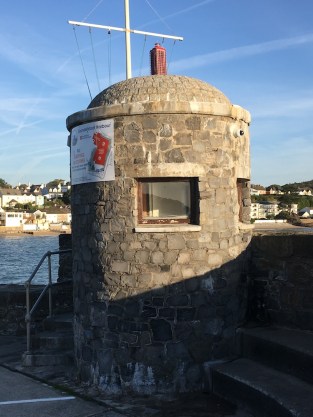
We got up super early on Saturday morning to allow plenty of time to get across to Tenby. Our journey was going well so we stopped off in Saundersfoot briefly to visit the lighthouse on the end of the pier. It’s not the most inspiring, and I actually preferred the “pretend” lighthouse inside the harbour, but we’ve been there now and you never really know what to expect until you’ve been there.

Arriving in Tenby there appeared to be little in the way of activity. It was then that we were informed that the boat wouldn’t be leaving until 10.30am (I probably could have found that out if I’d phoned the number again that morning), eating even further into the precious time we had to bag the lighthouse (and the island high point for Bob).

However, the coastline at Tenby is actually quite interesting to wander around, with the tidal St Catherine’s island just off of the beach, the old Tenby Castle and the very modern Lifeboat Station. While we waited for the boat a couple of ladies waiting behind us informed us that the boats had been cancelled the day before and it became very clear as time went by that a number of people must have been waiting to get over to the island, as they just kept on coming!

Photo 2018-09-29 10.56.29
The old Priory on Caldey Island

We were the first passengers on the boat and it was a very pleasant ride across to the island. The sun and blue skies were out in preparation for some wonderful picture opportunities. Once we were on the island we hurtled off ahead, stopping occasionally to take pictures. The island is stunning, not in the rugged way that most of the islands we visit are (partly because they are in Scotland), but in the same way as the Isles of Scilly (Tresco to be more precise). The island seemed very quiet and peaceful as we walked up the main road that took us to the lighthouse. Aside from a man in a van giving a lady a lift into the village we saw nobody else on the way there. The village is perfectly picturesque with the monastery sitting above it. A little further on there is the old Priory, possibly the most beautiful view on the island (excluding the coastline and the lighthouse, of course). There is a large pond bordered by trees in front of the Priory, and it would be easy to forget at this point that you are in Carmarthen Bay just off of the Bristol Channel. If someone passed you there and greeted you in Italian or Spanish it wouldn’t seem at all odd. There’s something quite Mediterranean about the island.

Photo 2018-09-29 11.03.18
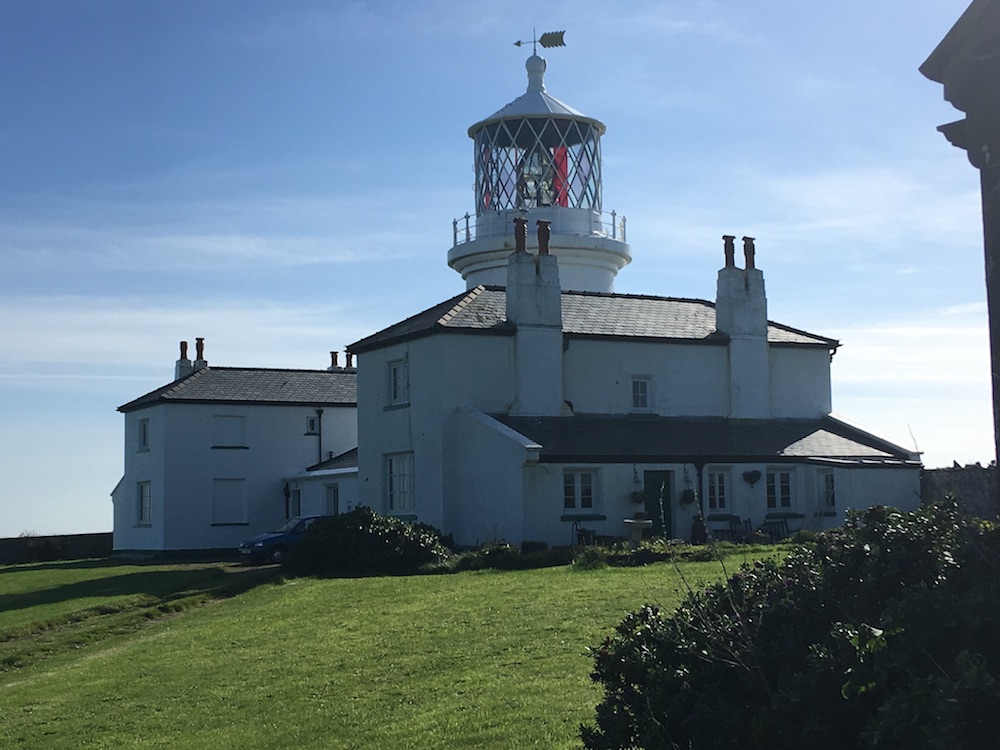
Caldey Island lighthouse

Not long after passing the Priory I spotted the top of the lighthouse appearing. As the lamp room came into view the optic sparkled as the sunlight shone through it. It is one of those towers that looks amazing from every angle – or at least it does when the sun is shining! The lighthouse is still in operation, and has been under the control of Trinity House since it was built in 1829. It was rather late to the old electricity game, being the last of Trinity House’s lighthouses to begin using mains electricity when it was converted in 1997. It’s a great tower, made even better by its location. If we hadn’t been so short on time then I would have happily wandered around the area enjoying the isolation and tranquility. But the need to get back to the boat was there in the back of our minds, so Bob ran off to the island high point (contrary to what it reported online, the actual high point is not where the lighthouse is located) while I started the journey back down the road.

Upon returning to the village it seemed like an entirely different place to the one I had passed through only a short time before. Everything was open, people were milling around and it suddenly felt more like the tourist destination that it is during Summer days (excluding Sundays when the boats don’t run). There were too many people about in my opinion (again, I’m used to smaller Scottish islands on my lighthouse bagging trips) and I had a deadline. Arriving back at the pier just as the boat was leaving I waited around in the sunshine and a short time later Bob turned up. We were privileged to have the boat to ourselves on the way back – although there were still plenty of people heading in the other direction.

I am pleased to report that we did indeed make it back in time for the start of the ALK AGM and even managed to fit in a cup of tea and chats with a number of people before the meeting started. We had about 1 hour on the island in total. A very enjoyable day, and Caldey is certainly somewhere I would like to re-visit at some point to explore a bit more. I made it to the lighthouse though and that was the aim this time so all is well 🙂

Back to the Usks and Barry

As covered in my last post, I was at the Association of Lighthouse Keepers (ALK) AGM in south Wales this weekend. The AGM is not just a meeting, it is actually a three or four day event with a number of associated lighthouse visits. For us, the event began on Friday with our first stop being East Usk. We’d visited this lighthouse, as well as West Usk, a few years ago. This time would be different though. Not only were we going to visit with a number of other lighthouse baggers, but we were also to be given a tour.

Photo 2018-09-28 10.44.37
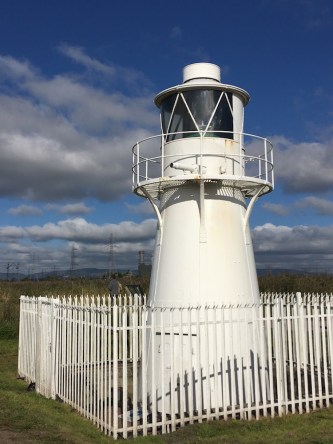
East Usk lighthouse

Our tour of East Usk began with a presentation by a very knowledgeable man called Jeremy who works/volunteers for the RSPB Newport Wetlands. Jeremy is the kind of person I plan on being when I am older and have more time on my hands – researching topics in great detail. Fortunately his chosen subject recently has been East Usk lighthouse so he was perfectly placed to deliver a presentation to us! His presentation began with the reason the lighthouse had been built, which was the first of many mentions of the huge tidal range along that part of the coastline over the weekend.

The lighthouse was first lit in 1893 following ongoing demand over a number of years to reduce the number of shipwrecks in the area. Interestingly the lighthouse was attended by a local man who would keep an eye on the light and make sure it came on, restarting it when required. Perhaps the most fascinating “factoid”, as Jeremy referred to it, was that the lower section of the lighthouse is now buried so it is actually taller than it looks. The ash from the power station was disposed of in the area, increasing the ground level around the lighthouse. You can see it as you walk through the Wetlands. That’s the sort of information you would be unlikely to know without actually going there. Another rather interesting, and rather amusing (to me anyway) fact was that the area surrounding the Wetlands features the widest variety of pylons in the country, which makes it particularly appealing to pylon baggers – yes, pylon baggers really do exist – we even met one on Saturday! Brilliant!

During Jeremy’s presentation he showed pictures of the lights in the surrounding area, including a small structure in Goldcliff. I had previously heard about it and the name rang a bell, so our priority after finishing at East Usk was to quickly swing by Goldcliff to check it out. We were a little short on time so had to run a bit, but it was easy enough to find by parking up and dashing along a private road. The lighthouse is in a pretty sorry state, but it’s a nice place and (if you have more time than we did) there’s always a cup of tea at the nearby cafe!

Photo 2018-09-28 13.01.31
West Usk lighthouse

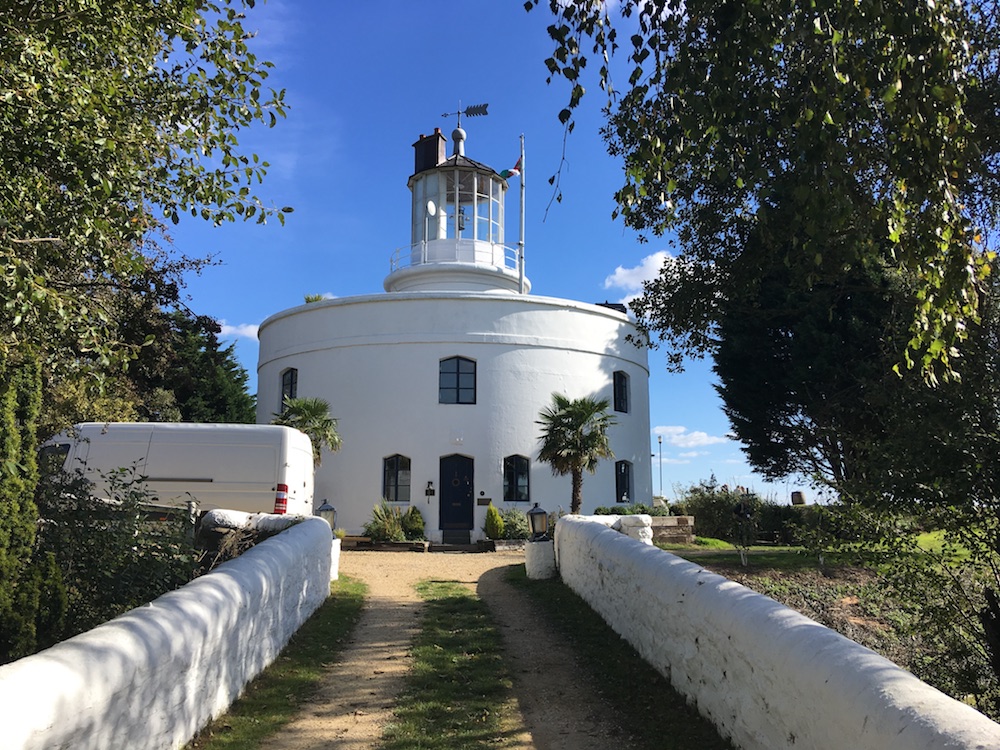
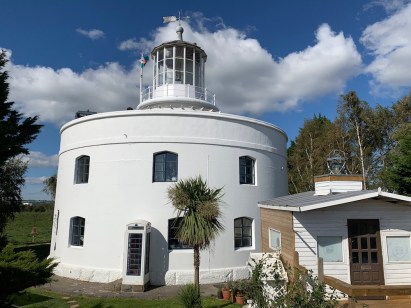
The reason we were in a hurry was because a visit to West Usk beckoned! We were pleased to learn that this time we would have a much more dignified approach and actually be able to park outside rather than walk across the boggy land to the west to reach it which we did last time (I am reliably informed that the Ramblers have now put a path in across the bog land). West Usk lighthouse is no longer operational and is privately owned and run as a B&B. What can I say about the lighthouse, apart from it is absolutely stunning! From the picturesque views of it as you approach to the fascinating decor inside, it was astounding. I’ve already decided that I absolutely must stay there one day. The bedrooms are beautiful and the work they have done on the lamp room has turned it into the kind of room that you would be happy to spend hour after hour in. Everywhere you look inside and outside there are tiny little touches that make you feel like you are on some sort of adventure while there. All of this topped off with a very friendly and welcoming owner who seemed happy to chat to us all, considering he was hosting a wedding the following day. Just need to book my stay now!

We had been informed by another ALK member that the best place to view Monkstone lighthouse, a few miles off of the south Wales coast, from was Penarth so that was our stop for lunch. We saw Monkstone a few times over the weekend, but never managed to get particularly close to it. We will need to organise a boat to get us out there sometime.

Photo 2018-09-28 16.52.27
Barry breakwater lighthouse

Our final lighthouse re-visit of the day was to the light on the end of Barry breakwater. We’d previously seen it from just above the beach, but the ALK had arranged for the gate to the breakwater to be opened for us. It’s a good walk along the breakwater and the lighthouse is much more substantial close up than it looks from the beach. There are old railway sleepers running to the end of the breakwater and we wondered what their purpose had been. Since returning home I found this interesting post with more information on the history of the railway.

So, that was the first day of the ALK AGM weekend. Plenty more still to come though with a couple of very exciting islands – regular readers will know how much I love an island! 🙂

My first ALK event

At the weekend I finally made use of my Association of Lighthouse Keepers (ALK) membership, which I have had for 5 years, and attended their AGM and associated lighthouse visits in South Wales.

Earlier in the year I received an email to say that the ALK required a new team to organise their events and I had expressed an interest in joining the team. After meeting their Secretary/Events Coordinator, I was still keen to be involved so I spoke to their Chair, Neil Hargreaves (a former lighthouse keeper for Trinity House), and Trustee Lin Sunderland, who is also joining the events team and is on the committee for the St Mary’s Lighthouse Group and a volunteer at Spurn lighthouse.

Of course, to organise any events for the ALK I needed to attend at least one of them, and the AGM in Cardiff seemed like the perfect one – particularly as the members would be approving the new events team at the meeting. Going along to the AGM would also mean I’d get to see Ian Duff again (see my earlier post on Skerryvore for more information about Ian), as well as Stephen Pickles from Bidston lighthouse who I’d met a few years ago on our visit there. Prior to the event I had also been in contact with another ALK Trustee, John Best, who shares my enjoyment of lighthouses of all shapes and sizes (including the Northern Lighthouse Board’s “flat-pack/IKEA” type). John has been a massive help recently in my attempt to pull together some form of a list of lighthouses. So the AGM would also be an opportunity to meet him.

So Bob and I went along and were immediately welcomed by the record number of ALK members attending the AGM. I shall prepare separate posts about our lighthouse visits over the weekend, which included East and West Usk, Caldey Island, Flatholm and Nash Point. We met a number of them during the day on Friday and had some good first in-person chats with Lin, John and Neil.

Photo 2018-09-29 18.44.37
The particularly impressive ramparts at St Donat’s Castle

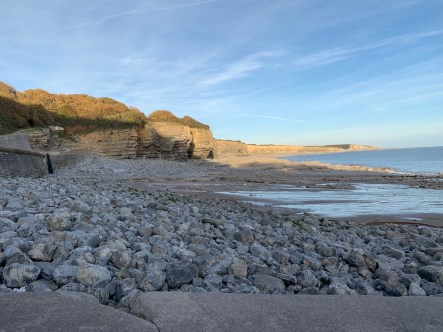
On the Saturday afternoon we arrived at the amazing AGM venue, Atlantic College at St Donat’s Castle. It really is a hidden gem with some incredible buildings and a fantastic little beach and slipway where the early lifeboats/RIBs used to be launched. The room we had dinner in reminded me of a smaller-scale version of the hall in Harry Potter, and I don’t even know where to begin with describing the toilets…

The AGM went well and the new events team proposal was approved, so I am now officially involved with the ALK. As well as Lin, I also met Laura who is the third member of the team and has embarked on her own lighthouse tour this year. She had come across this blog while preparing for her tour, and it was nice to hear that it was useful to her. The three of us had some good laughs over the weekend, so I am sure we will get on well as a team. The AGM was concluded with a fascinating presentation on foghorns delivered by a lady who is doing a PhD on the human aspects of the topic!

Photo 2018-09-29 17.56.36
The view from the slipway at Atlantic College, St Donat’s Castle, where the first RIBs were launched

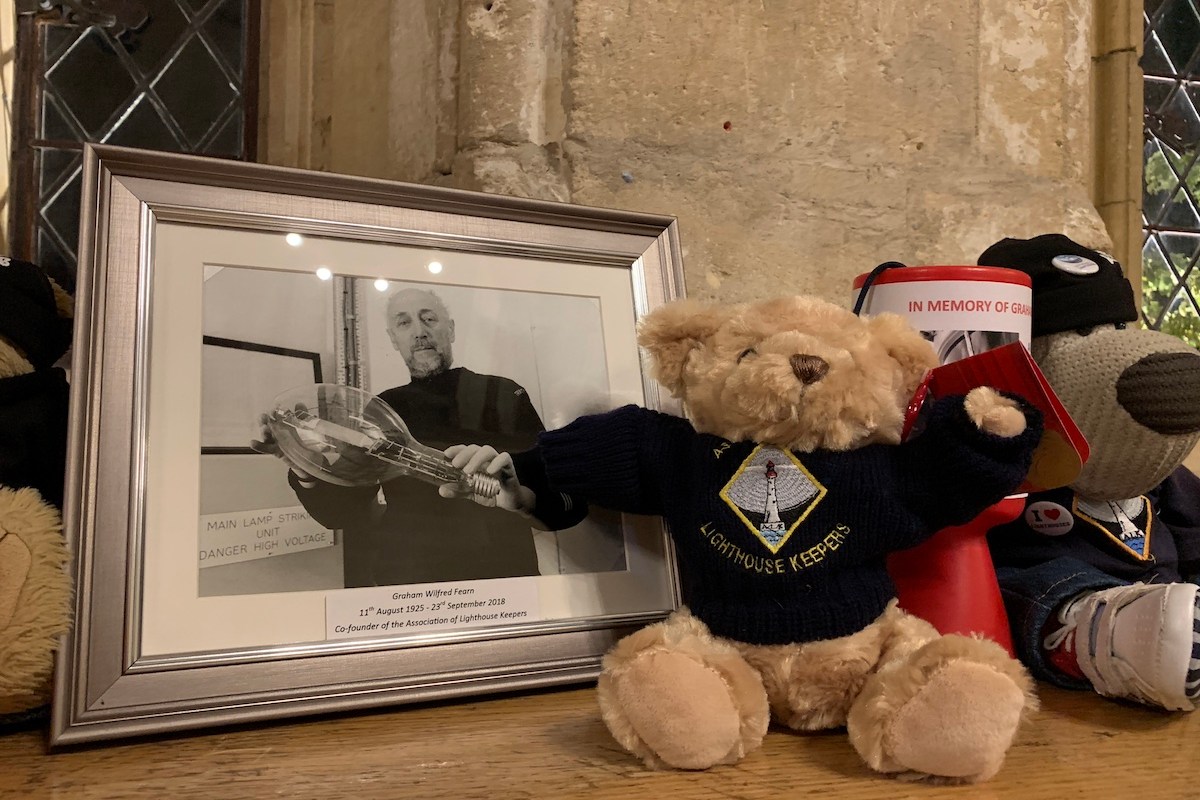
As well as meeting Neil Hargreaves, I was also privileged to meet another former keeper, Gerry Douglas-Sherwood. Gerry was one of the three founding members of the ALK alongside Neil and the recently departed Graham Fearn. Gerry served at the Needles lighthouse and wrote the first issues of the ALK journal, Lamp, on a typewriter during his time in the lighthouse. Getting a chance to speak with both Gerry and Neil, as well as Ian again, was a real honour for me. To date I have found no other profession that people are more proud of than lighthouse keeping. It is incredibly refreshing in a time when work is so frequently seen as a chore. The former keepers also seem very grateful to the rest of the ALK membership for their appreciation of the structures they lived and worked in. They all seem so modest and humble. Such a wonderful experience to speak to them.

Among the others I met at the AGM and dinner were Chris Nicholson whose book Rock Lighthouse of Britain was one of my first ever books on the topic. Also, Roy Thompson who appears to know boatmen all over the country and will, I’m sure, be a huge help in putting us in touch with the right people. There were a number of very well-connected people there who were happy to help anyone looking to visit a particular lighthouse. There were also a number of people wishing me “good luck” with taking on the events! I’m not sure if I should be scared by this or not. I guess only time will tell!

While this hasn’t been my standard sort of blog post, I felt it was important to share and to give some more details on the ALK. As stated on their website:

“The Association of Lighthouse Keepers provides a forum for everyone interested
in lighthouses, lightships and aids to navigation. We have a number of serving and former keepers amongst our members, although being a lighthouse keeper is not a requirement for joining the Association.

Membership is open to everyone!”

There may be some regular visitors to my blog who aren’t aware of the ALK, but if you are interested in lighthouses anywhere in the world (they have members from a number of countries) then do check our their website. Annual membership is only £18 per year, £24 for joint membership or £35 for family membership. I would highly recommend it already and I’ve only just become an active member. Why I left it so long, I don’t know!

More to follow soon on the lighthouses we visited over the weekend 🙂