During our recent trip I’d got back into the habit of visiting lighthouses and, as they say, old habits die hard. With it being the first weekend back after the holiday it seemed like a good time to make the most of the sunshine and see some lighthouses at the same time.
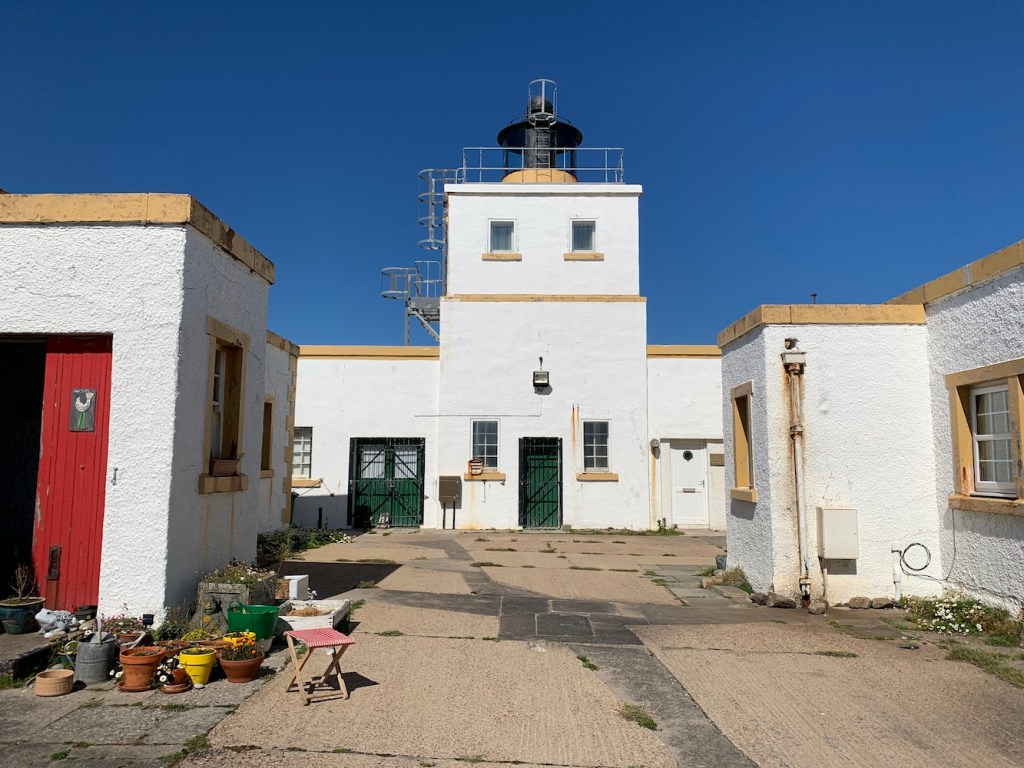
Yesterday we visited a friend at Strathy Point lighthouse for the first time in a few months. With it being so close to home, we’d been thinking of dropping by for a while, but wanted to hold off as we knew there would be hoards of people (relatively) descending on the Point once lockdown restrictions were eased.
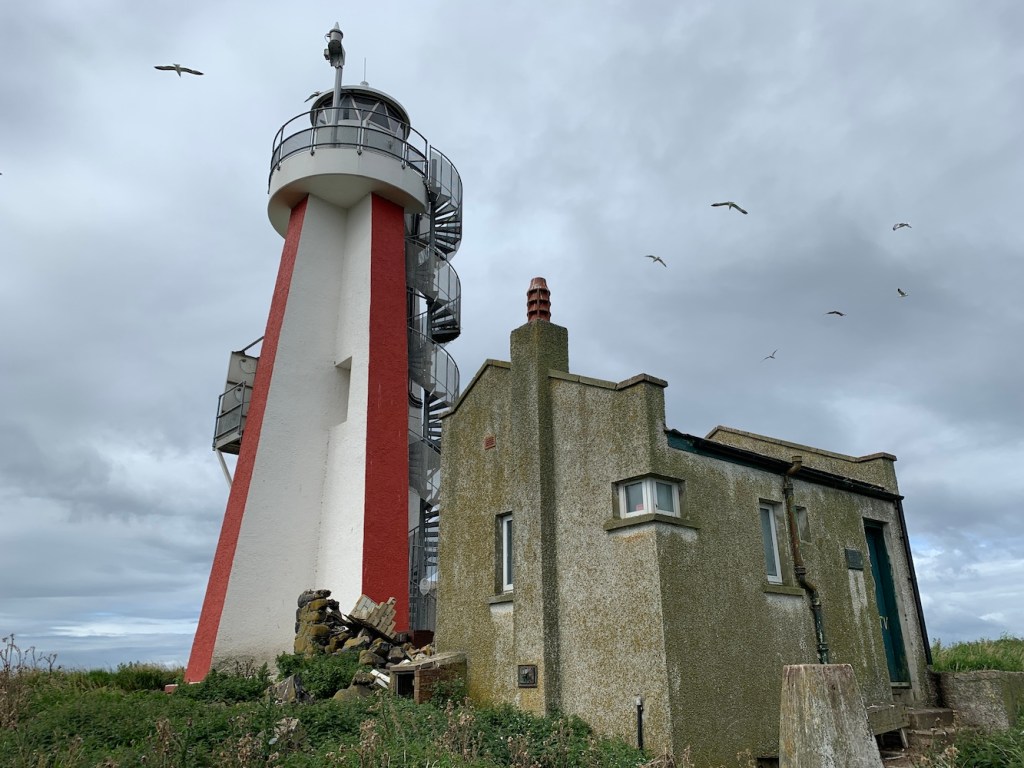
Strathy Point lighthouse
Joe the Drone had to come along too, of course, and with permission from our friend he got some great shots of the lighthouse.
Strathy Point lighthouse from the sky
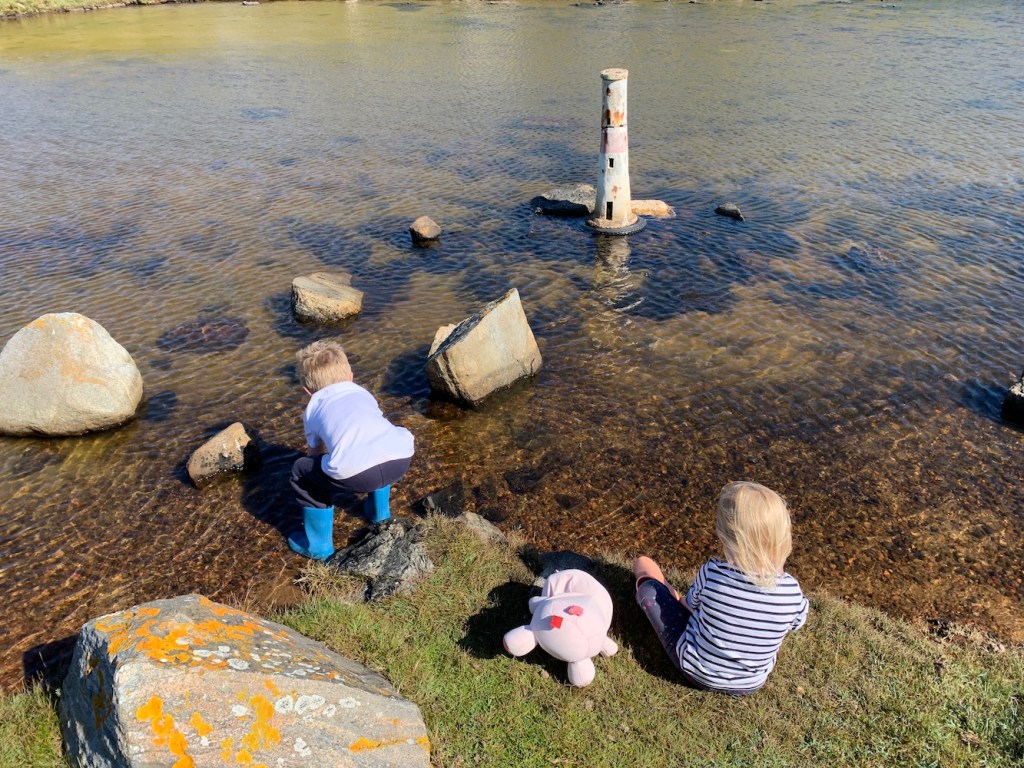
I never get bored of Strathy Point, and the kids thoroughly enjoyed paddling in the small loch close to the lighthouse. Anyone who has been before will know that there is a model lighthouse in the loch. Apparently they were made by the lighthouse keepers and, when the light was automated one of the engineers took one of the models with them. At one point one of the residents put a solar powered light on top of the remaining tower, but that obviously didn’t last.
The loch and model lighthouse at Strathy Point
Today looked like it would be cloudy at home, but sunny and warm on the west coast. So it seemed sensible to go somewhere where the weather was good for the day. One of the benefits of living on the north coast, although it was a three hour drive each way. We chose Stoer as I’d not been there since my original tour in 2012, Bob hasn’t been for a while and there was a nice beach nearby for the kids to enjoy.
As we headed west the skies started to clear, the sun came out and so did the cars. As we got closer to the turn off for Achmelvich beach the traffic really picked up. Clearly many people were aware of the incredible beaches the area had to offer, as well as the beautiful mountain views.
Some of the Assynt mountains
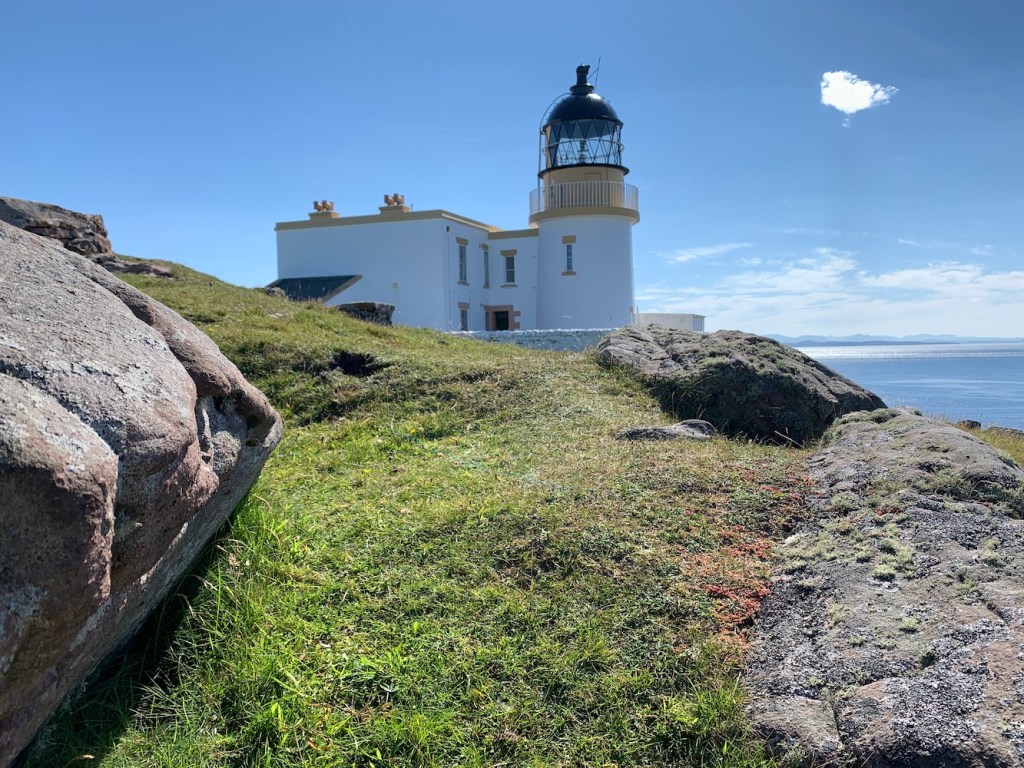
We made it over to Stoer and parked up. After a picnic on the hill close to the lighthouse Bob went off with Joe the Drone – who managed to unearth a lone bonxie from nowhere as soon as it took off. After lunch we wandered up to the lighthouse and I handed over parenting duties to Bob while I wandered around the lighthouse.
Stoer Head lighthouse
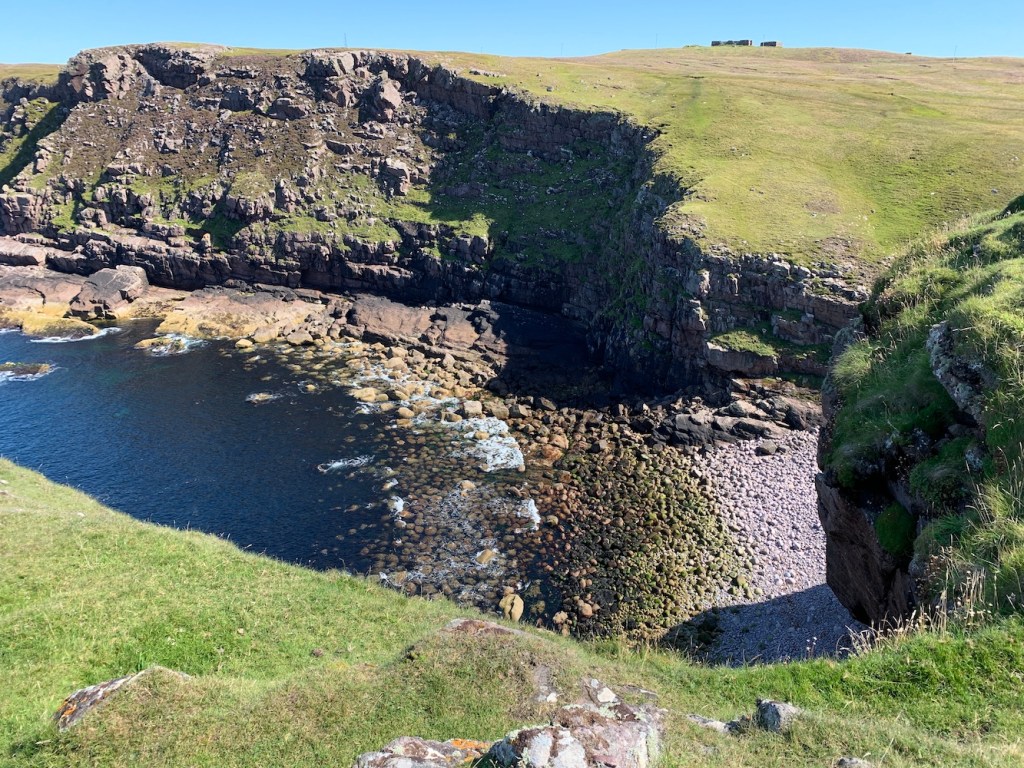
It’s such a beautiful location and the coastline here is fascinating. It’s hard to appreciate from the land really, although starting the walk along to the Old Man of Stoer as I did on my last visit gives an extra wonderful angle. Last year on our west coast boat trip I was fascinated to see Stoer Head lighthouse from the sea and to get a better idea of the lie of the land around it.
The cove behind Stoer Head lighthouse
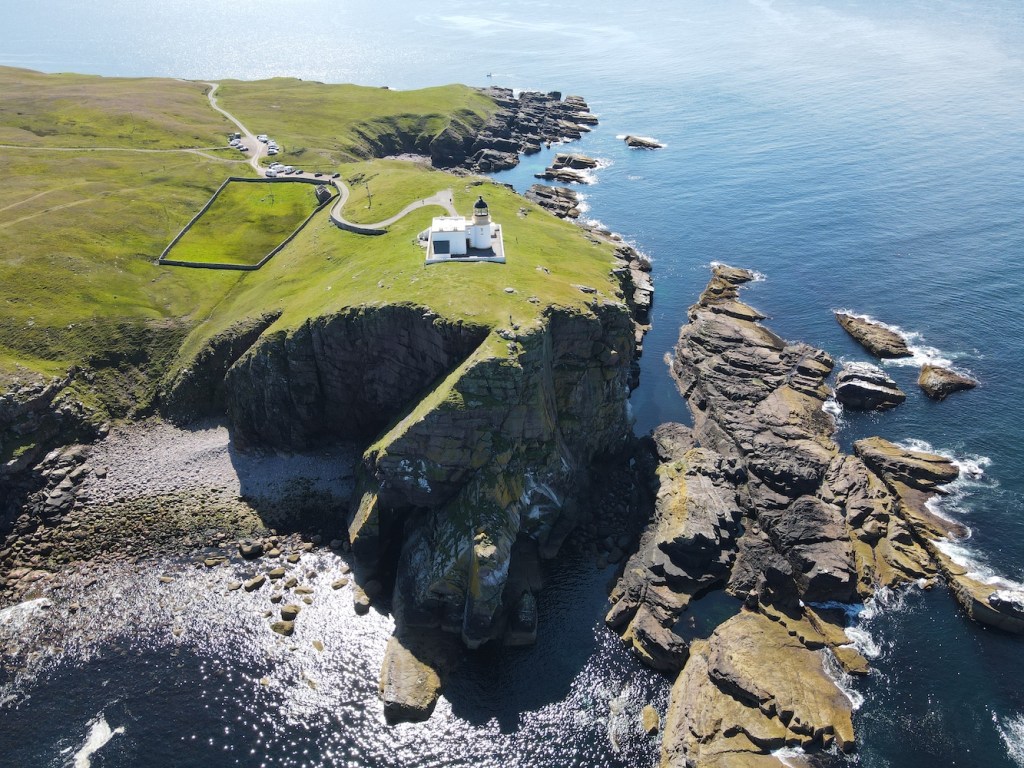
This was where Joe the Drone really came into his own as the aerial shots really showed the shape of the land to its full effect. That is what I’m finding I enjoy most about the drone pictures, is being able to see the shape of the land around these lighthouses. Just the little ins and outs and grass slopes leading down to the cliffs, looking like a green blanket has been laid over the top of the land. It’s wonderful to see – and I’m sure Bob will be very grateful to read that I appreciate his new toy!
Stoer Head from above
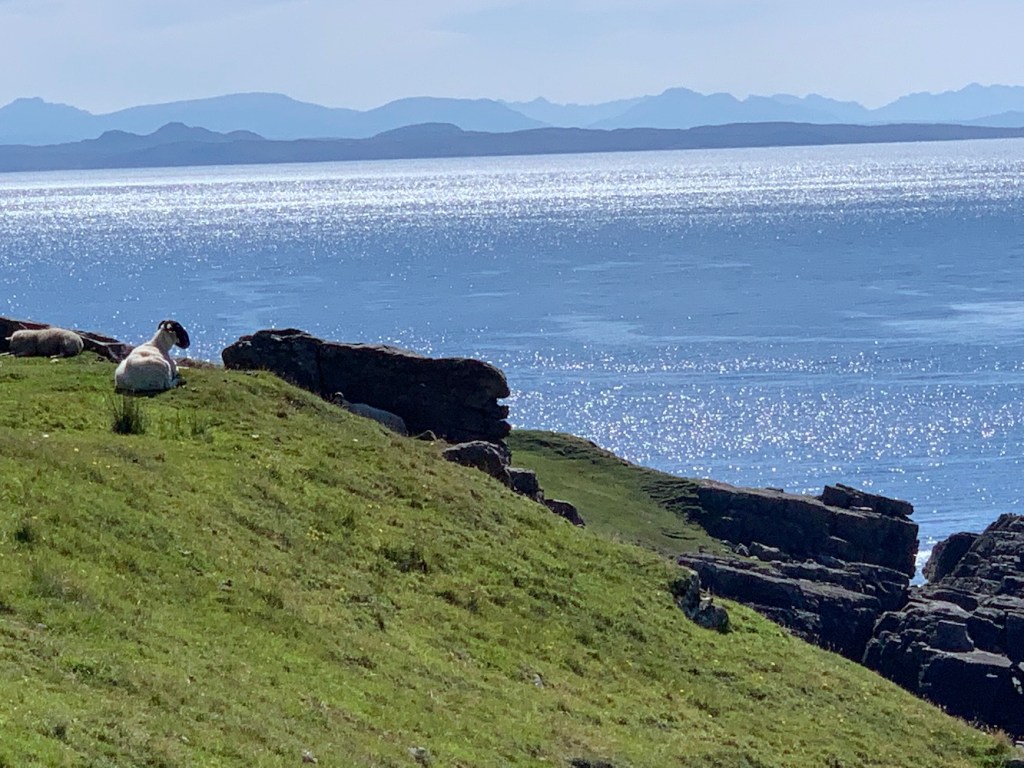
The lighthouse buildings have now been converted into holiday accommodation with an upstairs and a downstairs flat. It’s not the cheapest of place to stay, but the 360 degree views make it worth it, including (as they did today) over to the hills in Assynt, then Skye and even small sections of the Western Isles too. There was even a sheep nearby watching out over the sea.
The sheep enjoying the view at Stoer Head
The light in the tower has now been replaced with one of the LED “puddings”, so the lamp room looks fairly empty. It’s still such a beautiful complex throughout though and the buildings are looking really well maintained.
Stoer Head from the south
Waving goodbye to the lighthouse, we then stopped off at Stoer Bay, just around the corner from the busy Clachtoll beach, which the kids absolutely loved – to the point where our little girl thanked Bob for “making this beach”!
It’s the final day of the holiday before the journey home and I couldn’t let it pass without a lighthouse or two. Loch Ryan and Killantringan lighthouses featured in my original tour, but I’d not been back since. I’d learnt that it was possible to get better views of them than I’d previously had and now with Joe the Drone (yes, he has a name and I thought I’d use it as I think he may receive regular mentions in the future) as part of the tools available to us it seemed like a good time to pay them a revisit.
In my previously cautious way (and I am still cautious sometimes) I’d contented myself with the view of Loch Ryan lighthouse from the road. The signs saying “Danger” and “Keep out” were enough to put me off attempting anything more. The lighthouse is at the back of what appears to be an abandoned area of wasteland. Parking at the car park we went down onto the beach and quickly came to the burn (or stream) that crossed the beach, heading down into the sea. It was deeper than it looked in places, but we managed to navigate our way across and I was glad of the extra platform I have on my walking boots, and their waterproof features too!
Loch Ryan lighthouse and the burn
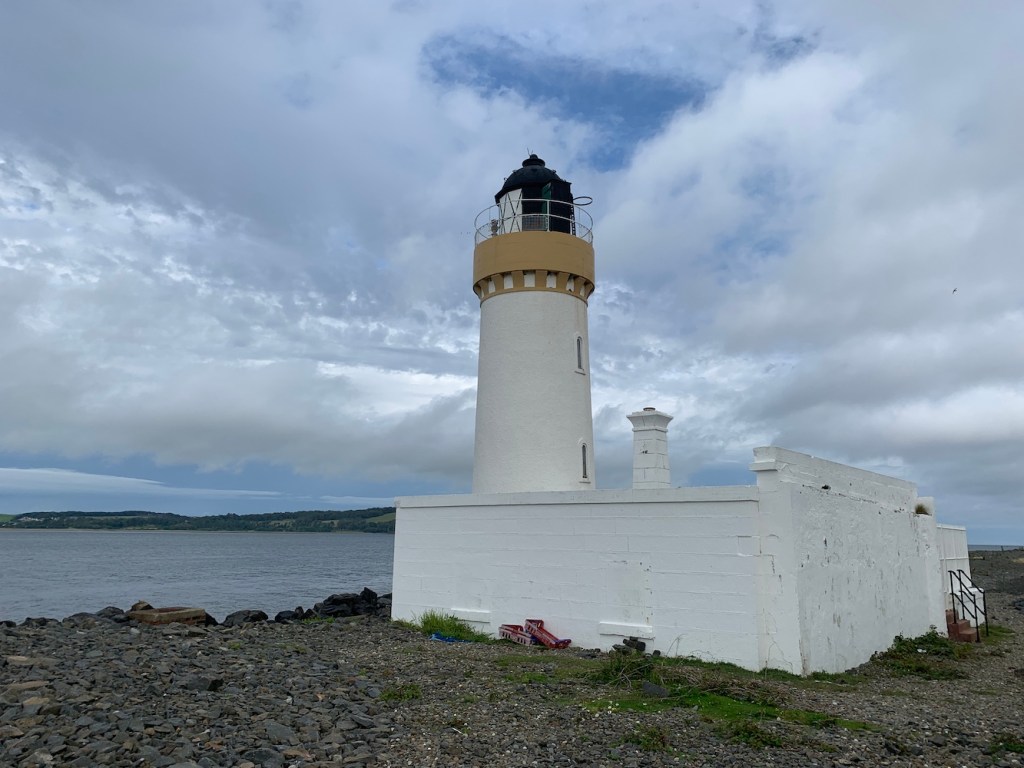
From here it was a short walk along the shoreline to the lighthouse. Although it’s quite a substantial tower there are no associated cottages next to it or within the compound. It is clear that its purpose is limited to navigating ships safely into and out of Loch Ryan by its basic layout and lack of the little decorative details that you find on many other Scottish lights – particularly those designed by Alan Stevenson as this one was.
Loch Ryan lighthouse
It was a nice stroll along the shore though and Joe the Drone managed to capture some great images too. As we left I noticed a sign warning that large waves often occurred on the beach there up to 30 minutes after a ferry had passed. Luckily we didn’t need to worry about that!
Loch Ryan lighthouse
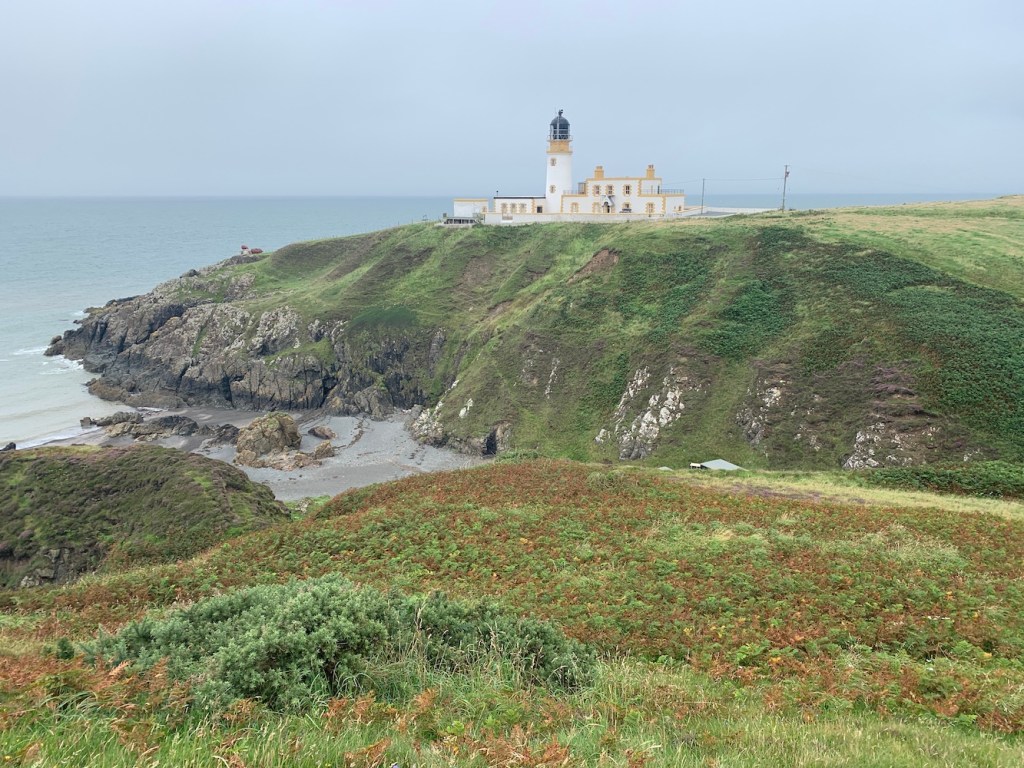
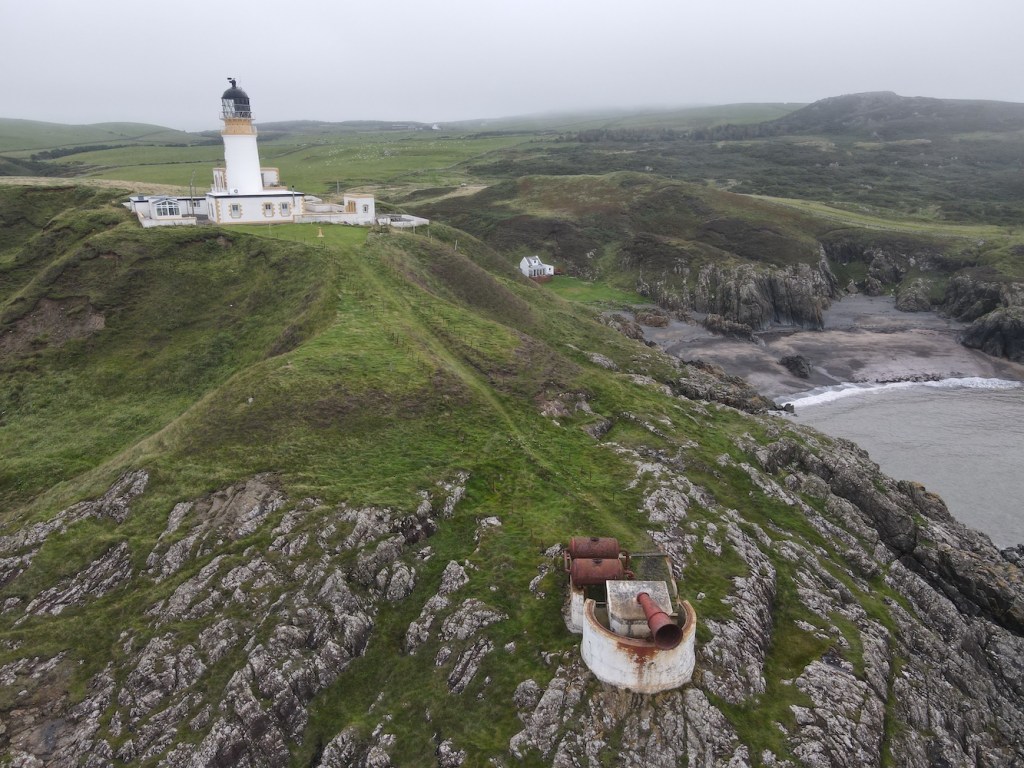
The revisit to Killantringan was partially inspired by the fact that Bob hadn’t been there before and also that my lighthouse accomplice John had sent a picture of it taken from an entirely different angle than I’d seen it from before, one from which you could see the old foghorn which I hadn’t realised was there before. When I’d been there previously it was a matter of driving up, parking, walking up to the lighthouse, taking some pictures and then going back to the car. There is no way to get around the outside of the wall so there seemed nowhere else to go.
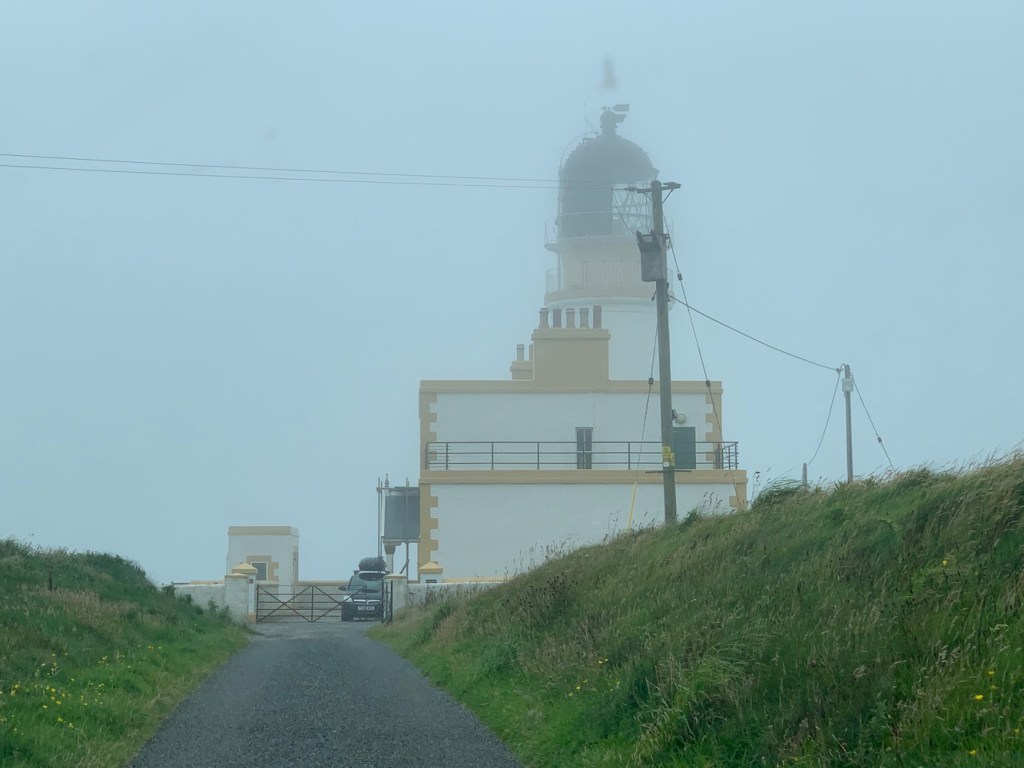
Killantringan lighthouse in the mist
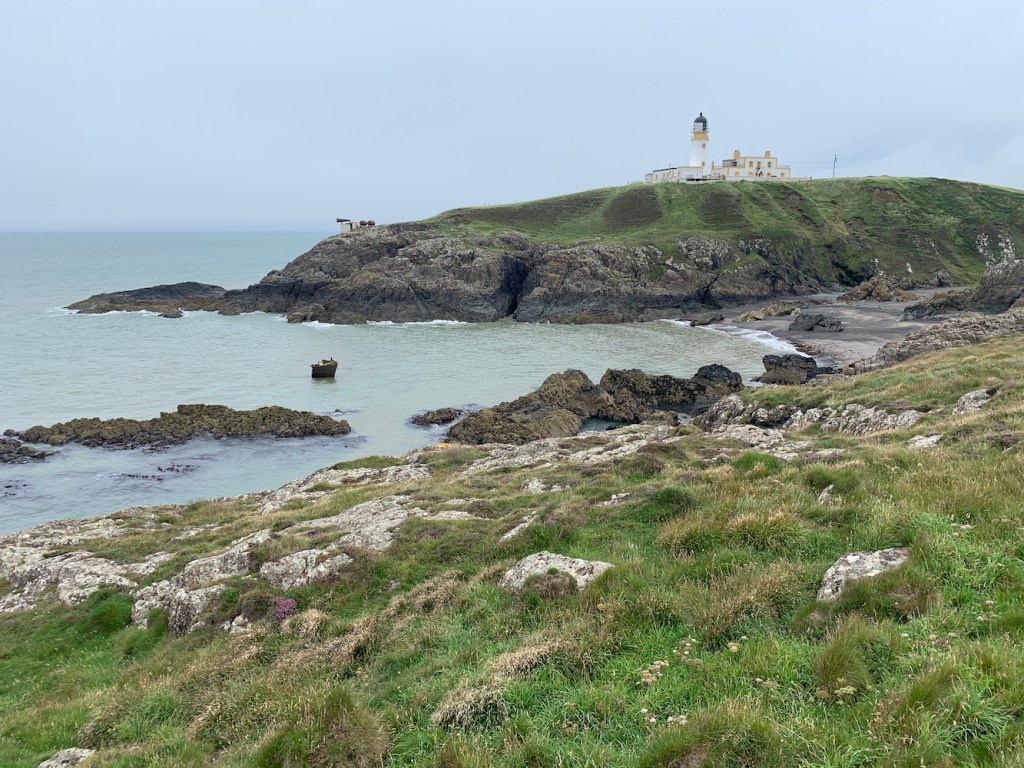
As we approached the lighthouse a thick sea mist had appeared and it was looking unlikely that Joe the Drone would get a spin at this one. I quickly took a few pictures and we retreated to the car park to assess the situation. Thankfully the mist cleared and we set off with Joe flying above our heads. While Bob was working with Joe I set off along the coastal path, part of the Southern Upland Way, to get the panoramic view of the lighthouse, foghorn and the fantastic cliffs surrounding them.
Killantringan lighthouse with the foghorn coming into view
A benefit of visiting at low tide as we did was that the remains of the bow of MV Craigantlet could be seen. The cargo ship was en route from Belfast to Liverpool when it was wrecked in February 1982 and thankfully the crew were saved after the keeper at Killantringan lighthouse raised the alarm.
Killantringan foghorn and lighthouse with the bow of the MV Craigantlet visible
Funnily enough, as the foghorn really started to come into view I heard the deep boom of a ship’s foghorn out to sea, an indication that it was still foggy out there at sea. It seemed like perfect timing and I enjoyed the views for a little longer before heading back to the car, not quite in time to miss the rain though! Joe had also done well and captured some nice shots, particularly closer in on the foghorn.
Killantringan lighthouse and foghorn from the sky
It was great to get back to these two and really explore their surrounding areas a bit more. It’s so easy to not make the most of these places when you are on a time limit with plenty more still to go on your list. It was good to be able to spend more time there without these constraints.
These lighthouses are the final two of this holiday. It’s been a long wait for them, but completely worth it. I’ve spent time with treasured family and friends, laughed a lot, got plenty of fresh air and exercise, and been to places I will never forget. 🙂
It’s not often I use a pun in the titles of these posts, but it was too good an opportunity to miss today. It really has been a beautiful day and a good portion of our lighthouse antics took place on the Isle of Bute.
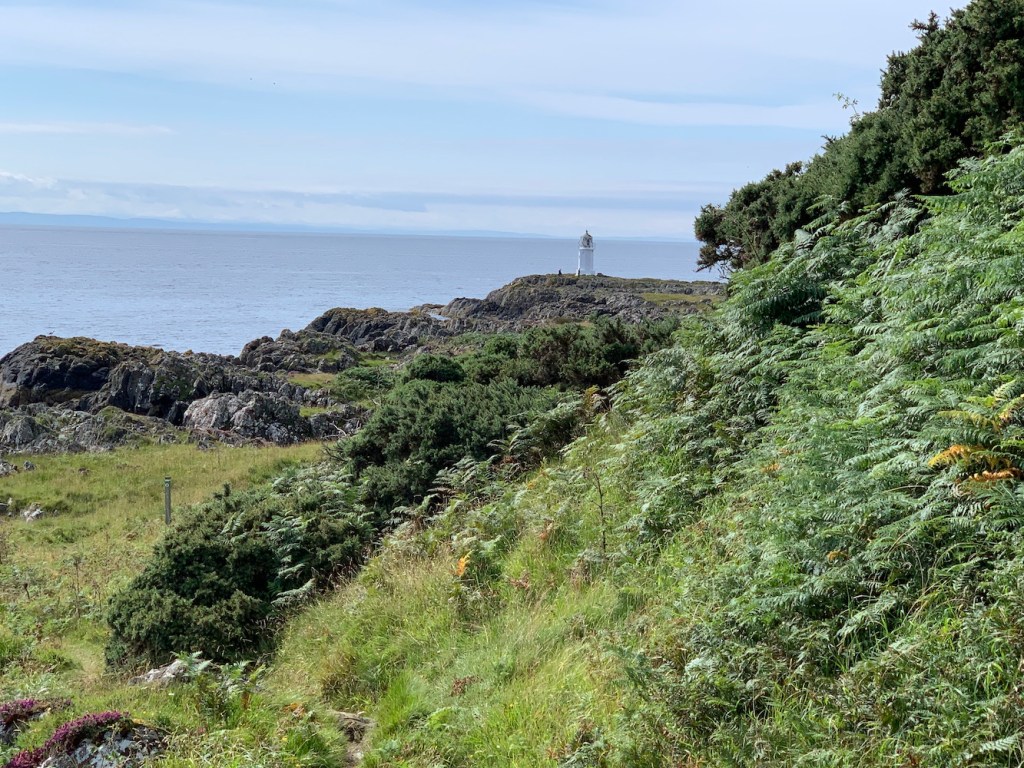
I have been aware of Rubh’an Eun lighthouse on the southern point of Bute for a long time and knew it involved a walk. It wasn’t one I was desperate to get to, but with it being a “proper” little lighthouse of a style I am rather partial to it did hold a fair amount of appeal. I’d heard from my friend John that the path to the lighthouse was a little narrow in places, that he’d seen a cow pat and then almost fallen into a gully. It all sounded a little dramatic and so Bob and I decided to invite him along for round two in the hope that it would make for a more enjoyable and less frightening day!
We had an early start this morning to make sure we could get across to Bute before the ferries got busy. The sun was shining and the sea was so calm that we all wished we were going out on a smaller boat hopping from one island to another. The journey to Kilchattan Bay, the starting point for the walk, was picturesque and when we arrived we began to realise that this wasn’t another one of our remote walks during which we would see no one else.
One of many views from the walk, with Little Cumbrae in the distance
Maybe it was the weather, but the walk was stunning and it was great to take in the surrounding views especially over towards Little Cumbrae. The walk makes up part of the West Island Way and is really varied with easy grassy sections, parts where you need to navigate around or over rocks, some slightly overgrown foliage and muddy stretches especially after the recent period of heavy rain.
One of the interesting natural features on the walk
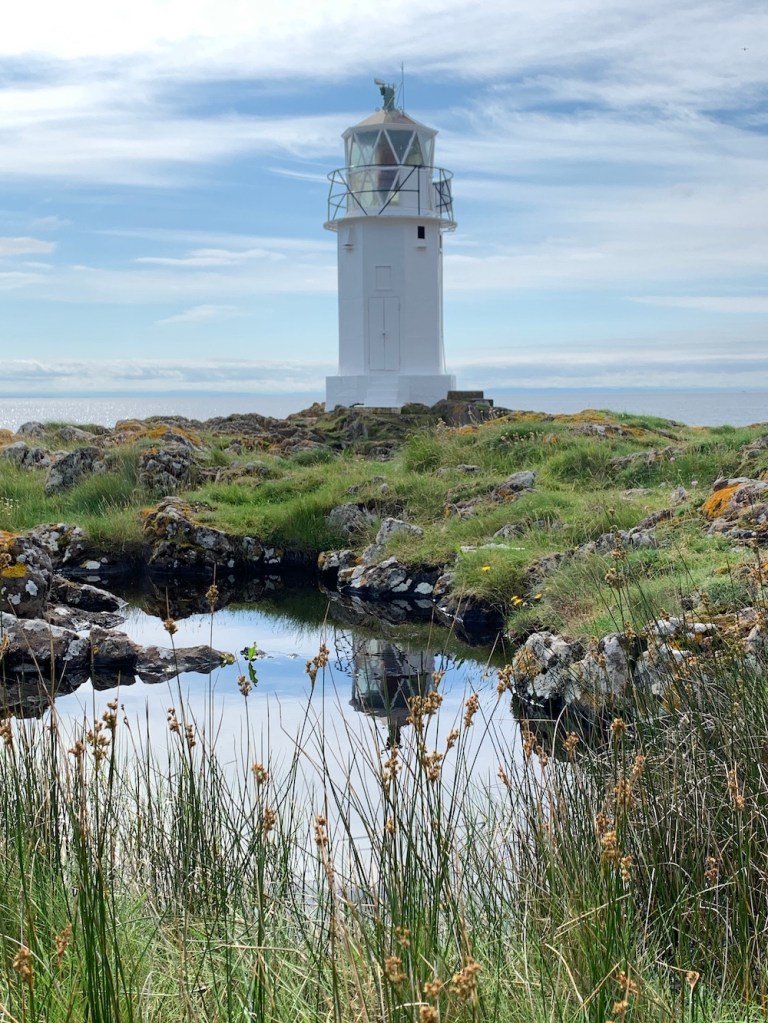
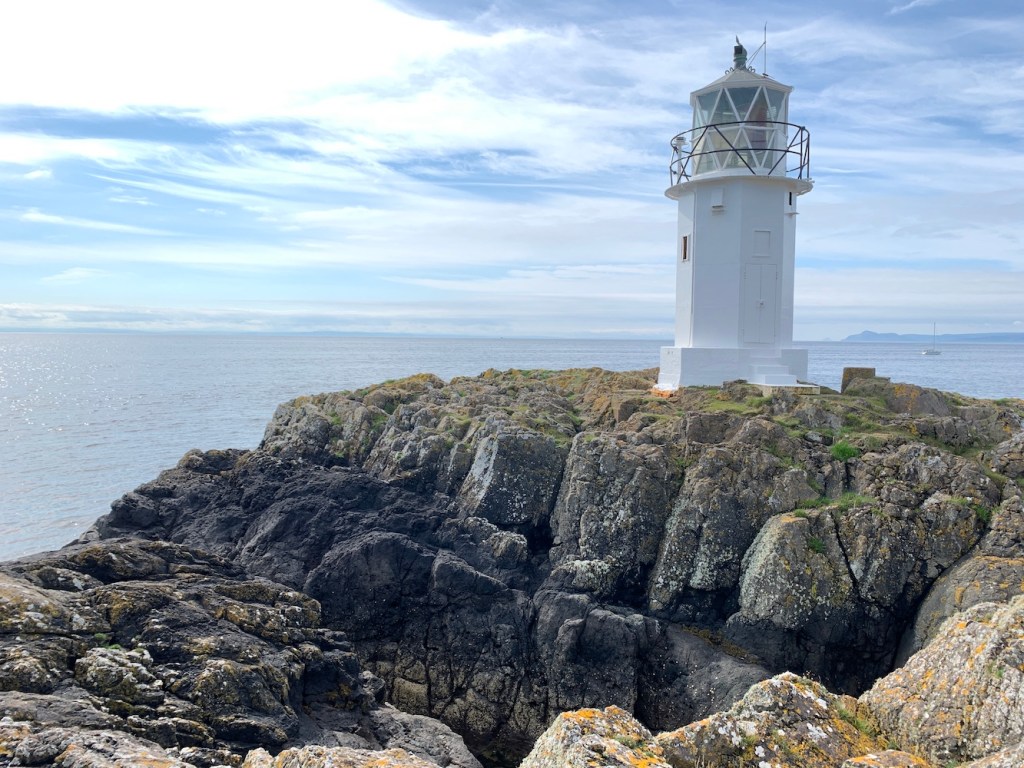
For most of the walk John had been up front, but as we rounded a corner he hung back and let me go first in order to let me see the lighthouse without others in the way. That first view you get of the lighthouse is beautiful – or it certainly was today anyway. The tower must have undergone a fairly recent makeover as it was nicely painted with the only remnants of its previous rust colour appearing near the very bottom of the tower. John said it was a vast improvement on his first visit when it looked in a poor state and the door was open.
Rubh’an Eun lighthouse comes into view
There were two people near the lighthouse as we approached, but thankfully they wandered off as we approached leaving us with plenty of time to explore before we were disturbed again. It really is a wonderful landscape and one which can only really be described to a certain degree by pictures so here are a few angles – including one from Bob’s drone which buzzed around while we explored.
Rubh’an Eun lighthouse
I won’t be forgetting this visit in a hurry and I’d be more than happy to go back again in future. It well and truly gets my seal of approval and I would recommend it to anyone who wants a good walk on a nice path with a hint of being in the middle of nowhere, but not too remote.
One of Bob’s aerial images of Rubh’an Eun lighthouse
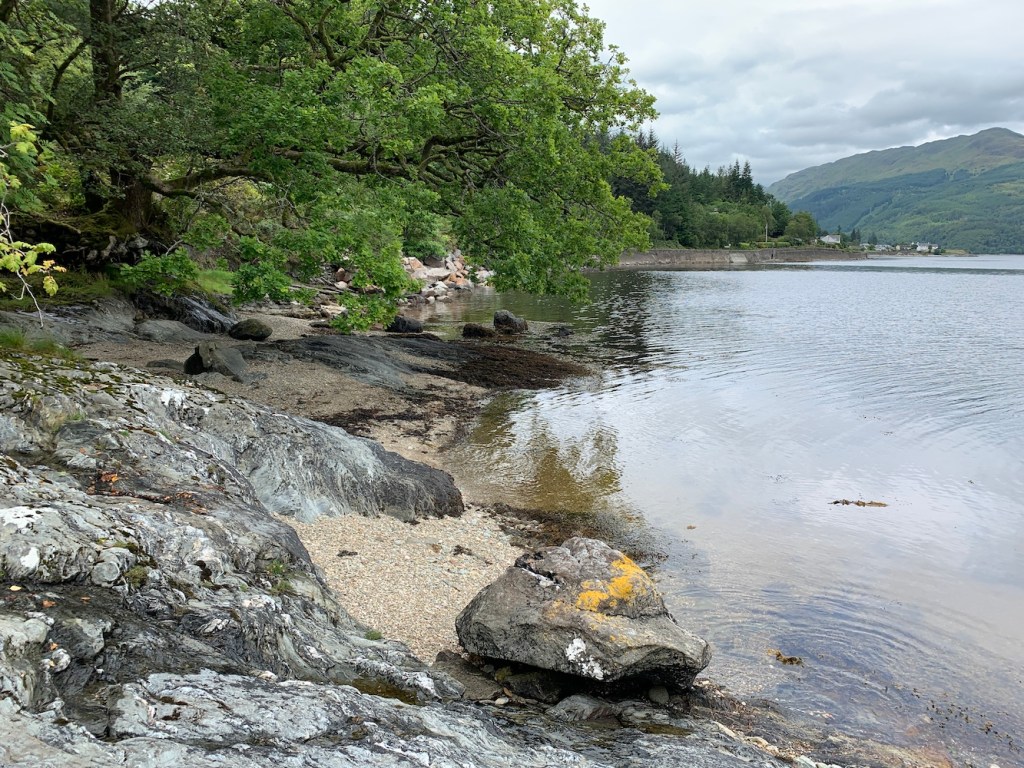
Leaving behind this impressive island we made for Ravenrock Point for the second day in a row. We wanted John to see the structure here and give his opinion on whether it was worthy of lighthouse status. I was pleased to have gone back as yesterday I’d been so focussed on the lighthouse that I’d not noticed the nice little cove and beach area just to the north of it. I’ve included a picture of the cove here, but one of the lighthouse can be found in yesterday’s post.
The cove at Ravenrock Point
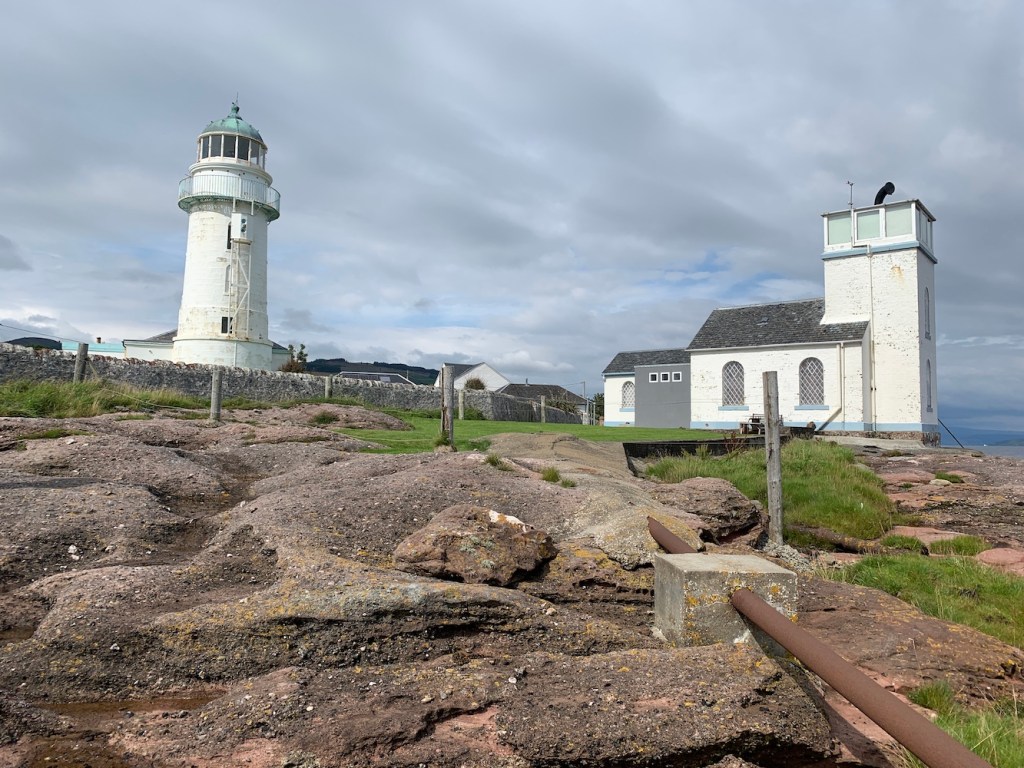
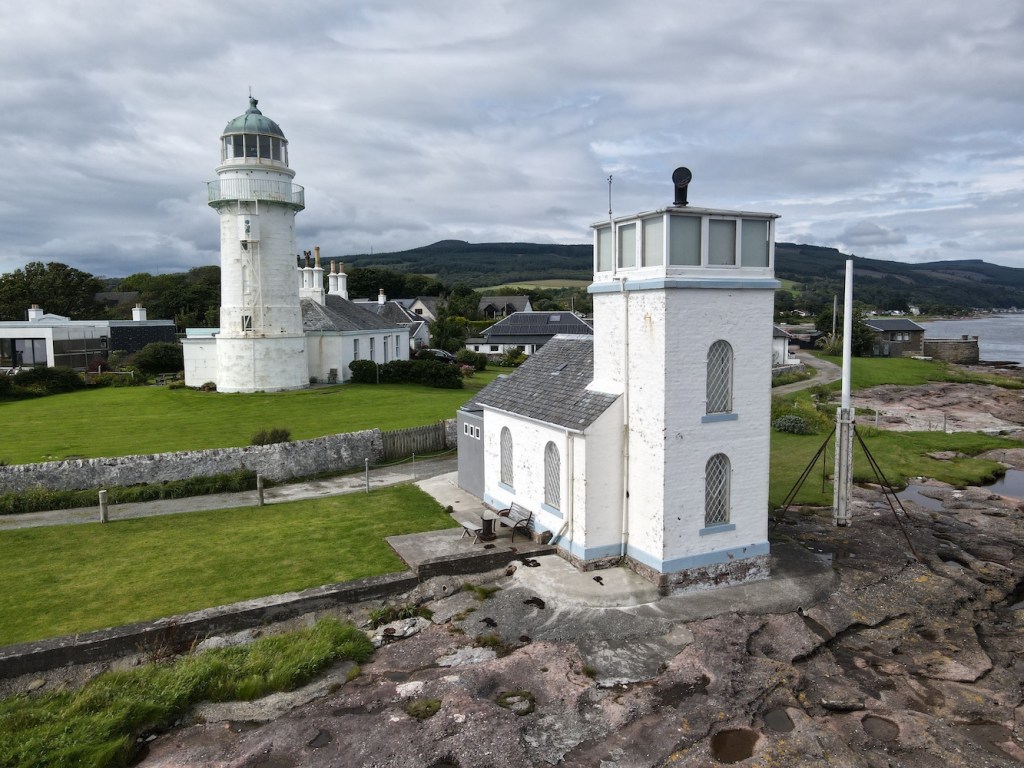
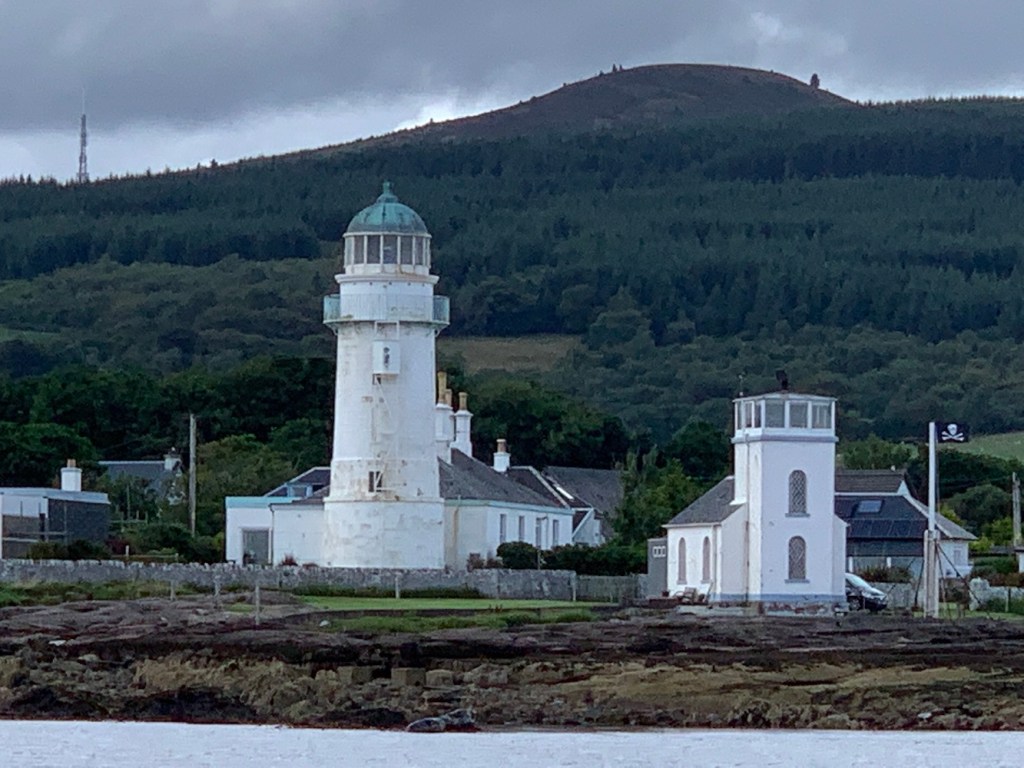
Having seen Toward lighthouse from various angles and numerous times over the past week it was time to finally pay it a visit. Bob hadn’t been to this one before which was even more reason to go. I really like this tower and I enjoyed seeing it the first time on my 2012 lighthouse tour. It was very interesting to be back there today, eight years later, with the extra knowledge and experience I have gained. I am still fond of it and imagine it is a great little place to live.
Toward lighthouse and foghorn
I paid more attention to the foghorn and its church-like building today than I ever had before. There’s not much to the actual horn itself so the building seems quite oversized – unless, of course, it was used for something else. As we wandered around on the rocks Bob spotted the old jetty that would have been used for servicing the lighthouse.
An aerial view at Toward
Heading north from Toward we had some time to kill before the fish and chip shop in Dunoon opened so we stopped in a small lay-by off of the main road to see the Perch beacon, which we had spotted from the boat last weekend. Bob had intended to send the drone out to get some closer images of the beacon, but the local oystercatchers kicked up a fuss and so that effort was abandoned. A little further up the road we glanced at the beacon on The Gantocks.
A poor quality image of Perch beacon was the best I could get
Arriving back just in time for fish and chips from Anselmo’s – which quite deservedly has great reviews – we made our way to the seafront and ended the day enjoying our dinner from a bench with views across the water to Cloch lighthouse. It’s days like this that you feel very lucky to be able to experience these places and to do so alongside family and friends makes it extra special. 🙂
Whilst it’s true that I do spend a lot of my lighthouse time trying to get to those I’ve not seen before it is always nice to be able to say “yes!” to an opportunity for a revisit, especially if it is revisiting two places that I enjoyed so much the first time around: Lady Isle and Little Cumbrae.
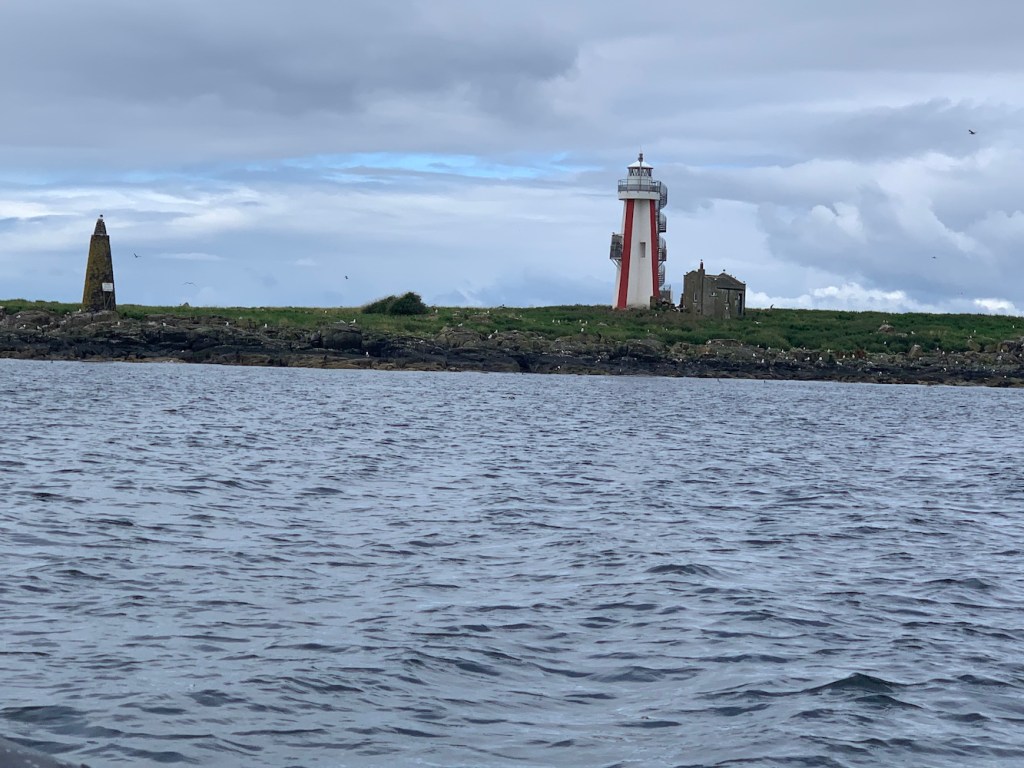
My lighthouse accomplice, John, had been very keen to get to Lady Isle to see its wonderfully unique lighthouse for a long time and had organised a trip in May, which of course had to be postponed. He’d spoken to the boatman at the weekend who had said that Monday (today) was looking suitable. I told John that I would be happy to go along if there was space with boat companies limiting numbers due to social distancing. Fortunately I was given the thumbs up and this morning we departed Fairlie on board Black Magic, an open RIB operated by C&C Marine. This was the boat that I’d previously visited Lady Isle on so we knew he had been there before and could get us onto the island as long as conditions allowed. Along for the ride too were Steve and Lianne who had driven for 5 hours to make it up just for this boat trip. They are fantastic company and such a lovely couple.
Lady Isle with its daymark and lighthouse
It took us about 90 minutes to reach Lady Isle and was a pretty comfortable journey – or at least it was for Lianne and I who sat on the nice comfy seat while the men bounced about a lot on the sides of the boat. As we approached the island the skipper had a look around at the area we’d landed at previously, but feeling it was just too bumpy we pulled back and moved in closer to the day mark on the east of the island. This was a good area to slide down on to the rocks without getting wet feet. Thankfully it hadn’t rained for a while so the rocks were nice and dry for walking over. What wasn’t so easy to walk over was the grass on the island itself, which was particularly long but nothing compared to what was to come later that day!
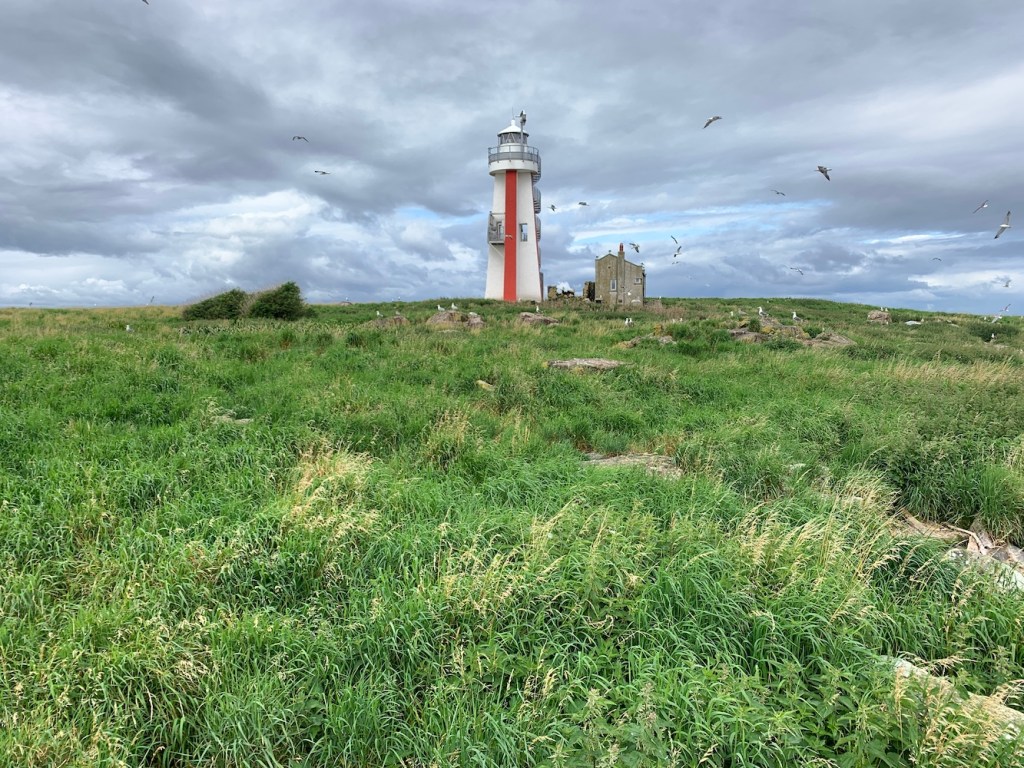
Lady Isle lighthouse
Lady Isle lighthouse really is very special and, as Lianne pointed out, it’s nice to have the island to yourself. I find that’s often one of the wonderful things about visiting these lights on islands that require a chartered boat. For the period you are there it almost feels like its your own little space. While we were there I sent a picture over to Bob of the island and it turned out the family were down at the seafront in Troon and spotted our boat approaching the island.
Lady Isle lighthouse with its external spiral staircase
There was genuine excitement amongst the group at managing to get there and land and I was pleased for John as, not only was it his final lighthouse in the area, but he had been very worried about whether or not we would make it and if it would be a wasted trip for Steve and Lianne. It certainly wasn’t and we all eventually returned to the boat. Getting back on the boat for Lianne and I with our short legs was rather amusing, but we managed it with a lot of help from the others!
One island simply wasn’t enough though and our second stop for the day was Little Cumbrae, which was a new island for Steve and Lianne. We weren’t sure, due to the wind direction, whether we would be able to land at the pier on the west side of the island, closest to two of the lighthouses, but the crew managed to get us in and it was lovely to follow the old tracks and steps up to the two more modern lighthouses.
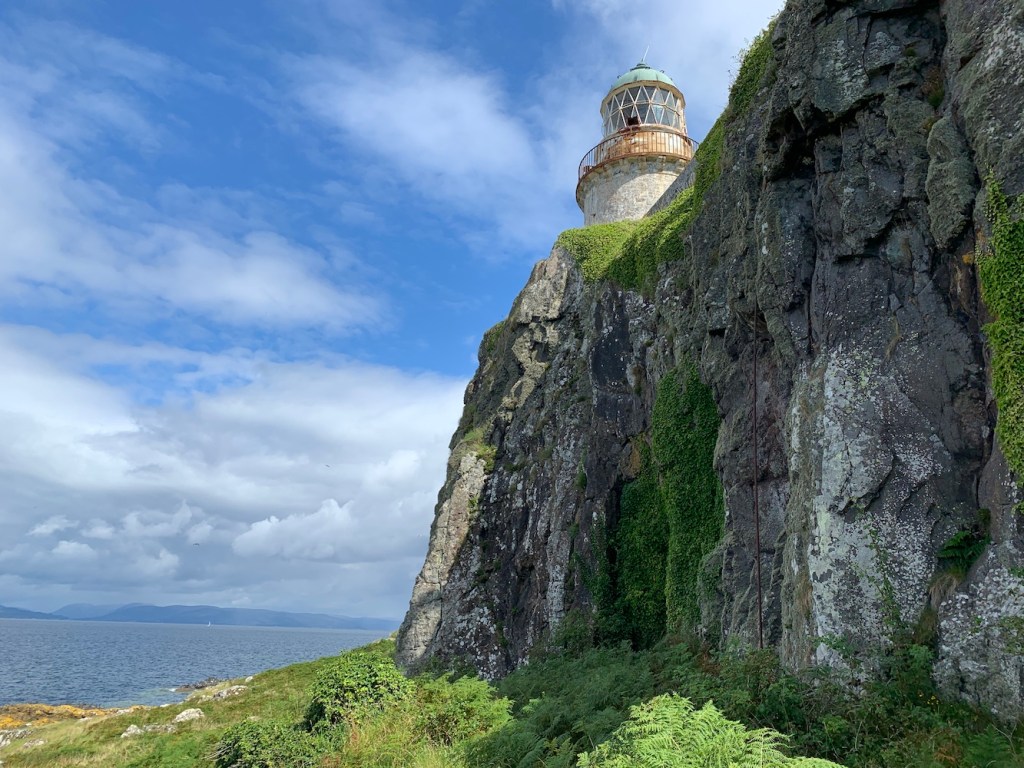
Little Cumbrae lighthouse taken from the steps up from the pier
Cumbrae Elbow is the active light that now operates on the island and presumably it works quite nicely alongside Rubh’an Eun on Bute to guide vessels through the channel between the two islands. Next to this light is the old engine room for the foghorn which still contains the machinery, although it’s not looking anywhere near its best. I usually love the smell of these rooms, but with broken windows and open doors the smells seems to have gone in this one.
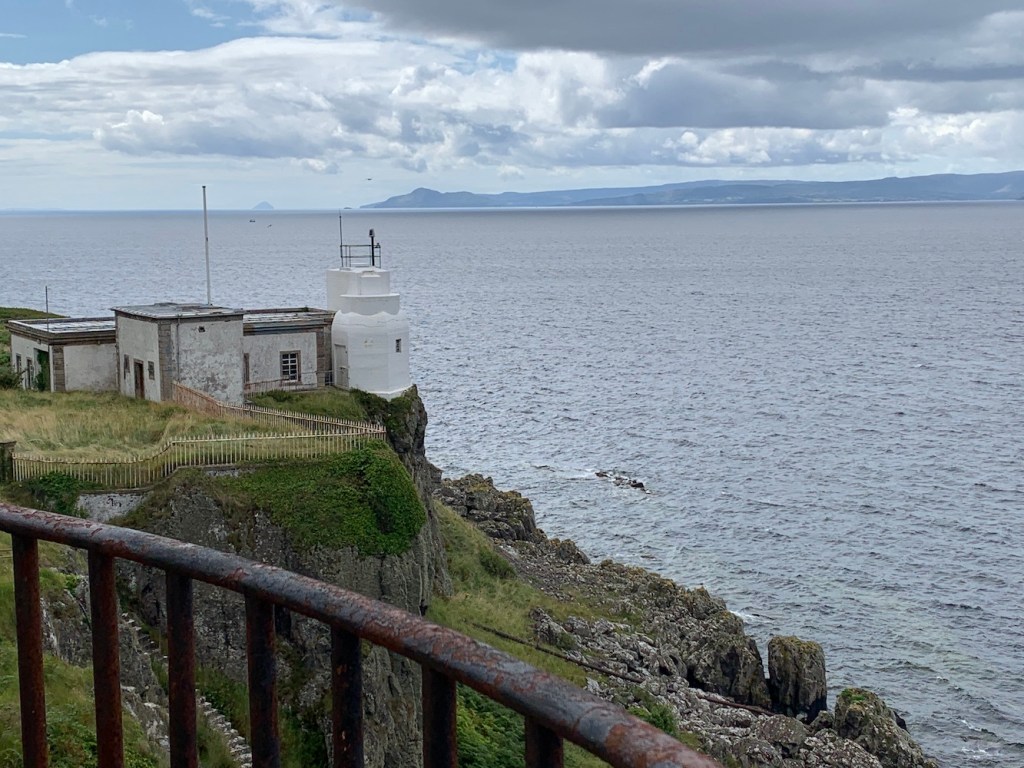
Cumbrae Elbow lighthouse
Exploring the old keepers’ cottages for the older lighthouse was again rather sad as the buildings have so much potential and could make incredible homes. There are signs that some improvements were made, but it is still in a bad way.
Inside the old foghorn engine room
Having both been to the island before, John and I knew there was a way to get into the tower and we thought this was through one of the cottages, but it became clear that it wasn’t and we eventually found the entrance around the side. One benefit of not remembering where we needed to go though was that John was able to show us a really nice carving of a lighthouse above one of the windows on the outside of the building. It seemed like such a nice little touch, but a bit odd that it was above a window when normally these things would be over doors.
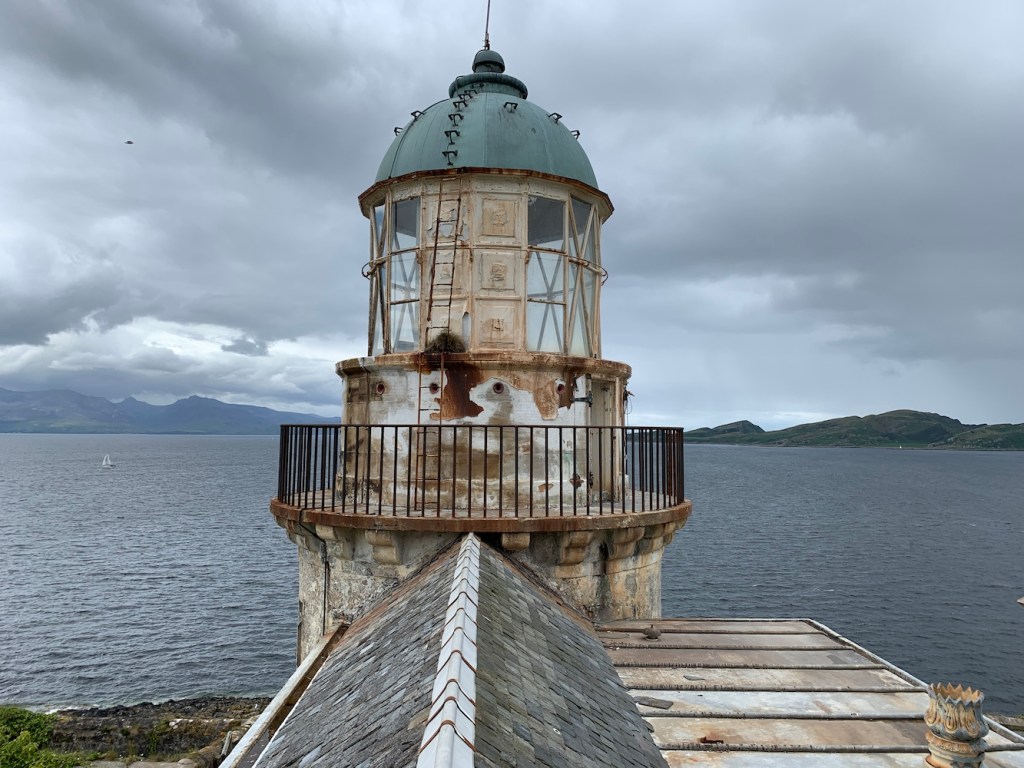
Little Cumbrae lighthouse
After eventually finding the entrance to the tower (and Steve who had already happened upon it) we set off up the tower. Not much had changed up there, but the views were still fantastic and it was just nice to be there again and enjoy the feeling of being at the top of a lighthouse.
With what looked to be a patch of rain approaching we decided to retreat to one of the cottages to eat lunch. We were going to head straight off from the lighthouse after lunch, but another building caught our attention and so we spent some more time exploring that and, in trying to establish what was at the far end of the building, John managed to find the old foghorn lying in the long grass!
The old Little Cumbrae foghorn
Realising that we were running short on time for making it across the island we set off up the hill, which seemed steeper than I remember it being last time. The path on the approach to the hill was very overgrown in places, but it was still clear enough that we could find our way through. We’d already decided that we wouldn’t attempt to reach the remains of the oldest of the three lighthouses on Little Cumbrae which is close to the highest point on the island. The grass and ferns were already becoming difficult enough to get through to even consider battling our way through even less tamed terrain. We could see it from the path though.
The old lighthouse on the summit of Little Cumbrae
In most places the path was relatively obvious, but a couple of times we were met with what seemed to be a dead end, but Steve and John managed to guide us through. Some of the ferns were ridiculously long with some reaching up higher than mine and Lianne’s heads. It seemed an almost unrecognisable place compared to my last visit and the path seemed to go on for such a long time, leading at least two of us to say that Little Cumbrae wasn’t so little after all.
We were all very pleased when we spotted the top of the castle on the little tidal island near the pier that we were aiming for. The boatmen were there waiting for our arrival – thankfully only 5 minutes after the agreed time – and a couple of other men there who had camped on the island overnight had said they’d been across the island and attempted to resurrect the path a bit. During the recent Covid-19 lockdown there have obviously been fewer people visiting the island and stomping down the path and so nature has started to reclaim the island again.
The castle on the small tidal island off of Little Cumbrae
Once back on the boat it was a short little journey back across to Fairlie. It was an excellent day and a real pleasure to return to both of these islands. The company was great and the weather did hold out for us with the rain only starting as we were heading back to the marina. As Steve said a few times today while we were out – and I often say it on this blog – this type of day is what it’s all about. 🙂
After the success of yesterday’s adventure on Loch Long, the crew at Sea Clyde had reserved the best weather day this weekend for getting to the island of Pladda – and what a day it was!
We set off from Largs mid-morning – the fabulous four: Bob, John, Seumas and I – with skipper Dan and were pleased to hear that conditions we’re looking great for landing on the island, but there was a fair amount to see from the boat even before we got there.
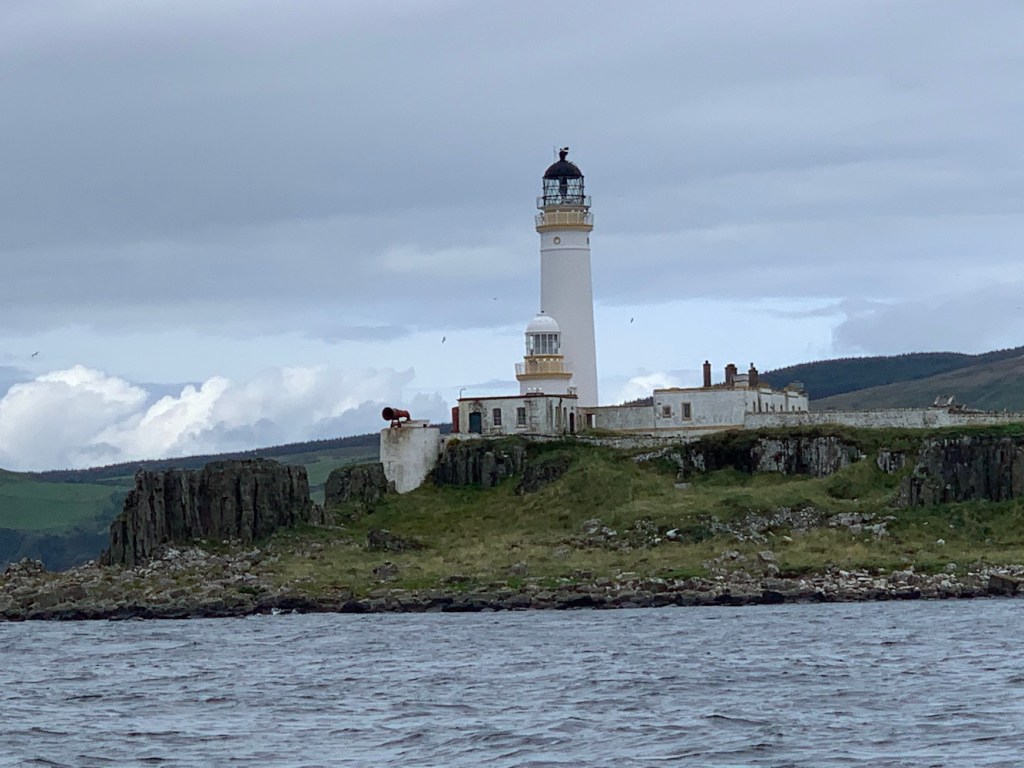
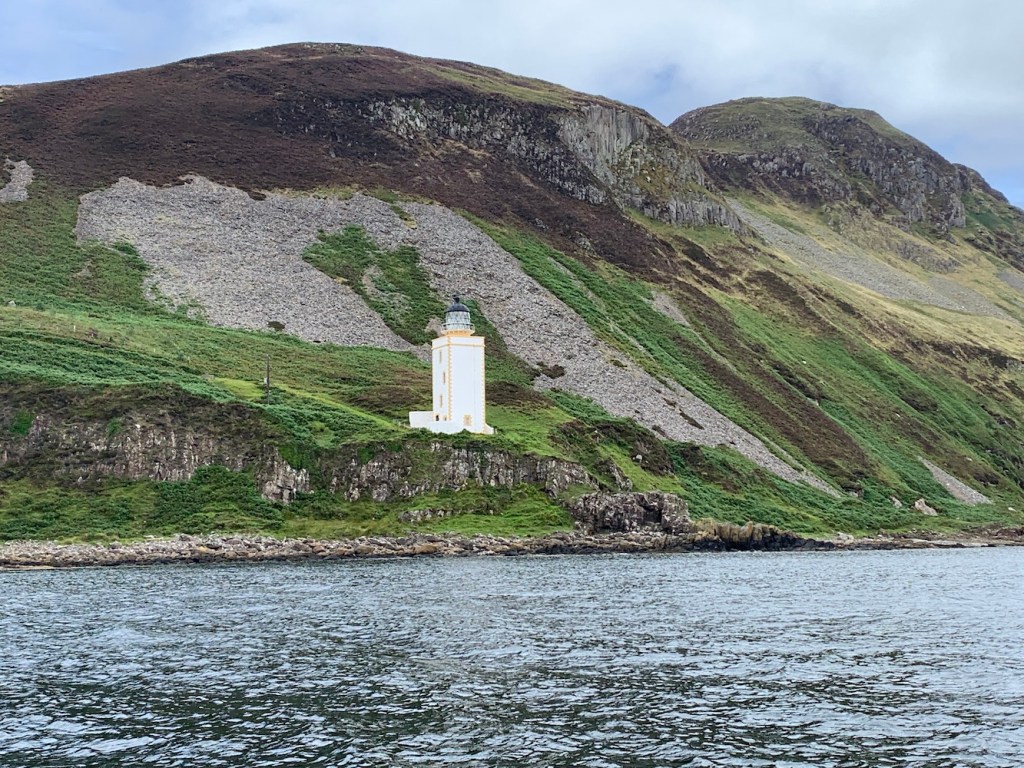
After an unsuccessful attempt to see Kylie, the resident dolphin, we continued on our way towards Little Cumbrae. Hugging the coastline as we went to protect us from any swell, we sailed down the west side of the island, taking in the views of the two lighthouses (and of course the old lighthouse on the approach) while at the same time occasionally glimpsing across to Bute where Rubh’ an Eun lighthouse could be seen from a greater distance. This felt like a proper return to the islands, even if we were just bypassing them.
The old and modern lighthouses on Little Cumbrae
Onwards towards Arran we went and as we approached the small stretch of water between Arran and Holy Isle the skipper pointed out a submarine in the water ahead of us. Now I know I was there for the lighthouses, but to see a submarine in real life was very exciting. Needless to say Seumas was delighted too! There are restrictions on how close you can sail to these monstrous vessels, so it wasn’t like sailing straight past it at close range, but it was still great to see.
It wasn’t long until we were sailing down the west side of Holy Isle and, of course, there was the Holy Isle Inner lighthouse ahead of us. This little tower is in such a great location and seeing it reflected in the water with the land rising to the highest point of the island behind it was just beautiful. That really is the best angle to see this one from.
Holy Isle Inner lighthouse
Back out into the sea again and rounding a corner I heard the cry “lighthouse” from the back of the boat – Seumas has really taken to the role of lighthouse spotter. There ahead of us was Pladda with the fantastic two towers basking in the lovely sunshine.
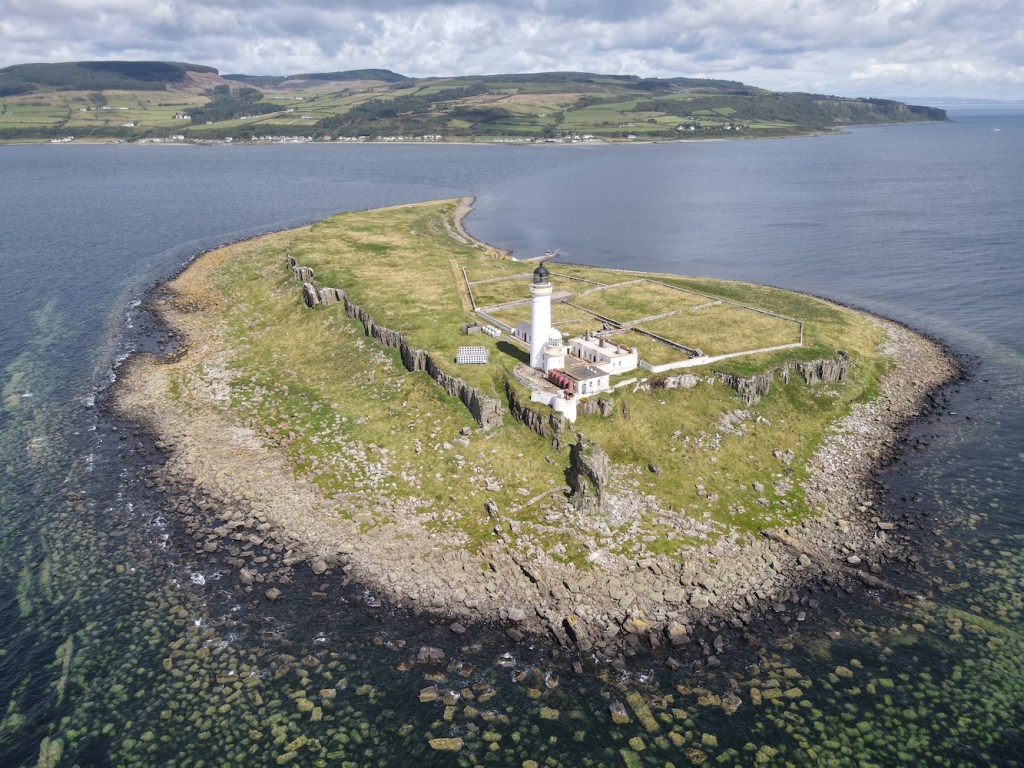
An aerial view of Pladda
It’s always a pleasure to land onto a nice jetty rather than rock hopping. It feels a little like luxury. The jetty is actually looking a little worse for wear now with large cracks running down it. Still it held together under our combined weight and that’s the most important thing.
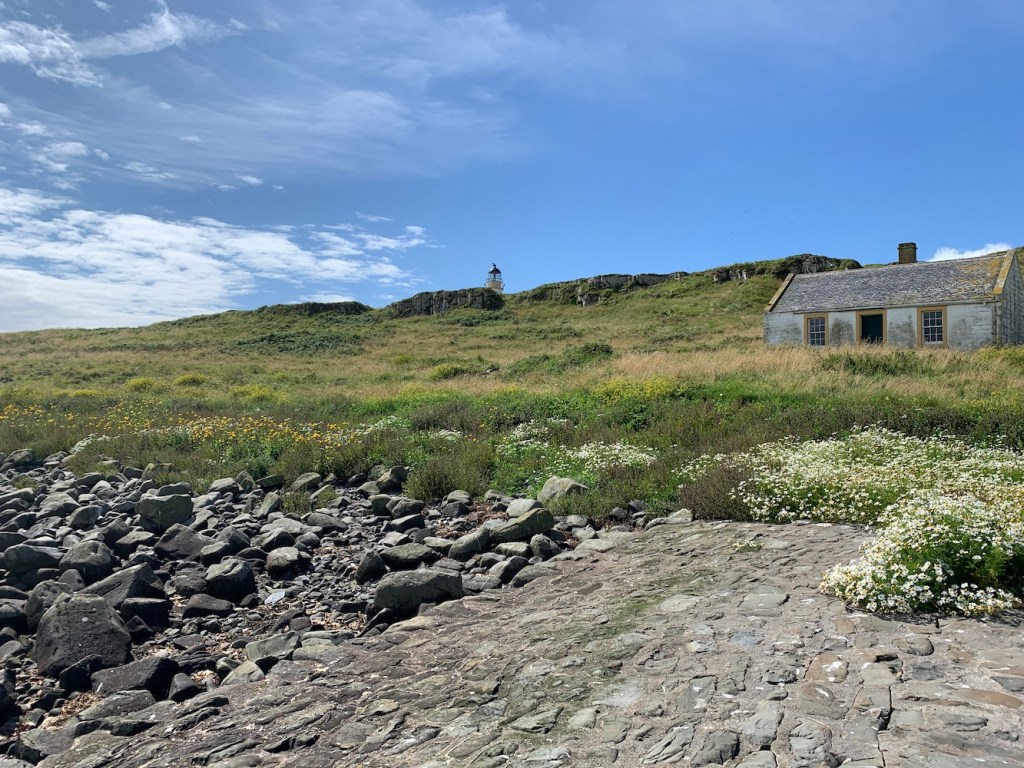
Arriving on Pladda
From the jetty it was a short uphill walk to the level grassy section of the island following a good, clear path which took us all the way to the lighthouse. The double towers are absolutely fantastic and, although the low light is no longer in operation it is still very well maintained on the outside.
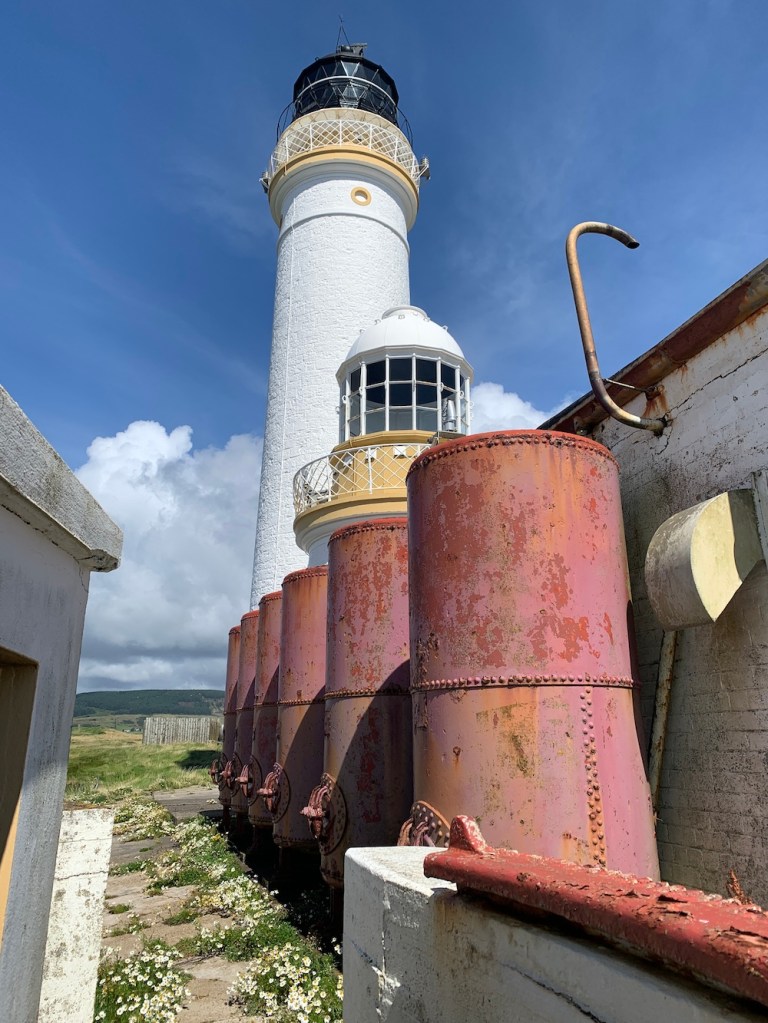
One thing about Pladda lighthouse is that it’s not the easiest one to take a picture of, particularly if you want both towers in the same shot without one looking like it’s leaning toward the other. You can get some rather dramatic views from the courtyard though.
The two towers on Pladda and the old foghorn air compressors
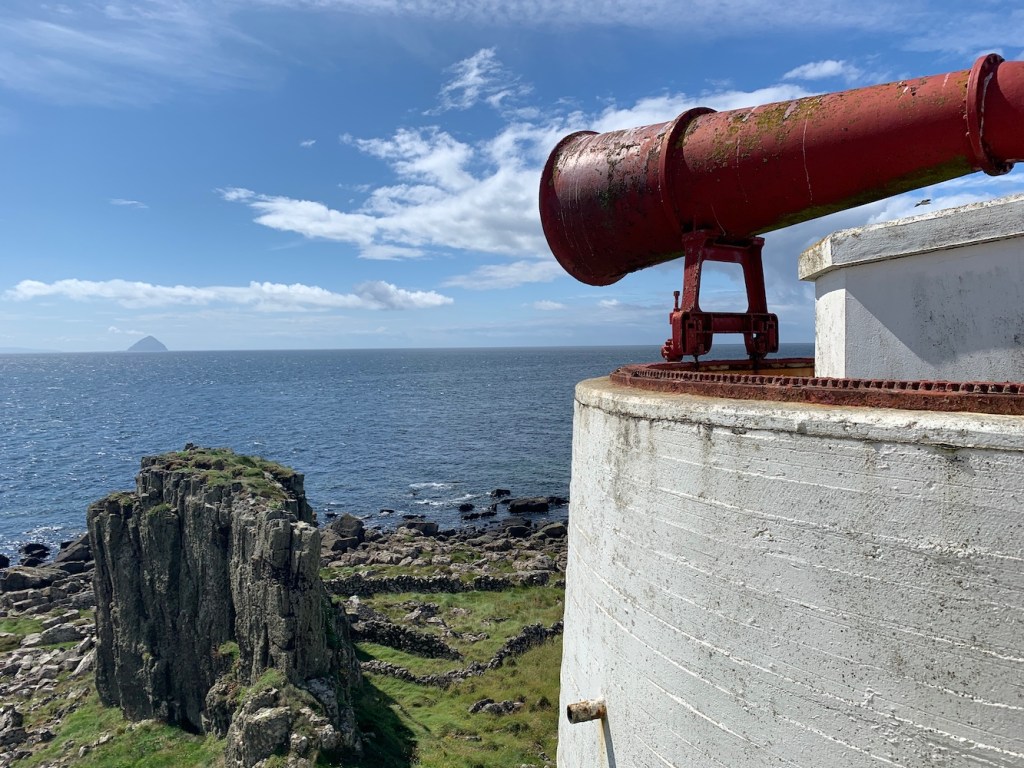
While Bob was flying his drone and capturing various aerial views, the rest of us explored around the old foghorn and took a number of pictures of the foghorn looking out towards the beautiful lump that is Ailsa Craig.
Looking out towards Ailsa Craig from the Pladda foghorn
In our next attempt to get a good view of the two towers I suggested the best area might be down near the rocks to which John replied that it would, but it would be a bit of a “jaump” (which I believe is a combination of “jump” and “jaunt”!?) He was right, although I wouldn’t have jumped it! There was another spot a bit closer next to the solar panels that I thought could be a good angle so we made our way around there, wading through the thick grass. This was a slightly better viewpoint, but still not quite right. John did find a ladder though that went down to the lower level. He went down, but decided not to walk too far as the birds were getting a bit stressed.
The Pladda towers, taken from the solar panels
We did a quick selfie using the drone (a “dronie” I believe it is called) and then explored the old gardens a bit. It was here that we discovered the best angle for getting both towers in the one picture and although it did mean upsetting a few birds we tried not to disturb them too much.
The two towers on Pladda seen from the garden
We trekked across the long grass towards the highest point on the island, which gave some excellent views towards the lighthouse (minus the little tower, which is obscured at that angle) with Ailsa Craig sitting quietly in the middle of the sea in the distance.
The view from the highest point on Pladda
It was then time to head back to the boat where we found Bob and Seumas playing on a small section of rocky beach. Seumas had built a lighthouse in the water and was throwing rocks (or asteroids) into the water surrounding it. That was his favourite part of the day!
Hopping back on the boat we took a quick spin around to see the lighthouses and foghorn from the sea, which again gave another interesting angle.
Pladda lighthouse towers and foghorn from the sea
Then the return journey began. This time we sailed up the east side of Holy Isle to get a nice view of the Pillar Rock lighthouse, which lived up to my expectations in terms of views. The steep slopes behind it looked a little frightening and Bob pointing out one of the crevasses up near the high point added to this.
Holy Isle Pillar Rock lighthouse
There was still no sign of Kylie the dolphin on the way back, but arriving back in Largs I think we all agreed that it had been a very successful and enjoyable day out. Pladda has most certainly moved up a number of places in my favourite lighthouses list. It’s such a great island with its unique two tower arrangement. Days like this really is what it’s all about. 🙂
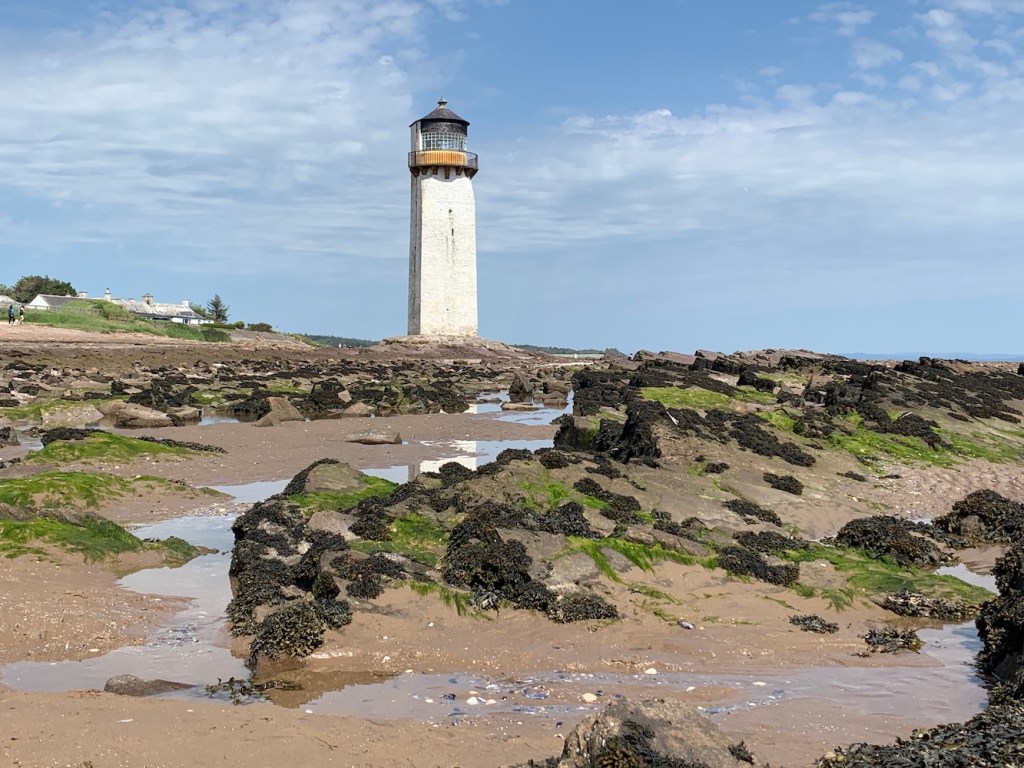
After the visits to Hestan island and some of the lights on the Rhins of Galloway last weekend, we had a great week in Dumfries and Galloway, including a fishing trip during which my son and I both caught our first fish. We also spent yesterday afternoon on the beach at Southerness. The location, of course, was based on there being a lighthouse there. I’m not sure I’ve spent quite so long at one lighthouse before as we did yesterday, but it was great to see it with the tide out as the previous visit had been at high tide.
Southerness lighthouse
Bob took the opportunity to play with his drone again and got some great images of the lighthouse from above.
Southerness lighthouse from above
We are now based over in Troon, staying with Bob’s mum. There have always been a few tricky lighthouses to get to in the area and so, with childcare on hand, we headed out today from Largs with Sea Clyde. We took along our little boy, Seumas, and my lighthouse friend John. Our destination for today was Loch Long, with a couple of others thrown in on the way there and back.
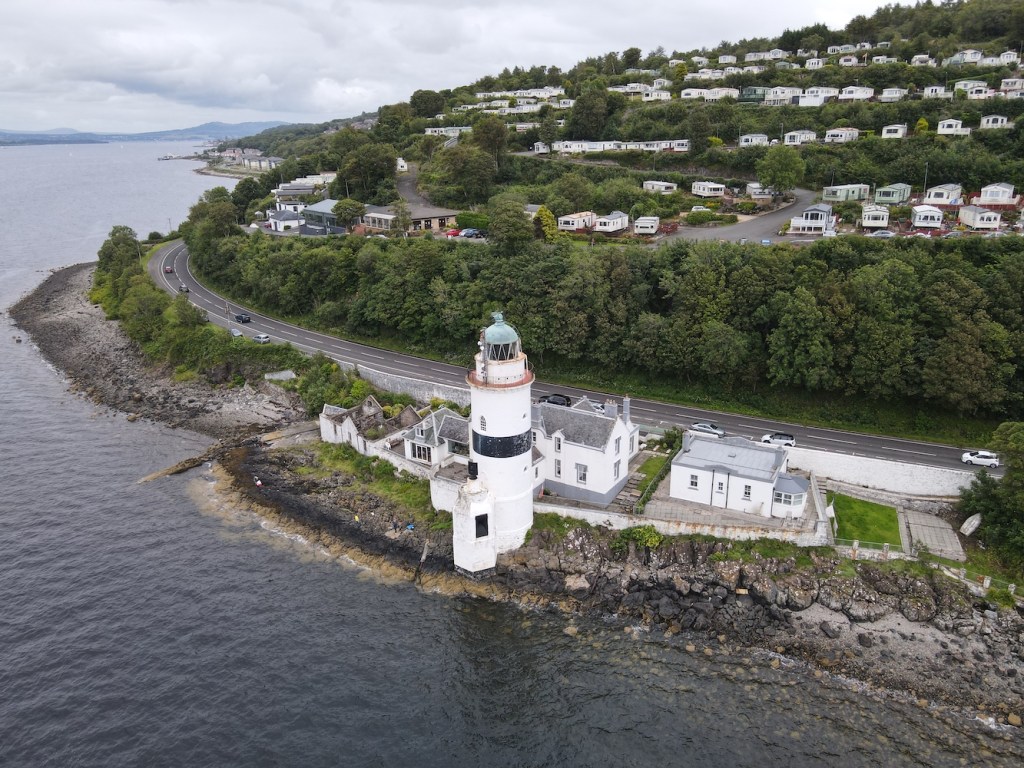
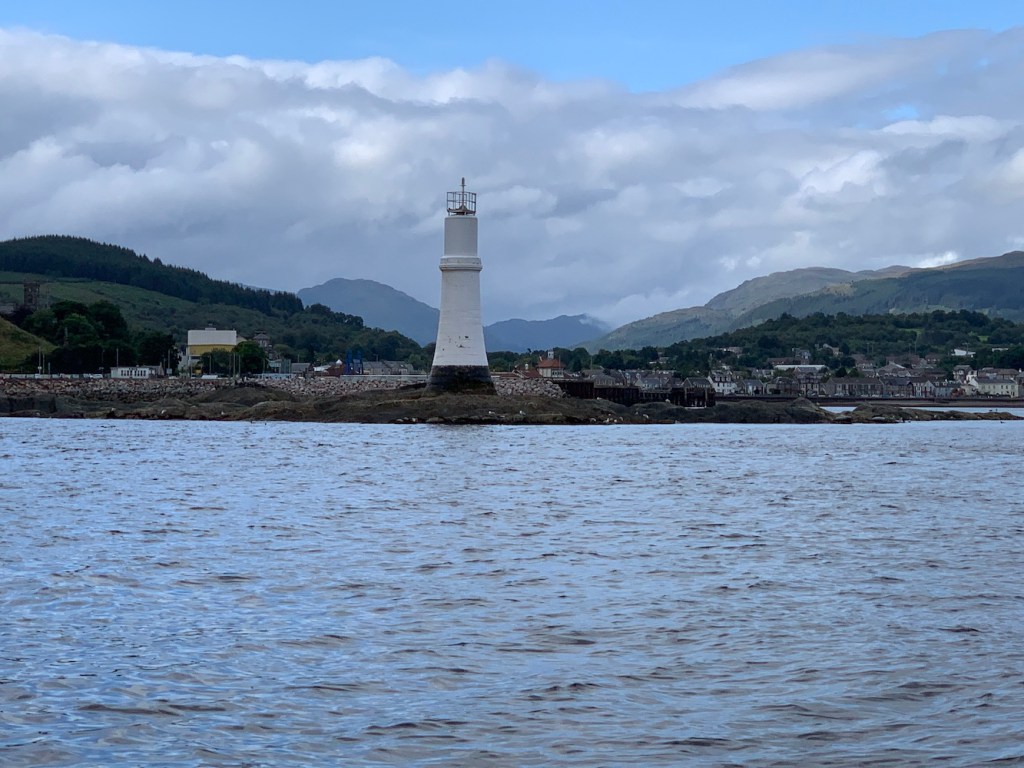
Regardless of how many times you see a lighthouse from land it is always different seeing it from the sea. After all they were made to be seen from the sea as John pointed out. On the way out today we sailed close to Cloch lighthouse and stopped for a while for some pictures. It looked a popular spot for fishing and it was good to see the foghorn in more detail too as the view is limited from the road.
Cloch lighthouse
Bob had his first attempt at launching the drone from a boat and landing it back down, which scary and amusing in equal measure. After a slightly stressful first attempt at taking off he then got on fine. Landing it back on the boat was very entertaining with the drone ending up giving John’s arm a firm hug!
An aerial view of Cloch lighthouse
Our next light was Ravenrock Point on the west bank of Loch Long. Due to social distancing guidance, Sea Clyde weren’t able to take along a dinghy to help with landings so we didn’t expect to be able to land at any of the lights today. The crew, John and Dan, took a look at how deep the water was around the lighthouse, but it wasn’t possible for us to land there. However it’s not too bad as this one is next to the road anyway so can be visited by land at another time. It looks like an interesting one to get a closer view of.
Ravenrock Point lighthouse
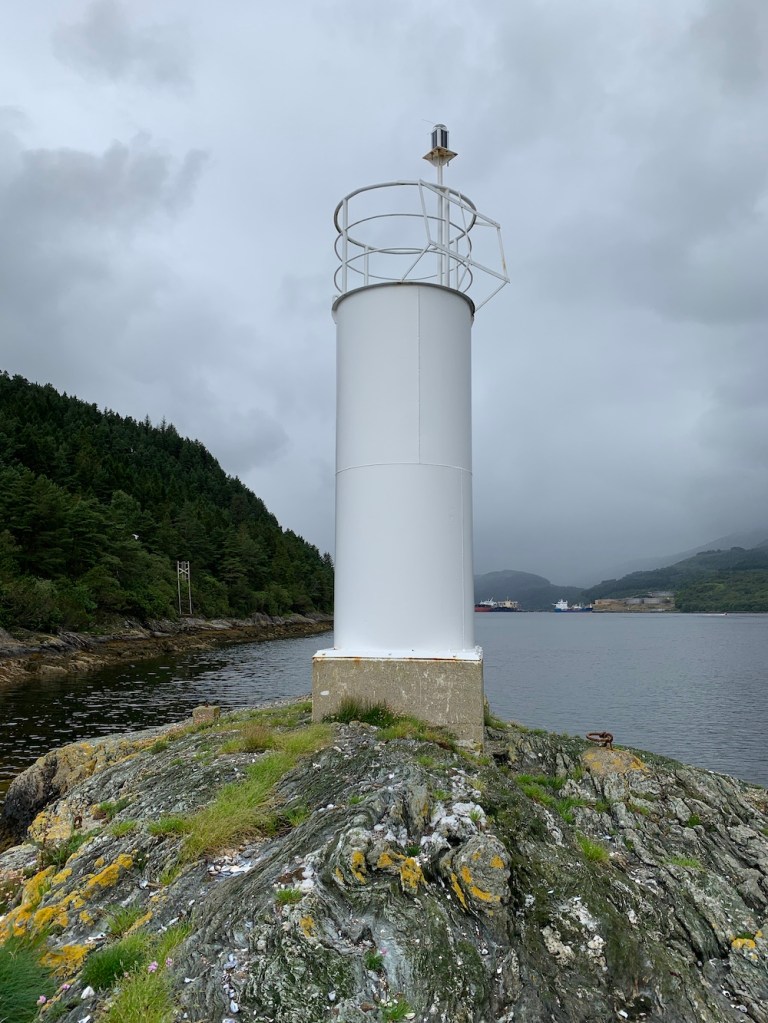
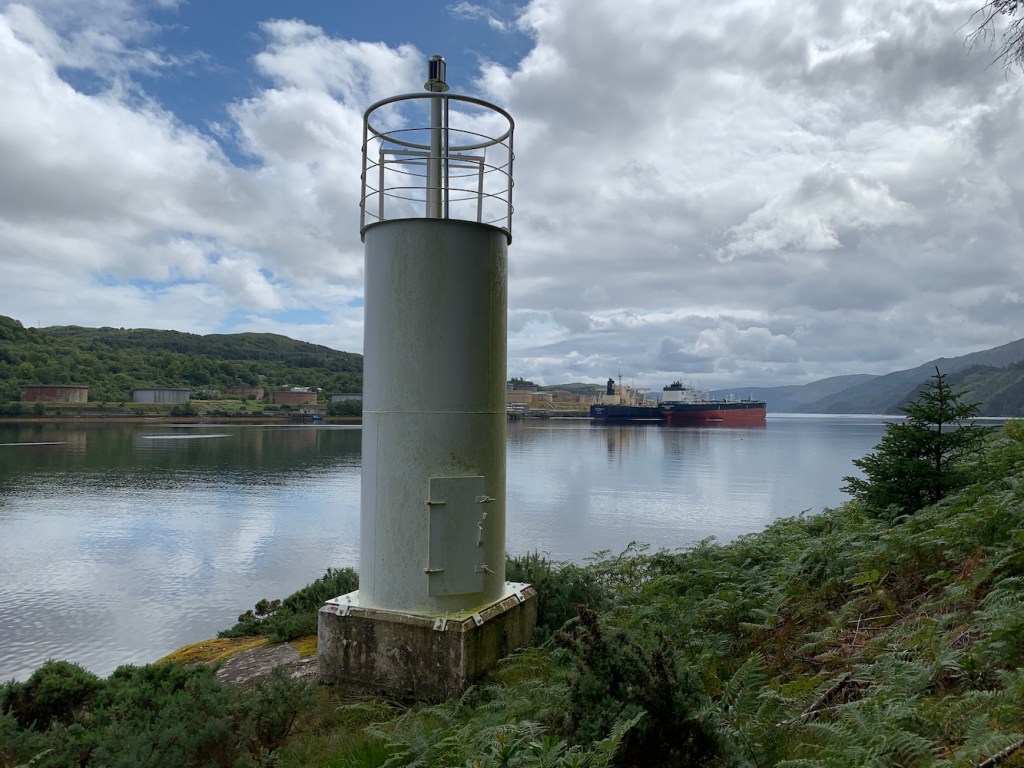
Further up the loch we stopped at Carraig nan Ron, or Dog Rock, and the water was nice and deep around this small rock which allowed them to get the boat right up to it. It was also dry and covered in barnacles so perfect for stepping onto. Seumas stayed safely in the boat with his camera, taking pictures of us as we visited the light. It was great to be back out and stepping onto these little islands again. There wasn’t much to the lighthouse, just a white column with the light sticking up from the top, but it had a little door and the rock was big enough to get some nice angles on it.
Carraig nan Ron (Dog Rock) lighthouse
We’d sailed past Coulport where nuclear warheads are stored and loaded onto submarines. As we sailed away from Dog Rock, John pointed out that from one particular angle the rock and lighthouse looked a little like a submarine. On the way back down the loch later in the trip we noticed the rock could be accessed from the mainland at low tide – although I wouldn’t want to advise anyone to get to it that way through the huge expanse of forest!
Carraig nan Ron in Loch Long
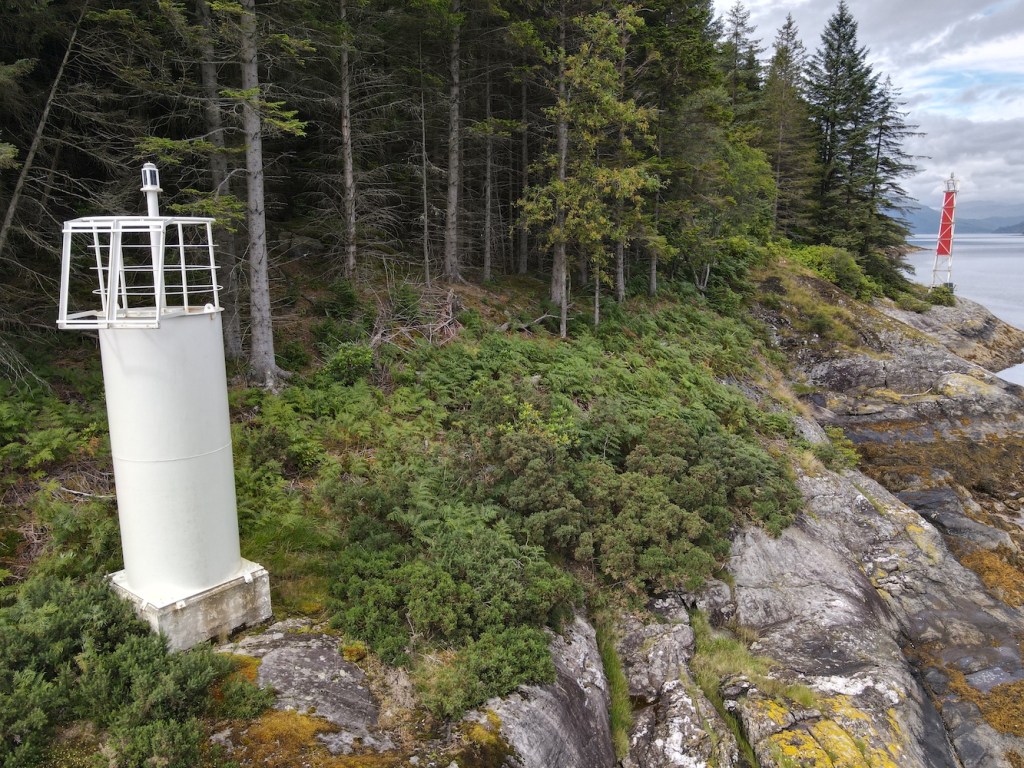
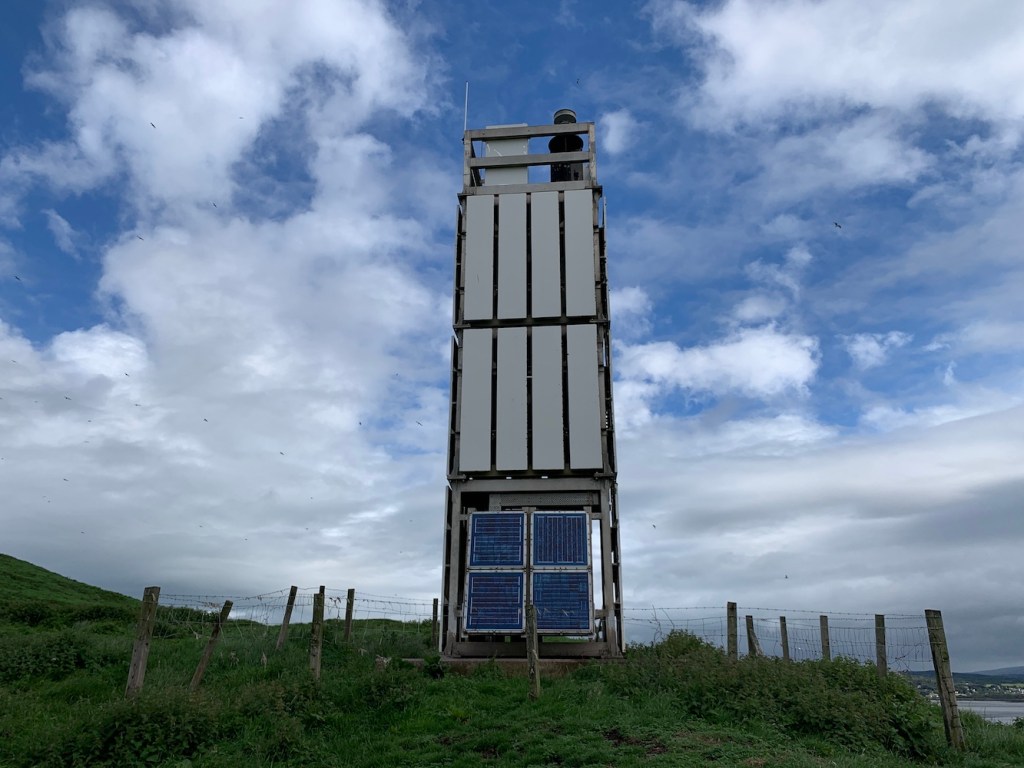
Our final disembarkation for this trip was Cnap Point, which turned out to be rather an adventure in itself. The easiest place to land was slightly to the south of the lighthouse which meant finding a route through the foliage and undergrowth to get the the lighthouse. Seumas stayed on the boat again this time while the three of us went ashore. Once we were past the rocks we found ourselves having, as I called it, “a nice forest walk”. It’s fair to say that Argyll Forest Park is very much a forest. Bob went off ahead to find a suitable route. At one point we lost track of where he had gone and John suggested we head down towards the coast to assess the route that way rather than continuing through the forest. It turned out to be a very good move as we heard Bob shout out a few times closer to the lighthouse. It turned out he’d walked into a wasp nest on the final approach to the lighthouse and had a battle with the wasps. Avoiding the same fate, John and I took the coastal route and arrived safely at the tower. It’s the same type of structure as Dog Rock, but with even better views around it. This light is the front in a range setup and the rear light – a framework tower with brightly coloured panels – was easy enough to see from a short distance.
Cnap Point lighthouse
The return walk was slightly less dramatic, thankfully, and once back on the boat we sailed further around to see both range lights from the sea. There aren’t many lighthouses you can see surrounded by trees and Argyll is fairly unique in that way, along with the Glenelg area in the Highlands.
The Cnap Point front and rear range lights
On the way back to Largs we passed The Gantocks and The Perch beacons in the Firth of Clyde. Although they are not officially lighthouses in my book, they are still interesting structures.
The Gantocks beacon
Our final lighthouse of the day was Toward Point. I’d only seen this one once previously from the land and so it was good to see it from the sea, even if John did refer to the foghorn as looking like a car exhaust. The foghorn building itself is quite interesting. Although it lacks the majesty of many of the bigger towers, it’s still a nice one.
Toward Point lighthouse
So that was my first boat trip of the year, which is strange to say in August. Normally by now most of my boat trips would have been and gone, but it’s certainly good to be back on the sea again. 🙂
This post feels like it’s been such a long time coming. After months of no new lighthouses, no travelling and cancelled trips today was the day I’d been waiting for.
We had originally booked 10 days in Shetland over this period, but with the ferry journeys cancelled for us we decided to chance it and book a week’s stay at a cottage near Lockerbie with a good cancellation policy. Thankfully restrictions were lifted enough to enable the trip to happen.
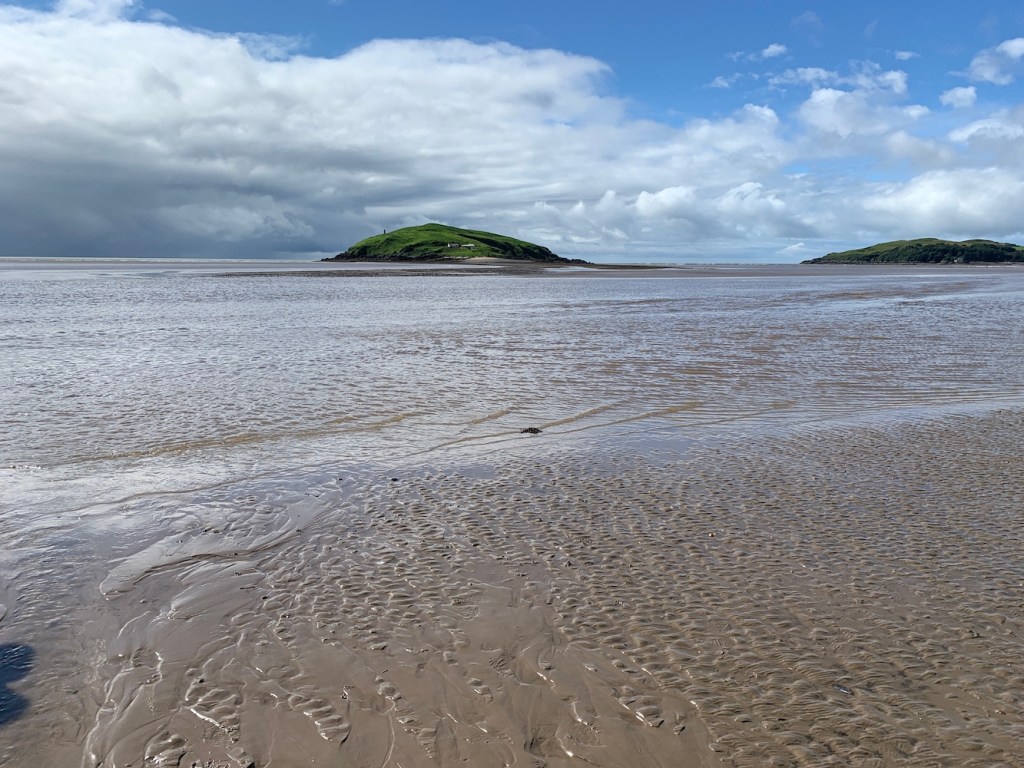
One of the key lighthouses I wanted to get to while in Dumfries and Galloway was on Hestan Island. Hestan Island is accessible at low tide from Almorness Point and so, in preparation for the trip, I looked at the days with the lowest tide during our stay in the area, which happened to be the first morning when it would be 0.93 metres at 10.18am. This meant an early start, meeting at 8.15am to allow us to begin our walk, returning from the island at the lowest tide.
The forecast was looking grim to say the least with heavy rain on the agenda, but we must always continue when the opportunity is there. The opportunity was even more appealing as we were to be joined by my wonderful lighthouse partner in crime, John, and a couple of lighthouse friends who share our enjoyment of islands and lighthouse, Steve and Lianne. There was no way this could be missed.
As we approached Palnackie, just to the north of Almorness Point the rain stopped and the cloud began to look like it was clearing. We parked up, met the others and all set off (with my dad along too) in our waterproofs. It turned out the waterproofs weren’t needed as the grey clouds continued to clear and the sun and blue sky even came out at a few points.
Part of the first section of the track
The walk to the sea was great. A clear track all the way and interesting enough to make it feel like it wasn’t onerous. It became muddier towards the end, evidence of the recent heavy rainfall.
Our first view of the lighthouse, which can just about be seen in the far distance
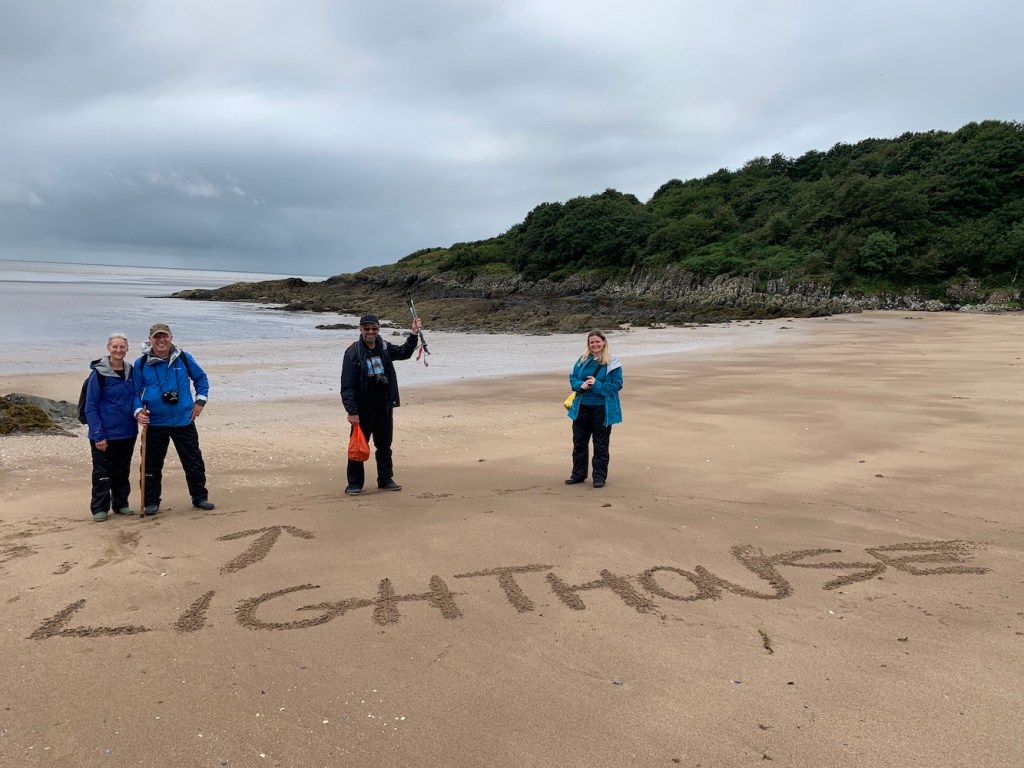
We arrived at the coast, a nice beach, and caught our first glimpse of the lighthouse in the distance. Changing into our wellies, applying Skin So Soft to put the flies off and removing a layer of clothing, we then set off from the beach across the, sometimes sticky, sand to reach the “wet” section. I say the wet section as it is never fully clear of water.
Enjoying time with friends
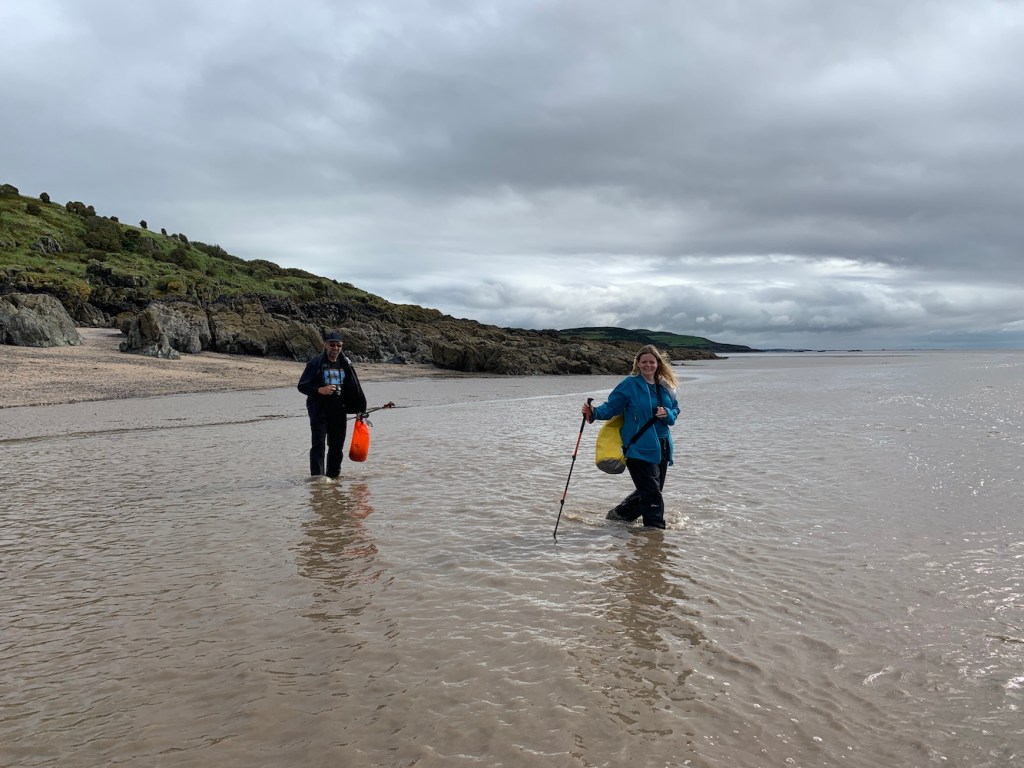
Thankfully Bob had visited last year and knew the best place to cross the water. After giving us instructions to walk sideways, facing the current, if we felt it was getting too strong we set off. Never before have I paddled in water that deep to see a lighthouse, but it was great fun. The water level was higher than we had expected, although we crossed around 45 minutes before low tide. We put this down to the amount of rain we’d had overnight and that morning. The pebble section beyond it was harder to walk on, but we were rewarded with some fantastic views of the island ahead of us.
Paddling to the island
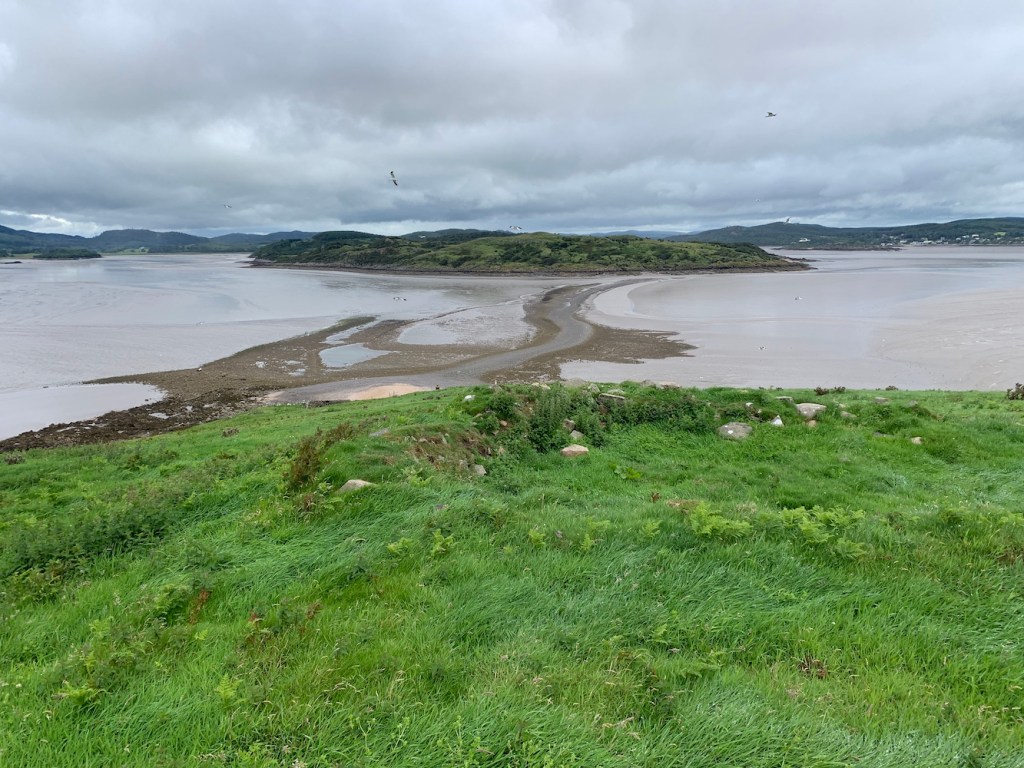
There is a holiday home on the island and the owners were clearly there as their dog jumped around barking in welcome at us. Once on the island we set off to the right of the house and up toward the high point. I’m not really a fan of walking uphill and John echoed my thoughts when he said “Is he [Bob] taking us to the high point?” He was, but it turned out that was the most direct route to the lighthouse. I must also give him extra credit as the views from the top were stunning, especially down towards the lighthouse and then back across the way we had come.
Looking back from the island
Of course, after we’d reached the highest point we then had to go back down the other side and, throwing our hoods up to avoid the circling gulls doing their business on our hair, we set off straight for the lighthouse.
The rather grubby lighthouse
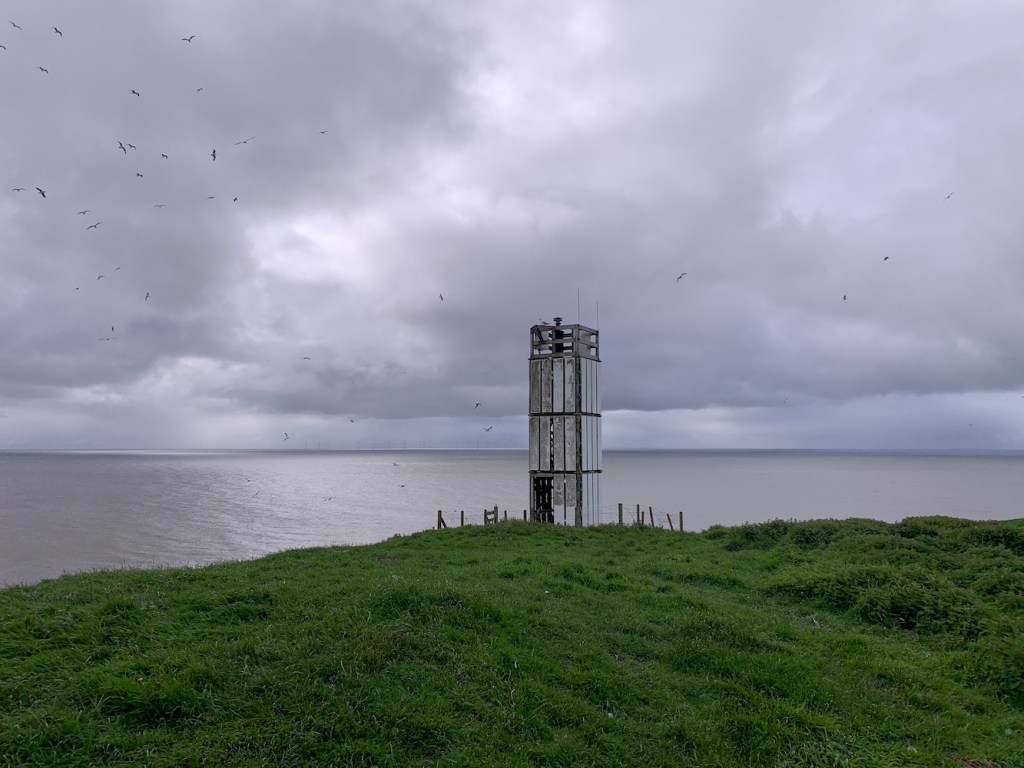
The lighthouse is a flat-pack (or IKEA) style, but what is worthy of note is that it is a three tier flat-pack and these are fairly rare – the only others that we could remember between us being on Hoo Stack and Shillay in the Monach Isles. This one is not pretty-looking and is quite dirty. As we approached we spotted the lack of a door. It would have been rude not to have stepped inside and so we did. The hatch up to the next level of the tower was sadly padlocked so we had to settle for viewing the ground floor level only, but we had made it and all thoroughly enjoyed the walk there. I think the lack of lighthouse visits in recent months added to this enjoyment and we were all relieved that we could be back out there and doing something we love.
Hestan Island lighthouse
I still strongly feel, and I said this today, that I often enjoy the journey getting to these flat-pack lighthouses more than I do the bigger lights. Their remote and challenging locations often make for some much more memorable moments, especially compared to driving to a car park next to a lighthouse wall and wandering around for a while.
Being up against the tide meant we couldn’t stay long so we began our return journey. We were all expecting the tide to have dropped further on the way back, but there appeared to be little change apart from the final section where we now had to move fast to avoid getting stuck in the sand.
Celebrating with Tunnock’s Caramel Wafers for a moment we enjoyed the views back to the island before continuing our walk back.
Looking back towards the island
These few hours going to and from Hestan Island were fantastic and sharing it with some brilliant friends and family made for a very special occasion. I will remember it for a long time to come and it was a perfect way to start a rather late bagging season this year. 🙂
Last weekend I had a phone call from a friend on the North Coast to say that he was at John O’Groats and a foghorn had just been delivered there. It seemed like a rather unusual event and yesterday he called again with more information. We had already planned to head over there today anyway, but this gave me a little more to work with during the visit.
En route we called in at Dunnet Head lighthouse. We arrived just after 10am and I was surprised to see the light still on, but I was glad it was. Although it no longer houses the original lens, I watched the lights rotating for a little longer than I normally would, knowing that at some point in the near future it will be replaced.
Dunnet Head lighthouse at 10am – with the light still on
I also wanted to make the most of being in the lighthouse complex. It’s not open to the public so often and we have been speaking to the current owner on a number of occasions in recent months so we have been able to take a look around the cottages and other buildings too. He is selling the cottages and engine room and had offered me a lovely picture of Bressay lighthouse in Shetland, which I’d recognised and liked when we had first looked around. It’s a beautiful painting. He’d also thrown in a picture of some Norwegian lighthouses too.
The oil painting of Bressay lighthouse
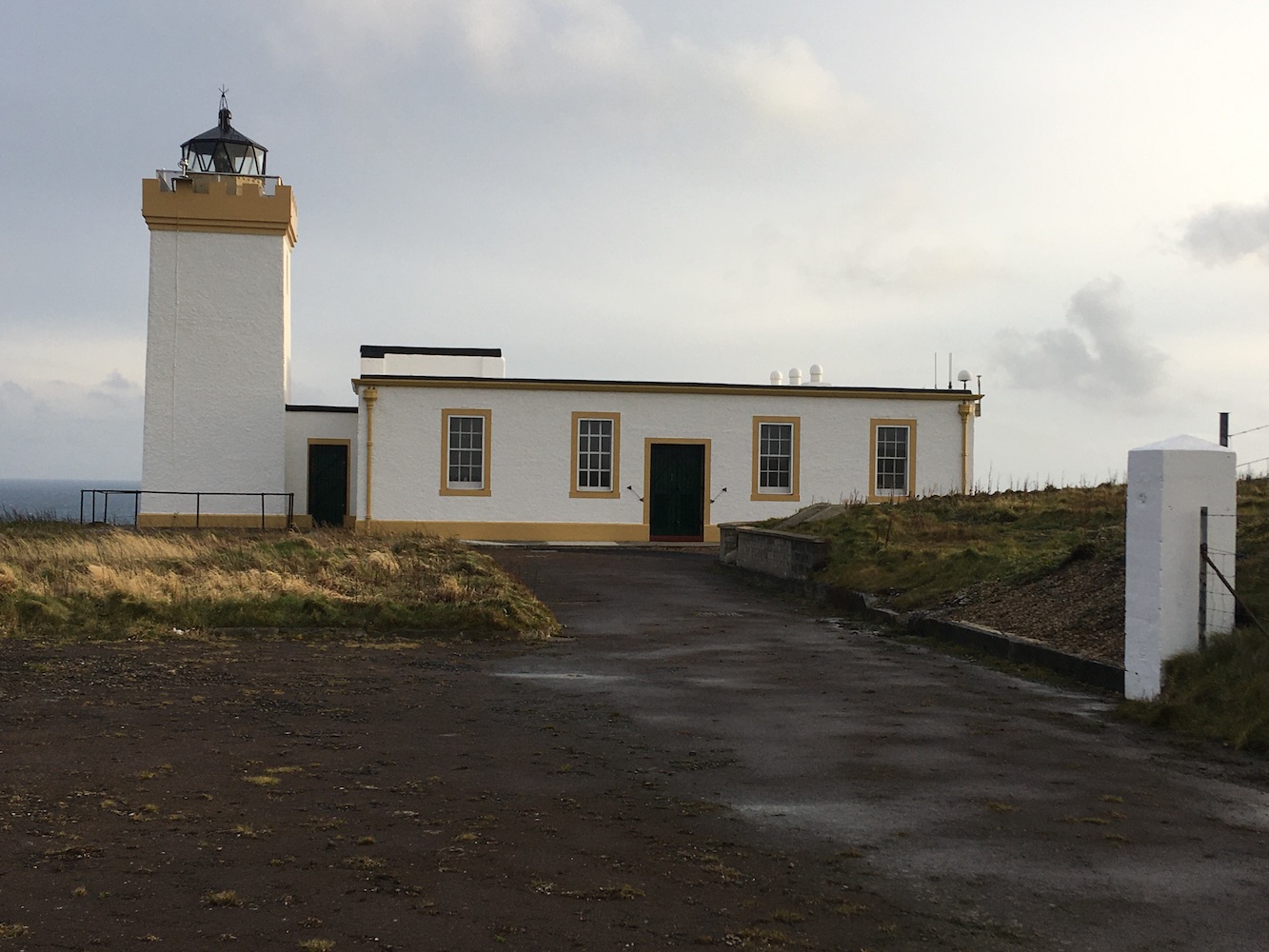
Onwards we went to John O’Groats, but of course we couldn’t go there without a quick visit to Duncansby Head itself. It was cold and windy, as it always is there, but the beautiful views are always worth it.
Duncansby Head lighthouse
This time it was even better as the two towers on Muckle Skerry, the largest of the Pentland Skerries, were visible and anchored just off of the island was the Northern Lighthouse Board’s maintenance vessel Pharos. Stroma lighthouse was also visible from here.
Not the greatest picture by any means, but good enough to make out the Pharos and the two towers on Muckle Skerry – hopefully
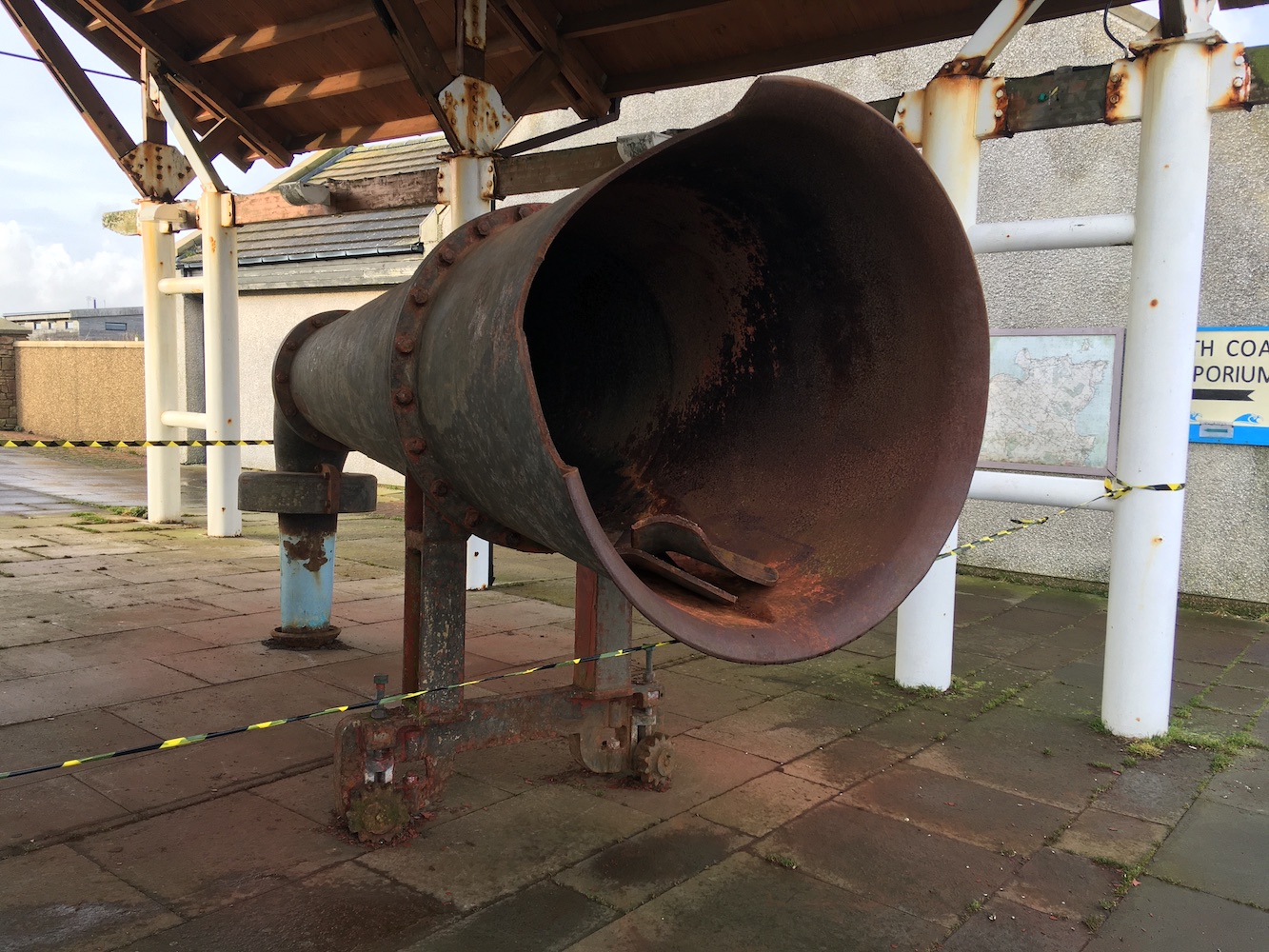
John O’Groats beckoned and, as expected, there was the foghorn under the arch next to the ice cream shop (which was closed). I’d expected it to be red like the others I’d seen, but it wasn’t. This was explained a little later on in the day. It looks like it needs a fair amount of work, and this is exactly what it is getting. We met the friend who told me about it in the local cafe and afterwards I stopped off at Seaview Hotel at John O’Groats to speak to the man behind the whole project.
The old Duncansby Head foghorn
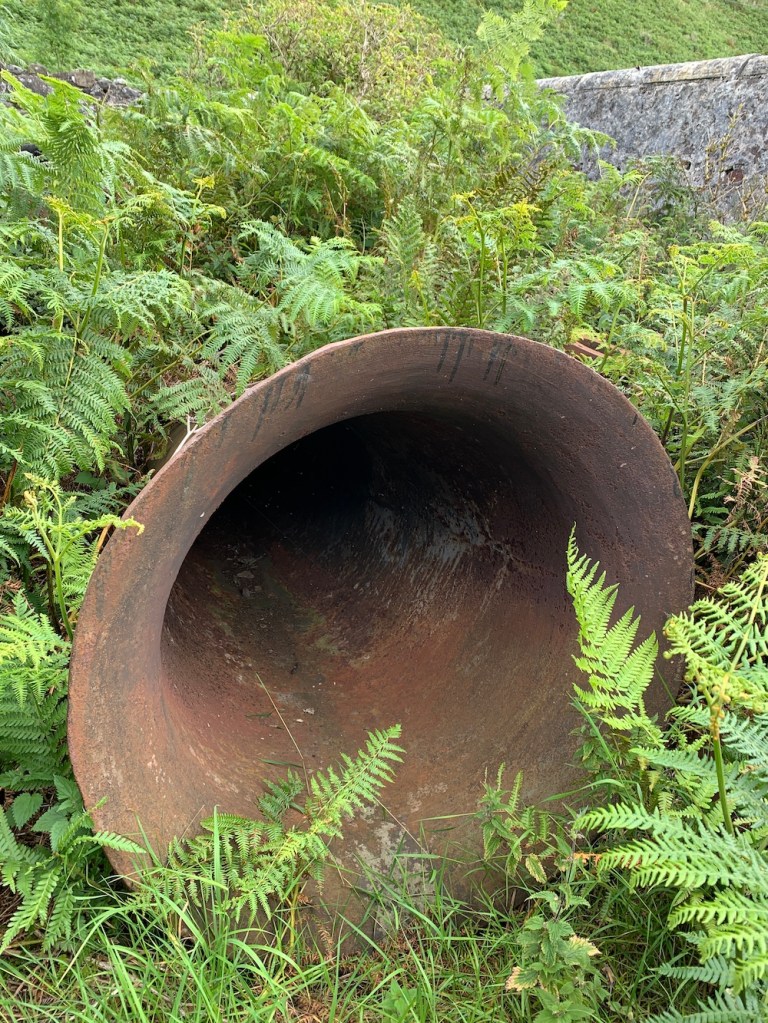
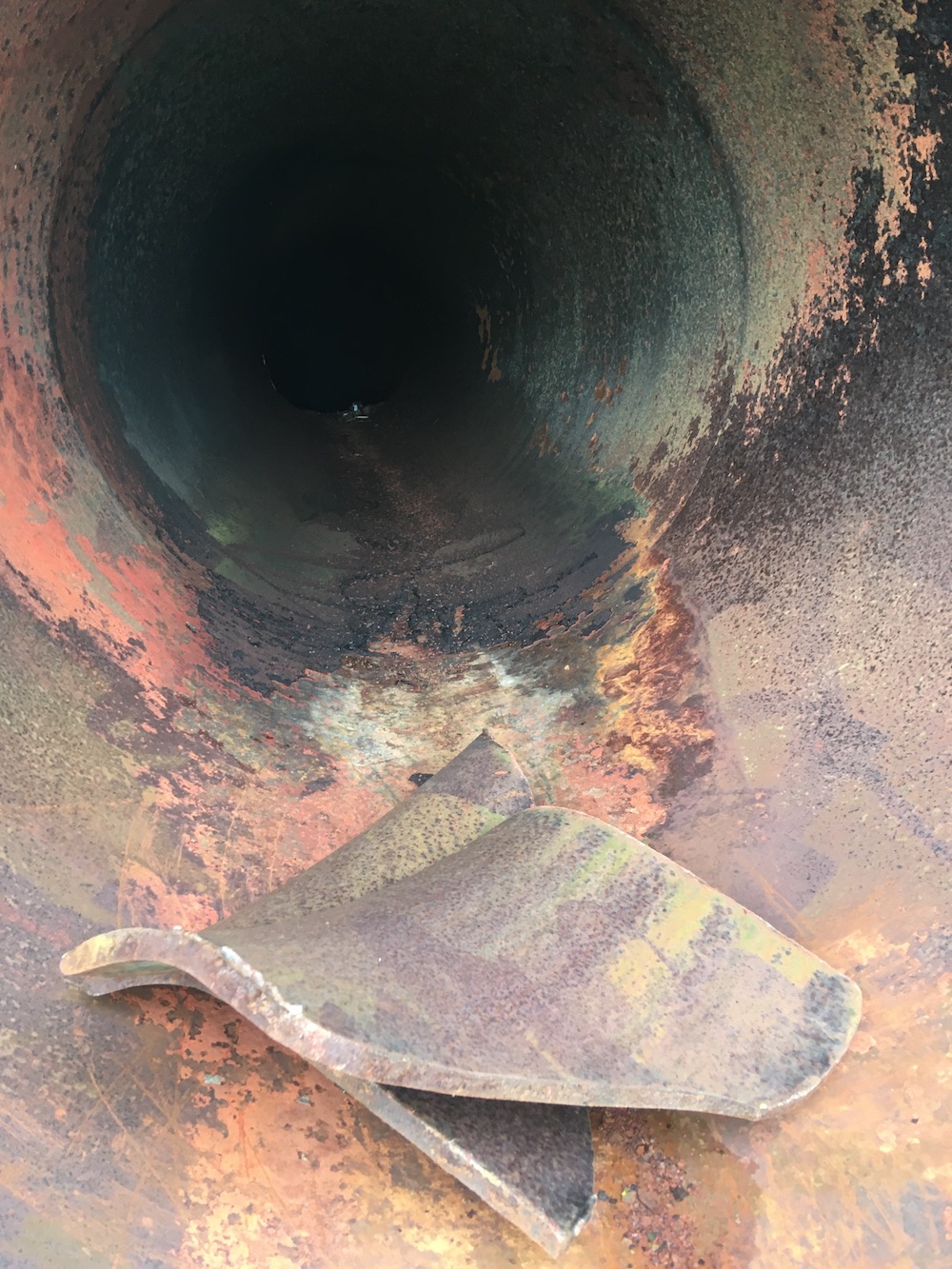
So here is the story behind the foghorn since it was removed. Back in the early 2000s (if the man at the hotel remembers correctly), the Northern Lighthouse Board had the old keepers’ accommodation at the lighthouse demolished as well as the foghorn. Everything was destined for landfill, but members of the community clearly spoke nicely to the demolition guys and it was agreed that the foghorn itself would be left and has since been living on the land of one of the local residents. While it was there it was damaged by a digger and a slightly rough job was made of welding the pieces back on. What this meant was that when the work began on it recently to remove the paint and clean it up, these pieces fell off and can now be seen laying inside the horn. They will be welded back on properly in due course.
Looking inside the foghorn
The foghorn has been placed in its current location to enable it to be re-painted without being too exposed if it rains. It was quite amusing to see the interest it generates. While we were there the children were enjoying booming into it with their best foghorn sounds. As we headed back to the car after lunch another family were doing the same – it was the dad who started it in their case too!
The foghorn’s current home
There are now big plans in John O’Groats, led by the John O’Groats Development Trust, to improve an area behind the First and Last House, which marks the beginning of a walk along the coast to Duncansby Head. The foghorn was included in the plans for this area along with a memorial to those who lost their lives in two shipping disasters in the area. The first is the trawler George Robb which was lost with all 12 of its crew in December 1959. Also lost during this incident was a land-based coastguard officer who died on the way to the scene. The second wreck to be remembered is the Cyprus-registered cargo ship, Cemfjord, which sank in the Pentland Firth in January 2015 with the loss of eight lives. The memorial will feature the names of all of those who lost their lives in these tragedies and their names will be displayed facing the direction in which the ships went down. It sounds like it will be a very touching way of remembering these 21 men who came to such a terrible end in the area.
There will be a memorial event for those lost on the George Robb on 6th December this year at Duncansby Head lighthouse, exactly 60 years to the day since the boat went down. I plan to go along to this event (which is at 2pm if anyone who is interested reads this) and will hopefully also meet up with Ian, my lighthouse keeper friend, who served at Duncansby back in the 80s. He and his family were very much a part of the community when they lived there and the man I spoke to this afternoon remembers him well. It will be nice to see Ian back with that community.
Once restored, the foghorn will be accompanied by an interpretive panel, which will explain where the foghorn came from, how it worked and its history. Interestingly, the father of the man I spoke to this afternoon has recordings of the foghorns at Duncansby, Stroma and Pentland Skerries and the idea of running some power to the area has been suggested so that buttons can be installed on the base of the foghorn to allow people to hear what the horns sounded like. It sounds like a wonderful idea to me and I hope it happens. They hope to have the area tidied up and the memorial and foghorn installed by Easter next year.
There is plenty more in the pipeline for John O’Groats too including: the improvement of the coastal path to Duncansby Head in general; the renovation of an old nearby mill to accommodate a hub for the local community to meet and socialise; a children’s play park; and, eventually, a golf course.
It’s all rather exciting and I look forward to seeing it all coming together. It’s fantastic to see a community really embracing and encouraging both their heritage and the number of tourists who visit the area. It’s very refreshing when so many people are keen to complain these days about increased tourism. 🙂
Inchkeith is one of those places I’d been desperate to reach for a long time. When you look across at it from Leith or even from higher points in Edinburgh it looks so close, but I’d not made it there. That was until the very end of last month! Bob had made contact with Forth Sea Safaris about attempting to go out and they had agreed to take us, weather permitting of course.
We arrived at Burntisland, our departure point, and I was extremely pleased to see the water so calm. The boatman, Stewart, had said that it was looking like it would be better than it had been for a long time. Sometimes you get very very lucky with these trips. Other times not so much. We met up with our island-bagging friend Charlie who had signed up to join us and quickly introduced him to the inner light in the harbour. It’s not changed much since we were last there, still rusty!
Burntisland East Pier Inner lighthouse
Stewart arrived and off we set, waving goodbye to the resident seal in the harbour (and her pup). We sailed nice and close to the lighthouse on the end of the west pier. This one is looking very good and Stewart informed us that this one has had some work done to it fairly recently, including modernisation of the light. It was great to be able to see this one as it’s visible from the harbour, but still just a little too far away to get a good picture of.
Burntisland West Pier lighthouse
After leaving the harbour I mentioned the old lighthouse that used to live in Burntisland harbour and is now on display in Leith Docks to the others. Stewart said he recalled there being something on the end of an old breakwater. After a minute or two he realised that he’d actually walked right past the tower in Leith Docks just a few days before. Imagine walking past a lighthouse and not thinking anything of it!
Now, the main target for the day was Inchkeith, but seeing as we were in the area anyway and I’d not been very close to Oxcars lighthouse we went along to that one first. It was, in fact, the addition of Oxcars to the itinerary that meant such an early start that day as we wanted to catch it at low tide – for landing, of course! There was no doubting the water was calm enough for landing and the RIB had a nice little platform on the front, which was very helpful for getting onto and off of islands. We were stepping off onto seaweed unfortunately, but it wasn’t so bad and within a short time we were there at the bottom of that fascinating tower.
Oxcars lighthouse
It looks so different at low tide. I’d only seen it at high (or higher) tides before and never realised just how much rock was there. We were able to walk out onto the two little jetties and get some pretty good pictures.
Oxcars lighthouse from the jetty
Stewart had told us that the ladder up to the base of the red and white banded section of the tower would be ok to climb up, but not to go any further as the ladder isn’t in a good way. That was fine with us (well me anyway). It was a similar experience to landing at the Barrel of Butter where you know you are somewhere that very few people go. Some people look at islands and think “I’d love to go there”, but they look at a bit of rock with a lighthouse on top and only the hardcore lighthouse and island “baggers” would really try to attempt it. What a wonderful lighthouse though and a real bonus for this trip. Just fantastic.
Looking up at Oxcars
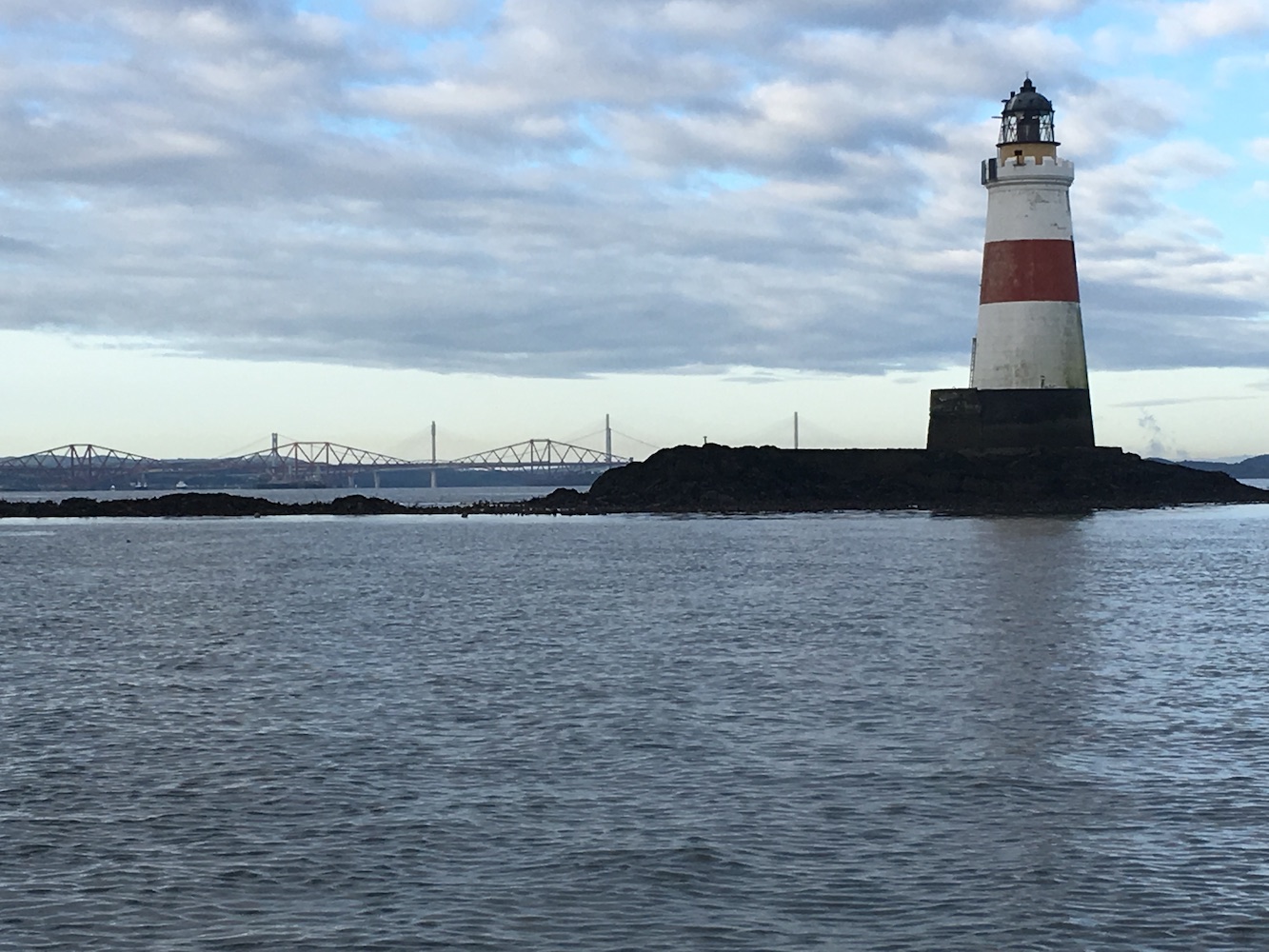
Stewart took us around Oxcars so we could get some pictures of the lighthouse with the new Queensferry Crossing bridge in the background. A very picturesque view.
Oxcars lighthouse with the Forth Rail and Road bridges
Inchkeith beckoned and, as the tide was still dropping, we knew there would be a ladder to climb. When Bob had been to the island previously the ladder was loose at the top, but thankfully Stewart reassured us that it had been fixed. It was quite a long way up and I must have made the ladder on Oxcars look really difficult as Stewart very kindly offered me a rope. I politely refused – I must make it look harder than I actually find it!
The lighthouse was sitting up there looking all majestic as it does. I could tell immediately that this was a special place. For a start Inchkeith has a lot of history and there is evidence of that all around with the range of buildings in various states. One of my favourite tales from its history is the alleged research that was undertaken when a mute woman was put on the island with her two young children. I’m not sure how long they were said to have been there, but the aim was to see what language the children would speak. Again, I don’t know what the outcome was!
Arrival on Inchkeith
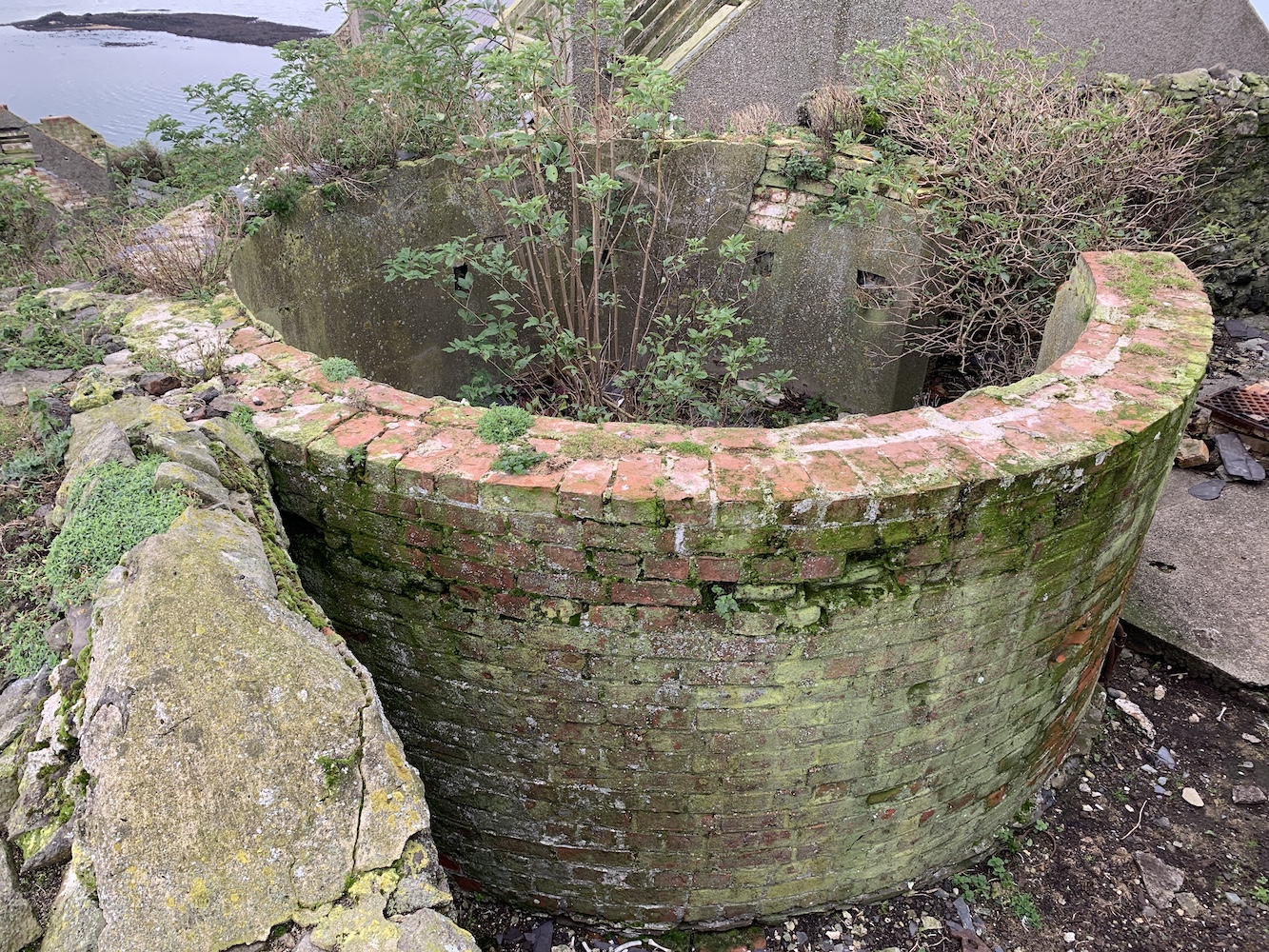
We walked up the path and wandered through a gate into a walled area containing what would have been the old keepers’ accommodation. Before we explored that we turned right towards a circular brick wall. It didn’t look like much, but it is the remains of an old experimental tower that was used for testing new light techniques. It was designed by Thomas Smith and built around 1785 and was used to test a new oil-burning reflector light system. The terracotta tiles on the floor are still there and the wall is still standing up to a point, so it is difficult to imagine what it previously looked like, but there is a picture showing it slightly more intact in the book At Scotland’s Edge by Keith Allerdyce.
The remains of the old lighthouse tower on Inchkeith
The nearby cottages are not in a good way, missing doors and windows and just how you would expect rooms to look if they are open to the wind and rain for years on end. I’ve said numerous times before that it’s a shame that a lot of the cottages have gone this way, but I suppose they have served their purpose now and it would be a very difficult place for somebody to live now, although not really that far from civilisation. Presevation of the buildings would be wonderful, of course, but if there is no one to preserve them for… (apart from the occasional lighthouse enthusiast).
Inside one of the old houses on Inchkeith
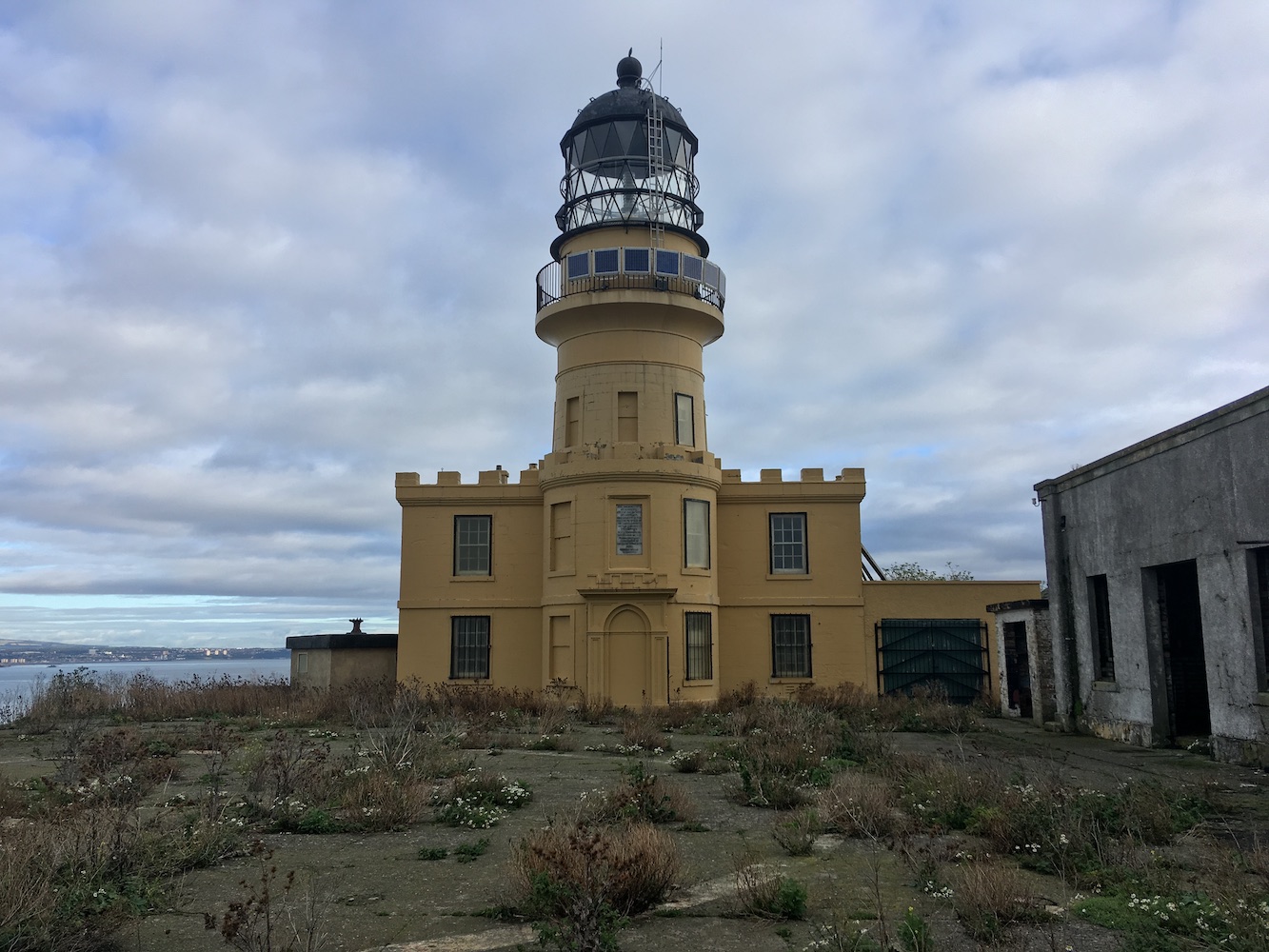
We crossed an overgrown stretch of foliage and then arrived at the archway the marks the entrance to the active lighthouse. The old air tanks for the foghorn are still there and the area looks very abandoned. Stepping through the arch you are then greeted with the lighthouse, uniquely painted entirely in the Northern Lighthouse Board’s bamboo/buff/etc. paint. The lighthouse is no longer owned or maintained by the Northern Lighthouse Board after it was passed over to Forth Ports in 2013.
Inchkeith lighthouse
There’s no doubting it’s a fantastic tower, a little castle-esque.
The best angle on Inchkeith lighthouse
I suppose, though, you are always aware that it is surrounded by neglect. The old engine rooms across the courtyard are exposed to the elements too and in a sorry state.
Inside one of the old buildings close to the lighthouse
On the plus side, and a big plus side it is, the views of the lighthouse and across the Firth of Forth are simply wonderful from up there. I’ve spent a lot of time on islands off of the west coast of Scotland, but those on the east have a very different feel about them. They aren’t so remote for a start, but still feel away from it all. There’s also a lot more life there, we saw countless snails and even the resident chickens gave us a noisy welcome.
The view from the top of Inchkeith
We decided to wander on over to where the old foghorn used to be. We’d recently seen the foghorn that was originally on the island at the National Museum of Scotland’s large item store in Granton. We had to navigate our way around some old wartime buildings to get there, but we made it to the old, and partially collapsed, lookout point. There were more wonderful views to be had from here.
Looking down to where the foghorn would have been
Due to the tide being too low for us to get back off of the island for a while, we’d had plenty of time to explore and while the others went off for a more off-piste exploration of a different bit I was able to sit down, enjoy the views and soak in the loveliness of being in such a great place. It was sad to see so much neglect of buildings there, but it was also interesting to see how nature was taking control again as it does when there is no one there to stop it. A thoroughly enjoyable day and definitely well worth the wait. 🙂
Throughout my lighthouse “career” (if you can call it that), I’ve tended to stick to the towers. Not literally, of course, but I’ve not necessarily been distracted by the intricate details of the lights and how they all worked, the lighting sources, how the keepers lived – although I find it all very fascinating, and knowing some former lighthouse keepers now that area is of particular interest. In terms of visiting things though, it’s always been about the towers – until now!
I have a growing fascination with the optics, or lenses, that once projected the light out of the towers. Perhaps it’s because I’m seeing more of them or they are becoming less common with technological advances. Or maybe they are just incredibly beautiful. Whatever the reason is behind it, I am very much enjoying discovering lenses.
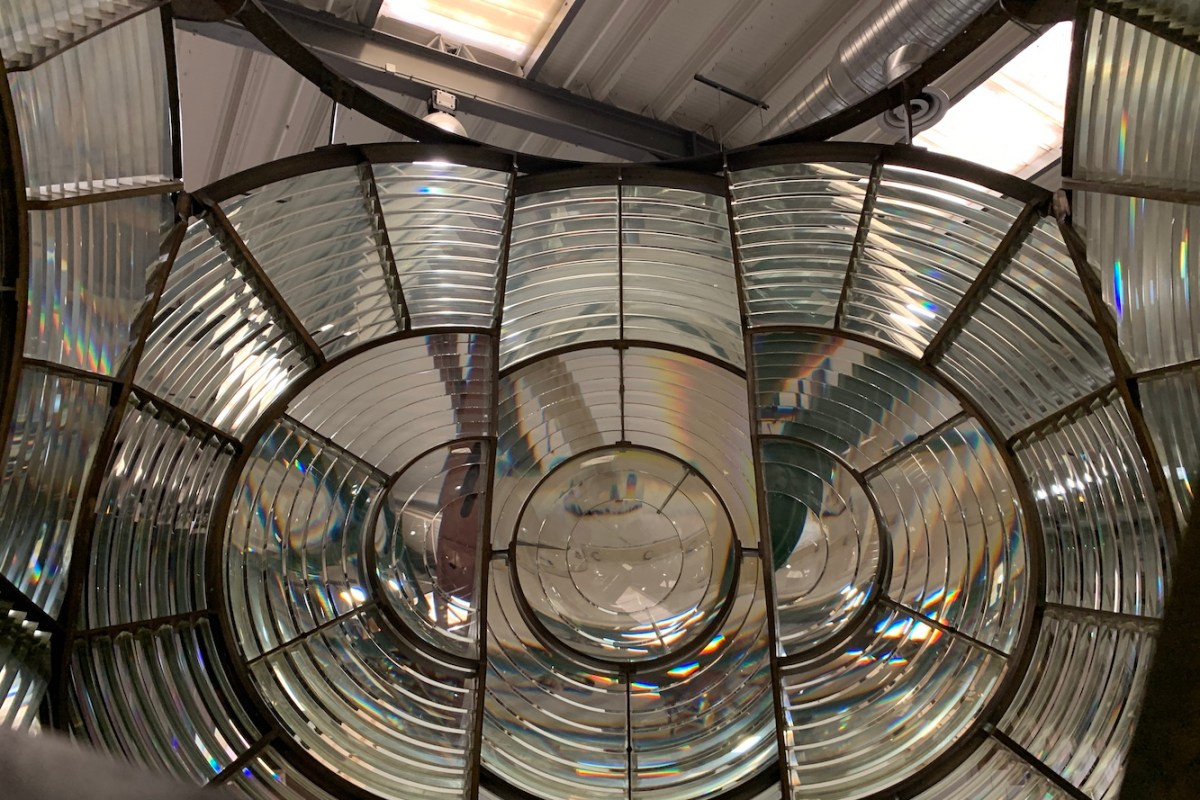
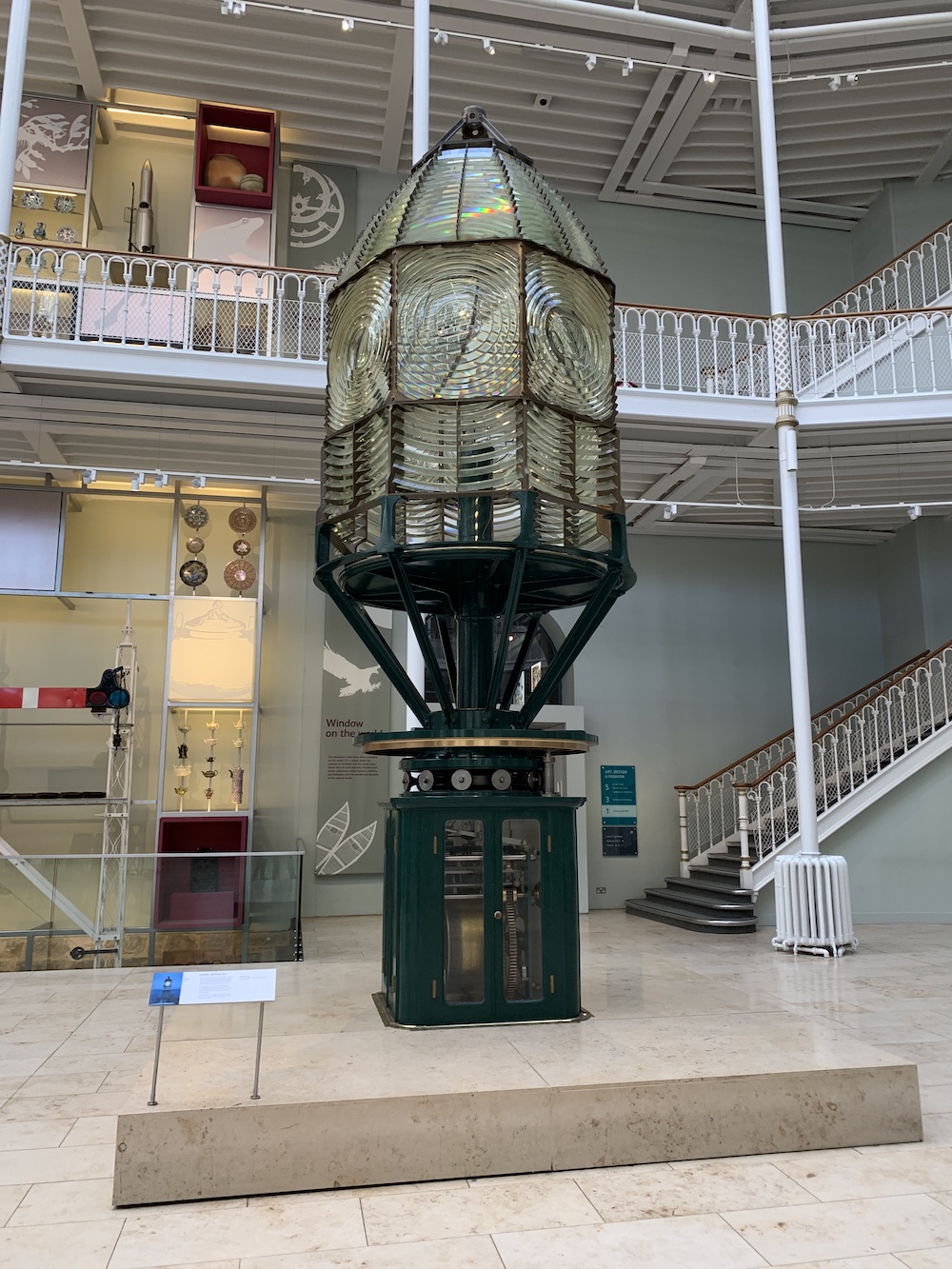
I had seen the former Inchkeith lens in one of the large halls at the National Museum of Scotland in Edinburgh earlier in the year and a couple of weeks ago I got to see it again. Most people use the platform it sits on as a seat and probably pay it very little attention (and get in the way of my photos), but it really is beautiful. It is a first order dioptric lens designed by David A Stevenson and it served its purpose in Inchkeith lighthouse, in the Firth of Forth, for 96 years before it was replaced in 1985. It is accompanied by the mechanism that rotated the lens. I recently spoke to a lady who curates the lighthouse exhibits for the museum (more on that very kind lady in a bit) and she said that they did try getting the lens and mechanism up and running in the museum in the past, but there were a number of technical problems with it. They have a number of other lighthouse-related exhibits at the museum with a dedicated section including a couple of films related to the keepers and the trials and tribulations of lighting the Eddystone Rocks off of the South Devon coast.
The Inchkeith lens
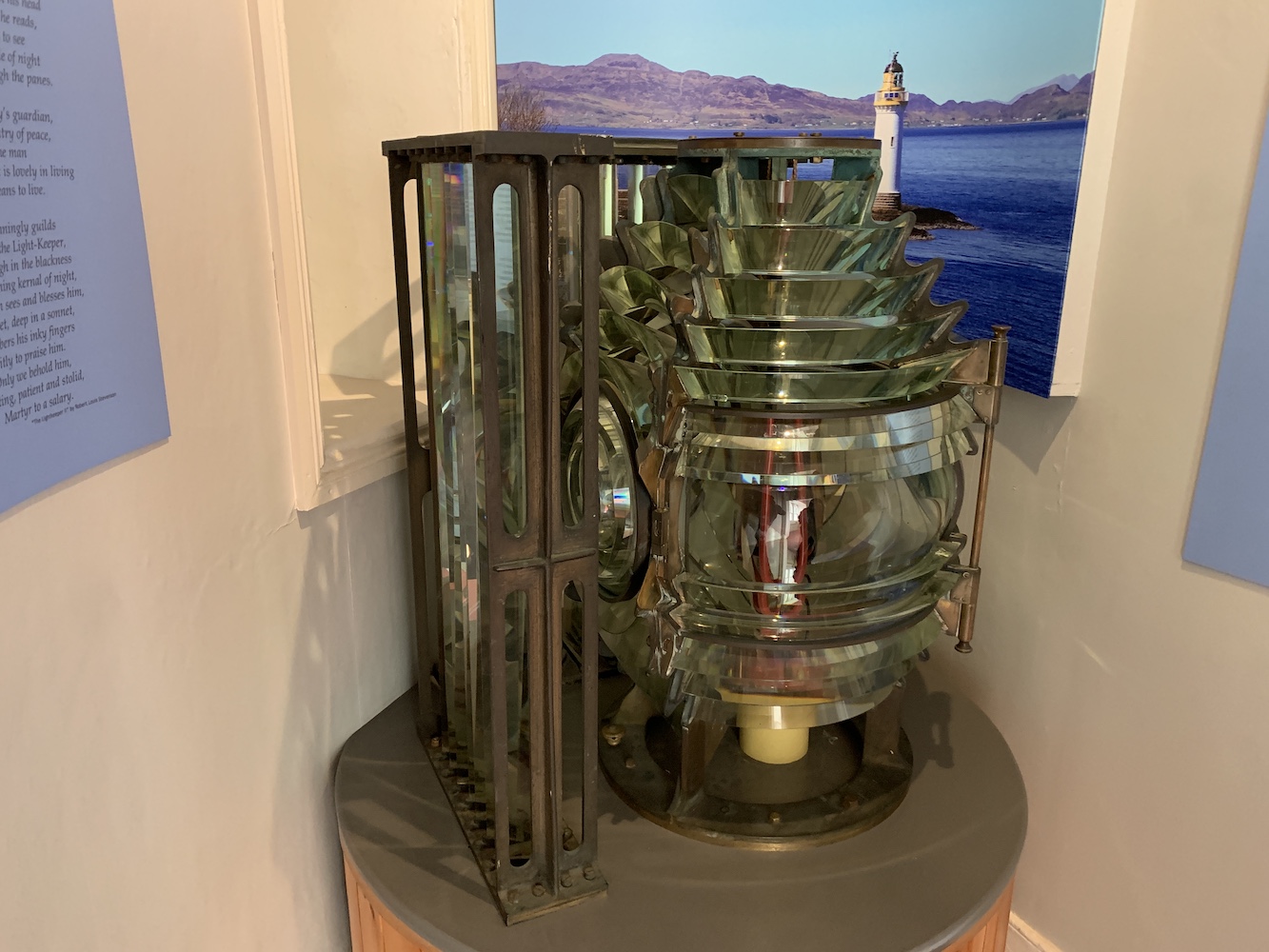
A few days later we found ourselves back in the centre of Edinburgh for a day. We were going to head towards the museum again, but our son decided that he wanted to walk up Carlton Hill to see the tower and buildings up there, so that was the decision made, up we went. We’d not necessarily planned to go into the Nelson Monument up there, but again the little man decided we would. As it was his birthday weekend and a bit of climbing up a tower is good exercise off we went. There are some great views from up there, including the island of Inchkeith where the lighthouse mentioned above can be found. It was back on the ground floor that we found an item of particular interest. Well, it was actually Bob who discovered it just as we were about to leave. It was the old lens from Rubha nan Gall lighthouse, just to the north of Tobermory on Mull. This one is a fixed Fresnel lens, named after physicist Augustin-Jean Fresnel who invented this type. It was removed from Rubha nan Gall lighthouse in 2012. That was quite a good find as there is very little information available about this one being hidden here. I’m hoping that will change now though since I’ve seen it and am telling everyone!
The Rubha nan Gall lens
Now, this is where it gets really exciting. Back at the beginning of the year during a visit to the Museum of Scottish Lighthouses I was talking to their Collections Manager, Michael Strachan, who is really into lenses and knows all of the different types, which I am still getting to grips with. His knowledge of lenses is extensive and he particularly likes the hyper-radial type (the biggest and most powerful of all, so it’s completely understandable). I can’t recall exactly how the subject came up, but I must have mentioned that I was planning on going to Sule Skerry this year and he informed me that the old hyper-radial lens from Sule Skerry is now in the possession of the National Museum of Scotland. A little while later I discovered that it was kept in storage at the museum’s facility in Granton. I was in contact with the curator at the museum, Julie, and we left it that I would contact her when I was next in the area to arrange a visit to see it.
Although I’d not forgotten about it, I did leave it too late on this occasion to contact Julie, but she did get in touch and managed to make it along to my talk at the National Library of Scotland last month. She quickly introduced herself after the talk and we agreed that I would let her know when I was next in the area. By this point I was becoming a bit obsessed with wanting to see the lens. To be honest I’ve been a little obsessed with Sule Skerry lighthouse in general since visiting it in May – or maybe the obsession began before that when I could only refer to Sule Skerry as “the place that cannot be named” due to getting over-excited every time I thought about it.
I did know that I would be passing Edinburgh at the end of last week on the way down to the Association of Lighthouse Keepers AGM in Hull. It seemed like the perfect opportunity to call upon Julie’s very kind offer to finally see the lens. Thankfully she was available and she also informed me that they are currently re-building the old Tod Head lens and mechanism next to the Sule Skerry lens – this was just getting better and better!
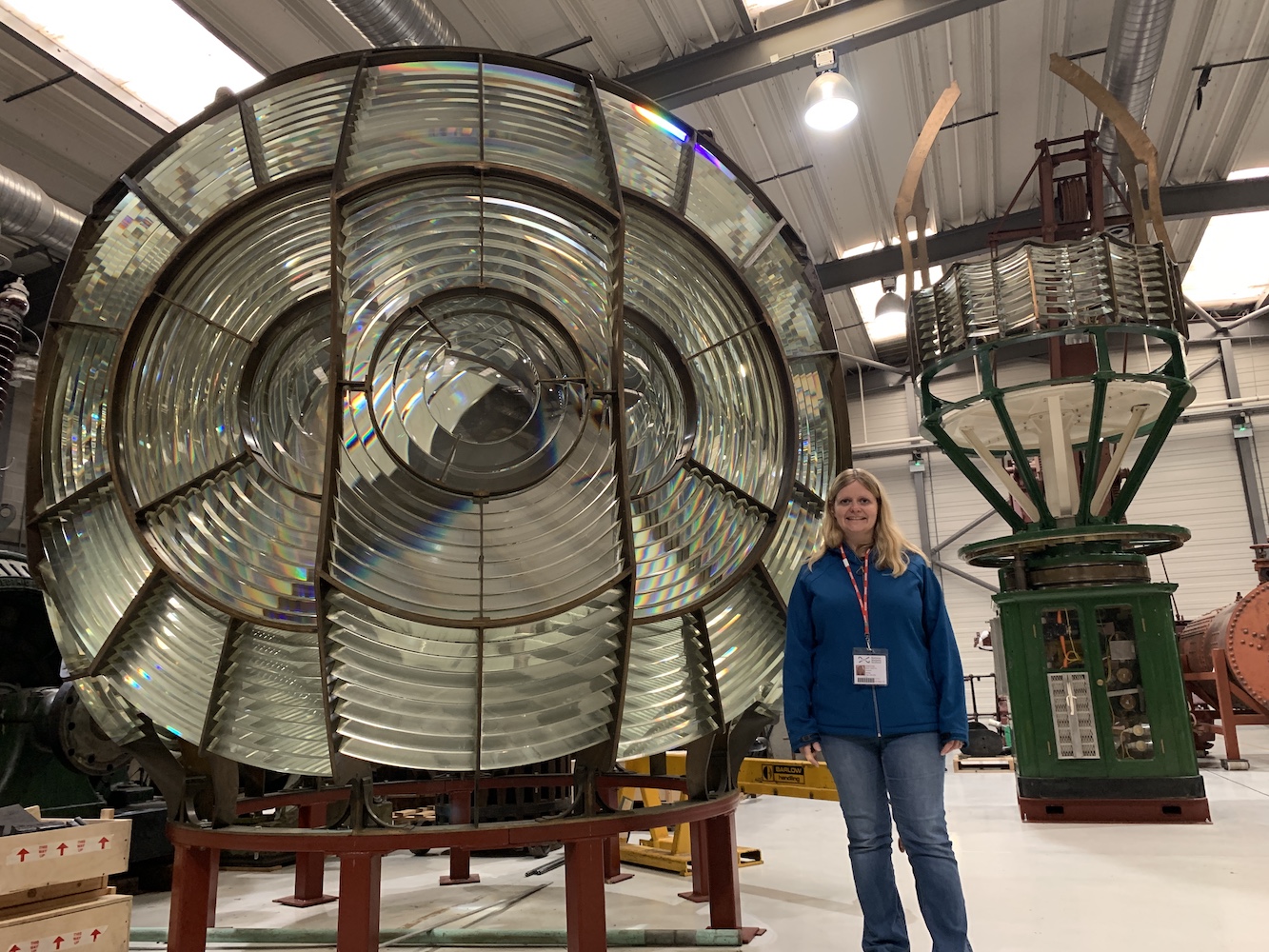
We turned up in Granton last Thursday and met Julie who took us straight to the large item store. There are certainly some large items in there. We skirted around the outside of them before arriving at the incredible lens that I had been so desperately waiting to see. Needless to say it is huge and I would have quite liked to have tried to see how many people you can fit inside it, but there were only three of us there and I don’t think we would have been allowed inside it anyway. I’m guessing at least 8 people there. It’s just incredible and when you see the size of it and the profile of the tower it came from with its oversized lantern, I immediately wanted to invent time travel so I could go back and see it in action with its powerful beam sweeping around – probably as I get blown off of the island! I did try to recreate what it must have been like by walking around the outside of it whilst filming, but there’s no light in the middle anymore so it didn’t really work. The lens was built by Barbier and Benard and was first lit in 1885. It was removed from the tower on 23rd April 1977. I can’t seem to find any pictures of the tower with the lens inside, so I may need to do some asking around to uncover one. If anything the visit here has possibly made me even more obsessed. I think I’ll be ok though, but I’m now even more desperate to go back for a re-visit.
The Sule Skerry lens with me to give an idea of its size. The Tod Head lens and mechanism can be seen in the background.
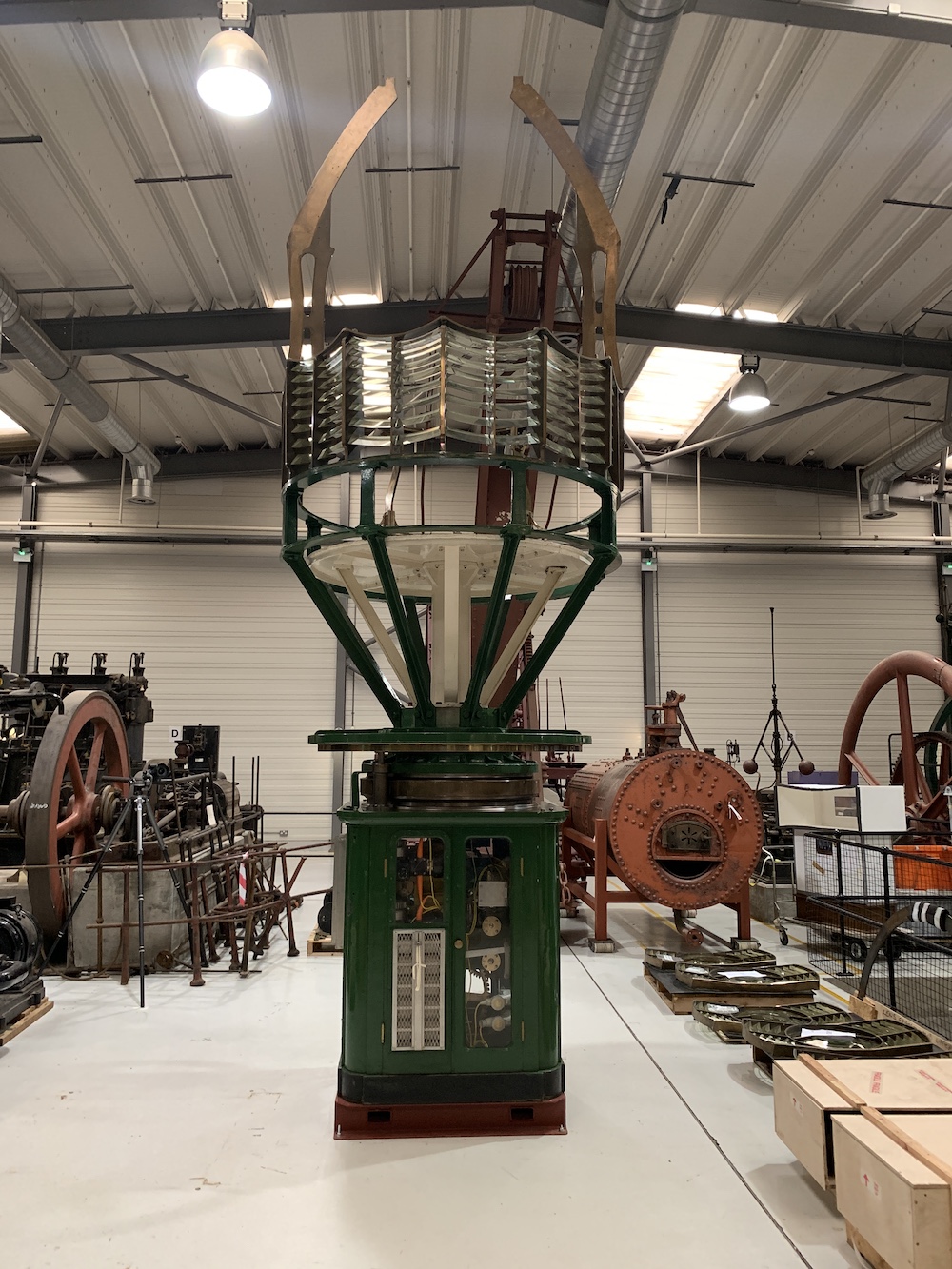
As expected, the Tod Head lens (another Fresnel) and mechanism were just next door to the Sule Skerry lens. This had actually been transferred here from the Museum of Scottish Lighthouses. There’s still some work to be done on it, but it’s getting there and it was quite nice to see it partially constructed with some of the parts still left to go on stored close by. When you see the lenses fully constructed you don’t tend to think about how difficult they must be to build, but seeing them partially constructed gives a bit of an insight into how much of a puzzle it must be. Perhaps not so much in this case when everything is so clearly and helpfully labelled. What a job that must be to do though! It was great to see this one having recently been inside the tower at Tod Head. It’s nice to be able to link these lenses to their original homes.
The Tod Head lens (so far) and mechanism
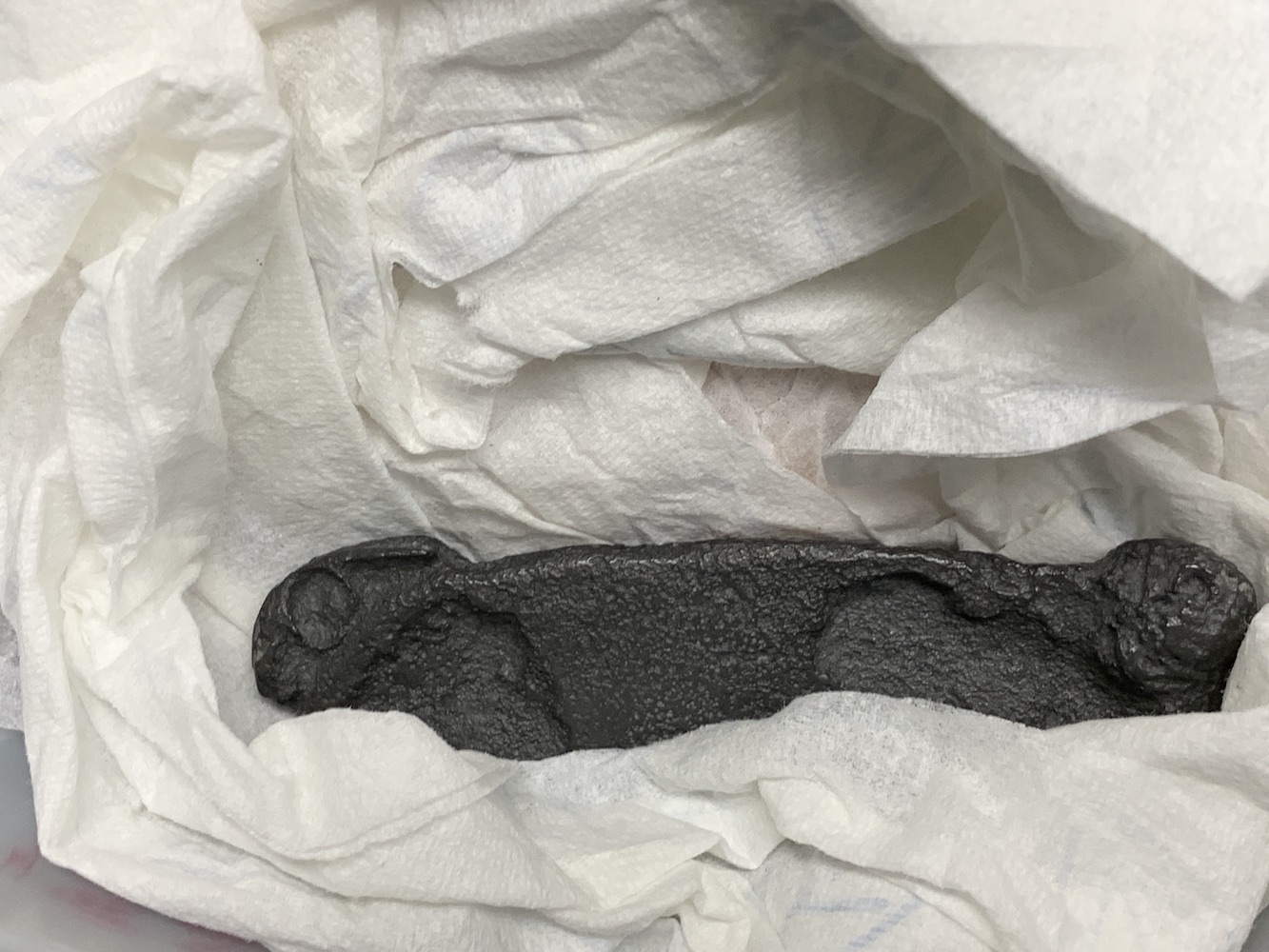
Julie then showed us around some of the smaller lighthouse-related items they hold in storage, including a beautiful model of one of the old lights that was on the Eddystone (I think it may have been the Rudyerd tower judging by the shape of the tower. There was a 3kW bulb (or lamp) which was rather impressive, but the best bit (of the small items) had to be a small piece of lead. There is a story associated with this particular piece of lead and it relates to the Rudyerd tower built on the Eddystone Rocks, which was first lit in 1709. The story goes that in December 1755 the lantern caught fire at the top of the tower and the keeper on watch at the time, Henry Hall, attempted to put the fire out by throwing water upwards at it using a bucket. Molten lead was dripping down from the lantern and some of this lead dripped into Hall’s mouth and down his throat. Hall died 12 days later and the piece of lead extracted from his stomach is that very piece that we saw at the museum stores last week. It’s a very dramatic story and there is even more details about it and the lengths the doctor who extracted the lead went to following the incident on the Trinity House website.
The piece of lead found in Henry Halls’ stomach
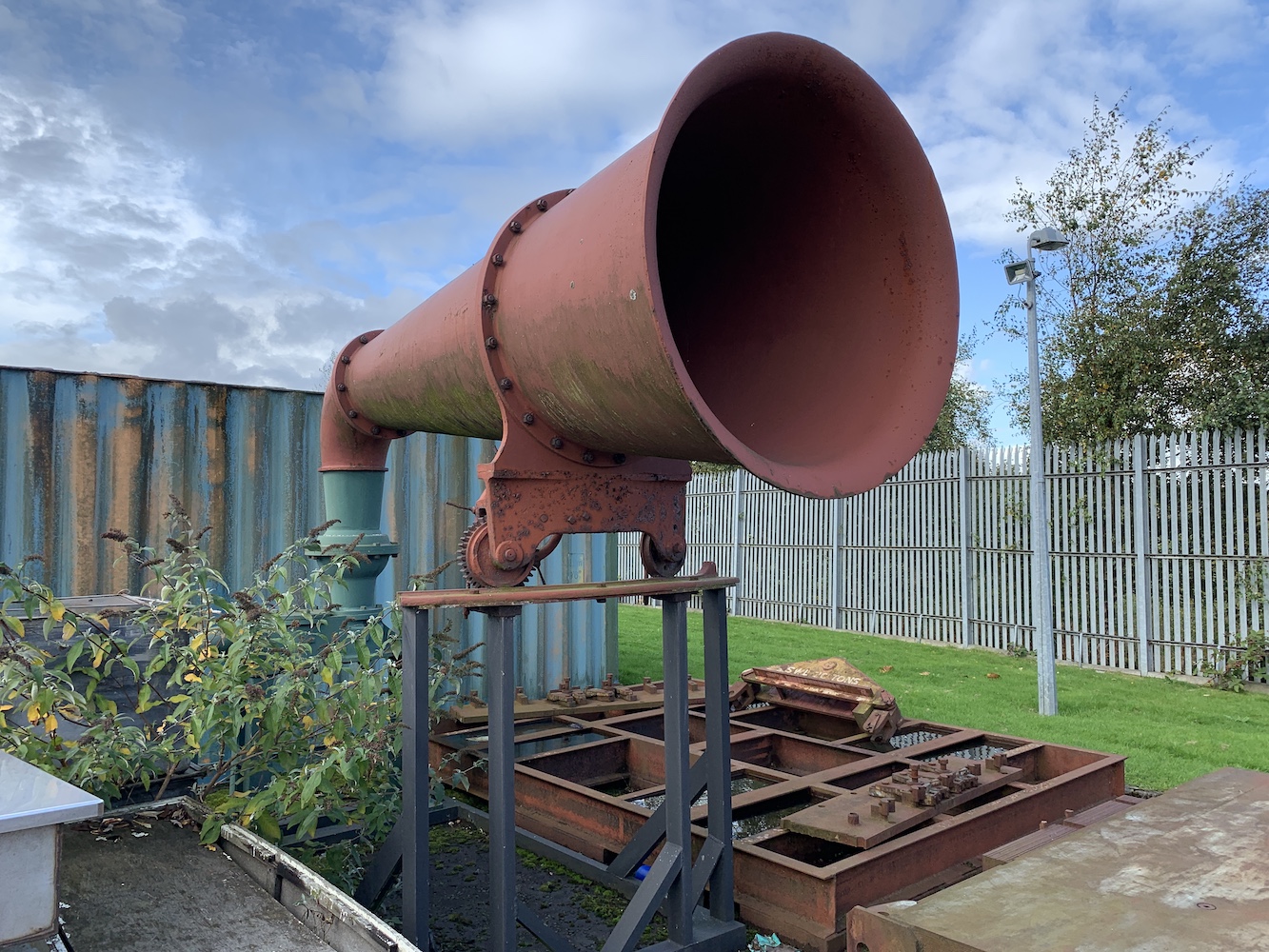
Just before we left the stores Julie took us right to the back of the grounds where we found the old foghorn from Inchkeith, which she explained will be moved inside soon.
The old foghorn from Inchkeith
What a fantastic time we spent with Julie. The stores are a treasure trove of various items and Julie is working her way through them, getting everything sorted out, dated, etc. It’s fascinating. As I said to Julie, when you go to a museum you have no idea that you are probably only seeing a relatively small percentage of what the museum actually owns or holds. This visit gave a great insight into exactly how it works.
For anyone who is interested in joining a tour of the stores then the museum do run monthly tours and you can find out more about them here. You can also organise a private visit like we did. It comes highly recommended. 🙂

































 uklighthousetour